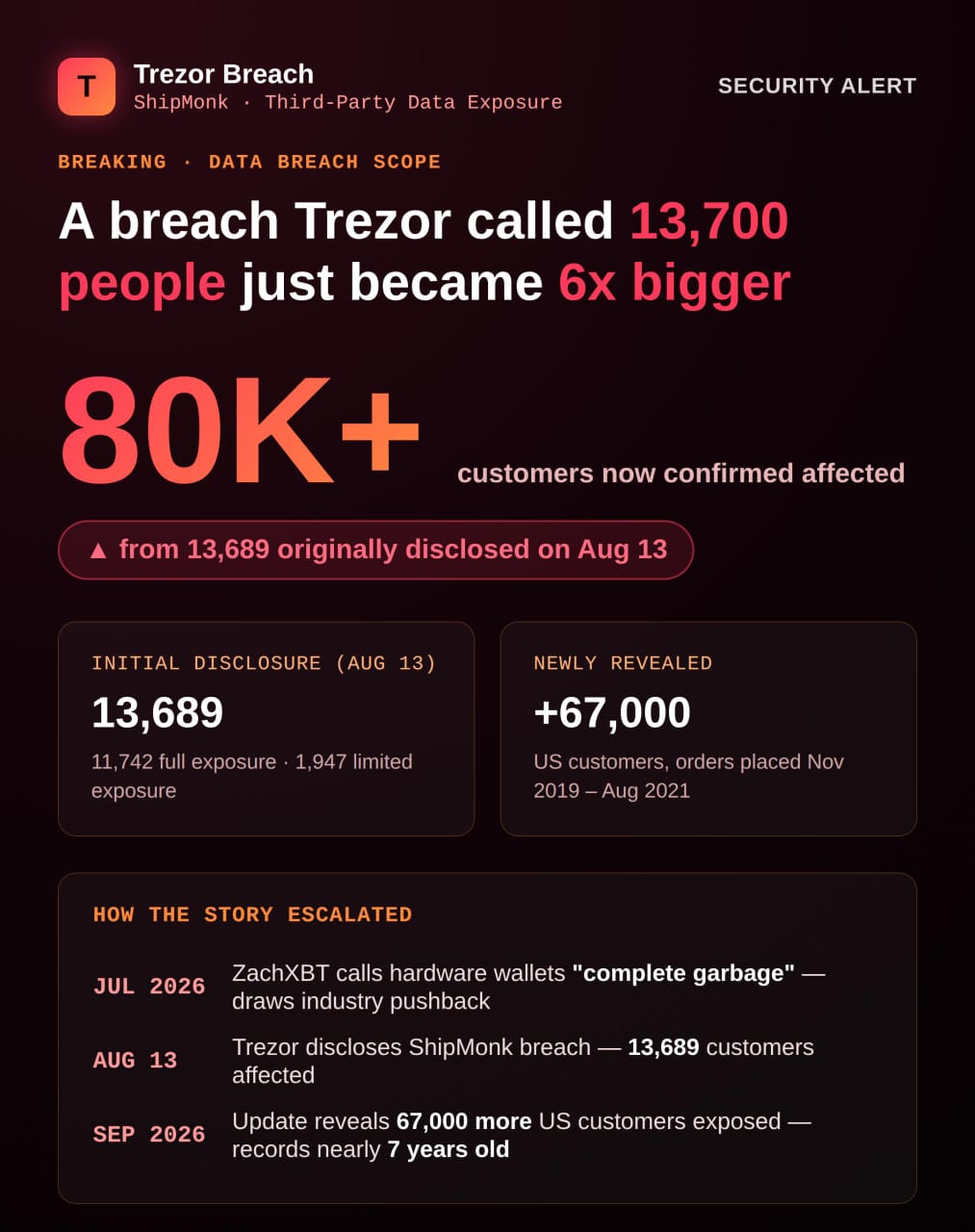
Back in July, when the prominent blockchain investigator ZachXBT controversially labeled every hardware wallet on the market as "complete garbage," drawing significant pushback from a crypto community that largely regards these devices as the pinnacle of digital asset security, his assessment was widely considered an overstatement. However, just two months later, the landscape shifted dramatically. Trezor, a pioneer in the hardware wallet space, quietly confirmed in September that a data breach, initially downplayed as affecting approximately 13,700 customers, had in fact compromised the personal information of over 80,000 individuals, with some exposed records dating back nearly seven years. This revelation has lent an unsettling prescience to ZachXBT’s earlier "hot take," transforming it from a contentious opinion into what many now perceive as a disturbingly accurate forecast of the industry’s underlying fragility.
Understanding Trezor’s Core Value Proposition
To fully grasp the gravity of this expanded breach, it is essential to understand Trezor’s foundational role and its core promise to users. Developed by the Czech company SatoshiLabs, Trezor is widely acknowledged as the world’s first hardware wallet, introduced to the market in 2014. Its revolutionary design allowed users to store their cryptocurrency private keys on a physical, offline device, effectively isolating them from internet-connected computers or exchanges. This "cold storage" approach is the very essence of a hardware wallet’s value proposition: even if a user’s laptop or smartphone is compromised by malware, viruses, or phishing attempts, the critical private keys, and by extension, their digital assets, remain secure on the separate, air-gapped hardware.
For over a decade, Trezor has meticulously cultivated a reputation for trust and security, building its brand around the inviolability of this offline protection. The company’s commitment to open-source principles, robust cryptography, and a user-centric design philosophy has cemented its status as a trusted guardian of digital wealth. It is precisely this decade-long dedication to verifiable trust that makes a breach involving sensitive customer data, even if not directly compromising the wallets themselves, land with such a profound impact on user confidence and the broader perception of security within the crypto ecosystem. The incident serves as a stark reminder that the security perimeter extends beyond cryptographic safeguards to encompass every operational aspect of a company, including its third-party partnerships.
Chronology of the Trezor Data Breach: From Disclosure to Escalation
The incident’s timeline reveals a concerning escalation in scope and a troubling lack of transparency from a critical third-party vendor. Trezor first publicly disclosed the security incident on August 13. At that time, the company announced that its shipping provider, ShipMonk, had experienced unauthorized access to systems containing customer order data. The breach was attributed to attackers exploiting a vulnerability within a third-party analytics platform utilized by ShipMonk.
In its initial disclosure, Trezor estimated that approximately 13,689 customers had been affected. This figure was further broken down into two categories: 11,742 customers experienced "full exposure," meaning their names, email addresses, phone numbers, and shipping addresses were compromised. A smaller group of 1,947 customers faced "limited exposure," with only their names, cities, and email addresses affected. Trezor immediately initiated efforts to notify affected customers and urged vigilance against potential phishing attempts.
However, the situation deteriorated significantly by September. In an update shared across its official social channels and website, Trezor revealed a dramatic expansion of the breach’s impact. An additional 67,000 US customers, who had placed orders between November 2019 and August 2021, were also found to have had their full details exposed. This included their names, email addresses, phone numbers, shipping addresses, and order numbers. This staggering increase brought the total number of known affected customers to well over 80,000. Perhaps even more alarming was the revelation that some of these exposed records stretched back nearly seven years, far exceeding any reasonable expectation for how long a shipping partner should retain such sensitive customer data. This extended data retention became a focal point of Trezor’s subsequent public statements, highlighting a critical failure in data governance by its vendor.
Trezor’s Unprecedented Rebuke of ShipMonk
One of the most noteworthy aspects of Trezor’s response to the expanded breach was its unusually direct and public criticism of its shipping partner, ShipMonk. In its updated communication, Trezor explicitly stated that throughout its entire relationship with ShipMonk, it had "repeatedly requested and received written assurance" confirming that customer data had been deleted in accordance with its contractual obligations, internal data policies, and prior communications. Despite these repeated written confirmations, the compromised data was never actually purged from ShipMonk’s systems.
This detail fundamentally reshapes the narrative of the incident. It transforms the situation from a mere vendor hack into a more profound issue of vendor accountability and integrity. This was not simply a case of a third-party service provider suffering a security lapse; it was a case where a vendor allegedly provided false assurances regarding data deletion practices to a security-focused client. Trezor did not mince words, expressing profound disappointment given the explicit assurances it had received. For a company like Trezor, whose entire brand identity and market position are predicated on verifiable trust and transparency, discovering that a written compliance confirmation did not align with actual practice represents a genuinely serious problem. This issue, importantly, lay entirely outside Trezor’s direct operational control, yet directly impacted its customer base and reputation. This incident underscores the severe challenges inherent in managing supply chain security and the critical need for rigorous auditing and verification of vendor compliance, especially concerning data retention and deletion policies.
The Nature of the Compromise: What Was Exposed and What Remained Secure
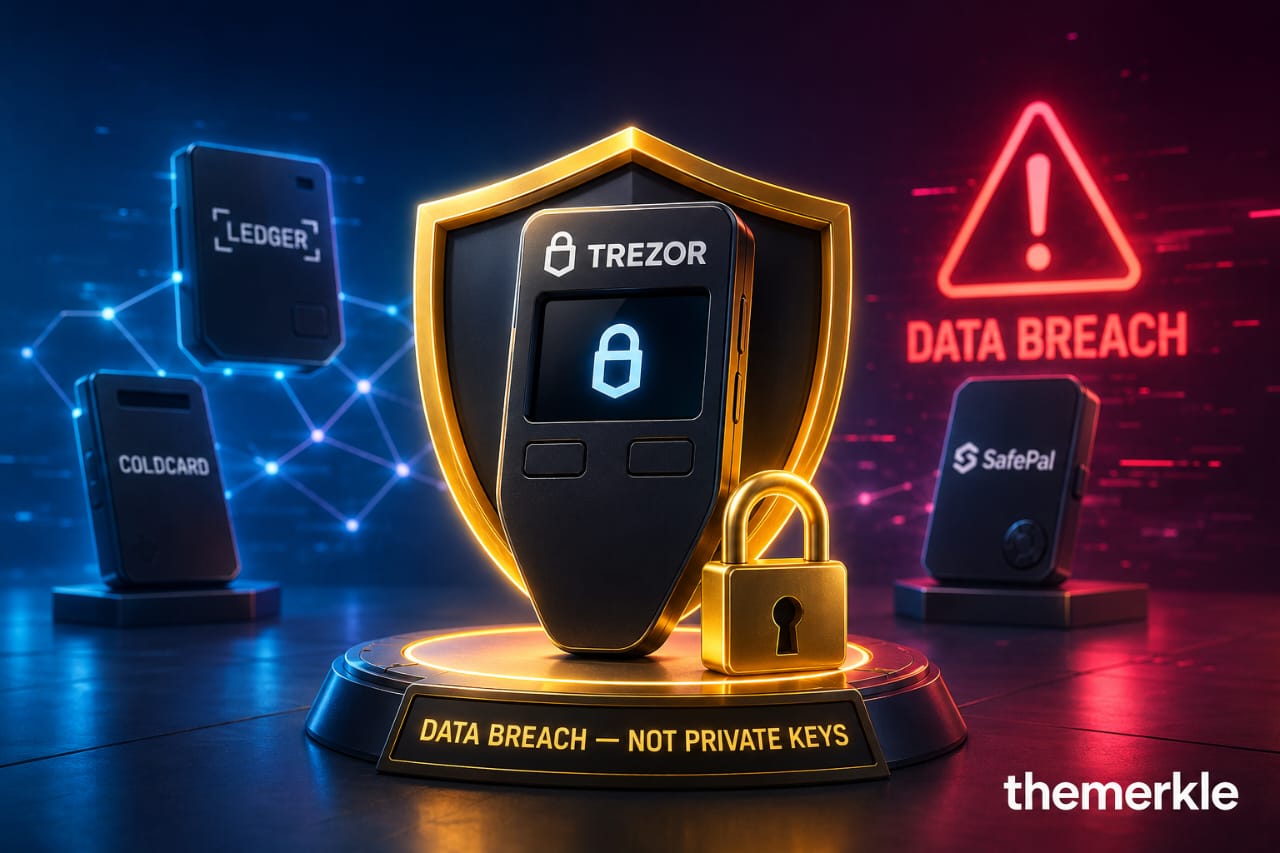
To Trezor’s credit, the company maintained consistent clarity regarding the precise boundaries of the breach. Crucially, Trezor’s own internal systems were not compromised, and no device, private key, or wallet backup was ever at risk. This is a vital distinction, as sensitive cryptographic information, by design, never touches a shipping provider’s systems. The exposed data was purely identifying and contact information: names, email addresses, phone numbers, shipping addresses, and order numbers.
While this might sound less severe than a direct compromise of digital assets, the implications of such data exposure are significant. Trezor specifically warned affected users to remain highly vigilant for various forms of social engineering attacks, including fake emails (phishing), fraudulent phone calls (vishing), and deceptive physical letters. The company also highlighted a more insidious and unsettling risk: potential threats to physical security. A verified list of individuals, complete with their home addresses and confirmation of their ownership of a hardware wallet, constitutes a highly valuable dataset for sophisticated attackers. This information can be leveraged for targeted scams, such as "swatting" (false reporting of a serious crime to draw an armed police response to an address) or, in the worst-case scenarios, physical intimidation and theft attempts. Unlike generic phishing campaigns launched indiscriminately, this level of detailed, verified information enables highly personalized and dangerous attacks. Trezor reiterated the paramount rule for all hardware wallet users: never, under any circumstances, share your wallet backup (seed phrase or recovery words) with anyone, nor type it into any website. This remains the ultimate safeguard against asset loss.
ZachXBT’s July Warning: A Prophecy Unfolding
The Trezor incident brings the narrative full circle back to ZachXBT’s controversial July statement. In a post on his Telegram investigations channel, ZachXBT declared hardware wallets in their current form to be "complete garbage" and unsuitable for critical tasks like signing transactions or storing substantial funds. He specifically advocated for a dedicated, air-gapped device used exclusively as a signing tool, completely separate from any internet-connected system, as a safer alternative. He singled out Ledger, another leading hardware wallet provider, as a particular offender, criticizing its frequent app and UI updates for regularly introducing vulnerabilities or breaking previously reliable functionalities.
At the time, this assessment provoked substantial backlash from the crypto community, which generally regards hardware wallets as the industry’s gold standard for security. The prevailing sentiment was that ZachXBT’s critique was overly harsh, lacking nuance, and potentially undermining essential security practices. However, reading his statement now, against the backdrop of Trezor’s breach nearly sextupling in scope within a single month, and considering the broader array of security incidents plaguing other major hardware wallet brands, his words resonate with a newfound, unsettling accuracy. His warning appears less like an "overheated opinion" and more like a prescient alarm bell, signaling that even the most reputable names in the industry were not adequately addressing the complex and pervasive risks posed by third-party dependencies in their operational supply chains.
A Troubling Trend Across the Hardware Wallet Landscape
The Trezor situation is not an isolated incident; it is part of a broader, more troubling pattern affecting nearly every major hardware wallet brand. This wider context is crucial for understanding the systemic nature of the problem.
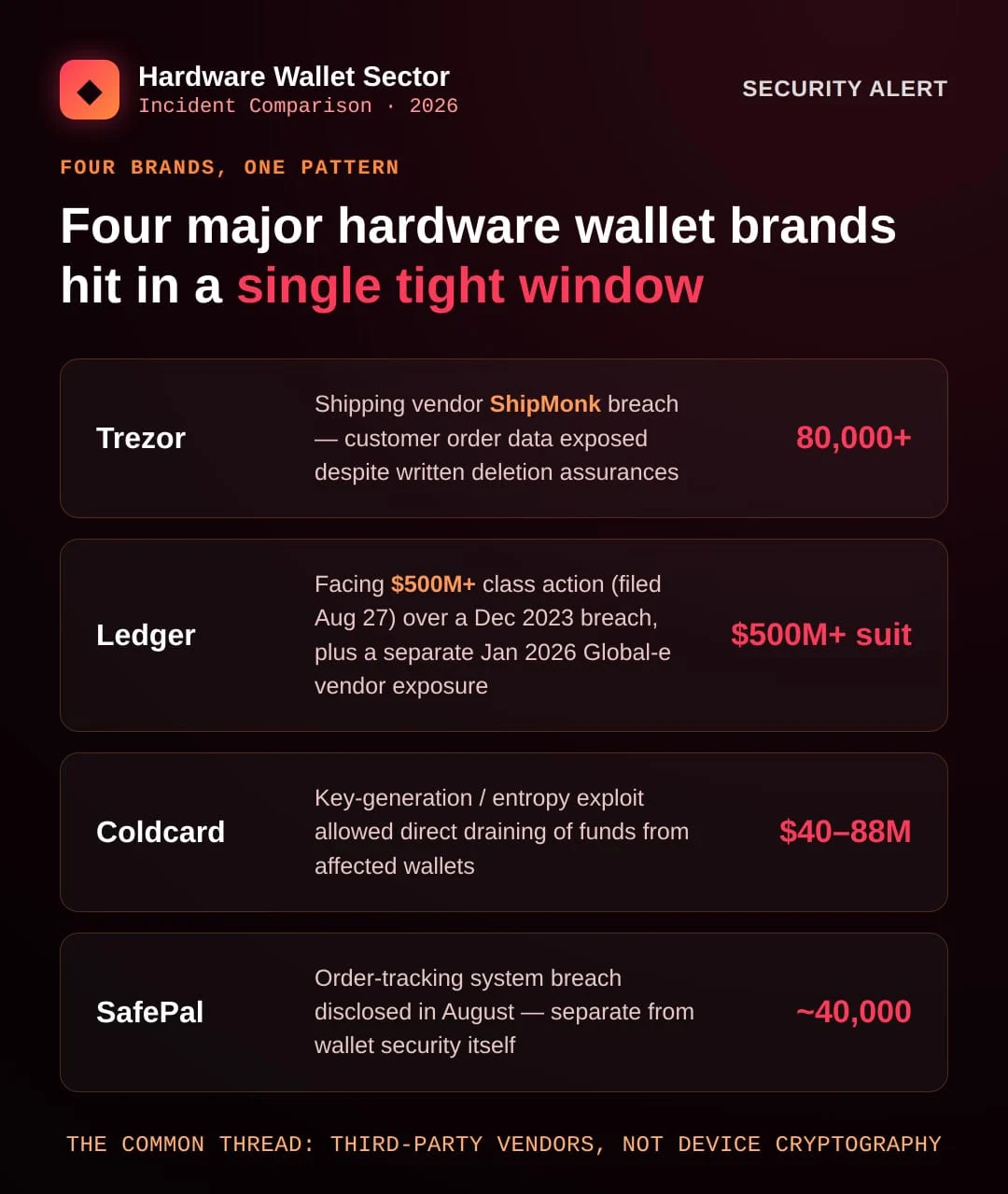
Ledger, the brand specifically called out by ZachXBT, is currently facing a proposed class-action lawsuit filed on August 27 in the Southern District of New York. This lawsuit seeks at least $500 million in damages, alleging that a December 2023 breach led to nearly $2 million being stolen from the plaintiff’s wallet. The plaintiff claims Ledger failed to adequately warn affected users about the risks following the breach. This incident follows a separate, significant Ledger data exposure disclosed in January 2026 (likely a typo in the source, implying a past event, possibly Jan 2021 or 2023), where its third-party payment processor, Global-e, suffered unauthorized access to customer order records. This exposed names and contact details in a pattern strikingly similar to what has now occurred with Trezor, highlighting a recurring vulnerability in the payment processing and logistics chain.
Beyond the two largest players, Ledger and Trezor, other prominent hardware wallet brands have also encountered severe security challenges:
- Coldcard: A highly regarded hardware wallet known for its robust security features, Coldcard suffered a major key-generation/entropy exploit. This vulnerability allowed attackers to drain an estimated $40 million to $88 million in Bitcoin from affected wallets. This incident is particularly alarming as it represents a compromise not of customer data, but of the core cryptographic integrity of the device itself, striking at the very heart of hardware wallet security.
- SafePal: In August, SafePal confirmed its own data breach, also linked to an order-tracking system rather than the wallets themselves. This incident affected nearly 40,000 customers, exposing personal information similar to the Trezor and Ledger breaches.
Taken collectively, these incidents paint a grim picture: four major hardware wallet brands have disclosed serious security compromises within a relatively short timeframe. While the nature of these breaches varies—from core cryptographic exploits (Coldcard) to extensive customer data exposures via third-party vendors (Trezor, Ledger, SafePal)—they all point to a fundamental weakness in the broader ecosystem. This weakness is often found not in the cryptographic security of the devices themselves, but in the extended network of third-party vendors: shippers, payment processors, analytics platforms, and other service providers. These peripheral entities, often overlooked in initial security assessments, frequently hold precisely the kind of customer data that transforms a security-conscious buyer into a highly specific and highly valuable target for malicious actors.
The Pervasive Threat of Supply Chain and Third-Party Risk
The common thread running through most of these recent incidents is the profound and often underestimated challenge of supply chain and third-party risk management. In today’s interconnected digital economy, companies rely on a complex web of external vendors for everything from shipping and payment processing to analytics and cloud infrastructure. While this outsourcing can offer efficiency and specialized expertise, it also expands a company’s attack surface exponentially. Each third-party vendor represents a potential weak link, an entry point for attackers that may not adhere to the same stringent security standards as the primary company.
The Trezor-ShipMonk situation exemplifies this perfectly. Trezor, a company built on security, had clear contractual agreements and received written assurances regarding data deletion. Yet, the reality was starkly different. This highlights the difficulty in effectively auditing and enforcing security and data governance standards across an entire supply chain. Many smaller vendors may lack the resources, expertise, or even the incentive to implement robust cybersecurity measures. Attackers are increasingly sophisticated, often targeting these weaker links to gain access to valuable data from larger, more secure primary targets.
Regulators globally are beginning to take notice. Data protection laws like GDPR in Europe and CCPA in California already impose strict requirements on how personal data is handled, including responsibilities for third-party vendors. The increasing frequency and scale of these breaches within the crypto sector could accelerate regulatory scrutiny, potentially leading to more stringent requirements for vendor due diligence, contract enforcement, and data retention policies. Companies may be compelled to internalize more of their operational processes or invest significantly more in continuous auditing and real-time monitoring of their third-party partners.
Repercussions for Trust and the Future of Hardware Wallets
The cumulative impact of these breaches on user trust is significant. Hardware wallets have long been championed as the ultimate defense against digital asset theft, a sanctuary in a volatile and often dangerous crypto landscape. When even these "gold standard" solutions are implicated in widespread data exposures or, in the case of Coldcard, core cryptographic vulnerabilities, it inevitably erodes confidence. Users, who have invested in these devices for peace of mind, may begin to question the fundamental premise of their security.
For hardware wallet companies, this period represents a critical juncture. They must re-evaluate their entire operational security posture, extending beyond the cryptographic integrity of their devices to encompass every aspect of their supply chain. This could involve:
- Stricter Vendor Contracts and Audits: Implementing more rigorous contractual clauses regarding data security, retention, and deletion, coupled with mandatory, regular, and independent security audits of all third-party partners.
- Internalization of Critical Processes: Considering whether certain highly sensitive operations, like shipping and customer data management, should be brought in-house to reduce external dependencies.
- Enhanced Transparency: Continuing to be transparent about breaches, their scope, and the measures being taken, even when it involves criticizing a vendor.
- User Education: Doubling down on user education regarding phishing, social engineering, and the critical importance of never sharing seed phrases, emphasizing that users are the ultimate firewall.
- Innovation in Security Architectures: Exploring advanced security models such as multi-signature schemes for enhanced asset protection, or more decentralized approaches to customer data handling.
Ultimately, the responsibility also lies with users to remain vigilant. No security solution is entirely foolproof, and the human element often remains the weakest link. Understanding the distinction between a breach of personal identifying information and a compromise of cryptographic keys is crucial. Users must adopt robust personal cybersecurity hygiene, including using unique email addresses for crypto-related accounts, enabling multi-factor authentication, practicing strong password management, and being perpetually skeptical of unsolicited communications.
In conclusion, the expanded Trezor data breach, alongside similar incidents affecting Ledger, Coldcard, and SafePal, serves as a powerful and sobering wake-up call for the entire hardware wallet industry. While the core cryptographic security of these devices remains largely intact, the broader ecosystem is demonstrating significant vulnerabilities, particularly in the realm of third-party vendor risk. ZachXBT’s once-controversial assessment now appears less like hyperbole and more like an urgent prophecy. The path forward demands not just stronger cryptography, but a holistic re-evaluation of security that encompasses every link in the operational chain, ensuring that the trust users place in these devices is mirrored by an equally robust and verifiable security posture across the entire organization and its partners. The future of hardware wallets as the "gold standard" of crypto security hinges on their ability to adapt, learn from these incidents, and rebuild an even more resilient and trustworthy infrastructure.