The blockchain ecosystem is on the cusp of a significant transformation with the burgeoning adoption of the Open Intents Framework (OIF). Launched in February 2025 by the Ethereum Foundation, in close collaboration with leading interoperability protocol Hyperlane and the specialized infrastructure provider Bootnode, the OIF is rapidly establishing itself as the de facto shared infrastructure for the development and execution of cross-chain intents. This ambitious initiative has garnered substantial support, with over 30 prominent teams, including major layer-2 scaling solutions like Arbitrum, Optimism, Polygon, ZKsync, and Starknet, throwing their weight behind the project. This broad coalition underscores the OIF’s strategic positioning not as a proprietary product from a single entity, but as a neutral, open standard designed to benefit the entire decentralized web.
The Genesis and Core Functionality of the Open Intents Framework
At its heart, the Open Intents Framework provides a comprehensive toolkit that empowers developers to build and deploy cross-chain intent mechanisms that function seamlessly across a multitude of blockchain networks. The framework is meticulously engineered, encompassing a suite of smart contracts, open-source solvers, sophisticated aggregators, and a developer-friendly Software Development Kit (SDK). This integrated approach allows developers to readily incorporate OIF’s capabilities into their decentralized applications (dApps) without the need for explicit permission from any central authority, thereby fostering an environment of unfettered innovation.
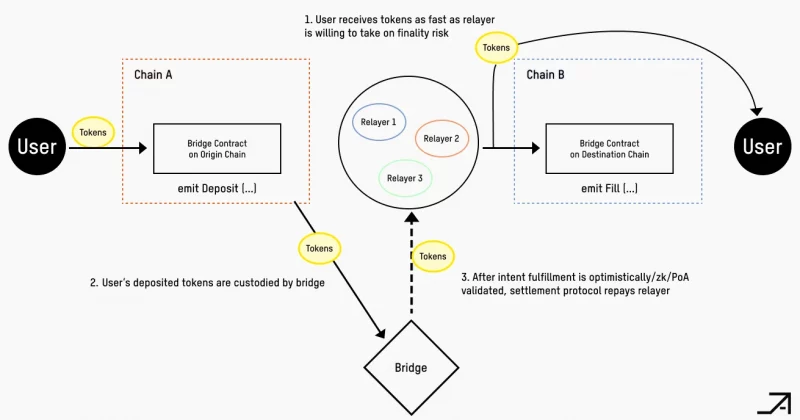
The architectural foundation of the OIF rests on three pivotal types of smart contracts: InputSettler, OutputSettler, and Oracle contracts. These contracts are intrinsically linked and orchestrated by an interoperability SDK, which acts as the connective tissue, enabling the smooth flow of information and execution of intents across disparate blockchain environments. The InputSettler contract is responsible for receiving and validating intents submitted by users, while the OutputSettler contract manages the execution and settlement of these intents on destination chains. Oracle contracts, in this context, are crucial for providing reliable off-chain data to on-chain smart contracts, ensuring that the conditions for intent fulfillment are accurately met.
Furthermore, the OIF is built upon the robust foundation of the ERC-7683 standard. This Ethereum Request for Comment (ERC) defines a standardized structure for cross-chain intents, ensuring interoperability and predictability within the framework. When a user initiates an intent, such as executing a cross-chain token swap, the OIF triggers a competitive landscape where specialized entities known as "solvers" race to fulfill that request with maximum efficiency and minimal cost. This competitive mechanism is a cornerstone of the OIF’s design, driving performance and ensuring that users receive the best possible outcomes for their cross-chain operations.
Early Deployments and Promising Performance Metrics
The practical application of the OIF is already being demonstrated through live deployments on several key blockchain networks. Initial deployments have been successfully established on Ethereum Sepolia and Optimism Sepolia, crucial testnets that allow for rigorous testing and validation of the framework’s capabilities in a controlled environment. Under optimal network conditions, the OIF has showcased impressive performance, with solver-filled orders being completed within a remarkably short timeframe of 10 to 60 seconds. This speed is a critical factor in enhancing user experience for cross-chain transactions, which have historically been hampered by slower settlement times.
The successful deployment and performance on these testnets are indicative of the OIF’s readiness for broader adoption. As more developers and projects integrate the OIF into their ecosystems, the efficiency and speed of cross-chain intent fulfillment are expected to further improve, setting a new benchmark for interoperability within the decentralized web.
Coinbase’s Strategic Integration and the Drive for Standardization
A significant milestone in the OIF’s journey was marked in September 2025, with the announcement that Coinbase Payments, the payments arm of the prominent cryptocurrency exchange Coinbase, had become a core contributor to the framework. This strategic endorsement from a major player in the crypto industry signals a strong belief in the OIF’s potential to standardize and streamline cross-chain asset transfers. Coinbase Payments’ involvement is expected to accelerate the development and adoption of OIF-based solutions, particularly within the realm of institutional and retail payment processing.
The decision by Coinbase Payments to actively contribute to OIF underscores the framework’s inherent advantages. The OIF’s design is deliberately modular and permissionless, a critical feature that allows any team to deploy, extend, and customize the smart contracts without requiring the approval or oversight of a central governing body. This inherent openness is further reinforced by the absence of a dedicated governance token. This means there are no tokenomics to navigate, no staking requirements to meet, and no protocol fee structures that are subject to the whims of token holder votes. This "no token" approach is a deliberate design choice, positioning the OIF as a truly neutral and accessible infrastructure for the entire blockchain community.
The Strategic Significance of a Tokenless Framework
The deliberate omission of a dedicated token for the Open Intents Framework is a strategic decision with profound implications for its positioning and adoption. By eschewing a token, the OIF deliberately avoids the complexities and potential conflicts associated with token-based governance and economic incentives. This allows the framework to be perceived and utilized as a pure infrastructure layer, devoid of the speculative pressures and governance disputes that can sometimes plague tokenized protocols.
For developers, this tokenless approach translates into a simplified development experience. They are liberated from the need to understand intricate tokenomics, navigate staking mechanisms, or adapt to fluctuating fee structures dictated by token holder consensus. This focus on core functionality and interoperability streamlines the integration process, making the OIF more accessible to a wider range of projects and developers.
However, the absence of a token also presents a unique challenge: the lack of a direct financial incentive mechanism to bootstrap the network of solvers and participants. The OIF’s model relies instead on the natural competitive dynamics inherent in the market. Solvers are motivated by the opportunity to profit from fulfilling user intents efficiently. The more effectively and economically they can execute these requests, the greater their reward. This market-driven approach fosters a highly competitive environment where performance and cost-effectiveness are paramount, ultimately benefiting the end-users who benefit from faster and cheaper cross-chain transactions.
The Broader Implications for Cross-Chain Interoperability
The Open Intents Framework represents a significant leap forward in the quest for seamless cross-chain interoperability. By providing a neutral, open, and permissionless standard, the OIF is fostering an environment where different blockchain networks can communicate and transact with each other more efficiently and securely than ever before.
The implications of this are far-reaching:
- Enhanced User Experience: Users will no longer be confined to a single blockchain ecosystem. They will be able to move assets, interact with dApps, and access services across multiple chains with greater ease and speed, reducing friction and improving the overall user experience in the decentralized web.
- Increased Liquidity and Capital Efficiency: The ability to move assets freely across chains will unlock new opportunities for liquidity aggregation and capital deployment. This can lead to more efficient markets, better price discovery, and greater overall economic activity within the blockchain space.
- Innovation and Application Development: By abstracting away the complexities of cross-chain communication, the OIF empowers developers to focus on building innovative applications that leverage the strengths of multiple blockchains. This could lead to the emergence of entirely new categories of dApps and services that are not currently feasible.
- Reduced Fragmentation: The current blockchain landscape is characterized by a degree of fragmentation, with distinct ecosystems operating in relative isolation. The OIF aims to bridge these gaps, fostering a more interconnected and cohesive decentralized web.
- Democratization of Interoperability: The permissionless and open-source nature of the OIF ensures that interoperability solutions are not controlled by a select few. This democratizes access to cross-chain capabilities, allowing smaller teams and new projects to participate on an equal footing.
The ongoing development and auditing of production contracts, coupled with the targeted expansion of solver development later this year, indicate a clear roadmap for the OIF’s continued growth and evolution. As more established players like Coinbase embrace and contribute to the framework, its influence and adoption are poised to accelerate, potentially shaping the future of how blockchains interact and how decentralized applications are built and consumed. The Open Intents Framework is not just another piece of infrastructure; it is a foundational element that promises to unlock the true potential of a multi-chain future.