


The cryptocurrency market is abuzz with anticipation as major financial institutions continue to pursue regulatory approval for spot Ether Exchange Traded Funds (ETFs) in the United States. This renewed wave of institutional interest, spearheaded by industry giants like BlackRock and Fidelity, signals a potential watershed moment for Ethereum (ETH), the second-largest cryptocurrency by market capitalization. Adding to the bullish sentiment, prominent market analyst Tom Lee, Chief Executive of Bitmine, has projected an ambitious target for ETH, suggesting it could reach $6,000 by the end of the current year, a forecast that has injected renewed optimism into the digital asset space.
The current landscape of the cryptocurrency industry remains firmly rooted in bullish territory, with long-term investors and traders closely monitoring potential future developments. Ethereum, in particular, has consistently been at the forefront of these discussions. Tom Lee’s recent pronouncements, delivered via broadcast, have provided a detailed outlook on the asset’s potential trajectory leading up to the close of the year. His conviction in Ethereum’s upward mobility is not merely speculative; it is deeply intertwined with his firm’s strategic investment approach. Bitmine has actively incorporated buying ETH into its institutional growth strategy, underscoring Lee’s long-term commitment and profound understanding of the asset’s intrinsic value and market dynamics.
Lee’s Vision: A $6,000 Ethereum by Year-End
Tom Lee’s recent broadcast detailed a robust bullish thesis for Ethereum, projecting a potential ascent to the $6,000 mark by year-end. This forecast is underpinned by a sophisticated analysis that extends beyond superficial speculation. Lee’s perspective is informed by a comprehensive understanding of Ethereum’s historical performance, its evolving network utility, and the prevailing macroeconomic forces that influence digital asset markets. His firm’s sustained investment in ETH, navigating both periods of significant growth and market downturns, provides him with a unique vantage point. This deep-seated experience allows him to interpret market signals and project future movements with a level of confidence that resonates with seasoned investors.
Lee’s analysis emphasizes the cyclical nature of cryptocurrency markets and Ethereum’s demonstrated responsiveness to technological advancements and broader market trends. He draws parallels to Ethereum’s significant bull run in 2021, which was largely propelled by the explosive growth of Non-Fungible Tokens (NFTs) and Decentralized Finance (DeFi). Looking ahead, Lee posits that a confluence of factors, including enhanced regulatory clarity, increased institutional adoption, and shifts in global interest rate policies, will be pivotal in shaping Ethereum’s future price action. These macroeconomic drivers, coupled with the inherent technological innovation within the Ethereum ecosystem, form the bedrock of his optimistic outlook.

Crucially, Lee has linked Ethereum’s potential surge to a corresponding increase in Bitcoin’s value. He posits that if Bitcoin reaches $150,000, a scenario he deems achievable, Ethereum’s market strength is likely to amplify in tandem. This correlation is attributed to Ethereum’s increasing capability to outperform Bitcoin as its adoption expands. Lee anticipates that key developments such as the tokenization of real-world assets, the growing integration of Ethereum into institutional financial frameworks, and the sustained growth of on-chain activity will collectively contribute to ETH’s upward momentum. In his view, a strong Bitcoin performance would provide the necessary tailwinds for Ethereum to achieve its $6,000 target. This interdependent relationship highlights the interconnectedness of the leading digital assets and their shared reliance on broader market sentiment and institutional embrace.
The Institutional Push: Spot Ether ETF Applications
The prospect of a spot Ether ETF receiving approval from the U.S. Securities and Exchange Commission (SEC) represents a significant catalyst for Ethereum’s market development. Following the landmark approval of spot Bitcoin ETFs earlier this year, prominent financial institutions have been actively seeking similar vehicles for Ether. Fidelity, a titan in the asset management industry, has officially filed for a spot Ether ETF with the SEC, marking a significant step in this ongoing regulatory saga. This move by Fidelity, a company with a substantial track record in traditional finance and a growing presence in the digital asset space, underscores the increasing institutional conviction in Ethereum’s long-term viability and investment potential.
The application process for these spot ETFs is a rigorous one, involving extensive review by the SEC. The regulator has historically adopted a cautious approach to digital asset-related financial products, often citing concerns about market manipulation and investor protection. However, the recent approval of spot Bitcoin ETFs demonstrated a shift in the SEC’s stance, largely influenced by the outcome of legal challenges and the persistent demand from institutional investors. The SEC’s decision on spot Ether ETFs will likely be influenced by a similar evaluation of market integrity and the robust frameworks proposed by applicants.
The implications of a spot Ether ETF approval are far-reaching. It would provide a regulated and accessible avenue for a wider array of investors, including retail and institutional participants, to gain exposure to Ether without the complexities of direct cryptocurrency ownership and management. This could lead to a substantial influx of capital into the Ethereum ecosystem, potentially driving up demand and, consequently, price. Furthermore, it signifies a growing acceptance of Ether as a legitimate asset class within the traditional financial system, enhancing its credibility and paving the way for further innovation and integration.
Ethereum’s Current Market Performance and Outlook

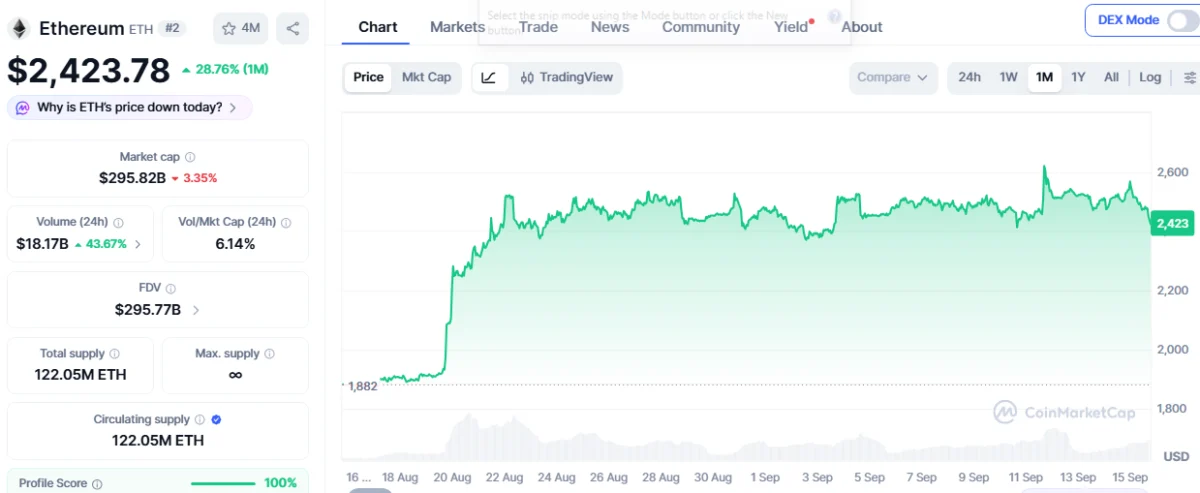
As of the latest reporting, Ether is trading around the $2,400 mark, indicating a period of consolidation following a recent market rally. Over the past week, the asset experienced a slight dip of 0.9%, a modest correction after reaching approximately $2,600 in the preceding week. This consolidation phase, occurring above the critical support level of $2,400, suggests that Ethereum’s underlying bullish structure remains intact. The asset appears to be taking a strategic pause after its recent surge, consolidating its gains before potentially embarking on its next upward trajectory.
Market data and technical analysis point towards continued upward pressure from institutional buyers in the near term. The next significant resistance level to monitor is $2,546, with analysts suggesting a high probability of Ether challenging and potentially surpassing the $2,600 to $2,670 range in the short to medium term. This sustained interest from institutional players is a critical factor underpinning the bullish outlook. Their participation not only injects capital but also signals a growing confidence in Ethereum’s fundamental value proposition and its potential for future growth.
The broader implications of these developments cannot be overstated. The pursuit of spot Ether ETFs by major financial players, coupled with optimistic price predictions from respected analysts, paints a picture of increasing maturity and mainstream acceptance for Ethereum. The network’s ongoing evolution, particularly its role in facilitating DeFi, NFTs, and the burgeoning world of tokenized assets, continues to solidify its position as a foundational technology for the decentralized web. While regulatory hurdles and market volatility remain inherent risks in the cryptocurrency space, the current momentum suggests that Ethereum is poised for significant advancements in the coming months and years. The interplay between institutional adoption, technological innovation, and macroeconomic factors will be crucial in determining whether ETH can indeed achieve the ambitious targets set forth by analysts like Tom Lee, ushering in a new era for the digital asset.
Historical Context and Catalysts for Growth
To fully appreciate the current optimism surrounding Ethereum, it is essential to consider its historical trajectory and the key catalysts that have propelled its growth. Launched in 2015, Ethereum introduced the concept of smart contracts, enabling developers to build decentralized applications (dApps) on its blockchain. This innovation fundamentally transformed the potential of blockchain technology beyond simple peer-to-peer transactions, laying the groundwork for a vast ecosystem of decentralized services.
The period leading up to and including 2021 was particularly transformative for Ethereum. The explosive growth of the NFT market, driven by digital art, collectibles, and gaming assets, saw a significant portion of transactions and value flow through the Ethereum network. Simultaneously, the Decentralized Finance (DeFi) sector experienced exponential growth, with protocols offering lending, borrowing, trading, and insurance services without traditional intermediaries. These two sectors, heavily reliant on Ethereum’s smart contract capabilities, created unprecedented demand for ETH as the gas token to power transactions and as collateral within DeFi protocols.

Furthermore, Ethereum has undergone significant technological upgrades. The most notable was "The Merge" in September 2022, which transitioned the network from a Proof-of-Work (PoW) consensus mechanism to Proof-of-Stake (PoS). This monumental shift drastically reduced Ethereum’s energy consumption, addressing a long-standing criticism and making it more environmentally sustainable. The PoS mechanism also introduced staking, allowing ETH holders to earn rewards by validating transactions and securing the network, further incentivizing holding and participation. Future upgrades, such as sharding, aim to further enhance scalability and reduce transaction fees, addressing some of the network’s persistent challenges.
Broader Impact and Future Implications
The increasing institutional interest in Ethereum, exemplified by the spot ETF applications from BlackRock and Fidelity, carries profound implications for the broader financial landscape. The traditional financial world is increasingly recognizing the utility and investment potential of digital assets, and Ethereum, with its robust ecosystem and technological advancements, is a prime beneficiary of this shift.
The approval of a spot Ether ETF would not only benefit Ethereum directly through potential capital inflows but also legitimize the cryptocurrency market further in the eyes of mainstream investors. This could trigger a ripple effect, encouraging more traditional financial institutions to explore and integrate digital assets into their offerings. It also signifies a maturing market where innovative financial products are being developed to meet investor demand, bridging the gap between traditional finance and the burgeoning digital asset space.
Moreover, the ongoing development and adoption of decentralized applications on the Ethereum network, from DeFi and NFTs to the burgeoning metaverse and decentralized autonomous organizations (DAOs), underscore its foundational role in the evolving digital economy. As more real-world assets are tokenized and as blockchain technology becomes more integrated into various industries, Ethereum’s utility and demand are likely to grow.
The convergence of institutional capital, technological innovation, and increasing real-world utility positions Ethereum at a critical juncture. While the path forward is subject to regulatory developments and market dynamics, the current sentiment and strategic moves by major financial players suggest a period of significant potential and growth for ETH. The projections of $6,000 by year-end, while ambitious, are indicative of the growing confidence in Ethereum’s long-term value proposition and its capacity to navigate the complexities of the evolving global financial and technological landscape.














