


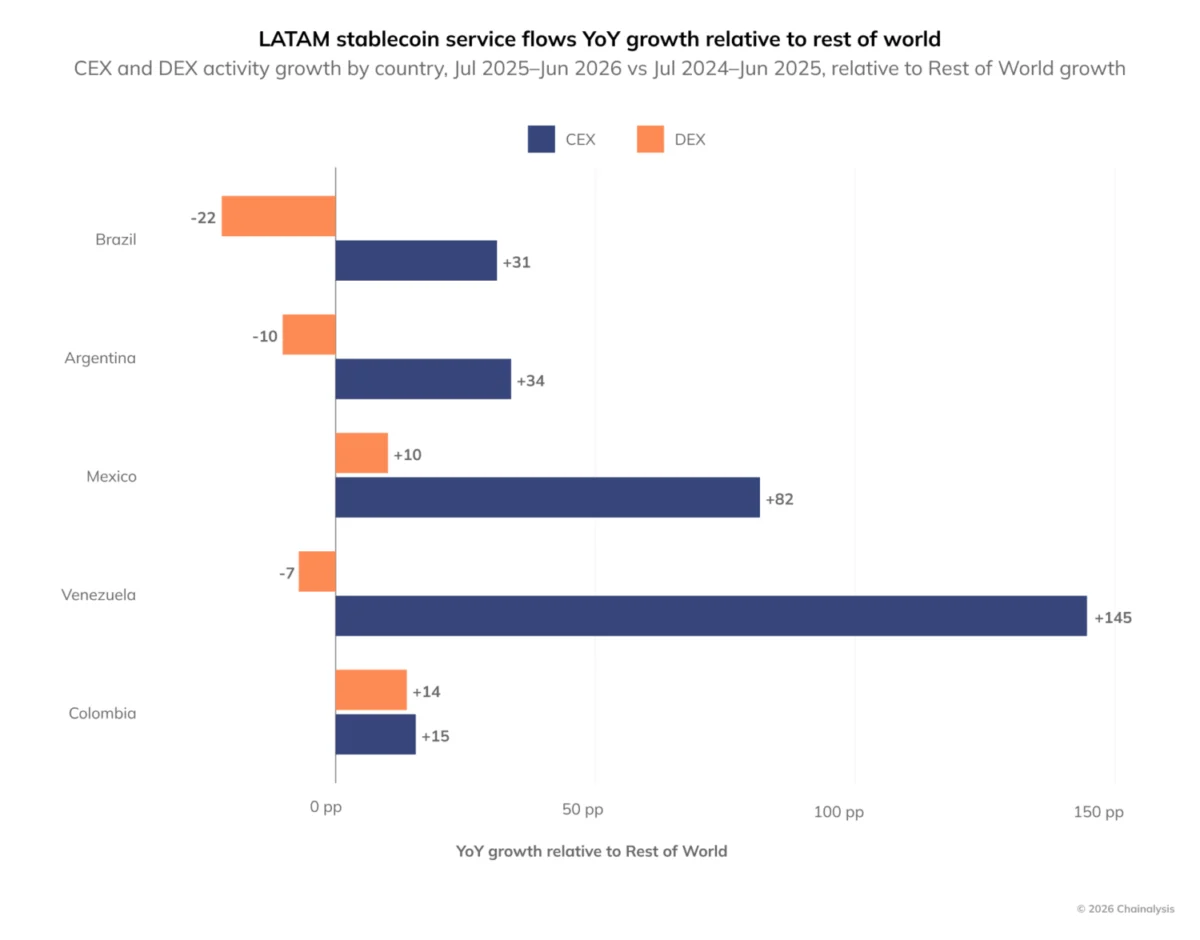
The Latin American cryptocurrency market has solidified its position as a critical pillar of the global digital asset economy, recording $593.8 billion in activity over the twelve-month period ending June 30, 2026. According to the latest regional analysis, the territory now stands as the sixth-largest crypto economy in the world, having achieved a 9.8% growth rate despite a broader global market correction that began in late 2025. This expansion is not merely a reflection of speculative interest but is fundamentally rooted in a "trifecta" of economic pressures: persistent inflation, extreme currency volatility, and restrictive capital controls that have left businesses and households seeking viable alternatives to traditional financial systems.

Regional Growth and Market Concentration
While the region encompasses dozens of nations with varying economic profiles, the vast majority of cryptocurrency activity is concentrated within five key markets. Brazil, Argentina, Mexico, Venezuela, and Colombia collectively accounted for more than 80% of the region’s total crypto value received during the reporting period. Brazil remains the undisputed leader in terms of volume, processing $252.5 billion in activity, representing nearly 44% of the regional share. However, the nature of growth across the continent is shifting. While Brazil’s crypto economy saw a slight contraction of 1.6% during this period, other nations experienced explosive surges.
Venezuela led the pack with a staggering 107.2% increase in activity, followed by Mexico at 25.5%, Argentina at 15.3%, and Colombia at 13.8%. Even smaller markets showed signs of rapid, albeit lower-volume, adoption; Honduras and Nicaragua recorded growth rates of 361.6% and 186.4%, respectively. Conversely, some Caribbean and Central American markets faced significant declines, with Trinidad and Tobago falling by 55.8% and Guatemala dropping by 51.4%, highlighting the uneven nature of adoption across the various sub-regions.

The Venezuelan Political Shock and Financial Flight
The most dramatic shift in the 2026 reporting period occurred in Venezuela, where cryptocurrency transformed from a supplementary tool into a primary survival mechanism. In January 2026, the political landscape was upended when the United States placed President Nicolás Maduro into custody, an event that sent shockwaves through the nation’s already fragile financial infrastructure. This political rupture served as a catalyst for a massive migration toward digital assets.
Immediately following the arrest, Venezuela’s crypto economy erupted. For the first time in the current decade, the country led the region in growth. Stablecoin payments surged as citizens sought to exit the bolívar, which faced renewed downward pressure. Data indicates that in the quarter following the political upheaval, cross-border net outflows increased by 891.7%, as value was moved out of the country to preserve wealth.

Marianella Vanci, a senior reporter at CriptoNoticias, observed that this "accelerated redollarization" is occurring largely outside the traditional banking sector. Merchants in Venezuela now report receiving approximately 40% of their income in USDT (Tether), while freelancers and remote workers have shifted almost entirely to crypto-based compensation to bypass the frictions of the domestic banking system.
Brazil’s Path Toward Institutional Maturation
In contrast to the crisis-driven adoption in Venezuela, Brazil is pioneering a model of "institutional maturation." Despite a minor dip in overall volume, the country has seen its share of the regional crypto economy grow from 31.6% in 2022 to 43.7% in 2026. This dominance is being supported by a sophisticated regulatory environment led by the Banco Central do Brasil (BCB).

In February 2026, the BCB implemented comprehensive new rules for virtual asset service providers (VASPs), mandating strict governance, risk management, and substantial minimum capital requirements. While these barriers to entry have put pressure on smaller, crypto-native firms, they have instilled a new level of confidence among traditional financial institutions.
Fabricio Tota, VP of Crypto Affairs at Mercado Bitcoin, noted that the landscape is consolidating. "If we fast forward 12 months, I think we will see many fewer crypto-native players here in Brazil," Tota remarked, suggesting that the market is shifting toward larger, regulated entities. This regulatory clarity is enabling banks and fintechs to integrate digital assets into their existing product suites, facilitating a surge in B2B demand. Stablecoins in Brazil are increasingly viewed as corporate tools for liquidity management and cross-border settlement, rather than just retail instruments.

The Rise of the Stablecoin Standard
One of the most defining trends across Latin America in 2026 is the overwhelming dominance of stablecoins. These assets, typically pegged to the U.S. dollar, have become the preferred medium for both domestic and international transactions. In Mexico, quarterly stablecoin service inflows reached $8.4 billion in Q2 2026—an eightfold increase compared to five years prior.
By June 2026, stablecoins accounted for:

- 32.1% of all cross-border value transfers.
- 22.1% of domestic peer-to-peer (P2P) activity.
- 17.6% of total personal wallet balances.
The shift toward stablecoins is particularly pronounced in the P2P sector. In Brazil, within-country P2P stablecoin transfers for amounts between $100 and $1,000 grew by 666%, vastly outpacing the regional average. Furthermore, the number of Brazilian wallets holding at least $10,000 in stablecoins has increased by 347% since mid-2024, indicating that a new class of "stablecoin savers" is emerging.
Mexico and the Remittance Revolution
Mexico has carved out a unique niche as a global hub for cross-border stablecoin flows, ranking fifth in the world for this specific metric. With a total crypto economy of $77.6 billion, more than 61% of Mexico’s flows are now denominated in stablecoins. The U.S.-Mexico remittance corridor, historically dominated by traditional money transfer operators, is being disrupted by digital assets.

Monthly stablecoin value on corridors connected to Mexico reached $1.8 billion in June 2026, representing a fourfold increase from 2024 levels. Ben Reid, Global Head of Stablecoins at Bitso, noted that while dollar-pegged coins remain popular, there is growing demand for peso-denominated stablecoins like MXNB. These local variants serve as crucial "fiat ramps" for companies that struggle to find reliable custody and conversion solutions within the traditional Mexican banking system.
A Structural Shift from Self-Custody to Centralized Services
The 2026 data reveals a significant departure from the "cypherpunk" origins of cryptocurrency adoption. Historically, Latin American users favored self-custody—holding their own private keys to ensure independence from intermediaries. However, the trend has flipped decisively toward centralized service providers.

As of June 2026, 71.2% of Latin American crypto balances were held within centralized platforms, surpassing the global average of 68.0%. This shift occurred even as the market faced a sharp correction; while self-custody balances plummeted by 66.7% following the late 2025 price crash, balances held on service platforms fell by only 28.0%.
Experts suggest this indicates a "platformization" of the market. Users are no longer just holding assets; they are using them to access financial products. Gabriel Campa, Head of Digital Assets at Towerbank, noted that customers increasingly want a unified experience. "They want to receive, hold, convert, transfer, spend, and access financial products from the same relationship," Campa said. This demand for a "one-stop-shop" is driving users toward regulated exchanges and banks that offer crypto-integrated accounts.

Analysis of Broader Implications
The evolution of the Latin American crypto market in 2026 suggests that digital assets have moved past the "early adopter" phase and are now an integral part of the region’s financial fabric. The growth is bifurcated: in stable economies like Brazil and Mexico, crypto is becoming an institutionalized tool for efficiency and cross-border commerce. In volatile economies like Venezuela and Argentina, it remains a vital hedge against systemic failure.
The 9.8% growth rate in the face of a 2025-2026 market correction proves the resilience of the sector. Unlike previous cycles where activity was driven by retail speculation and "fear of missing out" (FOMO), the current wave is driven by utility. Whether it is a freelancer in Caracas receiving USDT to avoid hyperinflation or a corporation in São Paulo using stablecoins for cross-border B2B payments, the use cases are practical and grounded in necessity.

As the region moves forward, the primary challenge will be the continued consolidation of the market. Higher regulatory bars in major economies like Brazil may squeeze out innovation from smaller startups, but they are simultaneously opening the door for trillions of dollars in institutional capital. The "Latin American model" of crypto adoption—one defined by high-utility stablecoin use and a pragmatic shift toward regulated services—may well provide a blueprint for other developing regions facing similar economic headwinds.














