


The incident unfolded as a user sought to repay a loan through a decentralized finance (DeFi) protocol, operating within the Backpack wallet environment. The crucial step involved transferring USDC, a prominent stablecoin, from a Binance account to a Solana address. Following standard procedure, the user copied their designated Solana recipient address and pasted it into Binance’s withdrawal interface. However, during this seemingly innocuous copy-paste operation, the final character of the address, a ‘J’, was inadvertently dropped. Critically, the truncated string, by an unfortunate statistical coincidence, still constituted a technically valid Solana address. Binance’s system, lacking advanced validation mechanisms for this specific scenario, accepted the malformed address. The transaction proceeded, confirmed on the Solana blockchain, and the $20,000 in USDC was irrevocably sent to an address that, in all likelihood, is not controlled by any entity and is effectively lost in the digital ether. This event serves as a stark reminder of the inherent risks in cryptocurrency transactions, particularly when human error intersects with nuanced protocol design.
The Anatomy of a Costly Error: Solana’s Address Design Under Scrutiny
The core problem, while not entirely novel in the realm of digital asset transfers, highlights a specific vulnerability within Solana’s address structure that differentiates it from many other major blockchains. Unlike protocols that employ fixed-length addresses or robust checksums, Solana’s design can, under certain circumstances, allow a partially truncated address to still appear valid. This critical distinction has been a point of contention and discussion among developers for years.
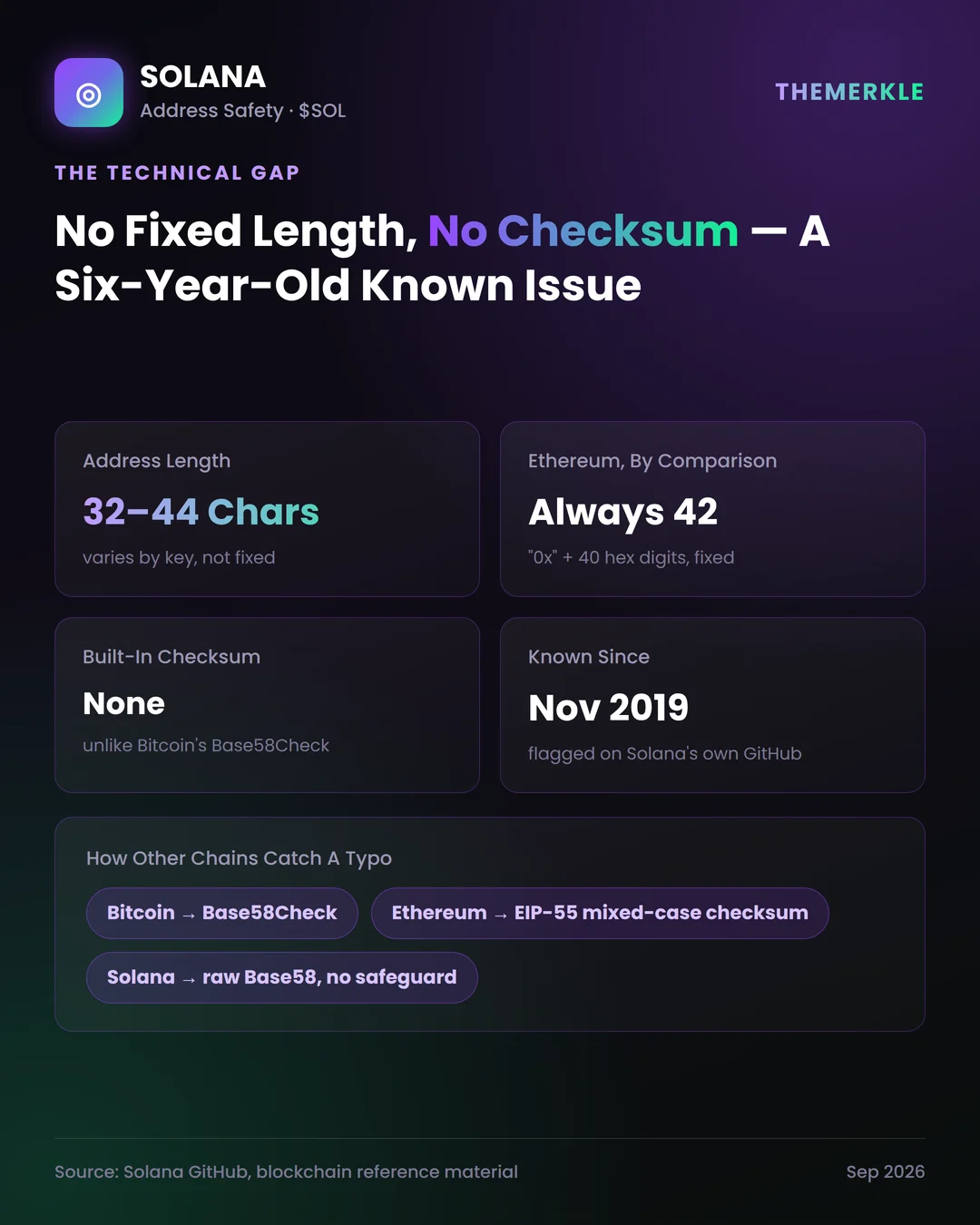
A Solana address is fundamentally the Base58-encoded representation of a 32-byte (256-bit) Ed25519 public key. While the underlying public key always maintains a precise length of 32 bytes, the Base58 encoding process itself does not guarantee a fixed-length output for a fixed-length input. This is because leading zero bytes in the raw key can collapse during encoding, leading to a variable-length string that can range anywhere from 32 to 44 characters. This variability is a well-documented technical aspect, understood by wallet providers and blockchain reference materials. However, it also means there is no single, universally accepted character count for users to visually verify, making "eyeball-checking" an address significantly less reliable than on other chains.
For comparison, Ethereum addresses are always 42 characters long, commencing with "0x" followed by 40 hexadecimal digits. If even a single character is altered or omitted from an Ethereum address, it immediately renders the address mechanically invalid, causing transactions to fail before funds are dispatched. The stark contrast with Solana is evident: dropping a character from most Solana addresses still carries a tangible risk that the resulting shorter string will fall within the acceptable 32-44 character range and decode into something that resembles a legitimate, albeit incorrect, public key. This structural characteristic significantly elevates the probability of human error leading to irreversible loss.

The Unheeded Warning: A Years-Old GitHub Issue
Further exacerbating the issue is Solana’s deliberate omission of a built-in checksum mechanism for its addresses. Checksums are crucial error-detection codes designed to identify accidental data corruption or transcription errors. Bitcoin, for instance, addressed this exact class of typo years ago with its Base58Check encoding, which appends a checksum to addresses. This means that a single incorrect or missing character in a Bitcoin address will cause the decoding process to fail outright, preventing funds from being sent to a non-existent or unintended destination. Ethereum, while not using Base58Check, implemented its own form of checksumming through EIP-55 mixed-case addresses, where the capitalization of certain hexadecimal characters serves as a checksum, making manual errors detectable.
Solana, however, has adopted neither of these widely used safety nets. This specific vulnerability was identified and formally flagged in a GitHub issue filed against the core Solana repository as far back as November 2019. Titled "Use Base58Check where humans are involved," the issue explicitly highlighted the inherent error-proneness of raw Base58 encoding without a checksum, particularly in scenarios where human users are manually interacting with addresses. Despite this early and clear warning from within the Solana developer community itself, this fundamental gap remains unaddressed at the base layer of the protocol, nearly six years later. The current incident tragically underscores the real-world financial consequences of this long-standing design choice.
Therefore, the direct answer to the question of Solana address length is multifaceted: it is not fixed, and the address format lacks any inherent mechanism to detect truncation or other single-character errors, unlike many other prominent blockchains. The unfortunate confluence of variable length and the absence of a checksum created the perfect storm for this week’s incident, where a shortened address appeared valid enough to bypass the limited checks in place.
The Protocol’s Role: Assessing Solana’s Responsibility
Assigning blame in such incidents is rarely straightforward, yet Solana’s core design unequivocally bears significant weight. The fact that protocol contributors themselves identified and documented the checksum gap years before this incident, without it being resolved at the base layer, is a critical point. When a blockchain’s address format permits a truncated string to parse as valid, and offers no automated, protocol-level mechanism to catch such a glaring error before a transaction is signed and broadcast, this transitions from mere user misfortune to a protocol-level user experience (UX) decision with direct, severe financial consequences.

Solana, launched in 2020, rapidly gained prominence for its high throughput and low transaction fees, often positioned as an "Ethereum killer." Its innovative architecture, including Proof-of-History, allows it to process tens of thousands of transactions per second, making it attractive for high-volume applications and stablecoin transfers. The surge in its user base and transaction volume, especially for stablecoins where it has seen significant growth (though still trailing competitors like Arbitrum in some metrics, as the original article’s linked source implies), means that the number of opportunities for such errors to occur is constantly increasing. With more users moving more value, the importance of robust error prevention at the protocol level becomes paramount. The design choices made in the early stages of a blockchain’s development often have long-lasting implications for security and usability, and the absence of a checksum is proving to be a persistent Achilles’ heel for Solana.
The Exchange’s Duty: Binance’s Part in the Equation
While Solana’s protocol design is a primary factor, centralized exchanges like Binance are not merely passive conduits for transactions. They operate their own withdrawal interfaces, which represent a distinct layer of security and user experience separate from the underlying blockchain protocol. Many major exchanges, keenly aware of the varying address formats and checksum deficiencies across different chains, have proactively implemented additional safeguards. These can include withdrawal address allowlisting with mandatory time delays, requiring small test transfers before authorizing large withdrawals, or employing visual address chunking (e.g., displaying addresses in groups of four characters) to make shortened or altered strings easier for users to spot.
If Binance’s withdrawal flow, in this specific instance, limited its validation solely to confirming that the pasted string conformed to Solana’s general Base58 pattern and length range, without incorporating any secondary safeguard against common human errors like truncation, then this constitutes a significant gap in Binance’s own product design. Such a deficiency is not dictated by Solana’s protocol but rather by the exchange’s independent decision regarding its user protection measures. In cases like this, it is reasonable to argue for shared responsibility: Solana for designing an address format that inherently makes a partial paste appear legitimate, and the exchange that processed the withdrawal for not implementing sufficient safety nets to intercept such a recognizable error before the irreversible movement of funds.
Broader Implications for the Ecosystem
This incident carries significant implications for user trust, not only in Solana but in the broader cryptocurrency ecosystem. For new users, or even experienced ones who are accustomed to the safeguards present on other chains, such an irreversible loss due to a subtle copy-paste error can be deeply disillusioning. It underscores the critical need for robust user education, but also for technological solutions that reduce the burden of perfect vigilance on individual users.

Developers building applications and wallets on Solana also face challenges. They must contend with a base layer that lacks a fundamental error-checking mechanism, forcing them to implement their own solutions or rely on users to exercise extreme caution. This can lead to fragmented security practices across the ecosystem, where some applications might implement robust address validation while others do not. The incident also highlights the ongoing tension between developer flexibility and user safety in blockchain design. While variable address lengths might offer certain technical flexibilities, their impact on user experience and security, particularly for non-technical users, is a significant trade-off.
Preventative Measures and User Best Practices
Practically speaking, this incident serves as an urgent reminder that the common crypto advice of "just verify the address" is far less reassuring on Solana than it is on chains with built-in checksums. On Solana, merely glancing to ensure an address "looks about right" or falls within a general length range is demonstrably insufficient.
For anyone transacting meaningful sums on the Solana blockchain, the diligence required extends to verifying the entire string character-by-character. Tools like address book features in wallets, QR codes, or even multisig wallets for larger sums can provide additional layers of security. Users should also be acutely aware of "address poisoning" scams, where attackers send tiny amounts to addresses similar to a user’s legitimate one, hoping the user accidentally copies the wrong (but similar) address from their transaction history. While not directly related to this incident, it underscores the broader landscape of address-related vulnerabilities.
Until Solana’s core tooling addresses the nearly six-year-old gap regarding checksums, or until major exchanges uniformly build stronger, more intelligent guardrails into their withdrawal processes, this type of mistake will continue to occur. The onus remains heavily on individual users to exercise extreme caution and employ meticulous verification processes for every transaction.
The Path Forward: Calls for Industry-Wide Solutions

The debate spurred by this loss is not merely about assigning blame but about fostering a safer, more user-friendly cryptocurrency environment. It presents an opportunity for Solana developers to revisit the 2019 GitHub issue and prioritize the implementation of a checksum or similar error-detection mechanism. Such a change would significantly enhance the security posture of the entire Solana ecosystem and instill greater confidence among users and developers alike.
Concurrently, this incident should prompt all centralized exchanges to review and fortify their withdrawal validation protocols, especially for blockchains with known address format quirks. Implementing multi-layered validation, including checks for common human errors like truncation, alongside standard Base58 pattern matching, should become an industry standard. The crypto industry, still relatively nascent compared to traditional finance, has a collective responsibility to evolve its infrastructure to mitigate preventable losses and build a more resilient and trustworthy system for all participants. The $20,000 lost this week is not just a personal tragedy for one user, but a critical lesson for an entire ecosystem striving for mainstream adoption.
Disclosure: This article is for informational purposes only and does not constitute trading or investment advice. Always conduct thorough research before engaging in any cryptocurrency transactions or investments.














