


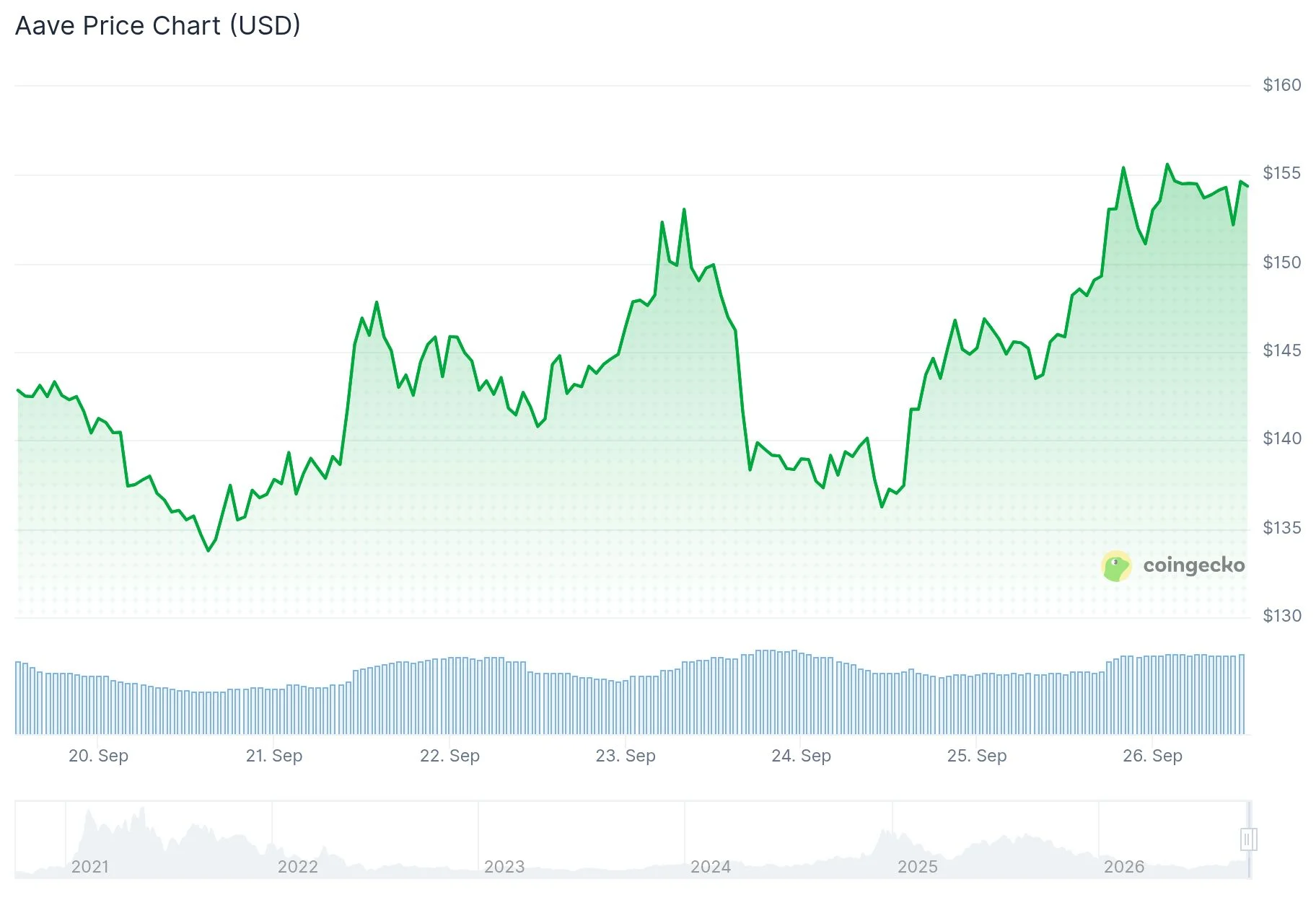
Aave, a leading decentralized finance (DeFi) lending protocol, has launched a pioneering lending market on the Base network, enabling users to secure USDC loans by collateralizing seven prominent Coinbase-issued tokenized equity products. This significant development has been met with immediate market enthusiasm, evidenced by AAVE’s price appreciating by over 7%, with the token trading in the range of $146 to $147 in recent activity. This new "Equities Hub" marks a pivotal moment in the convergence of traditional finance and decentralized applications, offering unprecedented utility for digital representations of real-world assets.
The Equities Hub: A New Paradigm in DeFi Lending
Operating on the robust Aave V4 infrastructure, the newly introduced Equities Hub facilitates the use of tokenized versions of shares from some of the world’s largest and most influential technology companies. The initial lineup of supported assets includes digital representations of shares from Apple (AAPL), Amazon (AMZN), Alphabet (GOOG), Meta (META), Microsoft (MSFT), Nvidia (NVDA), and Tesla (TSLA). These carefully selected equities represent a significant portion of global market capitalization and are highly liquid in traditional markets, making them ideal candidates for this innovative DeFi integration.
The fundamental mechanism of the Equities Hub allows participants to pledge these digital equity tokens as collateral to obtain USDC-denominated loans. This innovative approach addresses a long-standing challenge for investors: accessing liquidity without liquidating their equity holdings. By leveraging their tokenized stocks, users can maintain their exposure to the stock market’s potential appreciation while simultaneously unlocking dollar-denominated liquidity for various purposes, whether it’s for further investment, operational capital, or personal expenses. This capability enhances capital efficiency for investors who previously had limited options to utilize their equity portfolios within the DeFi ecosystem.
Crucially, the integrity and backing of these tokenized assets are meticulously structured. The tokenized shares are issued by Coinbase Onchain SPV Ltd., a specialized entity designed to facilitate the on-chain representation of traditional securities. The underlying real equity shares are held in segregated custody by Alpaca Securities, a regulated brokerage firm. This arrangement ensures that token holders possess legitimate claims backed by actual, physically held stock holdings, rather than mere synthetic derivatives or price-tracking instruments. This direct backing is vital for instilling confidence in the tokenized assets and distinguishing them from less robust forms of tokenized exposure, addressing concerns about asset ownership and redemption.
Market Mechanics and Operational Framework Explained
Within this novel lending ecosystem, USDC serves as the exclusive borrowable asset. This strategic choice simplifies the market’s structure, focusing on a widely adopted and stable dollar-pegged stablecoin. A key design principle of the Equities Hub is its unidirectional lending model: stock tokens cannot be directly borrowed, nor can users leverage one equity token to obtain another. This prevents complex, multi-asset collateral strategies that could introduce additional layers of risk, particularly in a nascent market integrating traditional securities with DeFi.
Risk management is a cornerstone of the Equities Hub’s design, reflected in the distinct loan-to-value (LTV) ratios assigned to each individual stock token. LTV ratios determine the maximum amount of a stablecoin that can be borrowed against a given collateral asset. Microsoft (MSFT) leads with a relatively high 79% borrowing threshold, indicating its perceived stability and liquidity. In contrast, Meta (META) and Tesla (TSLA) maintain more conservative 65% limits, reflecting potentially higher volatility or specific market dynamics associated with these companies. Apple (AAPL), Alphabet (GOOG), Amazon (AMZN), and Nvidia (NVDA) occupy the middle ground between these parameters, with their LTVs calibrated based on comprehensive risk assessments. These varied LTVs are a critical tool for the protocol to manage exposure to price fluctuations in the underlying equities, protecting both borrowers from liquidation risks and lenders from potential collateral shortfalls.
To further mitigate systemic risks and ensure controlled growth, the protocol has established specific capacity ceilings. An initial $32 million ceiling has been set for USDC supply capacity, while borrowing has been restricted to $21 million. These caps are strategic, allowing the protocol to gather real-world data on user behavior and market dynamics before scaling up. Risk assessment firm LlamaRisk, a key contributor to Aave’s risk management framework, determined the aggregate stock collateral threshold at approximately $29 million, aligning with the borrowing limits and ensuring a prudent buffer against potential market downturns. These initial caps are a standard practice in new DeFi markets, providing a conservative ramp-up period.
Reliable pricing data is paramount for any lending protocol, especially one dealing with assets whose values fluctuate significantly. Chainlink, a leading decentralized oracle network, delivers real-time pricing data for these tokenized equities. The oracle feeds operate on a 24/5 schedule, meticulously aligned with traditional stock exchange hours, ensuring that collateral valuations reflect the most current market prices during active trading periods. During weekends and market holidays, the prices remain static, reflecting the closure of the underlying equity markets.
Despite these pricing limitations, the lending protocol itself functions continuously. Users retain full capability to deposit, borrow, repay, and withdraw assets around the clock. This 24/7 operational capability is a hallmark of decentralized finance, offering flexibility that traditional markets often lack. However, it is important for users to understand that while they can interact with the protocol at any time, collateral valuations will only refresh and adjust when their corresponding equity markets are operational, meaning significant price movements outside of market hours would not immediately impact their loan-to-value ratios until the next trading day.
Background and Context: The Evolution of Aave, Base, and Tokenization
This launch is not an isolated event but rather a culmination of broader trends in the DeFi and blockchain ecosystems. Aave has long been a trailblazer in decentralized lending, consistently ranking among the top protocols by total value locked (TVL). Since its inception, Aave has pioneered features like flash loans and maintained a commitment to continuous innovation through upgrades like Aave V2, V3, and now V4. Its extensive track record, robust security audits, and decentralized governance model have solidified its position as a trusted platform for billions of dollars in crypto assets. The move to integrate tokenized equities represents Aave’s ambition to expand its reach beyond native crypto assets and into the vast domain of real-world assets (RWAs).
The Base network, where this Equities Hub resides, is Coinbase’s Ethereum Layer 2 solution. Launched with the explicit goal of onboarding the next billion users into the crypto economy, Base leverages Optimism’s OP Stack to offer a scalable, low-cost, and developer-friendly environment. As a product of Coinbase, Base benefits from the institutional backing and user base of one of the largest cryptocurrency exchanges globally. Its strategic importance lies in its ability to bridge the gap between Coinbase’s centralized services and the decentralized world, providing a regulated entity’s pathway into DeFi. The growth of Base has been rapid, attracting numerous protocols and developers due to its strong backing and promise of efficient transactions.
Coinbase’s initiative to offer tokenized stock portfolios on Base earlier this calendar year laid the groundwork for Aave’s Equities Hub. The product initially debuted with four tokens in August before expanding to ten offerings by September, all representing prominent U.S. technology corporations. This strategic move by Coinbase reflects a broader industry trend towards asset tokenization – the process of issuing a blockchain-based token that digitally represents a real-world asset. Coinbase’s motivation likely stems from a desire to expand its product offerings, cater to a global investor base that may have limited access to U.S. equities, and leverage the efficiency and transparency of blockchain technology. By tokenizing these shares, Coinbase creates new avenues for liquidity and fractional ownership, potentially democratizing access to traditional financial markets.
The integration of tokenized equities into Aave’s lending protocol is a significant step forward in the broader movement of bringing Real World Assets (RWAs) into DeFi. RWAs encompass a wide array of tangible and intangible assets, from real estate and commodities to intellectual property and traditional financial securities. The tokenization of RWAs is poised to unlock trillions of dollars in value by making illiquid assets liquid, enabling fractional ownership, and increasing transparency and efficiency through blockchain rails. Aave has been actively exploring RWA integration, as evidenced by its separate development of an institutional tokenized-asset market on Avalanche, unveiled on September 16th. In this Avalanche initiative, qualified entities would be able to secure Tether’s EURt stablecoin using tokenized real-world assets as backing, showcasing a multi-chain, multi-asset strategy for RWA integration.
Geographic Restrictions and Targeted Adoption
A critical aspect of the Equities Hub’s design is its adherence to existing regulatory frameworks, which necessitates specific geographic restrictions. Access to these tokenized equity products, and consequently their use as collateral on Aave’s Equities Hub, explicitly excludes U.S. residents. This limitation is a direct consequence of the complex regulatory landscape surrounding securities in the United States. To navigate these regulations, Coinbase distributes these tokenized assets via an Abu Dhabi-registered entity, specifically targeting non-U.S. qualified investors. This strategic choice allows Coinbase to offer these products in jurisdictions where the regulatory environment is more conducive to tokenized securities, while remaining compliant with international financial laws.
Antonio García-Martínez, Head of Growth at Base, further clarified the targeted user segments. He emphasized that qualified international customers are the primary beneficiaries for utilizing these tokens to borrow USDC. Simultaneously, broader segments of international users, even those who may not qualify to hold the tokenized equities themselves, can participate by supplying USDC to the Equities Hub, thereby generating yield. This dual-pronged approach ensures a wider appeal, attracting both sophisticated investors seeking leverage and liquidity, and yield-seeking participants looking for stable returns on their USDC holdings.
Statements, Reactions, and Governance Pathway
The launch has elicited enthusiastic responses from key figures in the DeFi space. Stani Kulechov, CEO of Aave Labs, underscored the transformative nature of this development. "Until now a tokenized stock was something you could hold or trade. Today it becomes something you can borrow against," he remarked. Kulechov’s statement encapsulates the profound shift in utility for these digital assets. Previously, tokenized stocks primarily offered enhanced accessibility and liquidity for trading. Now, their integration into Aave’s lending protocol elevates them to a new financial primitive, enabling sophisticated strategies such as collateralized borrowing, which can unlock significant capital efficiency for investors. This expanded utility is central to Aave’s vision of creating a more inclusive and robust decentralized financial system.
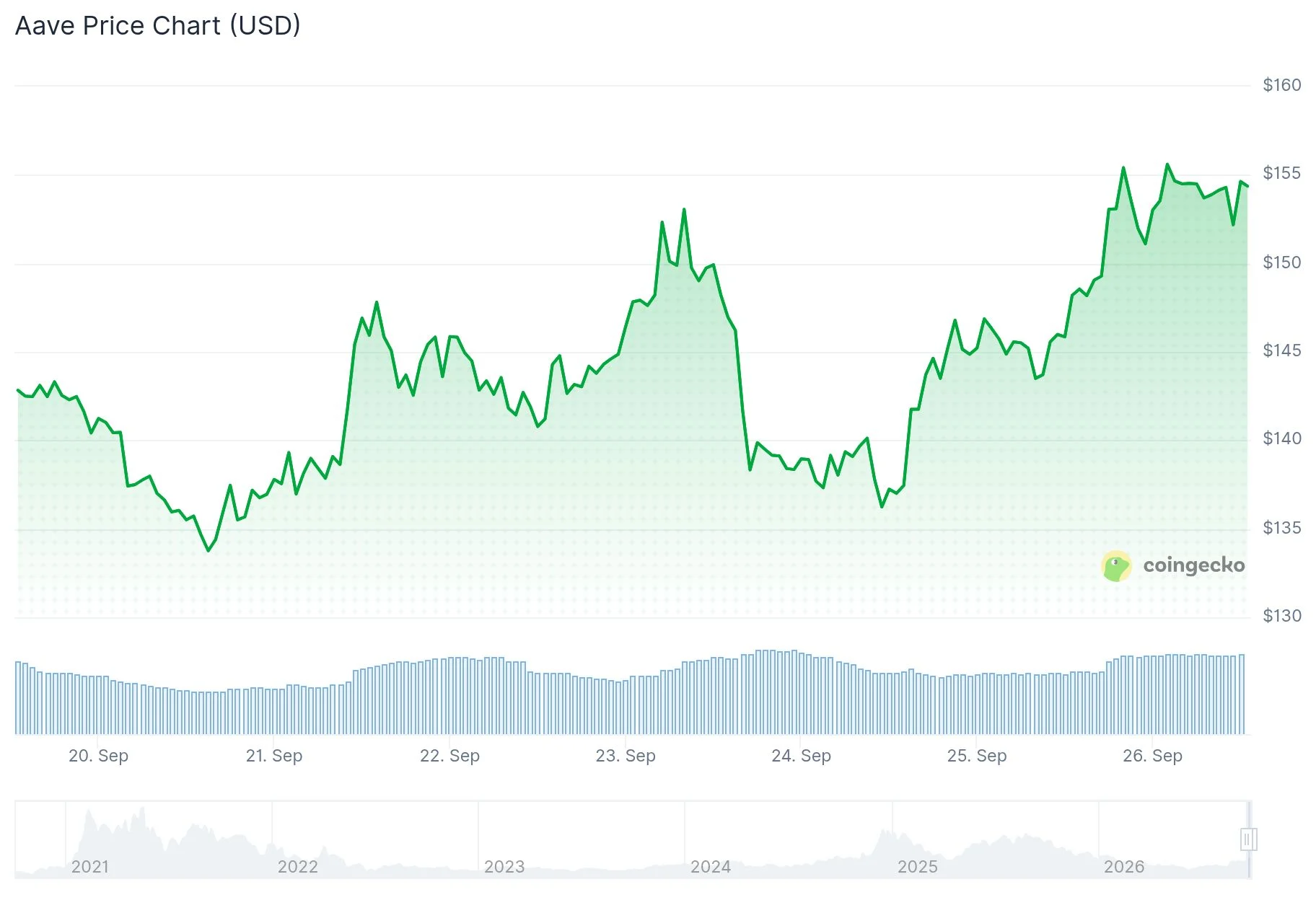
The immediate market reaction to this news was a testament to its perceived significance. AAVE, Aave’s native governance token, experienced a notable price appreciation exceeding 7%. The token touched an intraday high of $150.14 before consolidating around $147.41. This positive price movement reflects investor confidence in Aave’s continued innovation and its ability to capture new market segments through strategic integrations like the Equities Hub. The market’s positive sentiment suggests that this initiative is viewed as a substantial growth driver for the Aave ecosystem, potentially increasing its Total Value Locked (TVL) and cementing its leadership in the RWA space.
While the Equities Hub is operational, its full market activation on Base awaits final governance authorization from the Aave decentralized autonomous organization (DAO). Aave’s formal approval pathway is a multi-step process, embodying its commitment to decentralized decision-making. It typically involves an initial off-chain Snapshot poll, where community members signal their preliminary support for proposals. If the Snapshot poll passes, it is followed by a binding on-chain vote, where AAVE token holders formally approve or reject the proposal using their voting power. This rigorous governance process ensures that major protocol changes are aligned with the community’s consensus and undergo thorough scrutiny before full implementation.
Broader Implications and Future Outlook
The launch of Aave’s Equities Hub represents a monumental stride towards bridging the chasm between traditional finance (TradFi) and decentralized finance (DeFi). By integrating highly liquid, tokenized versions of blue-chip equities into a leading DeFi lending protocol, Aave is creating a seamless pathway for TradFi assets to gain new utility within the blockchain ecosystem. This convergence has the potential to attract a new wave of institutional and sophisticated investors who may have previously been hesitant to engage with DeFi due to its perceived volatility or lack of familiar asset classes. It signals a maturation of the DeFi landscape, moving beyond purely crypto-native assets to embrace a broader universe of financial instruments.
One of the most significant implications is the enhanced liquidity and capital efficiency this offers. Trillions of dollars are locked in traditional equity markets. By tokenizing these assets and making them available as collateral in DeFi, Aave is unlocking dormant capital, allowing investors to leverage their holdings without incurring capital gains taxes from selling, or losing out on potential future appreciation. This ability to maintain equity exposure while accessing instant, permissionless liquidity is a powerful proposition that could redefine how investors manage their portfolios.
However, this integration also introduces a new layer of risk and regulatory challenges. While the tokenized assets are backed by real shares, the interaction with a decentralized, permissionless protocol raises questions about compliance, market manipulation, and consumer protection across different jurisdictions. The current geographic restrictions highlight these complexities. Future expansion will undoubtedly require careful navigation of global securities laws, anti-money laundering (AML) regulations, and know-your-customer (KYC) requirements. The interplay between traditional market hours and 24/7 DeFi operations also presents unique risk management considerations, particularly during periods when underlying equity markets are closed but the lending protocol remains active.
Despite these challenges, the innovation in financial primitives offered by the Equities Hub is undeniable. It showcases how blockchain technology can create entirely new use cases for existing assets, fostering greater financial inclusion and flexibility. This development positions Aave and Base at the forefront of the tokenized RWA movement, potentially inspiring other DeFi protocols to explore similar integrations and further accelerating the mainstream adoption of decentralized finance.
From a technical analysis perspective, AAVE’s recent performance has been strong, confirming the positive market sentiment. The token’s ability to maintain positioning above its Supertrend indicator at $117.29 suggests a sustained bullish trend. While facing immediate resistance near $155.43, the establishment of immediate support at $134.56 indicates a healthy consolidation phase after the initial surge. Should AAVE successfully break past the $155.43 resistance, it could signal further upward momentum, reflecting continued investor confidence in Aave’s strategic direction and the success of its new initiatives.
In conclusion, Aave’s introduction of the Equities Hub on Base is a landmark event that pushes the boundaries of decentralized finance. By enabling USDC loans against tokenized Coinbase equities, Aave is not only expanding the utility of digital assets but also building crucial bridges between the established financial world and the burgeoning DeFi ecosystem. This move signifies a major step towards a future where traditional assets seamlessly integrate with blockchain technology, unlocking unprecedented liquidity, capital efficiency, and innovative financial opportunities for a global investor base, albeit under carefully managed regulatory and risk frameworks.














