


Ethereum (ETH), the second-largest cryptocurrency by market capitalization, experienced a period of subdued trading on Friday, largely mirroring its performance over the preceding week with only modest gains. This period of relative price stability has coincided with a notable shift in the supply dynamics of ETH, as over 116,000 tokens, valued at approximately $300 million at current market rates, were withdrawn from cryptocurrency exchanges within a 48-hour span. This significant outflow has drawn considerable attention from market observers and analysts, prompting discussions about its potential implications for Ethereum’s price trajectory.
The trend of decreasing exchange reserves is a closely watched indicator within the cryptocurrency market. A sustained reduction in the amount of ETH readily available on exchanges can theoretically decrease the immediate selling pressure, potentially creating a more favorable environment for price appreciation. While not a definitive predictor of upward movement, the sheer volume of these recent withdrawals, particularly in conjunction with Ethereum’s current trading pattern, has fueled speculation about a potential breakout.
Key Price Levels and Analyst Outlooks
Crypto analyst Ali Martinez highlighted that Ethereum has been trading within a narrow consolidation range, oscillating between approximately $2,370 and $2,530 since August 26th. Martinez suggests that a clearer indication of Ethereum’s next significant price movement will emerge once the cryptocurrency achieves a sustained hourly close outside of this established band. He further posited that a decisive breach above the $2,530 mark could bolster a bullish outlook, potentially propelling Ethereum towards the $2,700 level. The confluence of this compressed price action and the observed decline in exchange balances could serve as a potent catalyst for upward momentum, provided that buying pressure intensifies.

Complementing this perspective, analyst Daan Crypto Trades observed that Ethereum has maintained its position just above its previous breakout point for nearly three weeks, exhibiting trading within a confined range. This prolonged period of price compression, according to Trades, often precedes a more substantial price movement, drawing a parallel to the initial breakout that initiated the current consolidation phase. He identified the area around $2,350 as a critical support level for Ethereum bulls. Maintaining this zone would preserve the current technical structure, whereas a dip below it could trigger a liquidity sweep before a potential return to the broader trading range.
Further analysis from Daan Crypto Trades pointed to $2,550 as another pivotal level to monitor. This price point has consistently acted as a ceiling, limiting Ethereum’s advances. A decisive move beyond this resistance, he noted, would be significant in determining whether ETH can establish a more robust uptrend.
In a similar vein, analyst Michaël van de Poppe also expressed optimism regarding Ethereum’s potential for substantial upside gains, contingent on its ability to defend key support levels. He specifically highlighted the $2,520 area, suggesting that a successful breakthrough here could pave the way for prices to approach the $3,000 mark.
Long-Term Bullish Sentiment and Broader Market Context
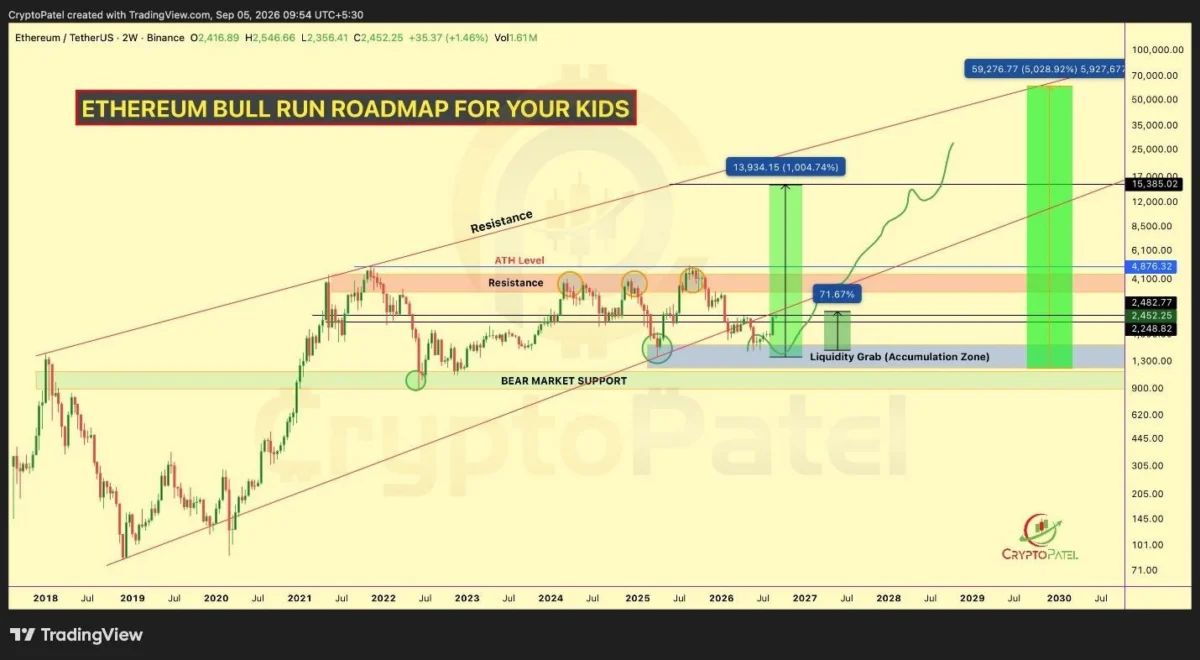
Beyond the immediate price action, a more expansive long-term bullish perspective was articulated by analyst Crypto Patel. Patel contends that Ethereum’s broader trajectory could extend significantly beyond $15,000. He views substantial price dips not as reasons for long-term holders to lose conviction, but rather as strategic accumulation opportunities. This sentiment underscores a belief in the fundamental growth and adoption of Ethereum’s ecosystem over an extended period.

The Bybit Hack and its Potential Influence
While the current analysis focuses on market dynamics, it is crucial to acknowledge broader events that can impact the cryptocurrency landscape. Although not directly linked to the recent exchange outflows, the memory of significant security breaches in the crypto space remains a salient concern. For instance, the devastating hack of Bybit, a major cryptocurrency exchange, reportedly resulted in losses exceeding $1.5 billion. Such events, even if distinct from current trading patterns, contribute to an underlying market consciousness regarding security and the potential for unforeseen disruptions. While the current article does not directly link the exchange outflows to a specific security event or suggest a rollback, the broader implications of such large-scale withdrawals can be amplified by the collective awareness of past vulnerabilities within the industry. The magnitude of the Bybit hack, in particular, serves as a stark reminder of the risks inherent in centralized cryptocurrency platforms and the potential impact on market sentiment and regulatory scrutiny.
Analyzing the Implications of Exchange Outflows
The substantial withdrawal of over $300 million worth of ETH from exchanges represents a significant reduction in readily available supply. This phenomenon can be interpreted in several ways. Firstly, it may indicate that a growing number of investors are opting for self-custody, moving their assets to personal wallets for long-term holding or to participate in decentralized finance (DeFi) protocols. This shift towards holding ETH outside of centralized exchanges can diminish the immediate selling pressure that can often influence short-term price fluctuations.
Secondly, such outflows can be driven by anticipation of future price appreciation. Investors who believe in Ethereum’s long-term potential may be strategically reducing their exchange balances to lock in their holdings, expecting them to grow in value. This behavior, when widespread, can create a self-reinforcing cycle, where reduced supply meets sustained or increased demand, leading to upward price pressure.
However, it is also important to consider that exchange outflows do not exclusively translate to bullish sentiment. Some investors might withdraw funds to participate in staking or other yield-generating activities on the Ethereum network. Nevertheless, the sheer volume of the recent withdrawals, coupled with the observed price consolidation, has positioned these outflows as a potentially significant factor influencing market sentiment.

Technical Analysis and Market Structure
From a technical analysis standpoint, Ethereum’s prolonged consolidation within the $2,370 to $2,530 range suggests a period of indecision in the market. This phase often occurs after significant price movements as traders and investors assess the next direction. The fact that ETH has remained above its crucial support levels, particularly around $2,350 as identified by Daan Crypto Trades, indicates resilience.
The $2,520 to $2,550 resistance zone is now a critical area to watch. A decisive breakout above this level would signal a potential shift in momentum and could lead to a retest of higher price targets. Conversely, a failure to break through this resistance, coupled with increased selling pressure, could lead to a short-term correction, potentially retesting the lower bounds of the consolidation range.
The broader market context also plays a role. The overall sentiment in the cryptocurrency market, influenced by macroeconomic factors, regulatory developments, and the performance of Bitcoin, can significantly impact Ethereum’s price action. As of this report, ETH was trading at $2,436, reflecting a 2.89% decrease over the preceding 24 hours. This indicates that while the exchange outflows suggest potential bullish undercurrents, the market is still navigating short-term price fluctuations.
Future Outlook and Investor Strategy
The coming days and weeks will be crucial in determining Ethereum’s next significant move. The interplay between the reduced exchange supply and the market’s reaction around the key resistance levels of $2,520 to $2,550 will be paramount. Investors and traders will be closely observing whether increased buying pressure can overcome these resistance points, leading to a sustained uptrend.

The long-term bullish outlook, as espoused by analysts like Crypto Patel, suggests that any short-term price dips could be viewed as opportunities for accumulation by those with a conviction in Ethereum’s future growth. This perspective aligns with the idea that the underlying technology and adoption of the Ethereum network continue to strengthen, providing a solid foundation for long-term value appreciation.
In conclusion, Ethereum’s current market position is characterized by a delicate balance between price consolidation, significant exchange outflows, and diverse analyst outlooks. The substantial reduction in available ETH on exchanges, coupled with the technical observation of a prolonged price compression, suggests that the cryptocurrency may be poised for a notable price movement. The key will be the market’s ability to break through established resistance levels, with the $2,520 to $2,550 zone serving as the immediate hurdle. While short-term price action remains subject to market volatility, the underlying sentiment among many analysts and long-term holders points towards a potentially optimistic future for Ethereum.














