


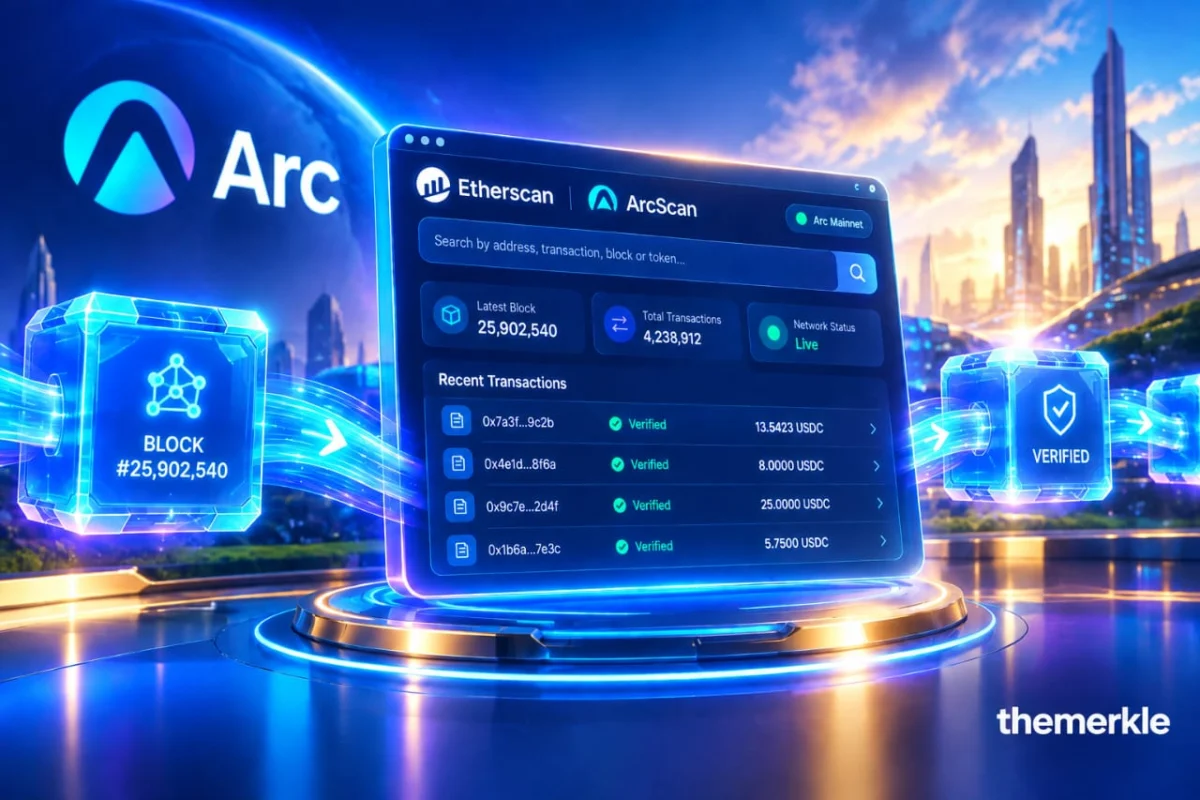
The immediate launch of ArcScan by Etherscan, coinciding precisely with the public debut of Circle’s new Arc blockchain on September 16, 2026, initially appeared to be a standard infrastructure update, a technical footnote easily overlooked amidst the fanfare of a new Layer 1 network. However, a deeper examination reveals that this synchronized rollout of a dedicated block explorer represents a highly deliberate and strategically significant maneuver, positioning Arc not as another speculative blockchain, but as a meticulously auditable and transparent payment rail from its inception. This seemingly minor detail, often dismissed as mere "filler news" in the fast-paced blockchain world, carries profound implications for Arc’s credibility, its intended enterprise adoption, and the evolving landscape of trust in decentralized finance.
The Strategic Significance of a Simultaneous Explorer Launch
In the nascent and often chaotic environment of blockchain innovation, the launch of a new Layer 1 network typically involves a scramble to establish foundational infrastructure. Block explorers, while critical for transparency and user interaction, frequently arrive weeks or even months after a mainnet launch. This delay often forces early adopters and developers to rely on a patchwork of unofficial tools, or navigate a landscape devoid of clear, verifiable transaction data. Arc, by contrast, circumvented this common pitfall entirely. The availability of ArcScan at arc.etherscan.io, live on the very day Arc went public, signals a fundamental difference in strategic intent. It means that from its very first block, Arc was designed to be explainable, verifiable, and transparent – a stark contrast to the typical "build it and they will come" approach prevalent in the industry.
This immediate readiness for public scrutiny is not merely a technical achievement; it is a powerful statement about Arc’s core purpose. For a blockchain explicitly positioned as a payment rail, rather than a decentralized application platform or a hub for speculative trading, the ability to audit every transaction from day one is paramount. Trust in a payment system hinges on verifiability, ensuring that funds move as intended and that all participants can independently confirm the integrity of transactions. By integrating Etherscan’s renowned infrastructure from the outset, Circle underscored its commitment to this principle, establishing a robust foundation for the kind of transparency that traditional financial systems demand and that enterprise users require.
Circle’s Arc Blockchain: A New Paradigm for Digital Payments
Arc is not just another entrant in the crowded field of Layer 1 blockchains. It is Circle’s proprietary network, a move by one of the most significant stablecoin issuers to control more of the underlying infrastructure for digital value transfer. Circle, the issuer of USDC, the second-largest stablecoin by market capitalization, has long been at the forefront of bridging traditional finance with blockchain technology. USDC, a dollar-pegged stablecoin, is a critical component of the crypto economy, facilitating billions of dollars in daily transactions across various networks. Arc’s design explicitly leverages this established ecosystem by allowing gas fees to be paid in USDC itself, rather than requiring a separate native token. This design choice simplifies the user experience, reduces friction, and aligns directly with Arc’s positioning as a stable, predictable platform for payments and financial applications.
The integration of established DeFi protocols, such as Uniswap v4, directly onto Arc at launch further reinforces its ambition as a serious financial infrastructure. Uniswap, as a leading decentralized exchange, brings liquidity and functionality essential for any robust financial ecosystem. By building Arc around these proven components and ensuring a stable, USDC-denominated fee structure, Circle is clearly aiming to attract institutional players and businesses seeking reliable, scalable, and cost-effective solutions for on-chain payments and financial services. The challenge for many new blockchains lies in achieving broad adoption and demonstrating tangible utility beyond speculative trading. Arc’s strategy, anchored in immediate auditability and a focus on real-world payment volume, aims to address this head-on.
Etherscan’s Role as a Pillar of Trust in the Blockchain Ecosystem
The choice of Etherscan as the provider for ArcScan is equally critical. Etherscan is not merely a block explorer; it is the de facto standard for transparency and trust on the Ethereum network. Since its inception, Etherscan has provided an indispensable public utility, allowing users to track transactions, verify smart contracts, and monitor wallet addresses with unparalleled detail and reliability. Its reputation for accuracy, uptime, and comprehensive data has made it an essential tool for developers, users, and auditors alike.
By extending its services to Arc on day one, Etherscan effectively transfers a significant portion of its established credibility and operational excellence to Circle’s new chain. This "credibility transfer" is invaluable for a nascent blockchain. Instead of having to build trust from scratch with an unknown, untested explorer, Arc immediately benefits from Etherscan’s proven track record. For institutions and enterprises, which operate under strict regulatory and compliance frameworks, the association with a trusted, established entity like Etherscan is a powerful endorsement. It provides an immediate level of assurance regarding data integrity and the verifiable nature of on-chain activity, which is crucial for fostering confidence in a new financial infrastructure. This strategic partnership underscores a shared understanding between Circle and Etherscan that for a payment-focused blockchain, trust infrastructure is not an add-on but a fundamental product feature.
Addressing the "Explorer Problem" in Blockchain Launches
The typical launch trajectory for new blockchains often creates a significant "explorer problem." Without an official, reliable block explorer available from the outset, users face a myriad of challenges. Verifying the legitimacy of smart contract addresses becomes difficult, leading to potential phishing scams where malicious actors deploy contracts with similar names or functions. Confirming whether a transaction has successfully cleared, or if a token being viewed is the genuine article versus a cleverly designed impersonator, becomes a guessing game. This vacuum of official information is frequently filled by unofficial tools, often of wildly varying quality, accuracy, and security. The resulting confusion can plague a chain’s ecosystem for months, eroding user confidence and hindering organic growth. Cleaning up this data clutter and misinformation is a resource-intensive and often thankless task.

Arc’s approach fundamentally sidesteps this entire phase of uncertainty. By launching ArcScan concurrently with its mainnet, Circle provided immediate clarity and a single source of truth for all on-chain data. This proactive measure ensures that developers, users, and auditors have access to consistent, reliable information from the very first block, fostering a healthier and more secure ecosystem from day one. This pre-emptive strike against data fragmentation and misinformation is a testament to Arc’s commitment to creating a stable and secure environment for its intended use cases.
Proactive Ecosystem Management: The Priority Support Window
Further demonstrating the deliberate and meticulously planned rollout, Etherscan announced a free priority support window for developers submitting token information updates on ArcScan, running through September 30, 2026, just days after the mainnet launch. This initiative, while appearing as a courtesy, is a highly strategic response to another common challenge faced by new blockchain ecosystems: the influx of new projects and tokens all vying for visibility and accurate representation on the block explorer.
In the absence of such a structured process, new explorers often become overwhelmed with submission requests. This can lead to a backlog of unverified, mislabeled, or even outright fraudulent token entries, further contributing to the confusion that plagues nascent chains. The priority support window on ArcScan is designed to streamline this process, allowing legitimate projects to quickly and accurately list their token information. This proactive measure is critical for maintaining data cleanliness and integrity within Arc’s ecosystem during its crucial initial weeks. It ensures that the explorer remains a reliable source of information, rather than becoming cluttered with dubious entries that could mislead users and undermine trust.
Guardrails for Trust: Accuracy and Verification
The conditions attached to Etherscan’s priority support window are particularly revealing about the underlying commitment to data integrity. Submissions remain subject to rigorous project review and eligibility criteria. Priority processing merely accelerates a submission through the queue; it does not guarantee verification, ranking, or automatic approval. Crucially, every label and piece of metadata submitted must be factually accurate. This last requirement is the most significant "tell" regarding the seriousness of this initiative.
Many token scams exploit the early, unregulated environment of new blockchains by submitting misleading names, inaccurate symbols, or false descriptions to block explorers. By drawing a hard line on factual accuracy, even while offering expedited processing, Etherscan and Circle are implementing vital guardrails. This approach ensures that speed is coupled with discipline. Without such stringent checks, a "free priority window" could easily become a liability, inadvertently facilitating the spread of misinformation or aiding malicious actors. Instead, it transforms into a powerful asset, actively curating a trustworthy data environment that is essential for a blockchain aiming to serve as reliable payment infrastructure. This emphasis on accuracy and verification underscores a maturity in design and execution that is often lacking in the early stages of blockchain projects.
Broader Implications for Enterprise Blockchain Adoption
Arc’s strategy, centered on immediate auditability, a trusted explorer, and proactive data management, holds significant implications for the broader landscape of enterprise blockchain adoption. For years, financial institutions and large corporations have expressed keen interest in blockchain technology’s potential for efficiency, transparency, and cost reduction. However, a major impediment to widespread adoption has been the perceived lack of regulatory clarity, security, and auditable infrastructure. Many existing public blockchains, while robust for their intended purposes, often present complexities that deter highly regulated entities, particularly concerning data provenance and transaction finality.
Arc’s design, with its USDC-based gas fees and immediate Etherscan integration, directly addresses many of these concerns. By building a chain that is "auditor-first," Circle is creating a compelling proposition for enterprises that require verifiable transaction histories, predictable operational costs, and a clear path to compliance. The ability to demonstrate transparent operations from day one is a powerful incentive for businesses operating in sectors like remittances, supply chain finance, and inter-company payments, where traceability and accountability are paramount. This approach could accelerate the shift from experimental blockchain pilots to genuine production deployments within the enterprise sector, potentially setting a new standard for how financial-grade blockchains are launched and managed.
The Future Landscape of Auditable Blockchains
The meticulous sequencing of Arc’s mainnet launch, the simultaneous deployment of ArcScan, and the subsequent implementation of an accuracy-gated developer support process indicates a long-term vision. This is not the behavior of a project rushing to capture fleeting attention before market excitement wanes. Instead, it reflects a deep-seated commitment to building robust, sustainable infrastructure that is prepared for intense scrutiny and significant transaction volume.
As the blockchain industry matures, the emphasis is increasingly shifting from raw innovation to reliability, security, and regulatory compliance. Chains that prioritize these aspects from their inception are likely to gain a competitive advantage, especially in areas that intersect with traditional finance. Arc, through its strategic partnership with Etherscan and its auditor-first design, is positioning itself at the forefront of this evolution. The seemingly small operational detail of a day-one block explorer launch quietly signals a much larger ambition: to build a foundational layer for digital payments that meets the exacting standards of the global financial system. This commitment to transparency and verifiable operations from the very first block could very well define the trajectory of enterprise blockchain solutions for years to come.














