


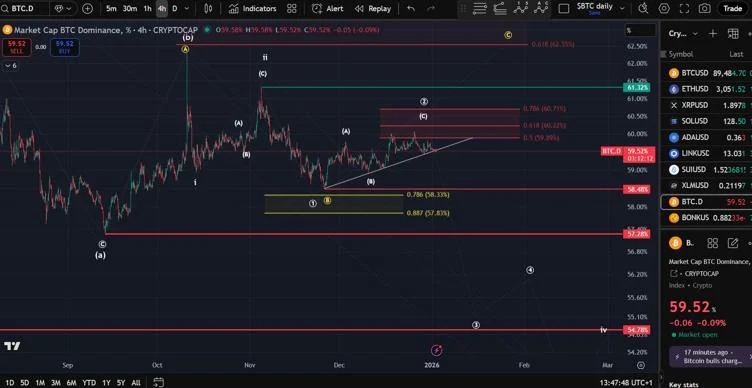
The digital asset market is currently witnessing a significant transformation in capital distribution as Bitcoin, the world’s largest cryptocurrency by market capitalization, struggles to maintain its upward trajectory above critical psychological and technical levels. Recent data and market observations indicate that Bitcoin’s failure to solidify its position above the $90,000 threshold has led to a breach of a long-standing trendline, a development that many analysts believe marks the beginning of a broader market rotation. Market analyst Justcryptopays recently highlighted that this technical breakdown may be the catalyst required for "altcoin season," a period characterized by alternative digital assets outperforming Bitcoin. As the market transitions into the early stages of 2026, the focus is shifting from Bitcoin’s dominance toward the potential of Ethereum, Solana, and other prominent altcoins to capture the next wave of investor liquidity.
The Technical Breakdown: Bitcoin’s Struggle at the $90,000 Mark
For much of the latter half of 2025, Bitcoin acted as the primary engine for the cryptocurrency market, drawing in the vast majority of institutional and retail capital. However, as the asset approached the $90,000 level, it encountered significant selling pressure and a lack of fresh momentum to push toward the elusive $100,000 milestone. Bitcoin is currently trading at approximately $90,525, but its inability to hold support above the key trendline that has guided its price action for months suggests a waning of the "bull run" intensity that defined the previous year.
Technical analysts point to the "break and retest" phenomenon, where an asset falls below a support line and fails to reclaim it, often signaling a change in the prevailing trend. For Bitcoin, this trendline breach is more than just a price correction; it represents a shift in market psychology. When the benchmark asset stagnates or shows signs of volatility, investors often seek higher returns in assets with lower market caps, which possess higher sensitivity to capital inflows. This migration of value is the fundamental driver of the rotation currently being observed across major exchanges.
A Chronology of Market Dynamics: From the 2025 Bearish Momentum to 2026 Recovery
The current market environment cannot be fully understood without examining the events of 2025. Following a period of rapid expansion, the cryptocurrency market faced a series of headwinds throughout 2025, including macroeconomic tightening by central banks and increased regulatory scrutiny in several Tier-1 jurisdictions. This led to a "bearish momentum" that saw many altcoins lose significant value relative to Bitcoin, which benefited from a "flight to quality" among investors.
- Q1-Q2 2025: High interest rates and inflation concerns led to a contraction in speculative assets. Bitcoin remained resilient, but the broader altcoin market suffered from a lack of liquidity.
- Q3-Q4 2025: Bitcoin dominance rose to multi-year highs as institutional investors utilized Spot ETFs to hedge against traditional market volatility. Altcoins remained largely stagnant, testing multi-year lows against their BTC trading pairs.
- January 2026: As the new year commenced, Bitcoin’s momentum began to plateau. The breach of the primary trendline in early January signaled that the "Bitcoin-only" phase of the cycle might be reaching exhaustion.
- Current Status: Capital is now flowing into "Large Cap" altcoins, with Ethereum and Solana leading the charge. This rotation is viewed as a necessary evolution for the market to achieve a more balanced and healthy distribution of wealth.
The Mechanics of Capital Rotation and the Altcoin Awakening
Capital rotation in the cryptocurrency space typically follows a specific hierarchy. Liquidity usually flows from Bitcoin into Ethereum, then into other high-market-cap assets like Solana (SOL), XRP, and Cardano (ADA), before eventually trickling down into mid-cap tokens and memecoins. This "waterfall effect" is currently in its early stages.

The primary beneficiary of this shift has historically been Ethereum (ETH). As the foundational layer for the majority of decentralized finance (DeFi) and non-fungible token (NFT) ecosystems, Ethereum’s performance is often seen as a bellwether for the rest of the altcoin market. Recent movements suggest that Ether is beginning to shake off the bearish sentiment of 2025, with increased trading volume indicating that whales—large-scale investors—are reallocating their Bitcoin profits into ETH.
Furthermore, Solana has maintained its position as a high-speed alternative to Ethereum, attracting significant developer activity and retail interest. The "altcoin resurgence" is not limited to utility-based tokens; even XRP and Cardano are seeing renewed interest as investors look for "laggards"—assets that have not yet experienced the significant gains seen by Bitcoin in 2024 and 2025.
Supporting Data: Volume and Dominance Metrics
The shift in market dynamics is supported by several key data points. Bitcoin Dominance (BTC.D), a metric that measures Bitcoin’s share of the total cryptocurrency market cap, has begun to show signs of a "double top" pattern on the weekly charts. Traditionally, a decline in BTC.D coincides with a surge in altcoin valuations.
Additionally, exchange flow data indicates a decrease in Bitcoin deposits and an increase in stablecoin inflows to altcoin trading pairs. According to on-chain analytics, the "Altcoin Season Index" has moved from a "Bitcoin Year" toward a neutral zone, suggesting that the market is on the cusp of a full-blown altcoin rally. Trading volumes for top-tier altcoins have seen a 15-20% uptick over the last fourteen days, even as Bitcoin’s volume remains relatively flat or slightly declining. This divergence is a classic indicator that the market is preparing for a "regime change."
Market Reactions and Analyst Perspectives
The sentiment among market participants is one of cautious optimism. While the breach of Bitcoin’s trendline could be interpreted as a negative signal for the entire market, seasoned traders view it as a healthy distribution phase.
"The rotation we are seeing is a textbook example of market maturity," stated one senior analyst at a leading digital asset hedge fund. "Bitcoin has done the heavy lifting of breaking through psychological barriers and bringing institutional eyes to the space. Now, the market is looking for the next growth narrative, which is likely to be found in the scalability of Solana or the institutional adoption of Ethereum’s Layer-2 solutions."
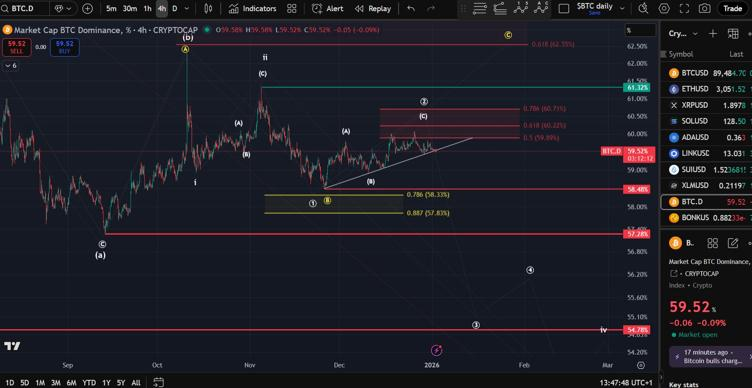
Justcryptopays and other independent analysts suggest that the $90,000 level for Bitcoin will act as a "pivot point." If Bitcoin remains below this level but stays above $85,000, it creates a "sideways" environment. This lack of volatility in Bitcoin is often the "goldilocks zone" for altcoins, as it allows investors to move capital into higher-risk assets without the fear of a sudden Bitcoin crash dragging the entire market down.
Broader Implications and the Path Ahead for 2026
The potential for an altcoin resurgence in 2026 carries significant implications for the broader blockchain industry. A thriving altcoin market typically correlates with increased activity in the DeFi and Web3 sectors. As capital flows into these ecosystems, decentralized applications (dApps) receive more usage, leading to higher protocol revenues and further innovation.
However, the challenge for the "bulls" remains the lingering bearish sentiment from 2025. Many altcoins are still trading significantly below their all-time highs, and a large number of "bag holders"—investors who bought at the peak—may look to exit their positions as prices rise, creating overhead resistance. For a sustained altcoin season to occur, these assets must not only attract new capital but also overcome the technical hurdles left behind by the previous year’s downturn.
As 2026 progresses, the market will likely become more bifurcated. Investors are expected to become more discerning, favoring projects with actual utility, revenue generation, and strong regulatory compliance over purely speculative tokens. This "flight to quality" within the altcoin sector will distinguish the current cycle from the speculative manias of the past.
In conclusion, the breach of Bitcoin’s key trendline and its struggle to maintain the $90,000 level are not necessarily signs of a market collapse, but rather a realignment of investor priorities. With capital rotating into established and emerging digital assets, the stage is set for a more balanced market environment. Vigilant investors will be watching the Bitcoin Dominance index and the performance of major altcoins in the coming weeks to confirm whether the long-awaited "alt-season" has finally arrived or if the market requires further consolidation before its next major move.














