



The cryptocurrency market has witnessed a significant reshuffling of its top-tier assets in recent months, with BNB reclaiming its position as a dominant force among large-cap altcoins. After successfully overtaking XRP in market capitalization during May, the native token of the BNB Chain ecosystem is now facing intense scrutiny regarding its long-term valuation potential. While some market participants have floated ambitious price targets ranging from $10,000 to $20,000, a comprehensive analysis of market dynamics, circulating supply, and global liquidity suggests that such milestones would require a fundamental transformation of the entire digital asset landscape.
As the industry matures, the debate surrounding BNB has shifted from simple price speculation to a more complex evaluation of its utility as both an exchange-utility token and the primary gas asset for a major Layer-1 blockchain. Current data places BNB as the fourth-largest cryptocurrency by market capitalization, trailing only Bitcoin, Ethereum, and the stablecoin USDT. However, the path toward a five-figure valuation is paved with significant mathematical and structural hurdles that demand a realistic assessment of the global financial ecosystem.
The Mathematical Reality of the Ten Thousand Dollar Milestone
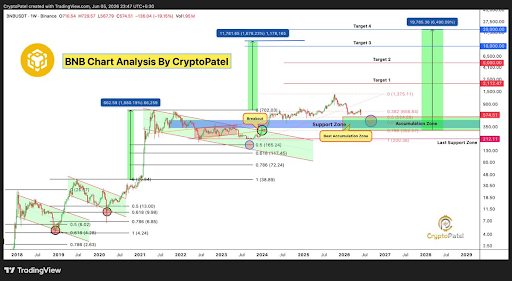
The primary challenge for any asset aiming for a massive price increase is the corresponding expansion of its market capitalization. For BNB to reach a price of $10,000, the total value of all tokens in circulation would need to reach a scale that currently rivals the world’s most established financial assets. Popular crypto analyst Crypto Patel recently highlighted this discrepancy, noting that at a $10,000 price point, BNB would command a market capitalization of approximately $1 trillion, assuming the supply continues its downward trajectory toward the 100 million token target.
To put this in perspective, a $1 trillion valuation would make BNB roughly equivalent to the entire market capitalization of Bitcoin at various points in its recent history. It would also place the token in the same league as global tech giants like Meta or NVIDIA. The leap from its current market cap of approximately $80.6 billion to $1 trillion represents a more than 1,200% increase, a feat that would require massive institutional inflows and a significant expansion of the total crypto market cap, which currently fluctuates between $2 trillion and $2.5 trillion.

The analysis becomes even more speculative when discussing a $20,000 price target. At that level, a single asset—BNB—would be worth approximately $2 trillion. This figure is nearly equal to the combined value of all existing cryptocurrencies today. As Crypto Patel noted, targets in this range are often the product of marketing rather than sober financial analysis, at least within the current market cycle. For such valuations to become even remotely plausible, the total cryptocurrency market would likely need to exceed $10 trillion to $15 trillion in total value.
Supply Dynamics and the Role of the Burn Mechanism
One of the unique drivers of BNB’s value is its aggressive deflationary mechanism. Unlike many other digital assets with inflationary tail emissions, BNB utilizes a "Real-Time Burn" and a "Quarterly Auto-Burn" system designed to reduce the total supply to 100 million tokens. This programmatic scarcity is a central pillar of the bull case for the asset.
The Auto-Burn mechanism uses a formula based on the price of BNB and the number of blocks produced on the BNB Chain during the quarter. This ensures that the burn remains transparent and predictable, independent of the Binance centralized exchange’s daily trading volume. By reducing the denominator (total supply), the protocol theoretically increases the value of each remaining token, provided demand remains constant or grows.
However, even with a reduced supply of 100 million tokens, the $10,000 target remains a "trillion-dollar question." The timeline for reaching the 100-million-token goal is expected to take several more years, meaning the price appreciation would need to outpace the rate of supply contraction significantly to hit those high-level targets within the current decade.
The Competitive Landscape: Overtaking XRP and Challenging Ethereum
The recent "flippening" of XRP by BNB marked a significant psychological victory for the BNB Chain community. While XRP has been mired in long-standing legal battles with the U.S. Securities and Exchange Commission (SEC), BNB has managed to maintain its utility and network activity. The gap between the two assets has widened since mid-May, solidifying BNB’s hold on the number four spot.

The next major hurdle is Ethereum. For BNB to overtake Ethereum and become the world’s leading altcoin, it would need to close a substantial valuation gap. At current market rates, BNB would need to reach a price of approximately $1,500 to match Ethereum’s current market capitalization of roughly $203 billion. While $1,500 is within striking distance of BNB’s projected all-time high zones, this comparison assumes that Ethereum’s price remains stagnant.
In a traditional bull market, Ethereum and BNB often move in tandem. Therefore, for BNB to "flip" Ethereum, it would need to demonstrate significant "alpha"—outperforming Ethereum’s growth by a wide margin. This could potentially occur through a massive migration of decentralized finance (DeFi) activity to the BNB Chain or a surge in institutional adoption through potential exchange-traded fund (ETF) products.
Institutional Interest and the Regulatory Horizon
A critical factor in BNB’s future price action is the evolving landscape of institutional investment. Recent filings and amendments by major asset managers like Grayscale and VanEck regarding various altcoin ETFs have sparked rumors that a BNB-based investment product could eventually reach the market. An ETF would provide a regulated pathway for institutional capital to enter the BNB ecosystem, potentially providing the liquidity needed to push the asset toward the $2,000 and $3,000 range.
However, the "Binance concentration risk" remains a primary concern for both regulators and large-scale investors. Unlike Ethereum, which is widely considered decentralized, the value of BNB is intrinsically linked to the health and reputation of the Binance exchange. The burn mechanism, exchange fee utility, and on-chain governance are all heavily influenced by the Binance ecosystem.
Historical events have shown that legal or regulatory pressure on Binance directly impacts BNB’s price. The settlement between Binance and the U.S. Department of Justice, which resulted in a multi-billion dollar fine and a change in leadership, was a significant stress test for the asset. While BNB proved resilient, any future regulatory challenges against the exchange would likely serve as a ceiling for the token’s price, preventing it from reaching the $10,000 stratosphere in the near term.
Ecosystem Growth: RWAs and Stablecoin Dominance
Beyond the exchange, the BNB Chain is positioning itself as a hub for Real World Assets (RWAs) and stablecoin transactions. Recent reports indicate that the total value of RWAs on the BNB Chain has hit $3 billion, reflecting a growing trend of tokenizing traditional financial instruments like treasury bills and real estate.
Furthermore, the BNB Chain continues to dominate global stablecoin transactions, often outpacing other networks in terms of daily active addresses and transaction frequency for assets like USDT and USDC. This high level of network utility provides a fundamental floor for the asset’s value. If the BNB Chain can successfully capture a larger share of the burgeoning RWA market, the demand for BNB as a gas token could provide the necessary momentum to reach the "believable" bull case of $3,000.
Chronology of BNB’s Market Evolution
To understand the current trajectory, it is essential to look at the timeline of BNB’s development:
- 2017: BNB launches via an Initial Coin Offering (ICO) as an ERC-20 token on the Ethereum network, primarily used for fee discounts on the Binance exchange.
- 2019: The launch of Binance Chain (BC) and the migration of BNB to its own native mainnet (BEP-2).
- 2020: The introduction of the Binance Smart Chain (BSC), bringing smart contract functionality and DeFi to the ecosystem.
- 2022: The rebranding of the networks to "BNB Chain," emphasizing the "Build and Build" philosophy and distancing the blockchain from the centralized exchange.
- 2023-2024: Regulatory settlements in the U.S. lead to a leadership transition from Changpeng Zhao to Richard Teng, focusing on compliance and institutional growth.
- May 2024: BNB successfully overtakes XRP in market cap, reclaiming its spot as the top non-stablecoin altcoin behind Ethereum.
Conclusion: A Realistic Path Forward
While the allure of $10,000 or $20,000 per BNB is strong for retail investors seeking life-changing returns, the economic data suggests a more measured outlook. A move toward $2,000 or $3,000 is supported by historical price action, the 100-million-token burn target, and the growth of the BNB Chain ecosystem. Reaching these levels would solidify BNB’s status as a cornerstone of the digital economy.
However, the $10,000 milestone remains a long-term vision that is contingent on the entire cryptocurrency market expanding to several times its current size. Analysts like Crypto Patel suggest that if such a scenario were to play out, it would likely not occur until 2029 or beyond, following multiple halving cycles and a total transformation of global finance. For now, the focus remains on the "battle for second place" against Ethereum and the continued expansion of utility within the BNB Chain. As the market moves forward, the success of BNB will depend on its ability to balance its ties to the world’s largest exchange with the growing need for a decentralized, high-performance blockchain infrastructure.














