


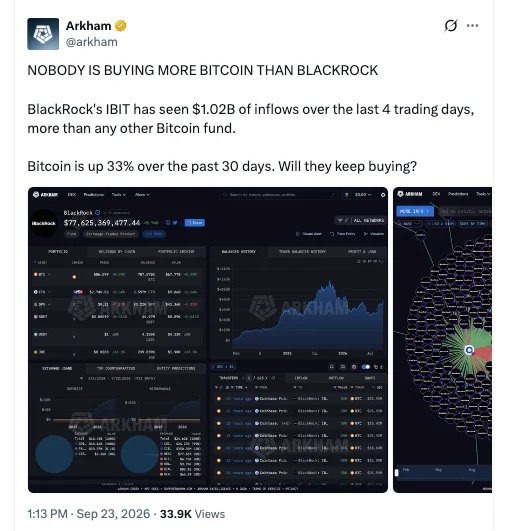
BlackRock’s iShares Bitcoin Trust (IBIT) has solidified its position as the leading institutional investment vehicle for Bitcoin, experiencing a remarkable surge of $1 billion in inflows over the past four days alone. This impressive performance has significantly outpaced other major institutional players, signaling a robust and sustained appetite for exposure to the premier cryptocurrency. The trend underscores a growing conviction among sophisticated investors that Bitcoin possesses the potential to serve as a valuable long-term store of value, a perspective echoed by prominent figures in the financial industry.
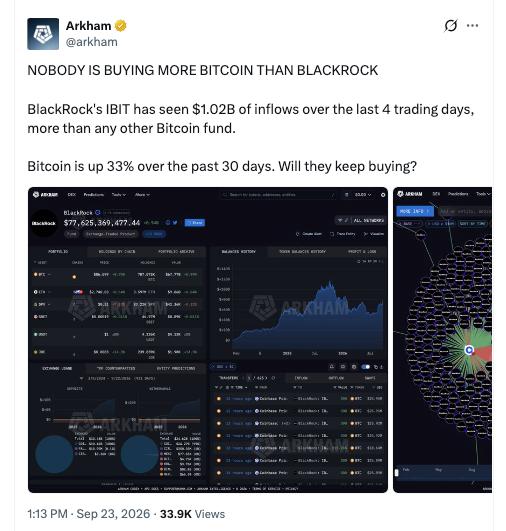
The on-chain intelligence firm Arkham recently highlighted this significant development via a post on the social media platform X (formerly Twitter), drawing attention to the sheer scale of BlackRock’s Bitcoin accumulation. This influx of capital into IBIT not only solidifies BlackRock’s dominance in the burgeoning spot Bitcoin ETF market but also reflects a broader shift in institutional sentiment towards digital assets. As of the latest reporting, BlackRock’s ETF now holds a staggering 786,360 BTC, valued at over $67 billion, with Bitcoin trading around the $85,000 mark at the time of this report. This substantial holding positions BlackRock as a formidable force in the Bitcoin ecosystem, influencing market dynamics and further legitimizing Bitcoin as an investable asset class.
IBIT’s Unprecedented Inflow Streak: A Deep Dive
The recent surge in inflows into BlackRock’s IBIT is not an isolated event but rather a continuation of a trend that has been building over the past several weeks. In the last month, Bitcoin has witnessed a healthy recovery of approximately 33%, largely propelled by this very strong institutional support. The $1 billion in just four working days marks the highest inflow volume for any ETF in over a year, underscoring the exceptional demand for Bitcoin exposure through this regulated and accessible product. While other spot Bitcoin ETFs, such as those offered by Fidelity ($14 billion in total assets), Grayscale ($10 billion), and Bitwise ($3 billion), have also attracted considerable investment, IBIT has consistently maintained its lead, demonstrating a clear preference among investors for BlackRock’s offering.
This sustained inflow momentum suggests that investors are not merely seeking short-term gains but are actively positioning themselves for long-term appreciation and hedging against potential economic uncertainties. The consistency of these inflows, even amidst market volatility, points to a strategic allocation of capital by seasoned investors who have historically favored assets with strong perceived long-term value propositions.
Investor Sentiment: A Quest for Long-Term BTC Exposure
Market observers and analysts widely interpret IBIT’s top-tier performance as a clear indication that investors within BlackRock’s extensive network are prioritizing long-term exposure to Bitcoin. This is further substantiated by the relative underperformance of ETFs for other cryptocurrencies, such as Ethereum (ETH), Solana (SOL), and Ripple (XRP). These alternative digital assets have struggled to capture the same level of institutional interest and sustained capital inflows, remaining largely on the fringes of mainstream institutional investment portfolios.
While BlackRock has not issued any public statements specifically addressing this latest inflow streak, the persistent nature of these investments speaks volumes. It suggests that investors are increasingly viewing Bitcoin as a hedge against persistent inflation, particularly in light of ongoing geopolitical tensions and their impact on global oil and commodity markets. The Middle East crisis, in particular, has heightened concerns about supply chain disruptions and inflationary pressures, driving investors to seek assets perceived as scarce and uncorrelated with traditional financial markets.
The Historical Context of Institutional Bitcoin Investment
The current wave of institutional interest in Bitcoin, particularly through regulated vehicles like ETFs, marks a significant evolution from previous market cycles. In the earlier days of Bitcoin, institutional adoption was hampered by regulatory uncertainty, concerns about custody, and a lack of accessible investment products. The landscape began to shift with the emergence of regulated futures markets and, more recently, the approval of spot Bitcoin ETFs in the United States.
BlackRock, a titan in the asset management industry with trillions of dollars under management, playing such a prominent role in the Bitcoin ETF market is a watershed moment. Their entry, alongside other major financial institutions, has lent significant credibility to Bitcoin and opened the floodgates for a broader range of investors, including pension funds, endowments, and wealth management firms, to participate.
The timeline of this institutional embrace can be traced back to the initial discussions and filings for spot Bitcoin ETFs in the U.S. following the SEC’s approval in January 2024. Since then, the narrative has shifted from speculative interest to strategic allocation. The current inflows are building upon a foundation of increasing institutional acceptance and a growing understanding of Bitcoin’s unique properties, such as its decentralized nature, fixed supply, and censorship resistance.
Supporting Data and Market Dynamics
The data paints a compelling picture of the current market sentiment. The average daily inflows for IBIT in the past week have consistently exceeded $250 million, a remarkable figure that highlights the intense demand. This dwarfs the daily inflows of many traditional asset classes, underscoring Bitcoin’s growing prominence.
Furthermore, the correlation between these inflows and Bitcoin’s price action is undeniable. As institutional capital has poured into IBIT, Bitcoin’s price has seen a significant upward trend. This symbiotic relationship suggests that institutional demand is a key driver of the current market rally. The fact that Bitcoin is hovering around $85,000 post-halving, a period often associated with increased price appreciation, further amplifies the bullish sentiment.
The Future Outlook: Sustainability and Potential Challenges
While the current sentiment is overwhelmingly positive, market observers are also cautious about the sustainability of the recent price breakout. The substantial inflows have coincided with a broader market rally, and questions remain about the underlying strength of this upward momentum. Some analysts warn that if Bitcoin’s support around the $80,000 level were to falter, a wave of outflows from short-term speculators could emerge, potentially leading to a price correction.
This scenario draws parallels to market events in the first half of 2026, when Bitcoin experienced a dramatic price surge driven by strong institutional interest. However, a lack of sustained retail participation ultimately led to a sharp decline, with the price retracing back to previous support levels. The current market dynamics are being closely watched to determine if a similar pattern will emerge or if the robust institutional backing will provide a more stable foundation for Bitcoin’s growth.
Despite these potential concerns, the current bullish sentiment among institutional investors remains strong. Even without widespread retail participation, the conviction of these large asset managers could propel Bitcoin to test new resistance levels, potentially reaching the $90,000 mark in the coming days. The ongoing "spot activity" – referring to on-chain transactions and network usage – is still considered relatively weak by some metrics, which could be a point of concern for sustained, organic growth independent of speculative inflows. However, the sheer volume of capital being deployed through regulated channels like IBIT suggests a fundamental shift in how Bitcoin is perceived and integrated into diversified investment portfolios.
The success of BlackRock’s IBIT is not just a testament to the growing acceptance of Bitcoin but also a reflection of the evolving financial landscape. As institutions continue to allocate capital to digital assets, the role of Bitcoin as a potential long-term store of value is likely to be further solidified, reshaping investment strategies and the future of finance. The coming months will be critical in observing whether this institutional-driven rally can sustain its momentum and establish new benchmarks for Bitcoin’s market valuation.














