


Once relegated to the periphery of the cryptocurrency market, privacy coins, including long-standing projects like Dash, have abruptly reversed years of decline and regulatory avoidance, experiencing a significant resurgence that has captivated the digital asset community. For an extended period, these assets were routinely delisted from exchanges, viewed with skepticism by compliance teams, and often dismissed as technological relics from an earlier, less regulated era of crypto. However, this entrenched narrative has been dramatically overturned in a concentrated period of market activity and fundamental developments. Zcash, a prominent privacy coin, recently shattered its decade-long price ceiling, surging past the $1,000 mark for the first time since 2016. In the wake of this monumental breakthrough, Dash has emerged as a compelling story within the market, witnessing an impressive rally of over 85% since mid-August 2026, punctuated by a particularly sharp upward movement on September 4, 2026. This is not merely an isolated price pump driven by a single headline; rather, it represents a confluence of a sector-wide narrative shift, the culmination of a decade-old product roadmap, and a long-anticipated official conference, all converging within the same pivotal week.
The Rebirth of a Category: Privacy Coins in Context
For years, privacy coins occupied a contentious position within the cryptocurrency ecosystem. Their core value proposition—enabling anonymous or highly confidential transactions—often clashed with evolving regulatory frameworks focused on anti-money laundering (AML) and know-your-customer (KYC) compliance. This regulatory pressure led to numerous exchanges delisting privacy-focused assets like Monero (XMR), Zcash (ZEC), and Dash (DASH), fearing potential legal repercussions or reputational damage. Investors and institutions largely steered clear, perceiving them as high-risk assets that lacked the transparency increasingly demanded by mainstream finance. This period saw many privacy coins stagnate, their development often continuing quietly but without the market recognition or capital influx seen in other sectors of crypto. The prevailing sentiment was that their time had passed, overshadowed by more compliant and scalable blockchain solutions. The recent events, however, suggest a profound shift in market perception, driven by a renewed appreciation for financial privacy and, critically, a landmark regulatory breakthrough that has redefined the category’s potential.
Zcash’s Institutional Breakthrough: The ETF Catalyst
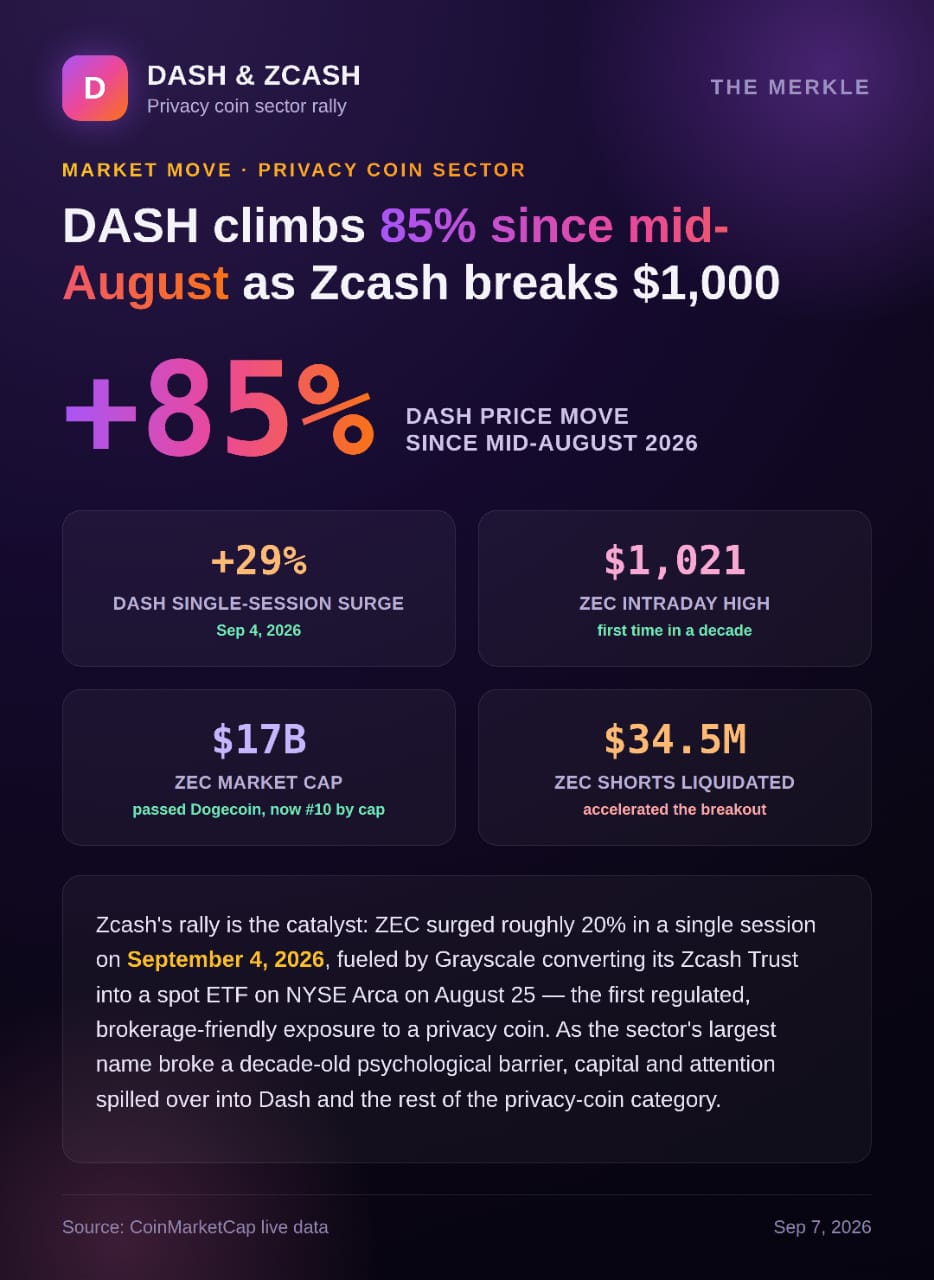
The most significant catalyst for the broader privacy coin rally can be traced directly to Zcash’s remarkable performance and a pivotal institutional development. On September 4, 2026, ZEC surged approximately 20% in a single trading session, printing an intraday high above $1,021. This propelled its market capitalization towards an astonishing $17 billion, a valuation that briefly elevated it past Dogecoin to become the tenth-largest cryptocurrency by market cap. This explosive rally was primarily ignited by Grayscale Investments’ successful conversion of its long-running Zcash Trust into a spot Exchange Traded Fund (ETF). This spot ETF began trading on NYSE Arca on August 25, 2026, marking a watershed moment. For the first time, institutional and retail investors gained access to a regulated, brokerage-friendly investment vehicle offering exposure to a privacy coin.
The approval and launch of a Zcash spot ETF by a major institutional player like Grayscale sent a powerful signal to the market. It suggested a potential softening or re-evaluation of regulatory stances on certain privacy-enhancing technologies, or at least a pathway for compliant access. The immediate market reaction was dramatic. Roughly $34.5 million in ZEC short positions were liquidated as the breakout gathered momentum, triggering a forced-buying dynamic that further accelerated the price surge. This event acted as a psychological barrier-breaker, demonstrating that regulated products for privacy coins are feasible. When the sector’s most recognized name achieves such a significant regulatory and price milestone, the resulting capital and attention inevitably spill over, validating the entire category and drawing interest to other projects bearing the "privacy" label, including Dash.
Dash’s Multi-Faceted Momentum
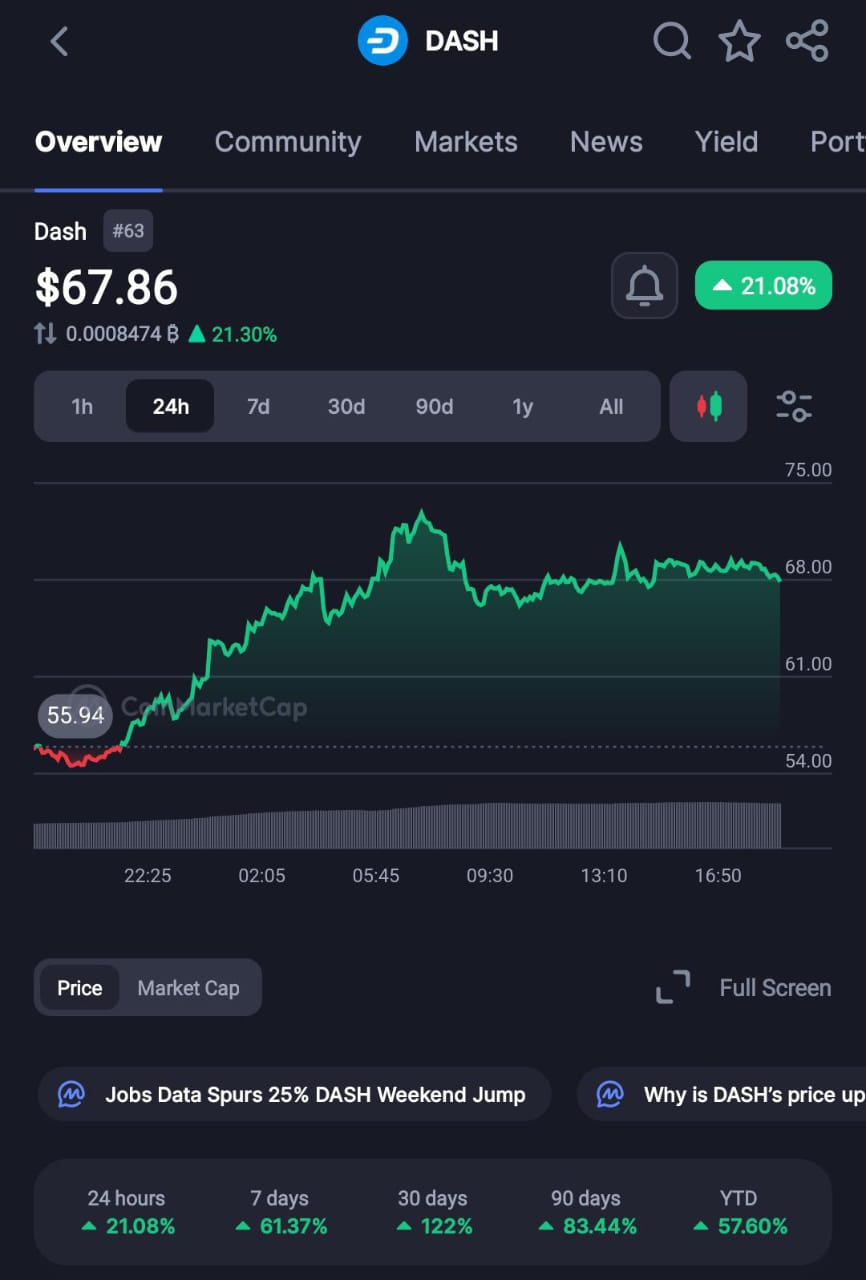
While Zcash provided the initial spark, Dash’s impressive rally—climbing more than 85% since mid-August and experiencing a 29% surge on September 4 alone—is underpinned by a confluence of its own unique catalysts, all converging at a critical juncture.
A Decade in the Making: Dash’s Resilient Journey
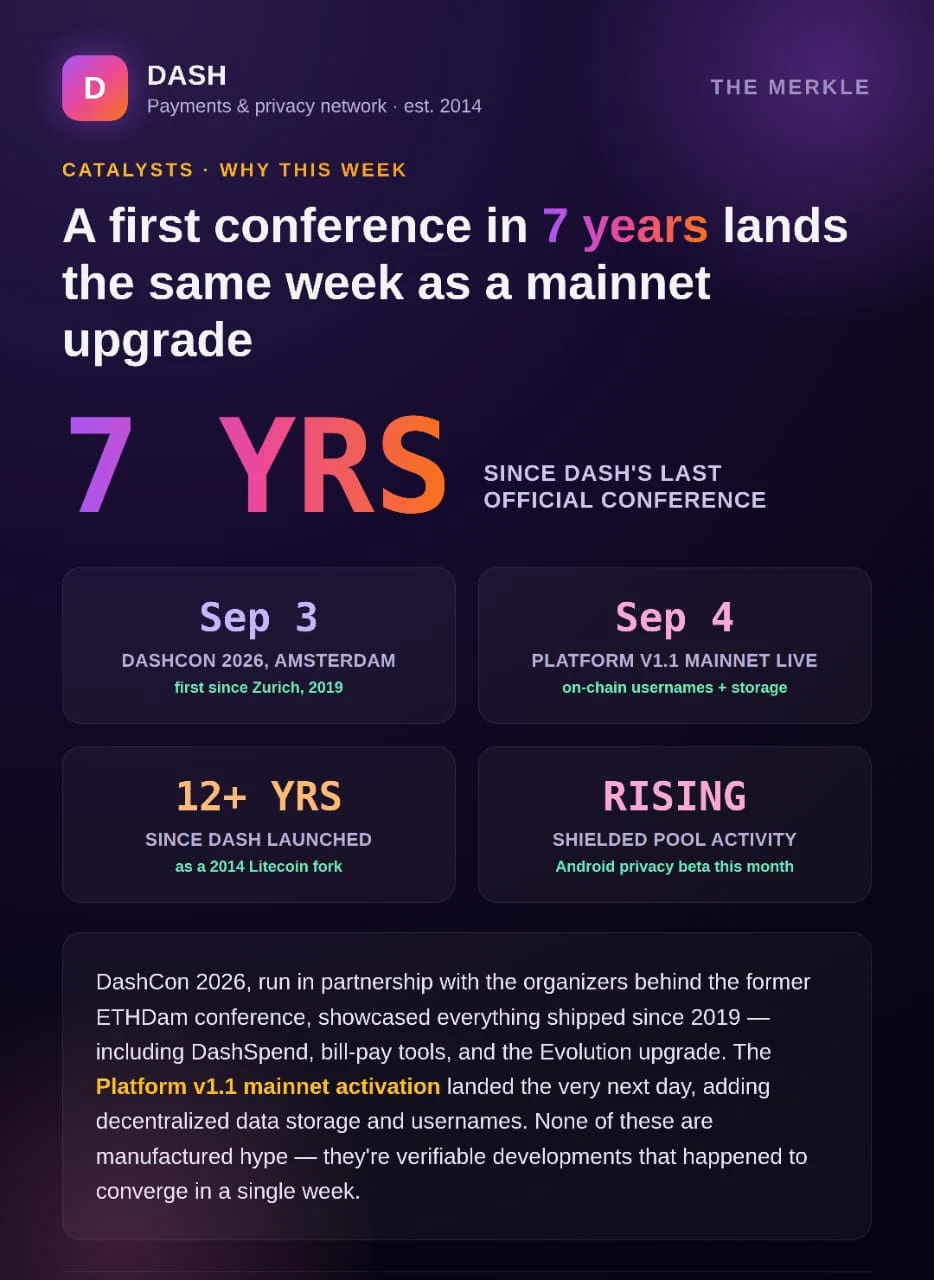
Dash is a genuinely venerable project by cryptocurrency standards, boasting over a decade of continuous development. It launched in January 2014 as a fork of Litecoin, initially known as XCoin, before rebranding first to Darkcoin and eventually to Dash (a portmanteau of "Digital Cash"). This long history provides crucial context: Dash is not a fleeting new entrant riding a speculative wave without substance. It has endured multiple market cycles, evolving from its initial focus purely as a payments-centric coin to a broader platform. This resilience and commitment to a long-term roadmap, often through periods of market indifference, highlight a robust foundation and dedicated development community. The project has consistently focused on delivering tangible utility, emphasizing fast, low-cost, and private transactions through features like InstantSend and PrivateSend, even as it expanded its vision to encompass more advanced blockchain applications.
DashCon 2026: Reconnecting and Showcasing Innovation
A significant factor contributing to Dash’s recent momentum is DashCon 2026, the project’s first official conference since 2019. Held from September 3-4, 2026, at De Hallen Studios in Amsterdam, this event marked a rare public gathering for a project that has historically prioritized "heads-down building" over frequent promotional events. Organized in partnership with CryptoCanal, an Amsterdam-based entity known for the former ETHDam conference (now rebranded as Common S3nse, which ran at the same venue immediately after DashCon on September 4-5), DashCon 2026 served as a comprehensive showcase. It highlighted seven years of accumulated development work since its last conference in Zurich. Key innovations presented included DashSpend, a suite of tools for global bill payments, and the highly anticipated Evolution upgrade, designed to enhance user experience and expand Dash’s functionality. The official announcement from Dash’s blog described the conference as a crucial opportunity to finally present years of dedicated effort to a community that had not had an in-person gathering in years. The timing of this long-awaited event, coinciding precisely with a sector-wide rally, created a potent compounding effect on market sentiment and visibility.
Technical Evolution: Dash Platform v1.1 and Enhanced Privacy
Layered on top of the conference and the broader privacy narrative is a substantive technical catalyst: the mainnet activation of Dash Platform v1.1 on September 4, 2026. This significant upgrade introduces decentralized data storage and on-chain usernames to the network. This expansion moves Dash beyond its original identity as solely a payments-focused cryptocurrency, positioning it further as a foundational infrastructure capable of supporting broader Web3-style applications. This strategic pivot allows developers to build more complex and data-rich decentralized applications (dApps) directly on the Dash network, diversifying its utility and increasing its relevance in the evolving blockchain landscape.
Concurrently with the platform activation, activity around Dash’s shielded transaction pool has noticeably intensified. This feature allows users to obscure transaction details, providing a higher degree of privacy than standard transparent transactions. Furthermore, new mobile privacy features are slated to enter Android beta testing later in September 2026. Dash itself has described shielded transactions as the most significant privacy overhaul in its more than twelve years of existence. The renewed focus and increased utilization of this privacy-enhancing technology, precisely as the broader privacy narrative heats up, is not a mere coincidence but a testament to the project’s foundational commitment to privacy and its timely delivery of advanced features. These verifiable technical developments provide a strong fundamental backing to the recent price action, distinguishing it from purely speculative pumps.
Market Dynamics and Technical Confirmation
The fundamental and narrative catalysts alone would not have translated into such a sharp price movement without the charts providing corroborating technical signals. Dash decisively broke out of a weeks-long trading range on strong volume, a technical confirmation that typically accelerates momentum after an extended period of consolidation. A breakout backed by substantial trading volume, as opposed to a thin, low-conviction move, is generally interpreted by analysts as a more credible indicator that genuinely new capital is entering the position, rather than a few large holders simply manipulating the price with minimal liquidity. This robust technical confirmation adds weight to the rally, suggesting a broader base of buying interest.
However, it is also crucial to acknowledge the market dynamics at play, particularly concerning liquidity. Dash, while a venerable project, possesses significantly thinner liquidity compared to larger crypto assets like Bitcoin or Ethereum. This characteristic inherently amplifies price movements in both directions. A 29% single-session pump on a lower-liquidity asset can be achieved with a fraction of the capital required to move a more liquid coin by the same percentage. While advantageous during an upward trend, this factor also implies that a reversal could be equally swift and pronounced should market sentiment shift or capital move elsewhere.
Broader Implications and Future Outlook
The recent surge in privacy coins, led by Zcash and amplified by Dash’s own developments, carries significant implications for the cryptocurrency market and the broader perception of privacy-enhancing technologies.
Shifting Regulatory Sands and Institutional Interest
Zcash’s spot ETF approval by Grayscale represents a landmark moment that could potentially reshape the regulatory landscape for other privacy assets. While regulatory bodies globally, particularly in the United States, have historically expressed concerns about the potential for privacy coins to facilitate illicit activities, the approval of a regulated investment product suggests that a pathway for compliant institutional engagement may exist. This could encourage other asset managers to explore similar offerings for privacy-focused cryptocurrencies, gradually integrating them into mainstream financial portfolios. The Grayscale Zcash ETF could serve as a precedent, forcing regulators to differentiate between legitimate privacy-enhancing technologies and tools exclusively designed for illicit use, potentially leading to more nuanced regulatory frameworks.
The Symbiotic Relationship: Sector-Wide Momentum
It is imperative to understand that this rally is not solely a Dash-centric story. A substantial portion of the momentum is derived from the broader privacy coin narrative, with Zcash at the forefront. The "spillover effect" is a common phenomenon in crypto markets, where a significant move in one leading asset within a category draws attention and capital to other related assets. Dash has effectively caught this resulting momentum, which has been further amplified by its relatively thinner liquidity and, crucially, a genuinely busy week of its own unique catalysts landing simultaneously. This symbiotic relationship underscores that while Dash’s fundamentals are strong, its performance is also intricately linked to the overall health and perception of the privacy coin sector.
Challenges and Considerations for Sustainability
Despite the impressive rally, sustainability remains a key consideration. The inherent risks associated with lower-liquidity assets mean that vigilance is warranted. Future price movements will heavily depend not just on continued narrative strength but on actual product adoption, sustained trading volume, and the ability of projects like Dash to continue delivering on their expanded roadmaps. While DashCon, the Platform v1.1 mainnet activation, and rising shielded pool activity are legitimate and verifiable developments, the market will scrutinize whether these advancements translate into real-world utility and user growth. Continued regulatory scrutiny, while potentially mitigated by Zcash’s ETF, will also remain a factor for the entire sector. A rally built partly on sector-wide spillover can unwind as quickly as it built once that attention dissipates or shifts elsewhere. Therefore, watching volume, liquidity, and tangible product adoption in the weeks and months ahead will be as critical as monitoring the price charts themselves.
In conclusion, the recent surge in privacy coins, spearheaded by Zcash’s institutional breakthrough and vigorously supported by Dash’s concentrated week of developmental milestones, signifies a potential turning point for a category once thought to be obsolete. The convergence of a powerful narrative shift, regulatory validation through an ETF, and substantive technical upgrades suggests that privacy coins may be entering a new era of relevance and adoption, challenging long-held market assumptions and opening new avenues for institutional and retail engagement.
Disclosure: This is not trading or investment advice. Always do your research before buying any cryptocurrency or investing in any services.
Follow us on Twitter @themerklehash to stay updated with the latest Crypto, NFT, AI, Cybersecurity, and Metaverse news!














