


For half a decade, the UNI token, native to the pioneering decentralized exchange Uniswap, was often characterized by a paradox: it anchored one of the most successful protocols in decentralized finance (DeFi) yet generated no direct financial benefit for its holders. Billions of dollars in trading fees flowed through the Uniswap protocol, enriching liquidity providers but leaving the token’s economic value accrual mechanism dormant. This long-standing narrative has dramatically shifted with the recent activation and widespread implementation of the "fee switch," transforming UNI’s financial landscape and ushering in a new era of direct value capture. Public data now vividly illustrates this transformation, with revenue charts displaying an unmistakable upward trajectory that signals the arrival of a significant revenue season for UNI holders.
A Monumental Shift: September’s Record-Breaking Revenue
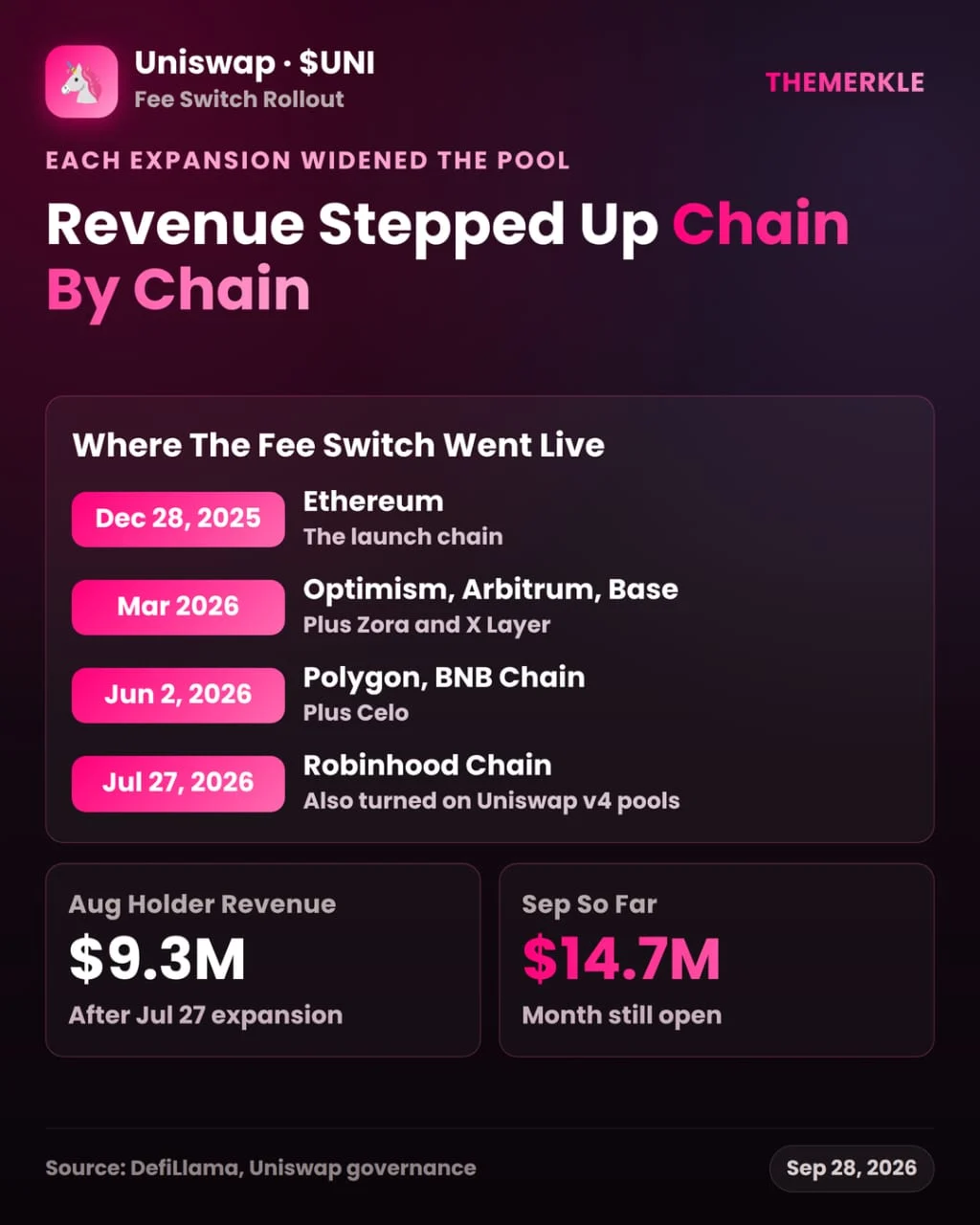
The most compelling evidence of this paradigm shift is presented by DefiLlama’s "holders revenue" chart for Uniswap, which paints a clear picture of escalating financial performance. After a period where token-holder revenue was virtually non-existent in December, monthly figures consistently hovered in a modest range of $3 million to $5 million from January through July. This trend, however, broke sharply in August, when revenue surged to approximately $9.3 million. September has since eclipsed this record, climbing to an impressive $14.7 million with the month still in progress. This represents more than double the pre-summer run rate and a substantial 60% increase over August’s then-record-setting figures.
The rolling 30-day statistics further corroborate this robust growth. DefiLlama’s main Uniswap page currently reports $15.67 million in protocol revenue over the past 30 days, stemming from a total of $207.64 million in fees. This translates to an annualized revenue rate of approximately $70 million. While calendar-month and rolling-30-day figures naturally exhibit slight differences, their convergent direction unequivocally points to the fee switch finally producing substantial financial returns for the protocol.
Understanding the Mechanics: How Value Accrues to UNI Holders

It is crucial to clarify the precise nature of "holders revenue" in this context, as it does not function as a traditional dividend payout. The mechanism for value accrual was established through the "UNIfication" proposal, which received overwhelming governance approval in December 2025. This landmark proposal stipulated that a designated portion of the swap fees, traditionally allocated entirely to liquidity providers, would instead be diverted to the protocol itself.
These newly captured fees are collected within specialized vault contracts known as TokenJar. A secondary contract, dubbed Firepit, facilitates the redemption of these collected fees exclusively in exchange for UNI tokens, which are then permanently removed from circulation, or "destroyed." DefiLlama accurately tracks this process as "buy-and-burn" revenue.
The practical implication of this design is that the fee income directly contributes to shrinking the total supply of UNI tokens, rather than distributing cash directly into holders’ wallets. Uniswap’s official documentation explicitly states that UNI holders do not possess a direct claim on protocol revenue. Consequently, the value accrual mechanism operates through increased scarcity of the UNI token, not through direct payouts. This constitutes a vital distinction; while "annualized revenue of $70 million" or "$15 million in buybacks" serves as an accurate shorthand for the financial impact, it is not synonymous with $15 million being paid out to individual holders in the form of cash dividends. This scarcity model aims to enhance the long-term value of existing UNI tokens by reducing their circulating supply.
Chronology of Expansion: The Drivers Behind the Revenue Surge
Several interconnected forces have converged to fuel this unprecedented revenue surge, all of which are traceable through the transparent on-chain record. The primary catalyst has been the systematic expansion of the fee switch’s activation across various blockchain networks and Uniswap versions.
The initial activation of the fee switch on the Ethereum mainnet occurred on December 28, 2025, marking the beginning of this new economic era for UNI. This foundational step was followed by a series of strategic expansions to leading Layer 2 solutions and other compatible chains. In March, the fee switch was extended to Optimism, Arbitrum, Base, Zora, and X Layer. This significantly broadened the base of transactions from which fees could be collected, as these networks host substantial DeFi activity.

Further expansion continued in June, with Polygon, BNB Chain (BSC), and Celo integrating the fee switch on June 2. These additions brought in even more diverse user bases and transaction volumes. The most recent and arguably most impactful expansion occurred on July 27, when the fee switch reached Robinhood Chain. Crucially, this particular integration also activated fee collection for Uniswap v4 pools, which, according to DefiLlama, had previously been generating significant trading volume without contributing to holder revenue. Each successive expansion systematically widened the pool of eligible fees that could be captured by the protocol, setting the stage for the dramatic increases observed in August and September.
Shifting Volumes and Market Dynamics
Beyond the mere expansion of the fee switch, a critical factor has been the strategic redirection of trading volume towards the newly activated fee-collecting environments. Over the past 30 days, Uniswap processed an impressive $81.3 billion in trading volume. Notably, Uniswap v4 pools accounted for roughly $43 billion of this total, slightly surpassing the volume seen on v3 pools.
A substantial portion of this volume originated from Robinhood Chain, which alone contributed approximately $33 billion. The timing of these developments is highly significant. Because the fee switch was extended to both Robinhood Chain and Uniswap v4 in late July, this influx of new, fee-eligible volume began feeding the UNI buy-and-burn mechanism almost immediately. This perfectly correlates with the sharp upward jumps observed in the August and September revenue charts, confirming the direct impact of these strategic deployments.
Furthermore, market momentum has played an indirect yet supportive role. The UNI token itself has experienced a robust rally, trading near $9 in recent days after closing around $5.84 on September 1. This positive price action can foster a virtuous cycle: stronger market sentiment often translates into increased trading activity, which in turn generates more fees for the protocol. While higher token prices do not inherently create revenue, they often accompany heightened interest and participation in the ecosystem. Reports have also alluded to a potential link between the token’s recent performance and ongoing regulatory developments surrounding tokenized stocks in automated pools, although the precise interplay between these factors remains complex and difficult to isolate. Analysts generally agree that while direct causation is hard to pinpoint, the overall positive sentiment and increased utility of UNI likely contribute to a more vibrant trading environment.
Broader Implications: Beyond a Single Month’s Record

While record-breaking months naturally command attention, the more profound significance lies in the underlying trend and the structural change it represents. The observed revenue for UNI holders did not materialize through a gradual, organic creep. Instead, it registered distinct, substantial steps upward each time the fee switch was activated on a new chain or for a different pool type. This pattern strongly suggests that the Uniswap protocol’s core business is fundamentally healthy and robust, and that earlier, lower revenue figures were primarily constrained by a specific configuration rather than a lack of underlying demand or activity. For a protocol that currently boasts approximately $3.9 billion in total value locked (TVL) and generates nearly $1 billion in annualized fees across all its operations, capturing even a modest share of that immense financial flow is immensely meaningful for its native token.
This development also carries significant implications for UNI’s valuation narrative. At a market capitalization of around $5.5 billion (at the time of reporting), UNI’s annualized revenue rate of approximately $70 million still implies a relatively rich multiple. This is a point frequently emphasized by skeptics, who highlight that the token only recently began accruing direct economic value. However, proponents and "bulls" counter that this revenue is growing at an accelerated pace from a historically low base. They also emphasize that the recurring buy-and-burn mechanism introduces a compounding effect on a fixed token supply, which could lead to significant long-term value appreciation through increasing scarcity. Both perspectives, skeptics and bulls alike, are now scrutinizing the same charts, interpreting the nascent but powerful trend through their respective lenses.
The activation of the fee switch and its subsequent impact represent a watershed moment for Uniswap and the broader DeFi ecosystem. It demonstrates the power of decentralized governance to evolve a protocol’s economic model in response to community consensus and market dynamics. For UNI holders, it transforms the token from a purely governance-focused asset into one with tangible, albeit indirect, value accrual mechanisms. This could set a precedent for other major DeFi protocols contemplating similar shifts in their tokenomics, as the industry continues to mature and explore sustainable models for value distribution.
Looking Ahead: Challenges and Opportunities
While the recent revenue surge is unequivocally positive, the path forward for Uniswap and UNI is not without its challenges. Sustaining this growth will depend on several factors, including continued innovation, maintaining market share against fierce competition from other DEXs, and navigating an increasingly complex global regulatory landscape. The successful integration of Uniswap v4 and its ability to capture fees on Robinhood Chain highlight the protocol’s adaptability and strategic vision. However, future expansions and upgrades will need to be equally impactful to maintain momentum.
The debate between the "scarcity" model of buy-and-burn versus direct dividends will also likely continue within the community and among investors. Each model has distinct advantages and disadvantages regarding regulatory classification, investor appeal, and operational complexity. Uniswap’s current approach prioritizes a clear distinction from securities that pay dividends, which could be a strategic move in an uncertain regulatory environment.

Ultimately, the activation of the fee switch marks a pivotal turning point for UNI. It has demonstrably altered the token’s economic fundamental, shifting it from a purely governance token to one with a powerful, supply-deflationary value accrual mechanism. The impressive revenue figures of August and September are not just records; they are concrete indicators of a re-engineered economic model that could profoundly influence UNI’s long-term trajectory and solidify Uniswap’s position as a leader in the evolving DeFi landscape. The market will undoubtedly be watching closely to see if this "revenue season" becomes a permanent climate.
Disclosure: This is not trading or investment advice. Always do your research before buying any cryptocurrency or investing in any services.
Follow us on Twitter @themerklehash to stay updated with the latest Crypto, NFT, AI, Cybersecurity, and Metaverse news!














