The Central & Southeast Asia and Oceania (CSAO) region, currently the sixth-largest cryptocurrency market globally, underwent a profound structural transformation between July 1, 2025, and June 30, 2026. While the region’s overall crypto economy saw a contraction of 6.8% in total transaction volume during this period—a reflection of broader global market trends—the headline figure obscures a more complex and optimistic narrative. Beneath the surface of declining speculative trading, the region recorded a significant uptick in institutional participation, tokenization of real-world assets, and the practical application of stablecoins for cross-border settlements. From the high-tech financial corridors of Singapore to the peer-to-peer (P2P) networks of Vietnam and the Philippines, the CSAO region has begun a definitive transition from treating digital assets as mere speculative vehicles to integrating blockchain technology as foundational financial infrastructure.

Regional Leaders and the Institutional Shift
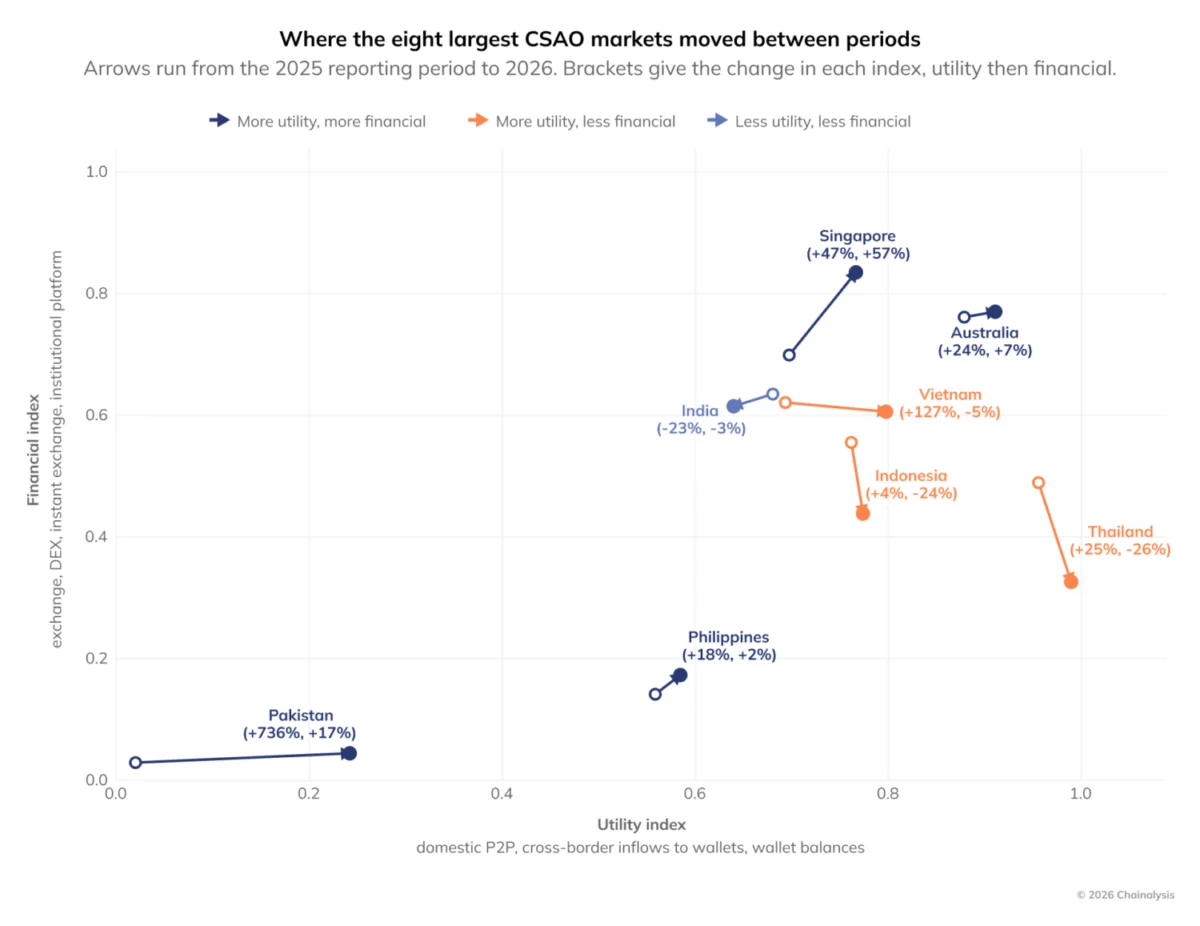
Singapore has solidified its status as the primary engine of the CSAO crypto economy. During the 2026 reporting period, the city-state recorded $284 billion in crypto activity, representing a staggering 55.4% increase year-over-year. This growth was driven almost entirely by institutional-platform activity, which surged 94% to reach $60 billion. This segment of the market is increasingly dominated by a sophisticated cohort of market makers, over-the-counter (OTC) trading firms, and institutional brokerages. Furthermore, Singapore’s growth was balanced across both centralized (CEX) and decentralized exchanges (DEX), which saw increases in flows of 30% and 69%, respectively.
Australia followed as the region’s second-largest digital asset economy, processing $173.1 billion. Although its overall activity dipped by 5.6%—largely due to a retreat in decentralized finance (DeFi) value flows—the institutional sector remained a pillar of strength. Institutional platform activity in Australia rose by 33.3% to $39.92 billion. Market observers note that this shift marks a turning point where crypto has ceased to be a "retail-only story." According to Nicolas Gilardi, head of risk and compliance at the Australian exchange BTC Markets, the year 2026 was defined by how assets were used rather than who was buying them. Assets are now frequently utilized as collateral, settlement instruments, and tokenized vehicles within regulated frameworks.

India remains a major force despite experiencing one of the region’s sharpest contractions. The Indian crypto economy shrank by 14.7% during the global bear market but still managed to record $135 billion in economic activity. Notably, India maintained its position as the region’s leader in centralized exchange (CEX) inflows. The investor profile in India is also maturing; while the market remains investment-driven, there is an influx of older, more affluent investors who view digital assets as a diversification tool similar to gold or mutual funds.
Chronology of Regulatory and Market Milestones
The 2025–2026 period was marked by several pivotal events that reshaped the regional landscape:

- July 2025: The beginning of the study period saw the region grappling with the tail end of a global bear market, leading to a reduction in retail speculative volume.
- November 2024 – March 2025: A massive shift in Singapore’s custody patterns occurred, where self-custody rates dropped from 71% to 39%, signaling a move toward institutional-grade custodial services.
- April 2026: Pakistan made a landmark decision to drop a seven-year ban that prohibited domestic banks from working with cryptocurrency companies. This led to a 736% rally in the country’s "utility" activity, albeit from a low base, rising from $69 million to $351 million.
- Mid-2026: The Reserve Bank of Australia (RBA), in collaboration with the Digital Finance Cooperative Research Centre, advanced "Project Acacia." This initiative explored the use of digital money and tokenized assets for wholesale financial market use cases, signaling official state interest in blockchain infrastructure.
- June 2026: The study period concluded with stablecoins emerging as the dominant tool for cross-border value transfer across nearly every analyzed market in the CSAO region.
The Rise of Utility: P2P and Remittances in Southeast Asia
While institutional growth dominated the narrative in developed economies, "utility adoption" became the hallmark of emerging markets like the Philippines, Thailand, and Vietnam. These three nations accounted for 5.4 million small-value P2P transfers (defined as under $10,000) during the 2026 period. Despite representing only 2.5% of the global crypto economy by value, these countries contributed 14.4% of the world’s total small-value P2P transactions.
In these markets, cryptocurrency is a tool for survival and daily commerce. More than 80% of domestic transfers in these three countries were under $1,000, with an average transfer size of $618—roughly half the global average of $1,210. This high frequency of low-value transfers indicates that crypto is being used for remittances and micro-payments rather than large-scale speculation.

The Philippines, in particular, has leveraged stablecoins to disrupt the traditional remittance market. As the fourth-largest remittance market globally, the Philippines sees a constant flow of funds from its vast diaspora. Nichel Gaba, CEO of the Philippine Digital Asset Exchange (PDAX), estimates that 5% to 10% of inbound remittances are now settled via stablecoins. Major remittance companies are increasingly adopting stablecoin settlement rails to bypass the delays and high fees associated with legacy banking systems.
Stablecoins: The Bridge for Cross-Border Commerce
One of the most significant findings of the 2026 report is the dominance of stablecoins in cross-border activity. In every CSAO market analyzed, the volume of stablecoins moving across borders far exceeded domestic usage. Malaysia showed the most dramatic disparity, with cross-border stablecoin activity being 29.5 times larger than domestic activity. Across the entire CSAO region, the ratio averaged 3.2 to 1.

David Low, CEO of the Malaysian exchange Hata, explains that stablecoins have a "relatively weak value proposition" for domestic payments in countries like Malaysia, which already possess highly efficient, near-instant digital payment rails. However, for international settlements, stablecoins offer a "deployed reality" that bypasses the inefficiencies of the SWIFT system. Srivatsan Tirumalai, a former executive at UOB, noted that corporate treasuries and regional merchants in Singapore are now using regulated stablecoins for B2B payments to cut fees and ensure instant settlement.
Regulatory Evolution and Institutional Confidence
The maturation of the CSAO crypto market is inextricably linked to the development of clearer regulatory frameworks. In Singapore, the Digital Payment Token (DPT) licensing regime and the finalization of the stablecoin regulatory framework provided the legal certainty required for institutional entry. This clarity allowed Singapore to become a net receiver of cross-border crypto value, with cumulative net inflows reaching approximately $5 billion by mid-2026.

Australia has followed a similar path. Amy-Rose Goodey, CEO of the Digital Economy Council of Australia (DECA), pointed to the 2026 expansion of the country’s AML/CFT regime as a key driver of confidence. The new rules apply to a broader set of providers, including crypto-to-crypto exchanges and custody services. Furthermore, the Australian Securities and Investments Commission (ASIC) has laid out a roadmap for a new licensing regime for digital asset platforms scheduled to begin in 2027, further cementing the industry’s status as a regulated sector of the broader economy.
In contrast, India’s market faces unique challenges due to its tax policy. In 2022, India introduced a 1% tax on crypto transactions (Tax Deducted at Source, or TDS) at local exchanges. Ashish Singhal, co-founder of CoinSwitch, noted that this has created "friction" for domestic platforms. As a result, the share of exchange volume received by domestic Indian platforms plummeted from 7% to a mere 0.7%, as users migrated to offshore exchanges that may not strictly enforce the local tax levy.

Broader Impact and Future Implications
The transition observed in 2026 suggests that the CSAO region is moving away from the "Wild West" era of cryptocurrency toward a period of "Blockchain as Infrastructure." The shift from self-custody to institutional services in Singapore and the rise of B2B stablecoin payments across the region indicate that the technology is becoming invisible—integrated into the back-end processes of banks, supply chains, and corporate treasuries.
However, experts caution that this increased institutionalization brings new risks. Ashwin Chockalingam, CFO of the Malaysian fintech firm Blox, warned that as digital assets become more intertwined with traditional finance, a major industry failure could have systemic implications and potentially undermine the hard-won trust of regulators and mainstream users.

Looking forward, the success of the CSAO region will depend on whether these practical use cases can be sustained through periods of market volatility. The data from 2026 proves that even during a contraction in trading volume, the underlying utility of blockchain technology—especially in remittances, institutional settlement, and tokenization—continues to expand. As Edul Patel, CEO of Mudrex, summarized, the region has moved past the question of whether crypto is an asset and is now focused on how blockchain will function as the plumbing for the future of global finance. The CSAO region is no longer just a participant in the crypto economy; it is increasingly the laboratory where its most practical and enduring applications are being forged.