Foundry, the digital asset infrastructure provider that operates the world’s largest Bitcoin mining pool, has officially announced its strategic expansion into the Zcash (ZEC) ecosystem with the planned launch of a dedicated mining pool in April 2026. This move is specifically designed to cater to the needs of institutional investors, public corporations, and large-scale mining operations that require sophisticated, North American-based infrastructure to participate in the privacy-preserving blockchain network. By leveraging its dominant position in the Bitcoin mining sector, where Foundry USA currently controls the largest share of global computing power, the company aims to professionalize the Zcash mining landscape and provide a bridge for institutional capital seeking exposure to privacy-centric digital assets.
The decision to enter the Zcash market comes at a pivotal moment for the cryptocurrency, which has seen a significant resurgence in network activity and computational security. According to data provided by Foundry and supported by on-chain metrics, Zcash has matured into a robust, institutional-grade asset; however, the supporting mining infrastructure has historically lagged behind the standards expected by enterprise-level participants. Mike Coyler, the Chief Executive Officer of Foundry, emphasized that the new pool is intended to fill this critical gap, offering a compliant and transparent gateway for miners to secure the Zcash network while adhering to the rigorous operational standards required by modern financial institutions.
The Strategic Importance of Institutional Mining Infrastructure
Mining pools function as collaborative hubs where decentralized miners combine their computational resources, known as hashrate, to increase the statistical probability of successfully mining a block and earning rewards. In the current competitive landscape, solo mining has become nearly impossible for all but the largest entities, making the choice of a mining pool a vital operational decision. Foundry USA’s rise to dominance in the Bitcoin sector was built on providing a reliable, US-based alternative to overseas pools, offering features like transparent reporting, regular payouts, and regulatory compliance.
By applying this same model to Zcash, Foundry is addressing a specific bottleneck in the privacy coin’s ecosystem. Historically, Zcash mining has been dominated by smaller, decentralized pools or international entities that may not meet the auditing or compliance requirements of publicly traded companies in the United States or Europe. The upcoming April 2026 launch represents a long-term commitment to the Zcash protocol, signaling to the market that privacy-preserving technology is viewed as a permanent and essential fixture of the broader digital asset landscape.

Zooko Wilcox, the founder of Zcash and current Chief Product Officer of Shielded Labs, expressed strong support for the initiative. Shielded Labs, an independent organization based in Switzerland dedicated to the advancement of Zcash, views the entry of a North American giant like Foundry as a validation of the network’s technical integrity. Wilcox noted that the presence of an enterprise-grade pool would likely attract a new tier of miners who have previously remained on the sidelines due to the lack of "trusted" domestic infrastructure.
Technical Foundations: Zcash and the Evolution of Privacy
Zcash was launched in 2016 as a fork of the original Bitcoin codebase, but it introduced a revolutionary cryptographic breakthrough known as zk-SNARKs (Zero-Knowledge Succinct Non-Interactive Arguments of Knowledge). While Bitcoin and Ethereum operate on transparent ledgers where every transaction and wallet balance is visible to the public, Zcash offers users the ability to conduct "shielded" transactions. These transactions hide the sender, recipient, and amount, while still allowing the network to verify the transaction’s validity using mathematical proofs.
This dual-nature—combining a transparent public ledger with cutting-edge privacy technology—is what Foundry identifies as a key selling point for institutions. In an era of increasing surveillance and data breaches, the ability to maintain financial privacy while remaining within a compliant framework is becoming a priority for corporate treasury departments and institutional fund managers. The Zcash protocol demonstrates that privacy and transparency are not mutually exclusive; rather, they can coexist to create a more secure and sovereign financial system.
The economic model of Zcash mirrors that of Bitcoin in several key aspects, which provides a sense of familiarity for institutional miners. Both assets have a hard supply cap of 21 million tokens and utilize a "halving" mechanism, where the issuance of new coins is reduced by 50% approximately every four years. These similarities allow miners to apply many of the same financial models and hardware strategies used in Bitcoin mining to the Zcash network, provided they have access to a pool that supports the Equihash algorithm used by Zcash.
Analyzing the Zcash Hashrate Boom
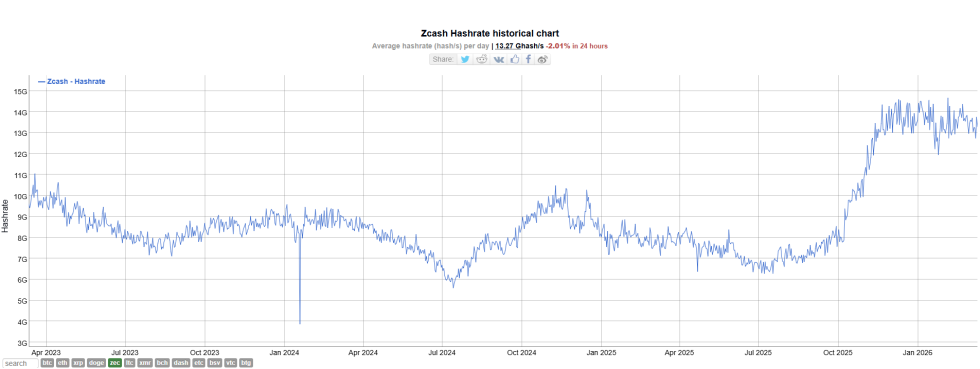
The announcement of the Foundry Zcash pool follows a period of unprecedented growth in the network’s hashrate. Computational power connected to the Zcash blockchain has surged over the past six months, reflecting a renewed interest from hardware manufacturers and industrial miners. In October of the previous year, the Zcash hashrate hovered at approximately 8 Gigahashes per second (Ghash/s). As of March 2026, that figure has climbed to over 13 Ghash/s, representing a nearly 63% increase in network security and miner participation in a relatively short window.

This surge in hashrate is often viewed as a leading indicator of network health. When miners commit significant capital to hardware and electricity to secure a chain, it suggests a long-term bullish outlook on the underlying asset’s value and utility. The increase in hashrate also makes the network more resistant to 51% attacks, further enhancing its appeal to institutional custodians who prioritize security above all else. Foundry’s entry into the space is expected to catalyze this trend further, potentially pushing the hashrate to new all-time highs as the April 2026 launch approaches.
Chronology of Development and Market Context
The timeline for Foundry’s expansion reveals a calculated approach to market entry. By announcing the pool more than a year in advance of its projected launch, Foundry is providing ample time for institutional partners to procure the necessary ASIC (Application-Specific Integrated Circuit) hardware and secure energy contracts.
- 2016: Zcash is launched, introducing zk-SNARKs to the crypto-economy.
- 2020-2023: Foundry USA emerges as the dominant Bitcoin mining pool, emphasizing US-based operations.
- Late 2025: Zcash network experiences a significant hashrate spike, rising from 8 Ghash/s to over 13 Ghash/s.
- March 2026: Foundry officially announces the development of its institutional Zcash pool.
- April 2026: Scheduled launch of the Foundry Zcash mining pool.
This chronology highlights a shift in the mining industry’s focus. For years, the primary focus was on Bitcoin’s dominance. However, as the market matures, there is a growing appetite for "Alt-PoW" (Alternative Proof-of-Work) assets that offer unique utility, such as privacy. Foundry’s move suggests that the infrastructure provider sees Zcash not just as a niche privacy coin, but as a fundamental pillar of the future digital economy.
Regulatory Implications and Compliance
One of the primary hurdles for privacy coins has been the evolving regulatory landscape. In various jurisdictions, including parts of the European Union and certain Asian markets, exchanges have faced pressure to delist privacy-centric assets like Zcash and Monero due to concerns over Anti-Money Laundering (AML) and Counter-Terrorist Financing (CTF) regulations.
However, Foundry’s approach emphasizes "compliant digital infrastructure." By operating a pool within the United States, Foundry subjects itself to domestic regulatory oversight, providing a layer of accountability that many decentralized or offshore pools lack. This move could potentially serve as a blueprint for how privacy-preserving technologies can be integrated into the regulated financial system. If an institutional-grade pool can successfully operate while maintaining the privacy features of the Zcash protocol, it may alleviate some of the concerns held by regulators regarding the anonymity of digital assets.
Furthermore, Zcash includes features such as "view keys," which allow users to selectively disclose transaction details to third parties, such as auditors or tax authorities, without making that information public. This selective transparency is a critical feature for institutional adoption, as it allows companies to meet their reporting obligations while protecting their proprietary financial data from competitors or malicious actors.
Market Reaction and Economic Outlook
At the time of the announcement, the price of Zcash (ZEC) was trading at approximately $209. While the asset has experienced a weekly retracement of roughly 11%, the long-term price action has shown signs of recovery from previous lows. The introduction of institutional mining infrastructure is often a precursor to increased liquidity and market stability. As more professional entities begin mining ZEC, the selling pressure often becomes more predictable, and the asset gains deeper integration into institutional portfolios.
The broader implications for the mining industry are also significant. Foundry’s diversification into Zcash indicates that large-scale infrastructure providers are looking for ways to hedge their Bitcoin-centric business models. By supporting multiple Proof-of-Work chains, Foundry can offer its clients a more diverse range of opportunities to deploy their hardware and optimize their returns based on fluctuating network difficulties and asset prices.
As the industry moves toward the April 2026 launch, the focus will likely remain on the continued growth of the Zcash hashrate and the potential for other major infrastructure players to follow Foundry’s lead. The success of this initiative could mark the beginning of a new era for Zcash, transitioning it from a specialized privacy tool into a mainstream institutional asset supported by the most powerful mining entities in the world. For the broader cryptocurrency market, it serves as a reminder that privacy remains a core value proposition of blockchain technology, and that the infrastructure required to support that privacy is finally catching up to the sophistication of the protocols themselves.