The global cryptocurrency landscape faced a significant security breach on September 24, 2026, when the prominent digital asset exchange Bitget was targeted in a sophisticated cyberattack resulting in the theft of approximately $387 million. In the immediate aftermath of the exploit, blockchain analytics firm Chainalysis deployed a specialized "war room" environment, utilizing its next-generation agentic AI platform to monitor and trace the movement of stolen assets in real-time. This incident, which has been formally attributed to threat actors linked to the Democratic People’s Republic of Korea (DPRK), represents a major escalation in the ongoing shadow war between state-sponsored hackers and global financial security investigators. The speed and complexity of the laundering process prompted Chainalysis to pivot from traditional manual tracing to a highly automated, AI-driven methodology, effectively compressing tasks that previously required 20 hours of human labor into less than 10 minutes.
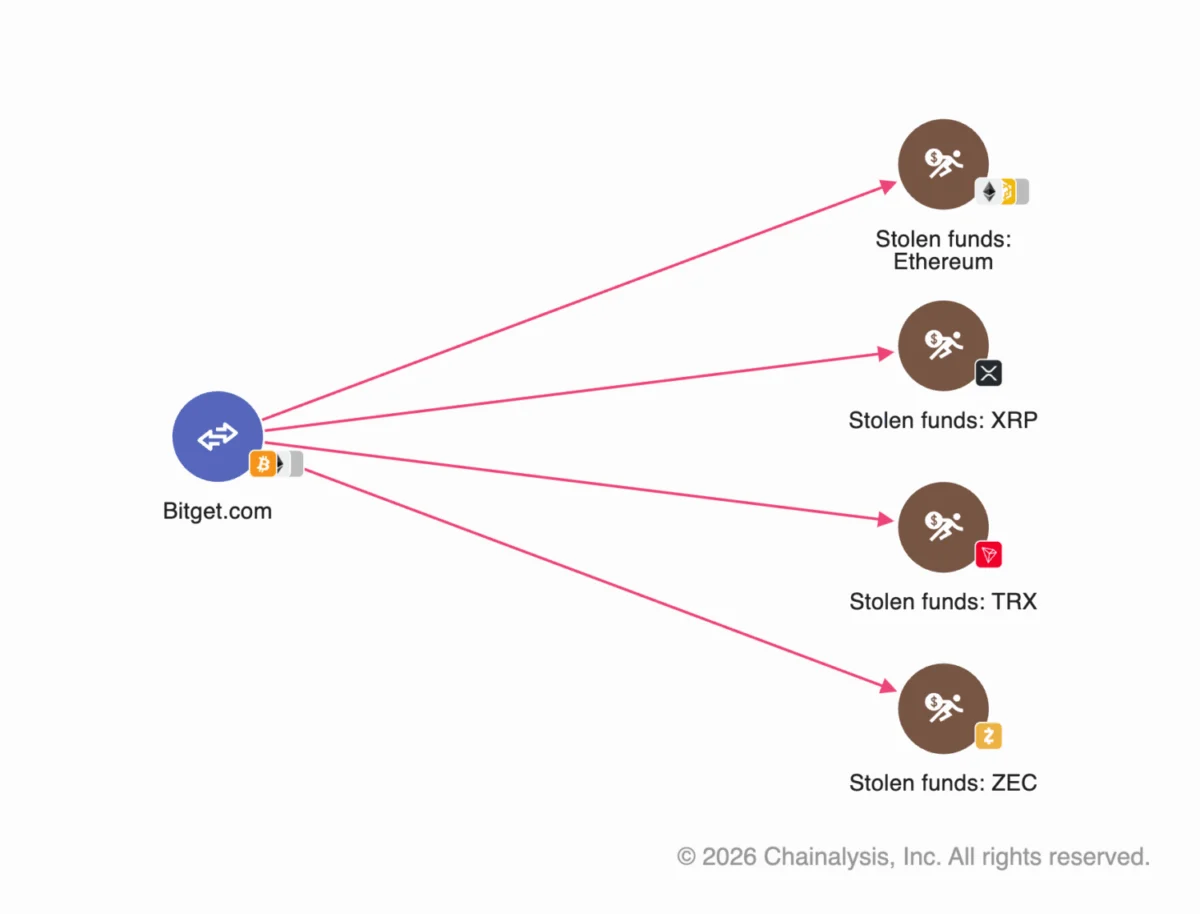
The Bitget exploit highlights a growing trend in the decentralized finance (DeFi) and centralized exchange (CEX) sectors, where attackers no longer rely on simple transfers but instead use automated scripts to disperse funds across a multitude of blockchains and protocols within minutes of a breach. According to investigative data released by Chainalysis, the initial phase of the theft saw $387 million exit Bitget’s hot wallets via 23 distinct transfers. These funds were strategically distributed across four primary blockchain networks to complicate recovery efforts. Ethereum served as the primary repository, receiving 49.7% of the stolen assets, followed closely by XRP at 40.8%. Smaller portions were diverted to Zcash (7.6%) and Tron (1.8%). This multi-chain approach is a hallmark of North Korean cyber-operatives, who have historically demonstrated a high degree of technical proficiency in navigating cross-chain environments.

The chronology of the event suggests a meticulously planned operation. Within the first three hours following the identification of the exploit, the attackers had already moved the entirety of the stolen $387 million into intermediary wallets. From there, the laundering mechanisms became increasingly complex. Rather than attempting to offload the assets directly onto centralized exchanges—which would have likely resulted in immediate freezes due to Anti-Money Laundering (AML) protocols—the threat actors utilized cross-chain liquidity and messaging protocols. A notable segment of the investigation focused on the stolen XRP. Chainalysis investigators observed that the attackers did not send the XRP to a traditional exchange; instead, they funneled it through a cross-chain liquidity protocol, effectively swapping it for Bitcoin on a separate blockchain. This "hop" between chains without a centralized intermediary is designed to break the "trail of breadcrumbs" that investigators usually follow.
To counter this level of sophistication, Chainalysis employed its new agentic AI platform. This technology represents a shift from static analytics tools to dynamic, autonomous agents capable of interrogating vast datasets and building custom automation logic on the fly. In a statement regarding the operation, Chainalysis emphasized that the AI did not replace the human element but rather served as a "force multiplier." Human investigators defined the logic and reviewed the outputs, while the AI handled the grueling task of reconciling thousands of transactions across different networks. This was particularly crucial for "bridge reconciliation," the process of matching a deposit on one blockchain (e.g., Ethereum) to its corresponding payout on another (e.g., Bitcoin). By automating this reconciliation, the team was able to maintain a live map of the stolen funds, even as they moved through mixers and decentralized exchanges (DEXs).
The broader context of this attack is alarming for the global financial community. The Bitget exploit has pushed the total value of cryptocurrency stolen by DPRK-linked actors in 2026 to over $1 billion. This figure underscores the reliance of the North Korean regime on cyber-heists as a primary source of foreign currency, often used to bypass international sanctions and fund state programs. The 2026 campaign has been characterized by an increased use of "instant swaps" and "laundering-as-a-service" platforms, which allow hackers to obfuscate the origin of funds with unprecedented efficiency. Investigators have noted that these threat actors are now using their own custom automation tools to move funds, creating a high-speed "arms race" between the thieves and the security firms tasked with stopping them.

The impact of the Bitget breach extends beyond the immediate financial loss. It has reignited debates regarding the security of centralized exchanges and the necessity of real-time monitoring. Bitget, which has grown significantly as a global player in the crypto derivatives market, now faces the challenge of restoring user confidence. While the exchange has historically maintained a "Protection Fund" to cover user losses in the event of security breaches, the sheer scale of a $387 million loss tests the limits of such safeguards. Logically inferred reactions from the industry suggest that other major exchanges are likely to increase their investments in AI-driven compliance and security tools to prevent similar "automated" drains of their liquidity.
Law enforcement agencies, including international partners and domestic cyber-task forces, were kept apprised of the investigation through Chainalysis’s live data feeds. Within minutes of the funds being moved, "labels" or digital tags were applied to the affected addresses in the Chainalysis platform. These labels act as a "red flag" for compliance teams at other exchanges, alerting them if the stolen funds attempt to enter their ecosystem. This collaborative effort is essential for "choking off" the exit ramps where crypto is converted into fiat currency. However, the use of privacy-focused coins like Zcash and the increasing sophistication of mixers make this a daunting task. The investigation revealed that tens of millions of dollars were moved through cross-chain protocols over a 36-hour window, eventually reaching attacker-controlled Bitcoin addresses that are currently under 24/7 surveillance.
A technical breakdown of the laundering process reveals the use of various sophisticated services. Beyond simple bridges, the attackers utilized decentralized exchanges to trade stolen tokens for more liquid assets, and mixers to "tumble" the coins and hide their transaction history. Chainalysis’s ability to reconstruct these pathways relied on a decade of cross-chain attribution data. By connecting activity across protocols that would otherwise appear unrelated, investigators were able to "bridge the gap" and maintain the trail. This level of forensic depth is what allowed the team to identify the ultimate destination of the funds, even after they had passed through multiple layers of obfuscation.

As the investigation moves into its next phase, the focus will shift from tracing to disruption. Chainalysis has stated that its work is far from over, with plans to continue monitoring the stolen assets and labeling any new addresses that emerge. The firm is working closely with issuers of stablecoins—who have the power to "freeze" assets on-chain if they are proven to be stolen—and with law enforcement to support potential seizure operations. The upcoming industry briefing on November 19 is expected to provide further insights into the next generation of investigative capabilities that were pioneered during this crisis.
The Bitget exploit serves as a stark reminder of the evolving threat landscape in the digital asset space. As threat actors like the DPRK adopt AI and high-speed automation, the defensive side must evolve at an equal or faster pace. The success of the Chainalysis team in compressing 20 hours of work into 10 minutes is a significant milestone, but it also highlights the necessity of human expertise in directing these powerful tools. In the world of blockchain forensics, speed is no longer just an advantage; it is a prerequisite for survival. The ability to identify, label, and track illicit activity in real-time is the only way to protect the integrity of the global financial system from state-sponsored cyber-criminals who view the blockchain as a borderless vault.
In summary, the $387 million Bitget exploit is a landmark case in the history of crypto-theft. It demonstrates the clinical precision of North Korean hackers, the transformative power of AI in blockchain forensics, and the critical importance of public-private partnerships in the face of national security threats. The data derived from this investigation will likely inform regulatory policies and security standards for years to come, as the industry grapples with the reality of automated, state-sponsored financial warfare. The fight to recover the Bitget funds continues, but the lessons learned in the Chainalysis "war room" have already fundamentally changed the way the world watches the money.