NEAR Intents, a pivotal cross-chain swap layer, has reported an exceptional third quarter, processing a staggering $10.41 billion in volume. This marks a significant 66.8% increase quarter-over-quarter and an astounding 891% surge from the previous year, solidifying its position as a dominant force in the interoperability landscape. However, the impressive headline figure for transactional volume stands in contrast to the concurrent announcement regarding an "$8 million+" allocation to NEAR buybacks, a number that upon closer inspection, represents a cumulative, lifetime total rather than a Q3 specific achievement. This distinction, coupled with observable discrepancies between official dashboards and on-chain data regarding buyback holdings, highlights an ongoing need for enhanced transparency from the NEAR Protocol to fully align its public disclosures with its verifiable on-chain activities.
NEAR Intents’ Explosive Growth and Ascending Market Position
The third quarter of 2026 proved to be a period of remarkable expansion for NEAR Intents, the innovative cross-chain swap layer designed to facilitate seamless asset trading across over 35 disparate blockchain networks without requiring users to bridge their assets manually. This architectural approach not only simplifies the user experience but also mitigates many of the security risks traditionally associated with cross-chain bridging. The reported $10.41 billion in processed volume for Q3 underscores a burgeoning demand for robust and secure cross-chain solutions, positioning NEAR Intents as a critical piece of the broader decentralized finance (DeFi) infrastructure.
The growth trajectory is particularly striking. The 66.8% quarter-over-quarter increase from Q2’s estimated $6.24 billion volume demonstrates accelerating adoption. Looking back a year, the nearly nine-fold increase (891%) from Q3 2025’s approximate $1.05 billion illustrates the rapid ascent of NEAR Intents within the competitive crypto ecosystem. This growth was not merely linear but compounded throughout the quarter, with monthly volume doubling from $2.40 billion in July to $4.80 billion in September. This implies August’s volume hovered around $3.21 billion, painting a picture of consistent, exponential expansion.
Industry analysis from reputable firms like Nansen further validates NEAR Intents’ growing influence. According to Nansen’s NEAR Q3 2026 report, NEAR Protocol’s own front-end, near.com, accounted for only about $2.57 billion of the total Q3 volume, roughly a quarter. This crucial detail indicates that the vast majority of transactional activity, approximately $7.84 billion, originated from external wallets and decentralized applications (dApps) integrating with NEAR Intents. Such broad integration signifies a strong product-market fit and a widespread acceptance beyond the immediate NEAR ecosystem, suggesting that NEAR Intents is indeed becoming a default layer for cross-chain interactions.
Complementing this transactional volume growth, Confidential Intents TVL (Total Value Locked) also experienced substantial expansion, rising approximately 463% to reach roughly $160 million by the end of Q3. Confidential Intents, which leverage zero-knowledge proofs to enhance privacy for transactions, represent a growing niche within the broader DeFi space. This parallel growth in TVL suggests increasing user confidence and liquidity commitment to NEAR’s more advanced, privacy-focused offerings, further cementing its innovative standing. The ability to facilitate complex, secure, and private cross-chain operations positions NEAR Intents favorably against other interoperability solutions like LayerZero, Wormhole, or Chainlink’s CCIP, which are also vying for market share in the critical domain of blockchain connectivity.
Unpacking the NEAR Buyback Mechanism: Lifetime vs. Quarterly Metrics
While the volume figures paint a picture of undeniable success, the communication surrounding the NEAR token buyback mechanism warrants closer examination. The Nansen report, a key source of data, stated that NEAR Intents’ cumulative fees had surpassed $52 million, with more than $8 million of that amount captured for NEAR buybacks. This "$8 million+" figure, however, is explicitly described as a "running total" or a lifetime cumulative amount, rather than a specific allocation for Q3. The report further clarified that the share of lifetime fees directed to buybacks stood at approximately 16.4% in an October 6 update, an increase from 11.5% reported in Q2. This mathematical consistency – 16.4% of $52 million yielding roughly $8.5 million – confirms the all-time nature of the "$8M+" claim.
This distinction is critical. The initial flash coverage that combined the "$10.41 billion" Q3 volume with the "$8 million" buyback figure inadvertently mixed a quarterly performance metric with an all-time cumulative total, potentially leading to misinterpretations about the immediate impact of Q3 activities on the buyback program.

The absence of a publicly published Q3-specific buyback total presents a transparency gap. While the rising fee capture rate (from 11.5% to 16.4%, with a trailing 30-day rate of 28.4%) indicates improved efficiency in directing fees towards buybacks during the quarter, without the precise cumulative fee total at the end of Q2, calculating the exact Q3 buyback amount from these ratios alone remains impossible. This omission prevents a direct assessment of how the impressive Q3 volume translated into token value accrual for the NEAR ecosystem within that specific period.
The mechanics of the buyback program itself were detailed in a tokenomics update published by NEAR in February. This update outlined that NEAR Intents levies two primary types of fees: protocol fees, which are designated for the NEAR Protocol, and distribution fees, which are shared with integration partners. Critically, the protocol fees, which NEAR states are "intentionally low," are the ones allocated for buybacks. The updated tokenomics also stipulate that these repurchased tokens are to be either "staked or locked," with the entire buyback process governed by the NEAR Foundation. This framework aims to create a deflationary pressure on the NEAR token supply while also allowing the protocol to accrue value, thereby benefiting token holders and the broader ecosystem.
On-Chain Verification: Following the Digital Trail
To independently verify the buyback claims and understand the operational reality, one must turn to the transparent, immutable record of the blockchain. NEAR’s official revenue dashboard names the specific account involved in the buyback process: buybacks.multisignature.near. The dashboard, at one point, displayed a balance of 1,543,672.9 NEAR. However, a direct inspection of this address on NearBlocks, a blockchain explorer, as of October 23, revealed a significantly different picture.
The actual on-chain holdings for buybacks.multisignature.near were found to be 2,051,693 NEAR tokens, alongside an additional 48,000 NEAR held within a staking contract, bringing the total verifiable balance to approximately 2,099,693 NEAR. Assuming a conservative market price of around $5 per NEAR token, this equates to a total value of roughly $10.5 million. This represents a substantial discrepancy of approximately 508,000 NEAR, or about $2.5 million, compared to the figure presented on the official dashboard. While the dashboard’s footer notes its figures are "illustrative," such a significant lag in updates can undermine confidence in reported data.
The good news for the NEAR ecosystem is that the actual on-chain value of the buyback account substantially exceeds the "$8 million+" cumulative claim. If the entire verifiable balance of approximately $10.5 million originated from the reported $8 million to $8.5 million in captured fees, it suggests that NEAR acquired these tokens at an average price ranging from $3.90 to $4.15 per token. Given the volatile nature of cryptocurrency markets, these holdings have evidently appreciated in value since their acquisition, reflecting a positive outcome for the protocol’s treasury.
However, a further point of contention arises from the "staked or locked" clause in the tokenomics. While the tokens are indeed held within a multisignature account, which inherently provides a form of locking by requiring multiple approvals for movement, the on-chain data indicates a near-zero staked balance within the main buyback account. The 48,000 NEAR in a staking contract is a small fraction of the total. This means the vast majority of repurchased tokens are not actively participating in the network’s staking mechanism to earn rewards, which deviates from the "Buy Back and Earn" model described in the tokenomics. Clarification on this aspect is crucial, as staking contributes to network security and decentralization, and earning rewards could enhance the long-term value proposition of the buyback program.
The Pulse of Automated Buybacks: Receipts and Real-Time Activity
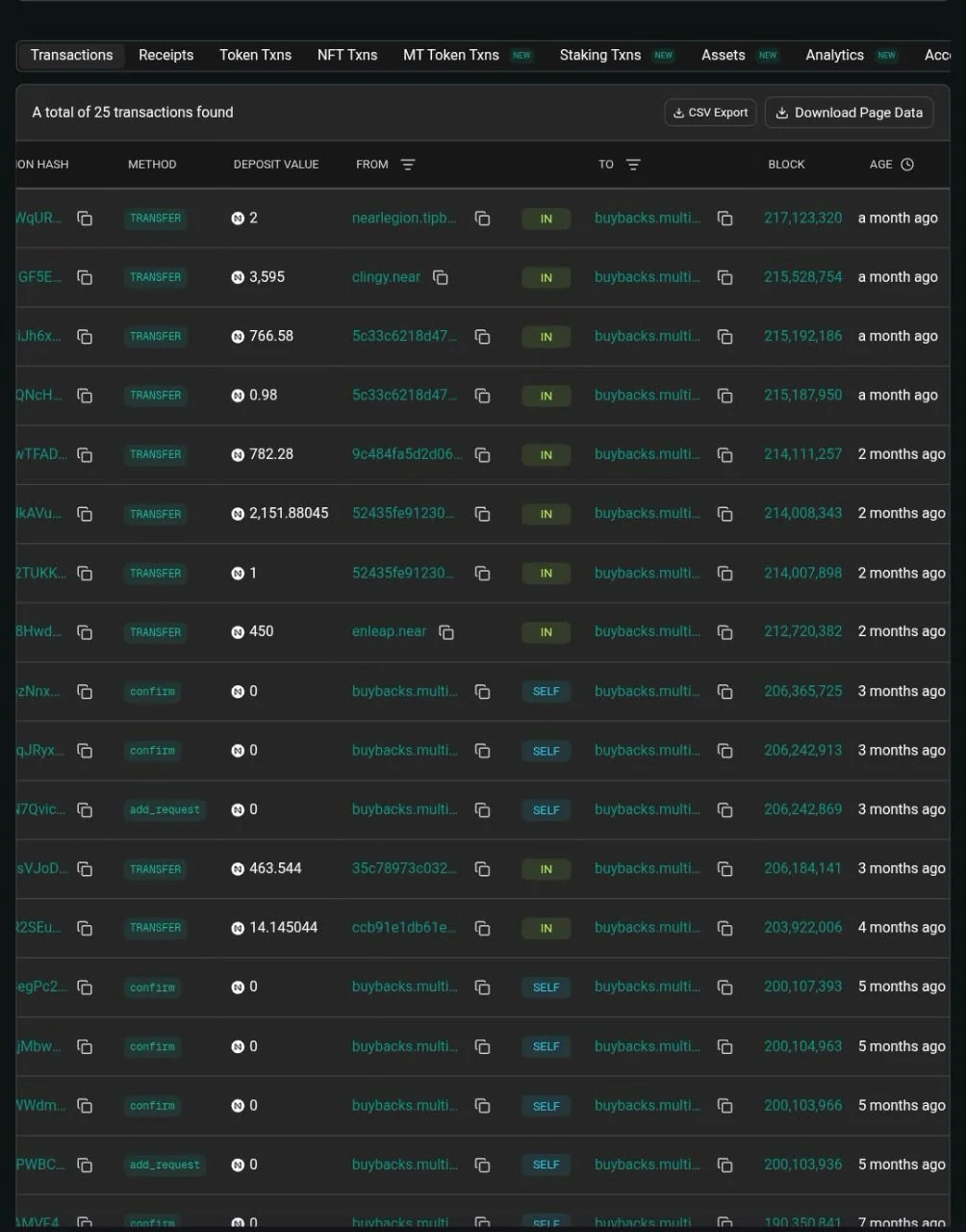
Delving deeper into the transaction history of the buybacks.multisignature.near account reveals an interesting paradox. A superficial glance at the account’s ordinary transaction list on NearBlocks shows only a limited number of entries – merely 25 transactions, predominantly small, manual transfers, and the internal add_request and confirm actions typical of a multisig wallet. The cumulative total of these incoming transfers amounts to a meager 8,227 NEAR, valued at approximately $41,000, which is negligible compared to the account’s substantial balance.
The true operational heart of the buyback mechanism lies not in these manual transactions but in the account’s receipts. These receipts document the automated, programmatic transfers initiated directly by NEAR’s smart contracts. NearBlocks lists an impressive 2,831 such receipts for the buyback account. In recent observations, every one of these transfers originated from intents.near, the primary NEAR Intents contract, and landed in the buyback account as a standard NEAR token transfer.

Over a recent 24-hour period, for instance, approximately 23 distinct deposits were observed, totaling 6,943.69 NEAR, valued at roughly $34,400. Each individual deposit ranged between 204 and 707 NEAR, with transfers occurring consistently every hour or two. This pattern provides compelling on-chain evidence that the fee switch mechanism is actively and continuously working, automatically directing protocol fees from the Intents contract to the designated buyback account. It serves as the strongest, most direct proof that NEAR’s buyback claim is not merely theoretical but a tangible, automated process.
However, while confirming the mechanism’s validity, this granular data also highlights the scale and potential variability. At the observed recent pace, a full quarter of such activity would bring in approximately 639,000 NEAR, amounting to about $3.2 million. This is a run-rate estimate and not the actual Q3 total, which would likely be higher given that NEAR Intents’ volume doubled over the quarter, implying a corresponding increase in fee generation and buyback deposits. Furthermore, the total count of 2,831 deposits, if averaged at today’s rate of ~300 NEAR per deposit, would only account for around 855,000 NEAR – significantly less than half of the current account balance. This suggests that earlier deposits were either substantially larger, or some portion of the buyback funds originated from other sources not immediately apparent through the intents.near receipts, or the average deposit size was historically much higher. The exact Q3 figure is embedded within these receipts, but without public aggregation by NEAR, it remains an unquantified metric.
Implications for Transparency and Trust: A Call for Enhanced Disclosure
NEAR Intents’ performance in Q3 2026 is unequivocally impressive, marking it as a significant player in the evolving landscape of cross-chain interoperability. The on-chain record provides robust verification of the buyback mechanism’s operational integrity: the protocol’s own contract consistently and automatically funnels NEAR tokens into the designated buyback account, and the account’s actual holdings surpass the publicly stated "$8 million+" cumulative figure. These are strong indicators of a healthy, functioning protocol and a commitment to its tokenomics.
However, for a project of NEAR’s stature and ambition, the current level of disclosure still lags behind its volume reporting. In the highly competitive and often skeptical cryptocurrency market, transparency is not merely a virtue but a fundamental requirement for fostering trust, attracting institutional investment, and ensuring long-term community confidence. The observed discrepancies and unquantified metrics, while not necessarily indicative of malice, can create ambiguities that undermine clarity.
To bridge this transparency gap and further solidify its position as a leading Layer-1 blockchain with robust and verifiable tokenomics, NEAR Protocol should consider implementing three key improvements:
- Publish the Exact Q3 Buyback Total: Providing a precise figure for the NEAR tokens repurchased and transferred to the buyback account during Q3 would directly link the protocol’s impressive volume growth to its value accrual mechanism. This would allow investors and the community to accurately assess the impact of quarterly performance on token supply dynamics.
- Clarify the "Staked or Locked" Provision: The discrepancy between the tokenomics statement of "staked or locked" and the predominantly unstaked balance in the multisig account needs to be addressed. NEAR should clearly communicate its strategy for these tokens, whether they will be staked in the future, used for other protocol-benefiting activities, or if the "locked" aspect of the multisig is considered sufficient for current objectives. If the intention is for them to remain unstaked, a revised explanation of the buyback’s benefits beyond staking rewards would be beneficial.
- Update and Enhance the Revenue Dashboard: The significant lag and underreporting on the official revenue dashboard diminish its utility and credibility. Regular, ideally real-time, updates to reflect accurate on-chain balances and provide granular data on buyback activities (e.g., Q3 totals, average buy prices, staking status) would vastly improve transparency and user experience.
NEAR Protocol has made revenue capture and value accrual central tenets of its tokenomics pitch. The existence of an automated, visible, and functioning buyback mechanism is a powerful testament to this commitment. By providing clear, quarterly-specific data and resolving the current ambiguities in its reporting and token management, NEAR can fully align its public narrative with the verifiable reality of its blockchain, fostering greater trust and strengthening its long-term viability in the decentralized future.
Disclosure: This is not trading or investment advice. Always do your research before buying any cryptocurrency or investing in any services.