North America maintained its position as the primary engine of the global cryptocurrency market during the 12-month period ending July 1, 2026, driven by a sophisticated investor base, the integration of digital assets into traditional finance, and the emergence of autonomous artificial intelligence (AI) as economic actors. According to the latest comprehensive reporting for the 2026 period, the combined crypto economies of the United States and Canada reached a staggering $3.02 trillion. While this represents a marginal 1.9% contraction from the previous year, the region continues to exert unparalleled influence over global liquidity, regulatory standards, and technological innovation.

The United States remains the world’s largest single crypto economy, valued at $2.78 trillion despite a .2% period-over-period decline. This resilience is particularly noteworthy given the broader context of a challenging bear market that tested the limits of digital asset valuations. Analysts attribute this stability to a fundamental "maturation" of the industry, where the speculative fervor of previous years has been replaced by institutional-grade products, including exchange-traded funds (ETFs), accelerated asset tokenization, and the widespread adoption of stablecoins as a primary layer for global settlements.
The Maturation of the US Market: From Speculation to Infrastructure
The slight contraction in the US market is viewed by industry leaders not as a sign of waning interest, but as a pivot toward utility. Hoolie Tejwani, Head of Coinbase Ventures, noted that the industry transitioned in 2026 from building foundational blocks to launching products with "real users, liquidity, and markets." This sentiment is echoed across the financial sector, where the "big-money index"—a measure of sheer crypto-economic power—ranks the US and Canada at the top of the global list.

The reporting period saw three distinct pillars of US influence: the rise of on-chain AI commerce, the global exportation of the digital dollar via stablecoins, and the aggressive tokenization of real-world assets (RWAs). These developments have essentially transformed the US into a global provider of financial infrastructure, where the rails of the future are being built in American laboratories and boardrooms.
The Rise of Agentic Commerce: The x402 Protocol and AI Economic Actors
One of the most significant shifts in the 2026 period was the emergence of AI agents as autonomous economic participants. The United States has taken a commanding lead in the "AI on-chain economy," largely through the proliferation of the x402 protocol. Published by Coinbase in mid-2025, x402 is a digital payment rail designed specifically to allow software agents to spend money without human intervention.

By the end of the 2026 period, over 138 million x402 transactions had been recorded on Base, the blockchain that has become the epicenter for agentic commerce. The data reveals a specialized market for micropayments—transactions so small they are economically unfeasible for traditional credit card networks. Approximately 87% of x402 payments fell between $0.0001 and $0.10. These "machine-to-machine" settlements are used for high-frequency tasks such as API data pulls, model inference, and automated code reviews.
The behavior of these AI-driven wallets indicates a "stickier" and more purposeful user base. In the third quarter of 2025, only 4% of wallets initiated their first payment within an hour of being funded. By the third quarter of 2026, that figure jumped to 67%. Furthermore, the share of wallets receiving a second funding within 30 days rose from 70.6% to 89.3%. This suggests that AI agents are no longer just an experiment; they are now provisioned with recurring budgets to perform specific, ongoing tasks.

Will Su, Head of Digital Assets Research at BlackRock, confirmed that major financial institutions are monitoring this trend closely. Su noted that AI agents are creating a "meaningful demand for frequent, low-value payments around the clock," a demand that traditional banking infrastructure is currently unable to satisfy.
Bitcoin and Stablecoins: A Tale of Two Digital Assets
The 2026 reporting period highlighted a fascinating divergence in how the United States interacts with different classes of digital assets. While the US is "importing" Bitcoin as a form of digital gold, it is "exporting" digital dollars to the rest of the world via stablecoins.

The Institutional Accumulation of Bitcoin
Since the landmark approval of spot Bitcoin ETFs in early 2024, the US share of global Bitcoin activity has risen consistently. For the first time since 2022, the US became a net importer of Bitcoin in 2026. The data shows a clear divide between retail and institutional behavior: while transfers under $10,000 were net outbound, institutional-sized transfers (above $10 million) saw a net inflow of approximately 53,200 coins. This institutional bid has been bolstered by the formalization of a federal Strategic Bitcoin Reserve, which has added a layer of sovereign demand to the market.
Stablecoins as a Global Export
Conversely, stablecoins represent a smaller portion of domestic US crypto activity compared to the rest of the world. Because Americans already have access to a stable dollar-based banking system, their need for stablecoins is lower than in emerging markets or foreign peer-to-peer economies.

The passage of the GENIUS Act in mid-2025 formalized the US position as the leading exporter of digital dollars. Stablecoins like USDC have become the currency of choice for international business and remittances. Circle reported that USDC circulation reached $73.3 billion, up 19% year-over-year, facilitating $14.8 trillion in on-chain volume in a single quarter. This proliferation benefits the US government, as nearly every dollar-pegged token is backed by reserves held in short-dated US Treasury debt, effectively creating a global, decentralized demand for American sovereign debt.
The Tokenization Frontier: Bringing Real-World Assets On-Chain
Tokenization—the process of putting traditional financial assets on a blockchain—experienced explosive growth in 2026. The global market for tokenized real-world assets (RWAs) reached $36.07 billion, a 135% increase period-over-period.

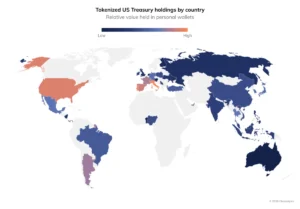
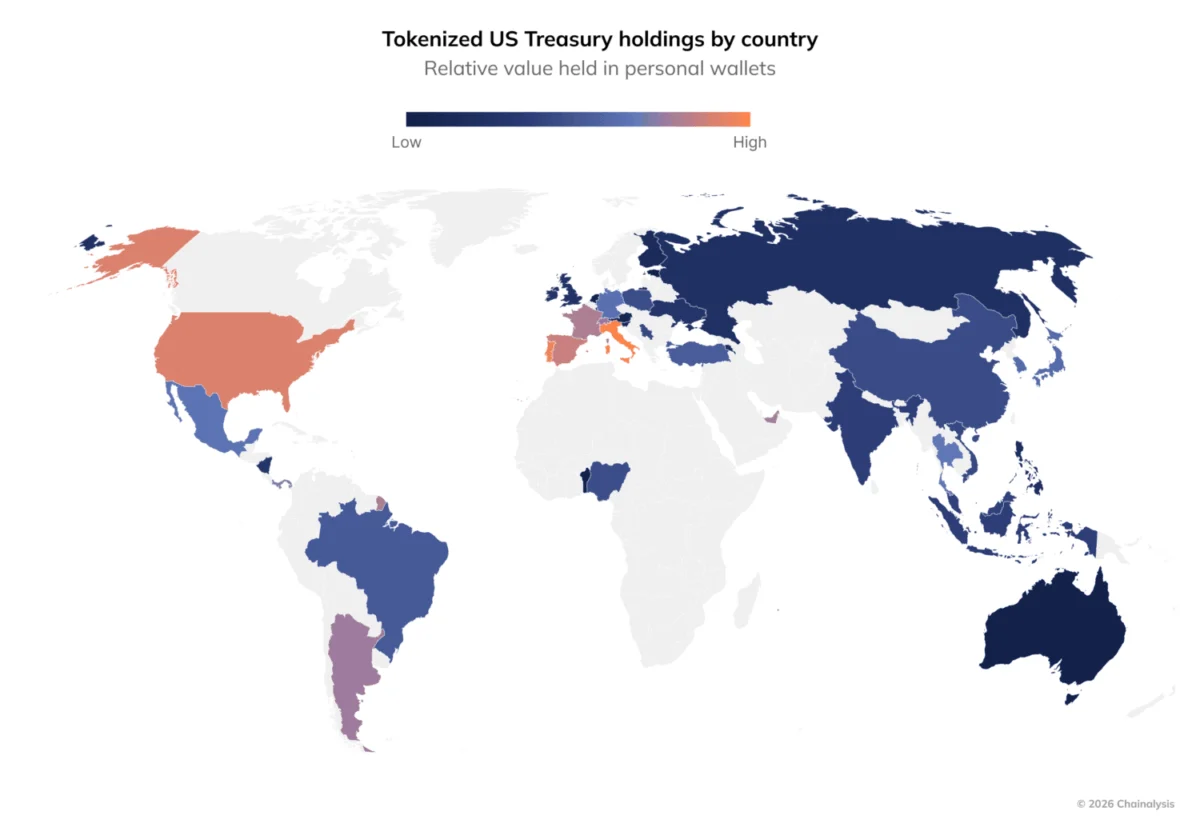
US Treasury bonds remain the dominant asset in this sector, accounting for $15.42 billion, or roughly 42.8% of all tokenized RWA value. Interestingly, the holder base for these tokenized Treasuries is largely international. Italy, Portugal, and Singapore lead in the value of geolocated holdings, while the US ranks fourth. This trend illustrates how tokenization democratizes access to US financial instruments, allowing a retail investor in Lisbon or Singapore to hold a fractionalized interest in a US Treasury bond without a traditional American brokerage account.
Tom Murphy of Securitize highlighted that the end state of this trend is not a separate "crypto" financial system, but rather "one financial system using better technology." While Treasury debt saw 125% growth, other categories like corporate credit and private equity saw percentage gains of over 1,000%, indicating that the market is diversifying rapidly.

Canada: A Global Hub for P2P and Remittances
While the US market contracted slightly, Canada’s crypto economy grew by 2.3% to reach $247.7 billion. Canada’s unique position is defined by its exceptionally strong peer-to-peer (P2P) economy, ranking seventh globally and first among G7 nations in both domestic and cross-border flows.
The driving force behind Canada’s crypto adoption is its large immigrant population, which makes up roughly 23% of the total population. For many foreign-born residents, traditional remittance channels are prohibitively expensive, with bank fees often exceeding 7%. In contrast, stablecoin transfers settle for a fraction of a cent.

During the 2026 period, stablecoin and Bitcoin remittances from Canada to India, China, and the Philippines totaled $2.36 billion—a 141% increase year-over-year. This activity involved approximately 75,100 unique senders per month with an average transfer size of $663.
However, this reliance on USD-denominated stablecoins has raised concerns among Canadian policymakers. Morva Rohani, Executive Director of the Canadian Web3 Council, noted that when Canadians buy USD stablecoins, they are essentially supporting US government debt instead of Canadian debt. To counter this, Canada granted Royal Assent to a Stablecoin Act in March 2026, paving the way for regulated Canadian Dollar (CAD) stablecoins.

Regulatory Geopolitics and the Road Ahead
The dominance of North American infrastructure is increasingly being challenged by other jurisdictions. The European Union’s MiCA framework has mandated euro-denominated reserves for stablecoins in Europe, and Singapore has finalized its own stablecoin licensing framework. These are explicit attempts to reduce the "dollar dominance" of the on-chain world.
Despite these efforts, the 2026 data shows that 99.1% of stablecoin order book volume remains pegged to the US dollar. The network effects of the dollar, combined with the technological lead of US companies in AI and tokenization, have created a high barrier to entry for competitors.

As the industry moves into the latter half of 2026, the focus has shifted from whether crypto will be adopted to how it will be regulated. Pending US guidance on agentic payments and tokenization will be critical in determining whether the US can maintain its role as the world’s primary financial architect. The convergence of AI, blockchain, and traditional finance suggests that the next era of global economics will be defined not by who holds the most tokens, but by who builds the rails that move them.