The U.S. spot Bitcoin Exchange-Traded Funds (ETFs) managed to close a turbulent trading week marginally in the green, securing approximately $301 million in net inflows despite facing significant capital withdrawals in the latter half of the week. This narrow positive finish snaps a two-week losing streak for the nascent investment vehicles, yet the underlying volatility and a substantial $773.5 million two-day outflow, primarily driven by a record single-day exit, underscore a period of cautious investor sentiment and market re-evaluation. The week’s performance highlights the complex interplay of institutional interest, macroeconomic pressures, and speculative trading that currently characterizes the digital asset landscape.
Navigating a Choppy Week: Bitcoin ETF Flows in Detail
The week for U.S. spot Bitcoin ETFs began with a promising surge of investor confidence, seeing robust inflows from Monday through Wednesday. During this initial three-day period, the funds attracted a substantial $1.07 billion, signaling a renewed appetite for Bitcoin exposure among institutional and retail investors alike. This early week momentum suggested a potential rebound, offering a glimpse of the strong capital attraction seen earlier in the year following the ETFs’ historic launch. Analysts attributed this initial optimism to a confluence of factors, including a generally positive, albeit brief, sentiment across broader financial markets and specific bullish pronouncements regarding Bitcoin’s long-term potential.
However, this positive trajectory was abruptly interrupted by a sharp reversal in investor behavior. Thursday witnessed the largest single-day outflow for Bitcoin ETFs in October, with $635.6 million exiting the funds. This significant withdrawal sent ripples through the market, quickly eroding a substantial portion of the week’s earlier gains. The outflows continued into Friday, albeit at a reduced rate, with an additional $137.9 million flowing out. Cumulatively, Thursday and Friday saw a staggering $773.5 million depart from these investment vehicles. This two-day slide effectively ate into the preceding three days of inflows, resulting in a net weekly inflow of just $301 million. While technically a positive close for the week, it marked a dramatic shift from the initial bullish sentiment and reflected heightened sensitivity to market fluctuations and profit-taking pressures. The sharp outflows underscore the continued sensitivity of the Bitcoin ETF market to sudden shifts in investor sentiment and broader economic indicators.
October’s Performance and Cumulative Impact
Zooming out to the monthly perspective, October, a month historically known for often being favorable to Bitcoin holders, has proven to be challenging for the spot Bitcoin ETFs. Despite the weekly net positive, the funds remain in the red for the month, currently down approximately $314 million. This monthly deficit is particularly noteworthy given the "Uptober" phenomenon, where Bitcoin has historically seen strong performance. The brief mid-week period where the funds momentarily turned positive for October was swiftly undone by Thursday’s substantial exit, pushing the monthly aggregate back into negative territory. This suggests that while there is consistent baseline interest, significant capital movements can quickly alter short-term performance metrics.
Since their groundbreaking debut in January 2024, U.S. spot Bitcoin ETFs have collectively amassed an impressive $57.6 billion in cumulative net inflows. This figure highlights the profound impact these products have had on legitimizing Bitcoin as an investable asset class within traditional finance. These inflows have contributed to a staggering $100.2 billion in total net assets currently held by these funds. The rapid accumulation of assets underscores the success of these vehicles in attracting significant institutional capital and providing a regulated, accessible avenue for investors to gain exposure to the leading cryptocurrency. The sheer volume of assets under management demonstrates a sustained, long-term commitment from a diverse range of investors, despite intermittent periods of volatility and outflows. The ability to cross the $100 billion mark in total net assets so relatively quickly after launch is a testament to the pent-up demand for Bitcoin exposure within traditional financial frameworks and the efficacy of the ETF structure in meeting that demand.
The Broader Spot Crypto ETF Landscape: Ethereum and Solana
Beyond Bitcoin, the broader landscape of U.S. spot crypto ETFs also experienced a turbulent week, with varying degrees of impact on other major digital assets. Ethereum ETFs, which launched in July, saw a modest $4.4 million inflow on Friday, providing a slight positive note amidst a challenging period. However, this small gain was overshadowed by a substantial weekly loss of approximately $221 million. For October, Ethereum ETFs have faced even more significant headwinds, with cumulative outflows totaling roughly $1.18 billion. This prolonged period of withdrawals suggests a more pronounced bearish sentiment or profit-taking among Ethereum investors, potentially due to its recent price performance or shifts in perceived market value relative to Bitcoin.

Solana ETFs, which commenced trading late last year, experienced no net flows on Friday, following an $8.9 million outflow on Thursday. Similar to Ethereum, Solana funds have also struggled throughout October, recording approximately $68 million in outflows for the month. The performance of these newer and smaller altcoin-focused ETFs often mirrors, and sometimes amplifies, the sentiment seen in the Bitcoin market, albeit with their own unique drivers. The relatively smaller market capitalization and newer status of Ethereum and Solana ETFs mean they can be more susceptible to significant percentage shifts from modest capital movements compared to the more established Bitcoin funds. The collective outflows from these altcoin ETFs indicate a broader cooling of speculative fervor or a reallocation of capital towards assets perceived as more stable during periods of market uncertainty. This divergence in performance, where Bitcoin ETFs manage to stay slightly positive while altcoin ETFs face more significant outflows, could signal a flight to quality within the digital asset space, with investors prioritizing the larger, more liquid cryptocurrency.
Understanding Spot Crypto ETFs: A Gateway for Investors
Spot crypto ETFs represent a pivotal development in the integration of digital assets into mainstream financial markets. Unlike futures-based ETFs, which track contracts betting on future prices, spot ETFs directly hold the underlying cryptocurrency, such as Bitcoin, Ethereum, or Solana. This structure offers investors direct exposure to the asset’s price movements without the complexities and security risks associated with directly purchasing, storing, and managing cryptocurrencies themselves. They trade on traditional stock exchanges, just like ordinary shares, making them accessible through standard brokerage accounts and familiar to a vast audience of investors, including institutions, wealth managers, and retail participants.
The launch of Bitcoin ETFs in January 2024, followed by Ethereum ETFs in July, and Solana ETFs late last year, marked a significant regulatory milestone and opened the floodgates for a new wave of capital into the crypto ecosystem. Bitcoin funds, in particular, have rapidly scaled, attracting $57.6 billion in net inflows, while Ethereum funds have accumulated $12.7 billion since their debut. These figures are not just statistics; they are a powerful indicator of the growing institutional adoption and acceptance of cryptocurrencies as a legitimate asset class. The daily reporting of ETF flows has become a crucial barometer of investor sentiment. Much of the capital flowing into these products comes from sophisticated institutional investors and financial advisors who are deploying capital on behalf of their clients. Consequently, these flow figures are closely scrutinized by market participants, analysts, and media alike, serving as a real-time gauge of confidence and investment trends within the digital asset space. The ability to access these assets through regulated, familiar financial products has lowered the barrier to entry for many traditional investors, fundamentally altering the market dynamics and liquidity profile of cryptocurrencies.
Crypto Price Action Amidst Macroeconomic Headwinds
The turbulent week in ETF flows was mirrored by corresponding declines in cryptocurrency prices, suggesting a correlation between capital movements and asset valuations, further exacerbated by broader macroeconomic pressures. Bitcoin, the market leader, experienced a 1.1% dip over a 24-hour period leading into Saturday, settling at approximately $80,490. On a weekly basis, Bitcoin recorded a modest decline of 1.2%. This price action, while not a drastic crash, reflected the cautious sentiment prevailing after the mid-week outflows from its associated ETFs.
Ethereum followed a similar trajectory, falling 2.6% to trade around $2,344. Solana, another prominent altcoin, saw a 2.8% decrease, bringing its price to roughly $101. The combined effect of these price reductions led to a 1.2% contraction in the total crypto market capitalization, which slipped to $2.79 trillion.
This weakness across the crypto market was not isolated but occurred against a backdrop of a broader midweek selloff in global financial markets. Traditional assets faced headwinds as oil prices climbed above $111 a barrel, fueling inflation concerns and potentially impacting corporate earnings. Simultaneously, high-flying artificial intelligence (AI) stocks, which had enjoyed significant rallies, experienced a notable slide. Such macroeconomic shifts often spill over into the cryptocurrency market, as investors, particularly institutional ones, rebalance portfolios and reduce exposure to riskier assets. The interconnectedness of global financial markets means that factors like rising commodity prices, interest rate expectations, and shifts in tech sector sentiment can indirectly influence the liquidity and demand for digital assets. Therefore, while ETF outflows directly reflect investor sentiment towards specific crypto assets, the broader market’s performance is often a complex mosaic influenced by a multitude of global economic and geopolitical forces.
Analyst Perspectives and Future Outlook
The week’s narrative for Bitcoin and the broader crypto market was one of contrasting signals, with long-term bullish outlooks clashing with short-term volatility. The week had opened on a notably brighter note with a significant endorsement from J.P. Morgan Asset Management. The financial giant projected an impressive 10% annual return for Bitcoin over the next decade, a forecast that positions the cryptocurrency favorably against traditional asset classes like stocks and gold. This long-term bullish assessment from a major financial institution provided a strong fundamental argument for Bitcoin’s enduring value proposition and its potential as a portfolio diversifier. Such statements from established players can often influence institutional investors’ long-term strategies, even if short-term market dynamics are challenging.
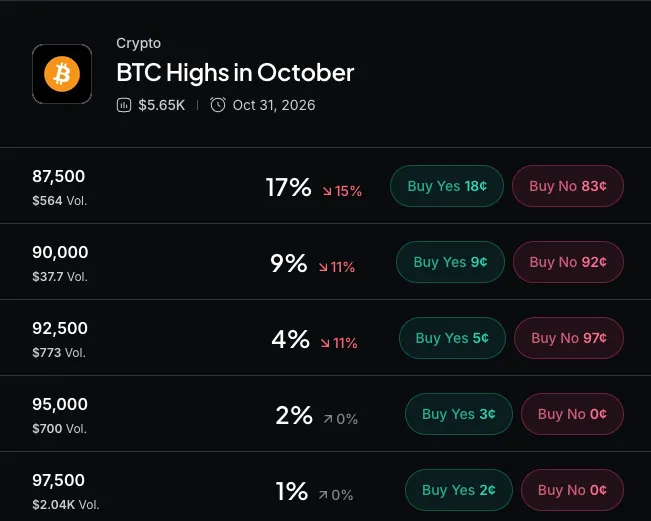
Despite this optimistic long-term view, Bitcoin has since settled into what analysts have described as a "wait-and-see" mode. This phrase encapsulates the current market sentiment—a period of consolidation and uncertainty where investors are holding off on significant directional bets, awaiting clearer signals regarding macroeconomic trends, regulatory developments, or sustained capital inflows. This cautious stance is further evidenced by shifts observed in prediction markets, which offer a unique, real-time gauge of collective investor sentiment.
On Myriad, a prediction market developed by Decrypt‘s parent company Dastan, traders have grown increasingly bearish regarding Bitcoin’s performance for the remainder of October. The odds of Bitcoin dropping to $77,500 before the month concludes surged to 43%, a significant increase from 32% just a day prior. Furthermore, there’s an 18% chance of Bitcoin falling to $75,000. Conversely, the likelihood of Bitcoin topping $87,500 by month-end has decreased from 17% to a mere 10%. These shifts in prediction market probabilities reflect a diminishing confidence in an immediate upward trajectory and suggest a prevailing expectation of further price consolidation or even a slight correction in the short term.
For other cryptocurrencies, the sentiment was mixed. Solana bulls still slightly edged out bears, with a 51.6% probability of reaching $160 before falling to $40, though this was down from 54.9%. This indicates a slight weakening of bullish conviction but still a prevailing belief in its upward potential. Ethereum, however, showed more resilience in its long-term outlook, with the odds of hitting $3,000 before dropping to $1,500 holding steady at 61.3%. This suggests that while Ethereum ETFs faced outflows, the underlying asset’s long-term price potential remains a strong belief among a significant portion of traders. The "wait-and-see" mode, combined with these nuanced prediction market insights, paints a picture of a market grappling with short-term pressures while maintaining a cautious, yet underlying, long-term optimism for key digital assets.
Implications for the Digital Asset Market
The recent performance of spot crypto ETFs, particularly Bitcoin funds, offers critical insights into the evolving dynamics of the digital asset market. The week’s events highlight a dual narrative: the undeniable success of these investment vehicles in attracting substantial institutional capital over the long term, juxtaposed with the persistent short-term volatility and sensitivity to market shifts. The $301 million net weekly inflow for Bitcoin ETFs, while modest given the preceding rally and subsequent outflows, underscores a fundamental resilience and a continuous, albeit fluctuating, baseline demand for Bitcoin exposure through regulated channels. This contrasts sharply with the more pronounced outflows seen in Ethereum and Solana ETFs, suggesting a potential flight to quality or a more cautious approach to altcoins during periods of uncertainty.
The fact that October, typically a strong month for Bitcoin, is currently in the red for ETFs, signals that even historical seasonality can be overridden by prevailing market forces, including macroeconomic headwinds and investor profit-taking. The largest single-day outflow of the month on Thursday, coinciding with a broader selloff in global markets (driven by rising oil prices and a dip in AI stocks), illustrates the increasing interconnectedness of the crypto market with traditional finance. As crypto assets become more integrated into conventional investment portfolios via ETFs, they inevitably become more susceptible to the same macro factors that influence stocks, bonds, and commodities.
The J.P. Morgan Asset Management report, forecasting 10% annual returns for Bitcoin over the next decade, serves as a powerful reminder of the long-term bullish thesis for the asset, irrespective of short-term price fluctuations. This institutional validation provides a strong counter-narrative to the immediate "wait-and-see" sentiment reflected in prediction markets and daily flow data. It suggests that while tactical positioning may lead to temporary outflows, strategic allocations by long-term investors are likely to continue, supporting the asset’s growth over a longer horizon.
Looking ahead, the digital asset market is likely to remain in a state of flux, balancing the transformative potential of blockchain technology with the realities of market cycles, regulatory scrutiny, and global economic conditions. Sustained institutional accumulation, further regulatory clarity, and continued innovation within the crypto ecosystem could serve as catalysts for renewed bullish momentum. Conversely, prolonged macroeconomic instability, further interest rate hikes, or unexpected regulatory crackdowns could trigger additional periods of outflows and price corrections. The performance of spot crypto ETFs will continue to be a crucial barometer for gauging investor sentiment and the ongoing maturation of digital assets as a legitimate and increasingly integrated component of the global financial system. The journey from niche asset to mainstream investment is fraught with volatility, but the sustained, albeit sometimes choppy, inflows into ETFs affirm the enduring belief in the value proposition of cryptocurrencies.