The digital asset landscape was shaken on September 24, 2026, when the cryptocurrency exchange Bitget fell victim to a sophisticated exploit resulting in the theft of approximately $387 million. The attack, which has been attributed by blockchain forensics experts to threat actors linked to the Democratic People’s Republic of Korea (DPRK), triggered an immediate, high-stakes investigation. As the hackers began moving the illicitly obtained funds with characteristic speed and precision, Chainalysis, a leading blockchain analysis firm, deployed a combination of human expertise and cutting-edge artificial intelligence to intercept the trail. The response highlighted a significant shift in the battle against state-sponsored cybercrime, where the speed of investigative tools must now match the automated tactics of the world’s most prolific digital thieves.
Immediately following the breach, Chainalysis established a 24-hour "war room" dedicated to assisting Bitget and various law enforcement agencies. The primary challenge was the velocity of the laundering process; within the first three hours of the exploit, the stolen assets had already been dispersed across multiple blockchain networks. To counter this, investigators leveraged an in-house "agentic" AI platform. This technology allowed the team to build custom automations capable of performing complex cross-chain tracing at a pace previously impossible through manual methods. According to internal estimates from Chainalysis, the AI-driven tools compressed more than 20 hours of manual bridge reconciliation into less than 10 minutes, providing real-time intelligence to compliance teams and authorities.
The Anatomy of the Exploit
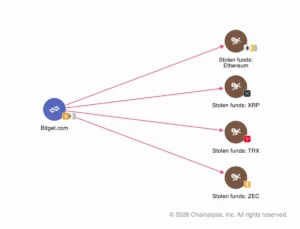
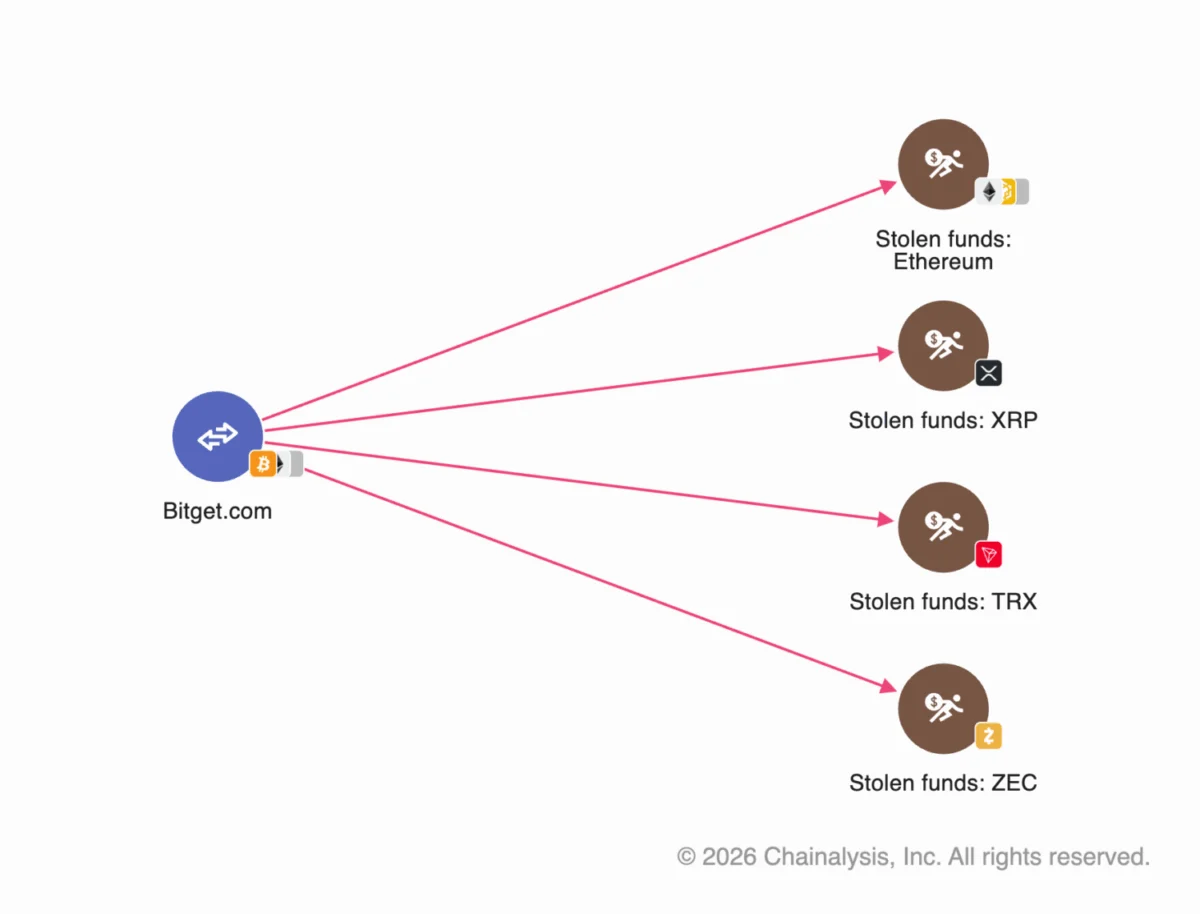
The breach occurred in the early hours of September 24, 2026, targeting Bitget’s hot wallets. The attackers executed a total of 23 transfers in the first three hours, draining a total of $387 million. The initial distribution of the stolen assets was strategically spread across four primary blockchains to complicate the tracing efforts of security firms. Ethereum received the largest share, accounting for 49.7% of the total value. This was followed by XRP at 40.8%, Zcash at 7.6%, and Tron at 1.8%.

The use of XRP and Zcash is particularly notable. While Ethereum and Tron are common targets in decentralized finance (DeFi) exploits, the inclusion of XRP and the privacy-focused Zcash suggests a multi-layered strategy intended to break the continuity of the "money trail." Zcash, which offers shielded transactions, provides a layer of anonymity that traditional transparent ledgers lack, while XRP’s high-speed consensus mechanism allows for rapid movement to various liquidity hubs.
Once the funds were distributed across these four chains, the threat actors began a complex laundering process involving cross-chain liquidity protocols, messaging protocols, and instant swap services. These mechanisms allow users to deposit one asset on a specific blockchain and receive a different asset on another without the need for a centralized intermediary or an account, effectively bypassing standard Know Your Customer (KYC) protocols.
Chronology of the Investigative Response
The timeline of the investigation underscores the critical importance of speed in modern blockchain forensics.
- T+0 Hours: The breach is detected. Bitget halts withdrawals and contacts security partners. Chainalysis activates its Customer Outcomes team and begins initial data ingestion.
- T+1 to T+3 Hours: $387 million is moved across 23 transfers to Ethereum, XRP, Zcash, and Tron. Chainalysis investigators begin defining the logic for custom AI agents to monitor these exit points.
- T+6 Hours: AI-driven labels for the stolen funds go live on the Chainalysis platform. These tags alert global exchanges and financial institutions that any incoming assets from these specific addresses are linked to the Bitget heist.
- T+12 Hours: The "War Room" identifies a major laundering vector through an XRP-to-Bitcoin cross-chain protocol. The AI agents successfully match deposit signatures with corresponding Bitcoin payouts, maintaining the trail despite the change in asset type and network.
- T+24 to T-48 Hours: Tens of millions of dollars are tracked through decentralized exchanges (DEXs) and mixers. The investigative team identifies several attacker-controlled Bitcoin addresses where the funds have finally converged for further obfuscation.
The Role of Agentic AI in Modern Forensics
The Bitget investigation serves as a landmark case for the application of "agentic" AI in cybersecurity. Unlike traditional AI tools that might simply assist in visualizing data or generating reports, an agentic platform allows experts to "interrogate" vast datasets and create autonomous solutions for specific tasks. In the context of the Bitget exploit, this meant the AI could be programmed to recognize the specific behavioral patterns of the DPRK-linked actors and automatically reconcile transactions across disparate blockchains.

One of the most difficult aspects of blockchain tracing is "bridge reconciliation." When funds move across a bridge—a protocol that connects two different blockchains—the link between the sender on Chain A and the receiver on Chain B is often obscured by the protocol’s internal smart contracts. Manually matching these transactions requires an investigator to look at timestamps, amounts, and contract logs across two different explorers. By automating this process, the Chainalysis team was able to maintain a continuous view of the stolen $387 million as it transitioned from XRP into Bitcoin.
However, Chainalysis emphasized that the AI did not replace human judgment. Instead, it served as an "accelerant." Human investigators defined the investigative logic, reviewed the AI’s outputs for accuracy, and made the final decisions on where to direct resources. This hybrid approach is seen as the only viable way to combat state-sponsored actors who use their own sophisticated automation to move and obscure stolen funds.
Broader Context: The DPRK’s 2026 Campaign
The Bitget exploit is not an isolated incident but rather part of a broader, increasingly aggressive campaign by North Korean cyber-operatives. With the $387 million from Bitget, the total value of cryptocurrency stolen by DPRK-attributed actors in 2026 has surpassed $1 billion. This trend highlights the North Korean regime’s continued reliance on cyber-theft as a vital source of revenue, often used to bypass international sanctions and fund its weapons programs.
Historically, the Lazarus Group—the most prominent of the DPRK’s hacking units—has targeted bridges and centralized exchanges with equal fervor. The Bitget attack mirrors previous high-profile heists, such as the 2022 Ronin Bridge hack and the 2023 Harmony Horizon Bridge exploit. The common thread in these attacks is the rapid movement of funds into mixers and the eventual conversion into Bitcoin, which remains the most liquid asset for final "cashing out" through illicit over-the-counter (OTC) brokers.

Industry Reactions and Implications
While Bitget has not released an official statement detailing the exact vulnerability that was exploited, the exchange has been working closely with security firms to recover the assets. The broader crypto industry has responded with calls for heightened security protocols, particularly regarding hot wallet management and the monitoring of cross-chain activity.
Industry analysts suggest that the Bitget exploit will lead to several long-term changes in the sector:
- Enhanced Real-Time Monitoring: Centralized exchanges (CEXs) are likely to invest more heavily in automated monitoring systems that can "freeze" assets the moment they interact with addresses flagged by AI-driven forensic tools.
- Regulatory Pressure on Bridges: The use of cross-chain protocols as laundering tools is drawing the attention of global regulators. There is a growing push to require bridge protocols to implement more robust anti-money laundering (AML) features.
- Collaborative Defense: The success of the Chainalysis "war room" model suggests that the future of crypto-security lies in deep, real-time collaboration between private firms, exchanges, and government agencies.
Future Outlook
The work of tracing the Bitget funds is far from over. Chainalysis has stated that its investigators will continue to monitor the identified destination addresses in the coming weeks. As the threat actors attempt to move the funds from Bitcoin addresses into fiat currency or other assets, the "labels" applied by the forensic team will play a crucial role in disrupting their ability to use the stolen money.
This incident also previews the next generation of investigative capabilities. Chainalysis has hinted at further developments in its AI-driven platform, which are expected to be unveiled in late 2026. As cyber-attackers become more sophisticated, the defense must evolve. The Bitget case proves that while the speed of the thief is formidable, the speed of an AI-augmented investigator can be even faster.

The $387 million heist remains a stark reminder of the vulnerabilities inherent in the digital asset ecosystem. However, it also demonstrates that the tools available to those who monitor and protect these networks are advancing at an unprecedented rate. The battle for the security of the blockchain continues, with AI now firmly established as a primary weapon on the front lines of defense.