The global cryptocurrency ecosystem is reeling from the largest financial cybercrime in history following a sophisticated multi-chain exploit of Binance, the world’s largest digital asset exchange, which resulted in the theft of approximately $6.4 billion. Forensic investigators from Chainalysis have officially attributed the attack to "TraderTraitor," a notorious cybercrime collective operating under the umbrella of the North Korean state-sponsored Lazarus Group. The breach, which began in the late afternoon of October 29, 2026, represents a watershed moment for the industry, highlighting both the persistent vulnerabilities of centralized exchange hot wallets and the unprecedented speed at which the global crypto-compliance infrastructure can now respond to crisis. While the scale of the theft is historic, a coordinated effort between law enforcement, blockchain analytics firms, and stablecoin issuers has already resulted in the freezing of approximately $2.8 billion in stolen assets, marking a significant victory for the industry’s defensive capabilities.
The attribution to North Korea’s TraderTraitor group was solidified through real-time on-chain observation of laundering patterns that mirror previous state-sponsored campaigns. Specifically, investigators identified a direct link between the Binance exploit and a previous attack on the Bitget exchange just one month prior. Funds from both incidents were observed commingling in the same digital addresses, a hallmark of North Korean laundering operations which often use a centralized pool of "clearing" wallets to move illicit proceeds toward the regime’s treasury. For years, the Democratic People’s Republic of Korea (DPRK) has utilized cyber-heists as a primary mechanism to circumvent international sanctions and fund its ballistic missile and nuclear programs, but the $6.4 billion Binance hack represents an escalation in scale that dwarfs all previous efforts, including the 2022 Ronin Bridge exploit.
A Minute-by-Minute Chronology of the Breach
The initial signs of the breach emerged at approximately 4:20 p.m. Eastern Time on October 29. On-chain monitors flagged an unusual volume of outbound transfers from Binance’s hot wallets across multiple blockchain networks, including Ethereum, Bitcoin, and several Layer-2 solutions. The attackers utilized a highly tactical approach on the Ethereum network, employing an operational wallet that had been pre-funded through Tornado Cash, a decentralized privacy protocol, to obscure the source of the "gas" fees required for transaction processing.

Using valid signed authorizations—the origin of which remains the subject of intense internal investigation at Binance—the attacker gained the ability to run custom-deployed code against Binance’s primary hot wallet. This allowed the perpetrator to "sweep" assets directly into addresses under their control. While some transfers appeared as ordinary signed transactions, others involved the execution of complex smart contracts designed to bypass standard withdrawal limits. Within the first sixty minutes of the exploit, the total value of unauthorized transfers had crossed the $5 billion mark, triggering emergency protocols at Binance and alert systems across the global compliance sector.
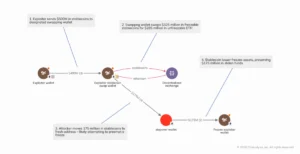
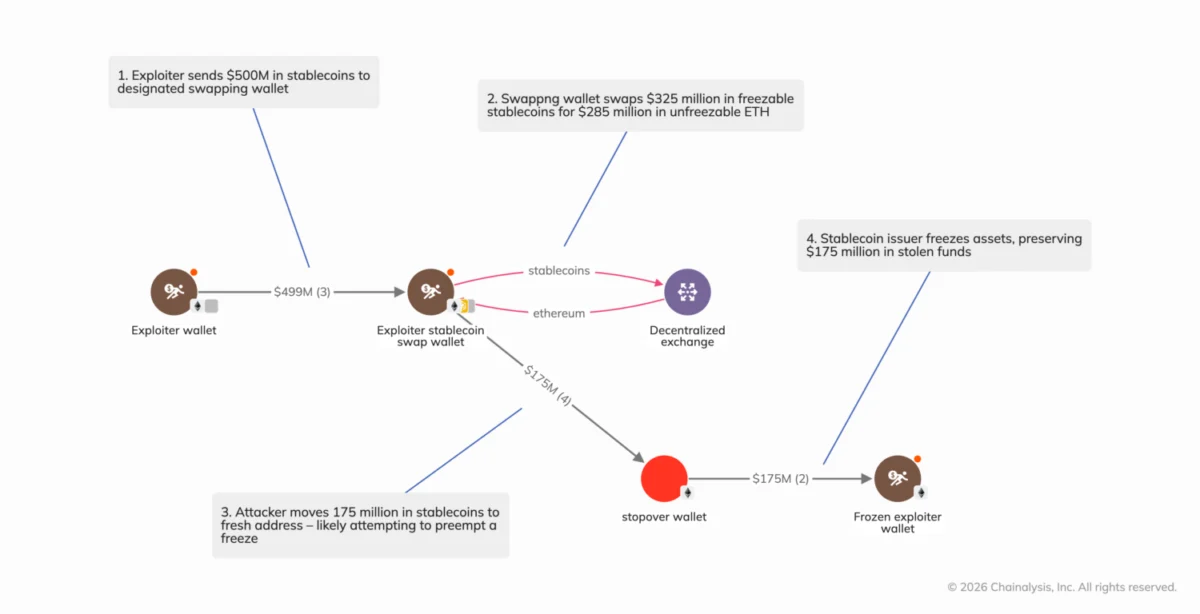
By 4:40 p.m. ET, the attacker entered a critical "race against the clock." While billions of dollars in Bitcoin (BTC) and Ethereum (ETH) are functionally unfreezable due to the decentralized nature of their underlying protocols, a significant portion of the stolen loot was denominated in centralized stablecoins such as USDT (Tether) and USDC (USD Coin). Because these assets are managed by centralized entities, they can be "blacklisted" or frozen at the smart contract level upon the request of law enforcement or during a clear security emergency. Recognizing this vulnerability, the TraderTraitor group attempted to move $500 million of stablecoins into a specialized "swap" wallet. Over a frantic 20-minute window, the attackers successfully converted $325 million of these freezable assets into $285 million worth of ETH, accepting high "slippage" costs in exchange for the permanence of the transaction.
However, the window for escape closed rapidly. By 5:14 p.m. ET, less than an hour after the first funds left Binance, stablecoin issuers—working in close concert with Chainalysis and federal law enforcement—initiated the first wave of freezes. This rapid response prevented the further conversion of roughly $2.8 billion in assets, effectively locking them in "stopover" wallets where they remain inaccessible to the hackers.
Technical Analysis of Laundering and Automation
As the investigation enters its second week, forensic experts have noted a shift in the attackers’ behavior toward high-frequency automation. The TraderTraitor group is currently employing sophisticated scripts to move the remaining unfrozen funds through thousands of addresses in a short period. This technique, often referred to as "peeling" or "chain hopping," is intended to overwhelm manual investigative efforts and create a "fog of war" around the final destination of the assets.

A unique signature of this specific campaign is the use of "circular laundering." Rather than moving funds in a linear path from Wallet A to Wallet B to an exchange, the attackers are circulating funds among a massive web of addresses, often returning funds to addresses used earlier in the sequence. Investigators have identified a consistent programmatic pattern: thousands of addresses are first "primed" with exactly 1 TRX (Tron) before receiving a portion of the stolen funds. This 1 TRX serves as a digital marker or "heartbeat" for the automated system, signaling that a specific address is ready to receive and then immediately forward a larger tranche of stolen assets.
This level of automation suggests that North Korea has significantly upgraded its cyber-infrastructure, moving away from manual laundering processes toward a fully algorithmic system capable of managing thousands of concurrent transactions across different blockchains. Despite this complexity, the transparency of the blockchain remains the investigators’ greatest asset. Every "automated" hop is recorded on the public ledger, allowing firms like Chainalysis to update their "labels" in real-time, effectively tagging the stolen funds as "tainted" before they can be off-ramped into fiat currency.
Global Reactions and Regulatory Implications
The scale of the Binance hack has sent shockwaves through the halls of government and the boardrooms of financial institutions. Binance, which has spent the last several years working to bolster its compliance and security image following previous regulatory settlements, now faces renewed scrutiny regarding its hot wallet management and internal authorization protocols. While the exchange has stated that it is working "around the clock" to assist in the recovery of funds and has hinted at the use of its Secure Asset Fund for Users (SAFU) to cover losses, the sheer magnitude of $6.4 billion may test the limits of any private insurance reserve.
Industry reactions have been a mix of alarm and resolve. "This is no longer just a ‘crypto problem’; this is a national security crisis," stated one former Treasury official. "When a state-sponsored entity can extract $6.4 billion in an afternoon to fund a weapons program, the entire global financial community must respond." Regulatory bodies in the United States, the European Union, and Asia are expected to use this incident as a catalyst for stricter "travel rule" enforcement and more rigorous security audits for centralized exchanges.

Furthermore, the role of "mixers" like Tornado Cash has once again become a focal point of the debate. While the U.S. Treasury had previously sanctioned Tornado Cash, its continued use in this exploit demonstrates the difficulty of de-platforming decentralized protocols. Proponents of privacy argue that the protocols themselves are neutral tools, while law enforcement officials argue they are the primary enablers of state-sponsored money laundering.
The Broader Impact on the Digital Asset Ecosystem
The Binance-TraderTraitor incident serves as a stark reminder of the "honeypot" risk inherent in centralized exchanges. Despite the transition toward decentralized finance (DeFi), centralized platforms remain the primary entry and exit points for the majority of the world’s crypto liquidity. These platforms hold billions of dollars in custody, making them the ultimate targets for elite hacking units with the resources of a nation-state behind them.
However, the fact that $2.8 billion was frozen within hours also provides a glimmer of hope for the industry’s future. It demonstrates a level of maturity and cooperation that did not exist during earlier eras of crypto-crime. The "immune system" of the blockchain—consisting of analytics firms, issuers, and law enforcement—is becoming faster and more resilient.
Looking forward, the investigation is expected to continue for months, if not years. As the TraderTraitor group attempts to move the remaining $3.6 billion of unfreezable assets (largely BTC and ETH) toward off-ramps, they will face a global blockade. Exchanges worldwide have been alerted to the specific wallet clusters associated with the hack, making it increasingly difficult for the attackers to convert the digital assets into the "hard" currency needed to purchase sanctioned goods and technology.

The Binance hack will likely go down in history not just for its record-breaking numbers, but as the moment the cryptocurrency industry was forced to fully integrate into the global security apparatus. As the line between cybercrime and geopolitical warfare continues to blur, the security of digital assets has become a front-line issue for the 21st-century financial system. For Binance and its millions of users, the path to recovery is long, but the lessons learned from this $6.4 billion wake-up call will undoubtedly shape the regulatory and technical landscape of the blockchain for decades to come.