North America remained the most influential region in the global cryptocurrency landscape during the 12-month period ending July 1, 2026, driven by a deep institutional investor base, significant regulatory updates, and the pioneering of "agentic commerce." According to recent market data, the combined crypto economies of the United States and Canada totaled $3.02 trillion during this reporting period. While this represented a modest 1.9% contraction from the previous year, the region continues to serve as the primary exporter of crypto-economic power, institutional standards, and technological infrastructure to the rest of the world.

The United States, which accounts for $2.78 trillion of the regional total, saw its crypto economy decline by 2.2% year-over-year. This dip is largely attributed to the tail end of a challenging bear market cycle; however, the market successfully retained the massive gains achieved during the 2025 period, when the industry nearly doubled in size. The resilience of the U.S. market is credited to the maturation of institutional forces, including the widespread adoption of crypto exchange-traded funds (ETFs), the acceleration of real-world asset (RWA) tokenization, and the global proliferation of dollar-backed stablecoins.
A Chronology of Maturation: From Speculation to Infrastructure
The 2026 reporting period marks a significant shift in the North American crypto narrative. To understand the current landscape, one must look at the sequence of events that stabilized the market following the volatility of the early 2020s.

- January 2024: The launch of spot Bitcoin ETFs in the U.S. provided a regulated gateway for institutional capital, fundamentally changing the country’s role from a speculative hub to a net importer of Bitcoin.
- May 2025: Coinbase incubated and launched the x402 protocol, an open-source standard designed to facilitate machine-to-machine payments.
- Mid-2025: The U.S. Congress passed the GENIUS Act, providing a formal legal framework for digital asset custody and stablecoin issuance, which formalized the U.S. dollar’s role as the primary currency of the on-chain world.
- March 2026: Canada’s Stablecoin Act received Royal Assent, paving the way for regulated Canadian Dollar (CAD) stablecoins and reinforcing the country’s robust peer-to-peer (P2P) economy.
Hoolie Tejwani, Head of Coinbase Ventures, noted that the industry has transitioned from building "blocks" to delivering "products." In 2026, the market is no longer defined by hype, but by real users, liquidity, and functional markets that bridge the gap between traditional finance (TradFi) and decentralized protocols.
The Rise of Agentic Commerce and the x402 Protocol
One of the most significant developments in the 2026 period is the emergence of the "AI on-chain economy." As the United States leads the global race in artificial intelligence, it has naturally become the dominant builder of the infrastructure that allows AI agents to spend money.

The x402 protocol has emerged as the leading digital payment rail for autonomous software. By the end of the 2026 period, over 138 million x402 transactions were recorded on Base, the blockchain most utilized for agentic commerce. This technology allows AI agents to perform micro-transactions that are economically unfeasible on traditional payment rails like credit card networks.
Data reveals that 87% of x402 payments fall into the "micropayment" category, valued between $0.0001 and $0.10. These tiny settlements enable a "pay-as-you-go" model for digital services, such as API calls, data pulls, and code reviews. Circle, the issuer of the USDC stablecoin, describes a burgeoning division of labor: traditional card rails remain the choice for consumer-prompted payments, while stablecoin rails handle machine-to-machine settlements.

The behavior of these AI-driven wallets suggests a maturing ecosystem. In late 2025, wallets typically waited 73 days after their initial funding to initiate an x402 transaction. By the third quarter of 2026, that gap plummeted to just 18 minutes. Furthermore, 67% of new wallets now spend within their first hour of being funded. This "temporal compression" indicates that wallets are being purpose-built for immediate economic activity rather than passive holding.
The United States as a Strategic Importer of Bitcoin and Exporter of Dollars
A distinct divergence has emerged between the U.S. and the rest of the world regarding asset preference. The U.S. has effectively become a "sink" for Bitcoin and a "source" for stablecoins.

Since the approval of spot ETFs, the U.S. share of global Bitcoin activity has risen consistently. In 2026, for the first time since 2022, the U.S. became a net importer of Bitcoin. While retail transfers (under $10,000) remained net outbound, institutional-sized transfers (over $10 million) saw net inflows of 53,200 coins. This trend is bolstered by the emergence of a federal Strategic Bitcoin Reserve, which has added sovereign-level demand to the private sector’s interest in Bitcoin as a "monetary alternative" to rising government debt.
Conversely, the U.S. is the world’s leading exporter of digital dollars. Stablecoins now account for a massive portion of global crypto activity, with 99.1% of stablecoin order book volume pegged to the U.S. dollar. For international users, dollar stablecoins provide a way to hold U.S. currency without an American bank account. For the U.S. government, this trend creates indirect demand for its debt, as most major stablecoins, like USDC, are backed by short-dated U.S. Treasury bills.

Tokenization: The Convergence of Blockchain and Traditional Debt
The tokenization of real-world assets (RWAs) saw explosive growth during the 2026 period. The global RWA market reached $36.07 billion, a 135% increase year-over-year. U.S. Treasury bonds remain the cornerstone of this sector, representing $15.42 billion, or 42.8% of all tokenized RWA value.
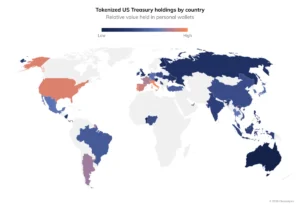
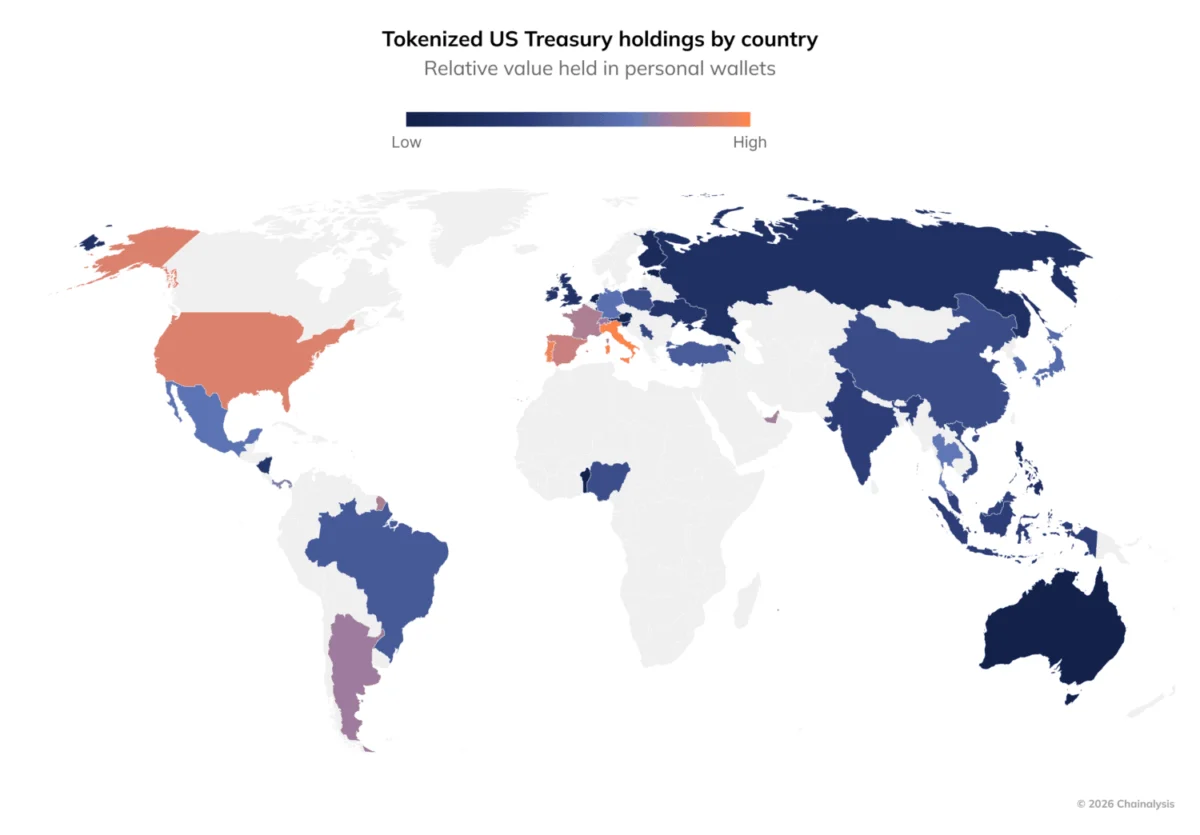
While the infrastructure is American, the user base is global. By value, the top holders of tokenized U.S. Treasuries are located in Italy (29.9%), Portugal (18.8%), and Singapore (18.2%). The United States ranks fourth in value held, despite having a significant number of individual holders. This suggests that tokenization is successfully democratizing access to U.S. government debt, allowing retail and institutional investors in foreign jurisdictions to hold Treasury-backed assets without a U.S. brokerage relationship.

Other sectors of tokenization are also showing rapid growth, albeit from smaller bases. Corporate credit tokenization grew by 3,156%, and private equity tokenization rose by 1,340%. Tom Murphy, Head of Communications for Securitize, stated that the end state is not a separate "crypto" financial system, but a single financial system utilizing superior blockchain technology for speed, programmability, and global interoperability.
Canada’s Resilience: A Global Leader in Peer-to-Peer Economy
While the U.S. market experienced a slight contraction, Canada’s crypto economy grew by 2.3% to reach $247.7 billion. Canada’s strength lies in its grassroots adoption and its robust peer-to-peer (P2P) infrastructure. Among G7 nations, Canada ranked first in the "Big Money Index" for P2P activity and seventh globally.

A primary driver of this activity is Canada’s large immigrant population, which makes up approximately 23% of the total population—the highest share in the G7. These residents utilize crypto rails, particularly stablecoins, for cross-border remittances to countries like India, the Philippines, and China.
Key data points from Canada’s remittance corridors include:

- Total Volume: $2.36 billion in stablecoin and Bitcoin transfers to India, China, and the Philippines (a 141% increase YoY).
- Transaction Count: 3.56 million transactions during the period.
- Average Transfer Size: $663, indicating high retail and personal usage.
- Cost Efficiency: While traditional banks charge upwards of 7% for international transfers, stablecoin transfers settle for a fraction of a cent.
However, this reliance on USD-denominated stablecoins has drawn the attention of Canadian policymakers. Morva Rohani, Executive Director of the Canadian Web3 Council, noted that when Canadians buy USD stablecoins, they are essentially creating demand for U.S. government debt at the expense of Canadian sovereign debt. The 2026 Stablecoin Act is a strategic attempt to foster a domestic CAD-stablecoin market to mitigate this "dollarization" of the Canadian digital economy.
Broader Implications and the Competitive Global Landscape
The 2026 reporting period highlights a fundamental reality: while the user base for crypto is global, the infrastructure layer remains predominantly American. U.S.-based institutions, developers, and regulators are setting the standards for how the world interacts with on-chain value.

However, this dominance is being challenged by "AI nationalism" and regional regulatory frameworks. In China, for instance, AI agents are increasingly utilizing domestic open-weight models that are free to use, rather than U.S.-developed metered models like ChatGPT or Claude. This has led to a lower share of "model inference" payments from Chinese-linked wallets compared to their American counterparts.
Furthermore, jurisdictions like the European Union (under MiCA), Singapore, and Brazil are aggressively building their own regulated stablecoin frameworks and programmable "digital real" rails. These efforts are explicit attempts to reduce dependency on U.S. dollar-denominated infrastructure.

In conclusion, North America’s crypto economy in 2026 is characterized by institutional maturation and the successful integration of AI into financial workflows. While market values may fluctuate with the broader economy, the underlying rails—built on x402, tokenized Treasuries, and stablecoins—are becoming a permanent fixture of the global financial architecture. The challenge for the coming years will be for regulators to keep pace with "machine-speed" commerce while ensuring that the benefits of this new infrastructure are balanced with consumer protection and national economic sovereignty.