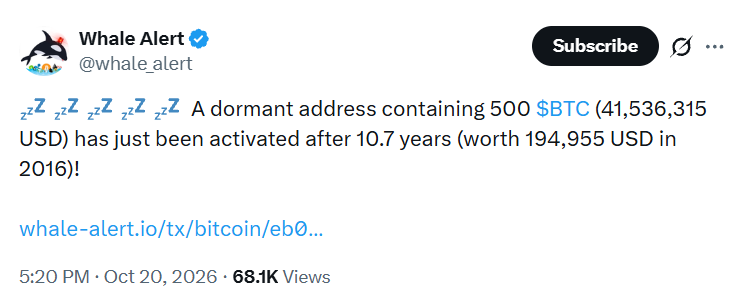
A significant movement of cryptocurrency has captured the attention of the financial and blockchain communities as a previously dormant Bitcoin (BTC) wallet, inactive for approximately 10.7 years, transferred 500 BTC, now valued at around $41.54 million, to Coinbase Prime. This transaction, flagged by the blockchain analytics firm Whale Alert on Tuesday evening, represents a remarkable increase in value, with the transferred stash appreciating over 212 times since its estimated acquisition in 2016.
The Origins of a Significant Bitcoin Stash
Blockchain analytics firm Arkham Intelligence has attributed this substantial Bitcoin holding to Clifton Collins, an Irish cannabis cultivator. Collins is reportedly associated with a fortune of approximately 6,000 BTC, a sum that has been the subject of intense recovery efforts by Irish authorities. The recent 500 BTC transfer is not an isolated event; it marks the fifth such movement of 500 BTC from wallets linked to Collins in 2026 alone, according to Arkham’s reports. These cumulative transfers this year now total 2,500 BTC, underscoring a pattern of activity surrounding what was once considered an inaccessible cryptocurrency fortune.
A History of Recovery and Evolving Access
The story of Collins’ Bitcoin is a fascinating case study in the challenges and eventual successes of cryptocurrency recovery. Collins, a former beekeeper from Dublin, amassed his considerable Bitcoin holdings in late 2011 and early 2012, a period when Bitcoin was trading at mere dollars per coin. He reportedly took meticulous steps to secure his wealth, dividing the approximately 6,000 BTC across 12 distinct wallets, each containing 500 BTC. His chosen method of protection involved printing private keys on paper and concealing them within the aluminum cap of a fishing rod case, which he then stored at a rented property in County Galway.
The turning point in this narrative came in 2020 when Collins was arrested following the discovery of cannabis in his vehicle, leading to a five-year prison sentence. During his incarceration, authorities conducted a search of the rented property. In a twist of fate that highlights the physical vulnerabilities of digital asset storage, the fishing rod case containing the crucial private keys was reportedly discarded as part of the property clearance. This oversight rendered the substantial Bitcoin fortune inaccessible, transforming it into one of Ireland’s most prominent cryptocurrency recovery challenges.
However, the tide began to turn for Irish authorities. In March 2026, Ireland’s Criminal Assets Bureau announced a significant breakthrough: the successful access of a previously inaccessible 500 BTC wallet. This achievement was facilitated by the collaborative efforts of Europol’s European Cybercrime Centre, demonstrating the growing international cooperation in tackling sophisticated financial crimes involving digital assets. Further recoveries followed in May and July of the same year, with another 500 BTC transfer to Coinbase Prime occurring in August, preceding the most recent transaction on Tuesday.
The Latest Transaction: What Does it Signify?
The recent transfer of 500 BTC to a Coinbase Prime deposit wallet raises several questions. Coinbase Prime is a service catering to institutional investors, offering robust trading and custody solutions for digital assets. While the destination address indicates a professional platform, the transaction data itself does not definitively reveal whether the Bitcoin was sold or who the ultimate initiator of the transfer was. The mere presence of the coins on a Coinbase Prime address does not automatically confirm their liquidation; they could be moved for various strategic reasons, including enhanced security, consolidation for future trading, or transfer to other institutional custody solutions.
The pattern of 500 BTC movements from Collins-linked wallets throughout 2026 is noteworthy. Cumulatively, these transfers represent approximately 42% of his reported 6,000 BTC fortune. This leaves an estimated 3,500 BTC potentially still held across other wallets, suggesting that the full extent of the recovery and redistribution of Collins’ assets may not yet be complete.
A Broader Trend of Dormant Bitcoin Activity
This substantial transfer by Collins-linked wallets occurs within a broader context of increased activity among long-dormant Bitcoin holders. In the days leading up to this event, other significant movements of older Bitcoin have been observed. On Sunday, a separate wallet, which had been inactive for over a decade, moved 411.45 BTC, valued at approximately $34 million. The day prior, two other wallets collectively transferred 417 BTC.
This surge in activity among "Satoshi-era" holders—those who acquired Bitcoin in its earliest days—has been accelerating since September and continuing into October. Several theories attempt to explain this phenomenon:
- Potential Selling Pressure: Some market participants speculate that these long-term holders may be preparing to realize significant profits, especially given the current bull market conditions and the extraordinary gains accrued over more than a decade.
- Custody Adjustments: Holders might be moving their assets to more modern or secure custody solutions as the cryptocurrency landscape evolves.
- Strategic Reallocation: Funds could be being moved between wallets for various strategic purposes, such as consolidating holdings, preparing for diversification, or simply enhancing security protocols.
- Regulatory Preparedness: As regulatory frameworks around digital assets become clearer in various jurisdictions, some holders might be proactively adjusting their holdings to comply with anticipated regulations.
Market Impact and Bitcoin’s Current Standing
The implications of these large, historical Bitcoin movements are multifaceted. On one hand, significant selling pressure from a large number of dormant coins entering the market could potentially exert downward pressure on Bitcoin’s price. However, the demand side of the equation is also robust, with increasing institutional adoption and growing interest from retail investors.
At the time of reporting, Bitcoin was trading at approximately $84,669, reflecting a 2.62% increase over the preceding 24 hours. This current market performance indicates resilience, even amidst the potential for increased supply from long-dormant wallets. The ongoing narrative surrounding Bitcoin, characterized by its limited supply, growing adoption, and its role as a potential inflation hedge, continues to drive its valuation.
The movements from Collins’ wallets, and similar transactions from other long-dormant holdings, serve as a stark reminder of the enduring value and the complex life cycles of early Bitcoin acquisitions. As these historical assets resurface, they not only contribute to market dynamics but also offer insights into the evolution of digital asset management, security, and the long arm of financial recovery efforts in the digital age. The coming weeks and months will likely reveal more about the ultimate disposition of these substantial Bitcoin holdings and their broader impact on the cryptocurrency market.