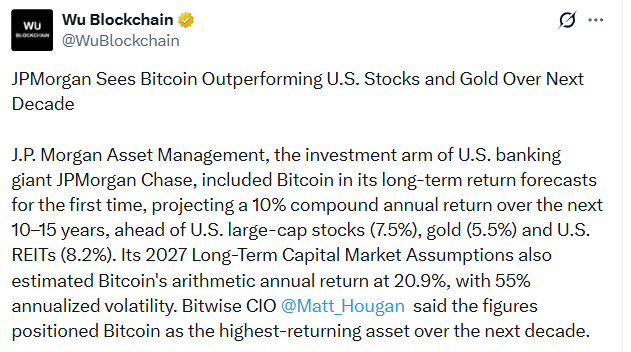
In a significant report released today, JPMorgan Asset Management, a titan in the global financial landscape, has put forth a bold projection: Bitcoin is poised to outperform both traditional safe-haven assets like gold and the broader US stock market over the next decade. This forecast from a prominent banking institution not only lends further credibility to Bitcoin as a legitimate investment alternative but also signals a potential shift in institutional perception towards digital assets. The report, titled "2027 Long-Term Capital Market Assumptions," marks a pivotal moment, as it is the first time in the 31-year history of JPMorgan’s annual report that Bitcoin has been included in its long-term return forecast.
Bitcoin’s Ascendancy: A New Asset Class in Focus
The core of JPMorgan’s analysis suggests that Bitcoin is expected to deliver an annualized compound return of 10% over the next 10 to 15 years. This projection places Bitcoin ahead of several traditional investment vehicles that have long been considered pillars of diversified portfolios. Specifically, the report anticipates that US large-cap stocks will yield an annual return of approximately 7.5%, while gold is expected to generate a 5.5% annual return. Furthermore, US real estate investment trusts (REITs) are projected to offer a return of 8.2% annually. These comparative figures highlight JPMorgan’s view that Bitcoin possesses a more robust long-term return potential than these established asset classes.
While acknowledging Bitcoin’s inherent volatility, which it estimates at 55% annualized compared to gold’s 17.2%, JPMorgan’s outlook suggests that this volatility, paradoxically, opens avenues for substantial gains. The report’s arithmetic return projection for Bitcoin stands at an impressive 20.9%, underscoring the potential for significant upside, albeit with the accompanying risk of substantial drawdowns. This dual nature of high reward and high risk is a characteristic that has long defined Bitcoin’s investment profile.
A Shift in Institutional Stance: From Skepticism to Inclusion
The inclusion of Bitcoin in JPMorgan’s long-term capital market assumptions represents a notable departure from the bank’s historical stance, particularly from its CEO, Jamie Dimon, who has been a vocal critic of cryptocurrencies. Dimon has previously referred to Bitcoin as a "scam" and a "fraud." However, the evolving financial landscape and the increasing institutional adoption of digital assets appear to have influenced the bank’s strategic outlook. This shift within JPMorgan mirrors a broader trend across Wall Street, where major financial institutions are increasingly engaging with and acknowledging the potential of cryptocurrencies.
Matt Hougan, Chief Investment Officer at Bitwise, a prominent cryptocurrency asset manager, lauded JPMorgan’s forecast as a significant milestone in Bitcoin’s journey toward mainstream acceptance. Hougan’s sentiment reflects a growing consensus within the crypto community that such endorsements from traditional financial institutions are crucial for the asset class’s maturation and wider adoption. The fact that JPMorgan, a firm with a historically cautious approach to emerging asset classes, is now formally forecasting Bitcoin’s performance signals a profound change in institutional thinking.
The Genesis of the Forecast: A Decade of Digital Evolution
The journey of Bitcoin from a niche digital experiment to an asset class considered by major financial institutions has been a dynamic one, marked by periods of intense speculation, regulatory scrutiny, and technological advancements. Launched in 2009 by an anonymous entity known as Satoshi Nakamoto, Bitcoin was initially conceived as a decentralized peer-to-peer electronic cash system. Its early years were characterized by a small community of enthusiasts and a low market capitalization.
However, as the years progressed, Bitcoin’s underlying blockchain technology garnered attention, and its scarcity, designed to be capped at 21 million coins, began to be recognized as a potential hedge against inflation, similar to gold. This narrative, coupled with increasing accessibility through regulated exchanges and the development of institutional-grade custody solutions, has gradually attracted the attention of sophisticated investors and financial institutions.
The JPMorgan report’s release can be contextualized within a broader trend of institutional adoption that has gained momentum in recent years. While specific details regarding the methodology and data points that led to JPMorgan’s projections are proprietary, it is reasonable to infer that the analysis likely considered factors such as:
- Network Effects: The growth in the number of Bitcoin users, developers, and businesses building on or accepting Bitcoin.
- Scarcity and Supply Dynamics: The fixed supply of Bitcoin and the halving events that reduce the rate of new Bitcoin creation, which historically have correlated with price appreciation.
- Macroeconomic Factors: The current global economic climate, including inflation rates, interest rate policies, and geopolitical uncertainties, which can drive demand for alternative assets.
- Regulatory Developments: Evolving regulatory frameworks around digital assets in major economies, which can either foster or hinder adoption.
- Technological Advancements: Improvements in Bitcoin’s infrastructure, such as the Lightning Network, which aim to enhance scalability and transaction speeds.
Broader Implications for the Financial Ecosystem
JPMorgan’s forecast carries significant implications for the broader financial ecosystem. Firstly, it suggests that major financial institutions are no longer viewing Bitcoin solely as a speculative asset but rather as a legitimate component of long-term investment strategies. This validation could encourage more retail and institutional investors to allocate capital to Bitcoin, potentially driving further price appreciation and market capitalization growth.
Secondly, the report could accelerate the development of more sophisticated financial products and services related to Bitcoin. This might include a wider array of exchange-traded funds (ETFs), futures contracts, and other derivatives, making it easier for a broader range of investors to gain exposure to the asset class. The recent approval of spot Bitcoin ETFs in the United States by the SEC is a prime example of this trend, facilitating easier access for traditional investors.
Thirdly, the comparison with gold is particularly noteworthy. For decades, gold has been the quintessential safe-haven asset, a store of value during times of economic turmoil. If Bitcoin is indeed predicted to outperform gold over the long term, it could signal a potential shift in the preferred "digital gold" narrative, especially among younger generations who are more digitally native.
However, it is crucial to temper enthusiasm with a realistic understanding of the risks. Bitcoin’s volatility remains a significant factor, and the asset class is still subject to regulatory uncertainties in various jurisdictions. Furthermore, the long-term performance of any asset class is not guaranteed, and unforeseen market events can significantly impact outcomes.
Expert Reactions and the Road Ahead
The reaction from industry experts has been largely positive, viewing JPMorgan’s inclusion of Bitcoin as a testament to its growing maturity and acceptance. The report serves as a powerful signal to investors that digital assets are no longer a fringe phenomenon but a serious consideration for portfolio diversification.
The inclusion of Bitcoin in such a prominent report by a major financial institution like JPMorgan is a data point that cannot be ignored. It suggests that the institutional perspective is evolving, moving from outright dismissal to strategic consideration. As the digital asset landscape continues to mature, further integration and acceptance by traditional financial players are likely, shaping the future of investing in profound ways. The coming years will undoubtedly reveal whether JPMorgan’s optimistic projections for Bitcoin hold true, but the report itself marks a significant step in the ongoing evolution of global finance.