The cryptocurrency landscape is abuzz with a significant development following a recent Senate vote aimed at nullifying a controversial Securities and Exchange Commission (SEC) policy that threatened to classify certain digital assets as securities. This legislative action, which has drawn praise from prominent figures in the crypto community, now faces a critical juncture as it awaits a potential presidential decision.
At the forefront of this celebration is Michael Saylor, a staunch Bitcoin advocate and co-founder of MicroStrategy. Saylor has been a vocal critic of what he perceives as the SEC’s overreach and its attempts to impose stringent regulations on the nascent digital asset industry. His public endorsement of the Senate’s vote underscores a broader sentiment within the crypto sector: a desire for regulatory clarity that fosters innovation rather than stifles it.
The policy in question, Staff Accounting Bulletin 121 (SAB 121), issued by the SEC, mandated that companies holding digital assets on behalf of clients must account for those assets on their balance sheets at fair value. Critics argued that this requirement would impose significant capital burdens on financial institutions, effectively discouraging them from offering custody services for digital assets. This, in turn, was feared to hinder institutional adoption and limit the accessibility of cryptocurrencies for mainstream investors.
The Senate’s vote, conducted under the Congressional Review Act (CRA), represents a powerful check on executive agency rulemaking. The CRA allows Congress to review and, if deemed necessary, overturn regulations issued by federal agencies. For the crypto industry, the passage of this resolution through the Senate was a welcome reprieve, signaling a potential shift in the regulatory tide.
However, the journey of this resolution is far from over. The bill now heads to President Joe Biden’s desk, where it faces a significant hurdle: a potential veto. President Biden has previously expressed concerns about the cryptocurrency market, and his administration has been cautious in its approach to digital assets. The White House has indicated that the President would likely veto the bill, citing concerns about undermining the SEC’s authority and its mandate to protect investors. This looming veto casts a shadow of uncertainty over the crypto community’s optimism.
Background and Chronology of the Regulatory Challenge

The debate surrounding the SEC’s approach to cryptocurrency regulation has been ongoing for several years. The commission, under Chair Gary Gensler, has consistently maintained that most cryptocurrencies fall under the definition of securities and should be regulated accordingly. This stance has led to numerous enforcement actions against crypto firms, creating a climate of apprehension within the industry.
The issuance of SAB 121 in March 2022 marked a significant escalation of this regulatory pressure. The bulletin’s strict accounting requirements immediately sparked backlash from financial institutions and crypto industry participants. They argued that SAB 121 was not a rule enacted through the formal notice-and-comment rulemaking process but rather an informal staff bulletin that imposed substantial operational and financial burdens.
In response to growing opposition, Senator Cynthia Lummis and Representative Mike Flood introduced a resolution to overturn SAB 121 using the CRA. The resolution successfully passed the House of Representatives in May 2024 with bipartisan support, and subsequently cleared the Senate. This legislative momentum highlights a growing bipartisan consensus in Congress to push back against what is perceived by some as an overly aggressive regulatory stance by the SEC.
The timeline leading up to the Senate vote underscores the urgency felt by proponents of the resolution. Lobbying efforts intensified in the weeks preceding the vote, with industry groups and influential figures like Michael Saylor actively engaging lawmakers to advocate for the nullification of SAB 121.
The Quantum Threat: A Looming Concern for Digital Assets
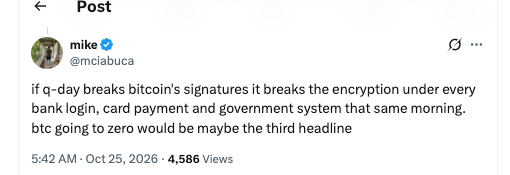
While the immediate regulatory battles capture headlines, another, more existential threat looms over the digital asset space: the advent of quantum computing. Renowned Bitcoin analyst Willy Woo recently shed light on this complex issue, addressing fears surrounding "Q-Day," the theoretical point at which quantum computers will possess the power to break current public cryptography.

Woo, known for his insightful and often contrarian analyses, took to X (formerly Twitter) to share his perspective. He acknowledged the legitimate concerns regarding older Bitcoin addresses that may not be quantum-resistant. However, he strongly refuted the notion that Q-Day would lead to a complete collapse of Bitcoin and its value plummeting to zero, labeling such predictions as a product of "sheer ignorance."
What is Q-Day?
Q-Day, also referred to as Y2Q, represents the anticipated moment when sufficiently powerful quantum computers will be able to compromise the public-key cryptography that underpins much of modern digital security, including the blockchain. Companies like Google have issued warnings, suggesting that Q-Day could materialize within the next few years, potentially ushering in a new era of cybersecurity challenges.
The primary risk associated with Q-Day for cryptocurrencies lies in the potential for private keys to be reverse-engineered from exposed public keys. This vulnerability primarily affects older Bitcoin address formats, such as the original Pay-to-Public-Key-Hash (P2PKH) addresses, and addresses that have been reused, making their public keys readily accessible. While a significant portion of Bitcoin addresses and most newer cryptocurrency networks have already migrated to quantum-resistant algorithms, the foundational Bitcoin protocol and older addresses remain theoretical targets. Satoshi Nakamoto’s original Bitcoin holdings, for instance, are theoretically vulnerable.
It is crucial to understand that the impact of Q-Day extends far beyond the cryptocurrency realm. The global financial system, including banking institutions, insurance companies, and countless other enterprises, relies heavily on public-key cryptography for securing sensitive data and transactions. A widespread cryptographic failure would have profound and far-reaching consequences across all sectors of the economy.
Industry Reactions and Expert Analysis

The debate surrounding Q-Day has generated a diverse range of opinions within the crypto community. Some users express a pragmatic approach, recognizing the threat while emphasizing the ongoing development of quantum-resistant solutions. One user, in a reply to Willy Woo, highlighted the long lead times required for quantum computers to reach such capabilities, noting that current machines are far from posing an immediate threat.
Willy Woo, in his subsequent replies, further elaborated on his nuanced perspective. He suggested that even in the event of successful exploitation of older addresses, the ensuing legal battles and the potential for seized funds to be locked up in litigation could paradoxically lead to increased Bitcoin price stability and even appreciation. This perspective introduces an element of economic and legal complexity to the purely technical threat.
The Quantum Computing Landscape: Progress and Projections
While the precise timeline for Q-Day remains a subject of intense debate and revision, progress in quantum computing is undeniable. Google has been a prominent player, with its quantum AI division actively researching and developing quantum algorithms. IBM Quantum has also made significant strides, boasting a 1,132-qubit system. However, estimates suggest that breaking Bitcoin’s SHA-256 algorithm, a critical component of its security, would require a quantum computer with around 20,000 qubits, a threshold that is still some distance away.
Current quantum computers are already finding practical applications in research and development, demonstrating enhanced processing capabilities for specific computational tasks. While not yet capable of breaking public encryption, their rapid advancement necessitates proactive measures from industries reliant on cryptographic security.
Broader Implications of Regulatory Battles and Technological Advancements
The Senate’s vote to overturn SAB 121, if it withstands a presidential veto, represents a significant victory for the cryptocurrency industry, signaling a potential shift towards a more accommodating regulatory environment. It suggests that lawmakers are increasingly willing to challenge the SEC’s expansive interpretation of securities laws in the digital asset space. This could pave the way for greater institutional involvement and innovation within the crypto ecosystem.
Simultaneously, the ongoing developments in quantum computing serve as a potent reminder of the need for continuous technological adaptation. The crypto industry, as a nascent and technologically driven sector, is particularly well-positioned to embrace and implement quantum-resistant cryptography. Proactive migration to secure algorithms will be paramount in safeguarding digital assets against future threats.
The interplay between regulatory frameworks and technological advancements will continue to shape the future of cryptocurrencies. While the immediate focus is on the SEC’s policies and the potential for a presidential veto, the long-term security and sustainability of digital assets will depend on the industry’s ability to navigate both regulatory challenges and the evolving landscape of cybersecurity. The events of recent weeks highlight a dynamic environment where legislative action, technological progress, and market sentiment converge to define the path forward for digital finance. The outcome of the presidential decision on the Senate’s resolution will undoubtedly be a key indicator of the direction of crypto regulation in the United States.