Moonshot AI, a prominent Chinese artificial intelligence startup, has made a significant move in the global AI landscape by releasing Kimi K3.1 Pro as open weights. This release, announced this week on the company’s Hugging Face organization page, presents a compelling paradox: a remarkably short and permissive license designed to foster widespread adoption, juxtaposed against a model of such colossal scale—2.8 trillion parameters—that its practical deployment is limited to organizations with substantial computational resources. The initiative signals Moonshot AI’s ambition to democratize access to its cutting-edge AI capabilities while strategically safeguarding its commercial interests.
Moonshot AI’s Strategic Vision and Kimi’s Lineage
Founded by Yang Zhilin, a former Google Brain researcher, Moonshot AI has rapidly emerged as a key player in China’s intensely competitive AI sector. The company gained significant traction with its Kimi chatbot, known for its exceptionally long context window, a feature that allows the AI to process and recall vast amounts of information in a single interaction. The Kimi K3.1 Pro release builds upon this foundation, post-trained from its predecessor Kimi K3 and boasting an impressive 1-million-token context window. This capability positions Kimi K3.1 Pro as a formidable competitor to global leaders like OpenAI’s GPT models and Anthropic’s Claude, particularly in applications requiring deep contextual understanding and extensive document analysis.
The decision to release K3.1 Pro as open weights underpins a broader industry trend where leading AI developers balance proprietary models with community-driven open-source or open-weight initiatives. Companies like Meta with Llama and Mistral AI have demonstrated the power of this approach, fostering innovation, attracting talent, and establishing their models as de facto industry standards. For Moonshot AI, this strategy likely aims to accelerate the development of applications built on Kimi’s architecture, expand its ecosystem, and solidify its reputation as a technical innovator on the global stage, beyond its already strong presence in the Chinese market. The company, which reportedly secured over $1 billion in funding earlier this year, including investments from Alibaba and Tencent, is clearly leveraging its financial and technical prowess to make a significant impact.
Unpacking the Permissive License: Freedom with Strategic Guardrails
At the heart of the Kimi K3.1 Pro release is its license, a document spanning a mere 3.08 kilobytes—significantly shorter than most standard terms of service agreements. Described as an MIT-style grant, the license is remarkably broad in its permissions. It explicitly covers the model’s weights, parameters, configuration files, inference and training code, and associated documentation. Licensees are granted extensive rights, including use, copying, modification, distribution, sublicensing, and sale, with explicit inclusion for fine-tuning and the creation of derivative works. This level of permissiveness is a strong indicator of Moonshot AI’s intent to encourage widespread experimentation and commercial application.

The foundational conditions are straightforward: a copyright notice must accompany all copies, and use must comply with applicable laws. The software is provided "as is," without warranty, a standard clause in such open releases. For the vast majority of developers, researchers, and startups, these terms mean they can download the model, adapt it to their specific needs, and integrate it into products without the need for complex negotiations or significant legal hurdles. This accessibility stands in stark contrast to the highly restrictive licenses often associated with purely proprietary models, fostering an environment of rapid development and deployment.
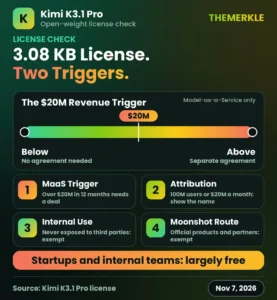
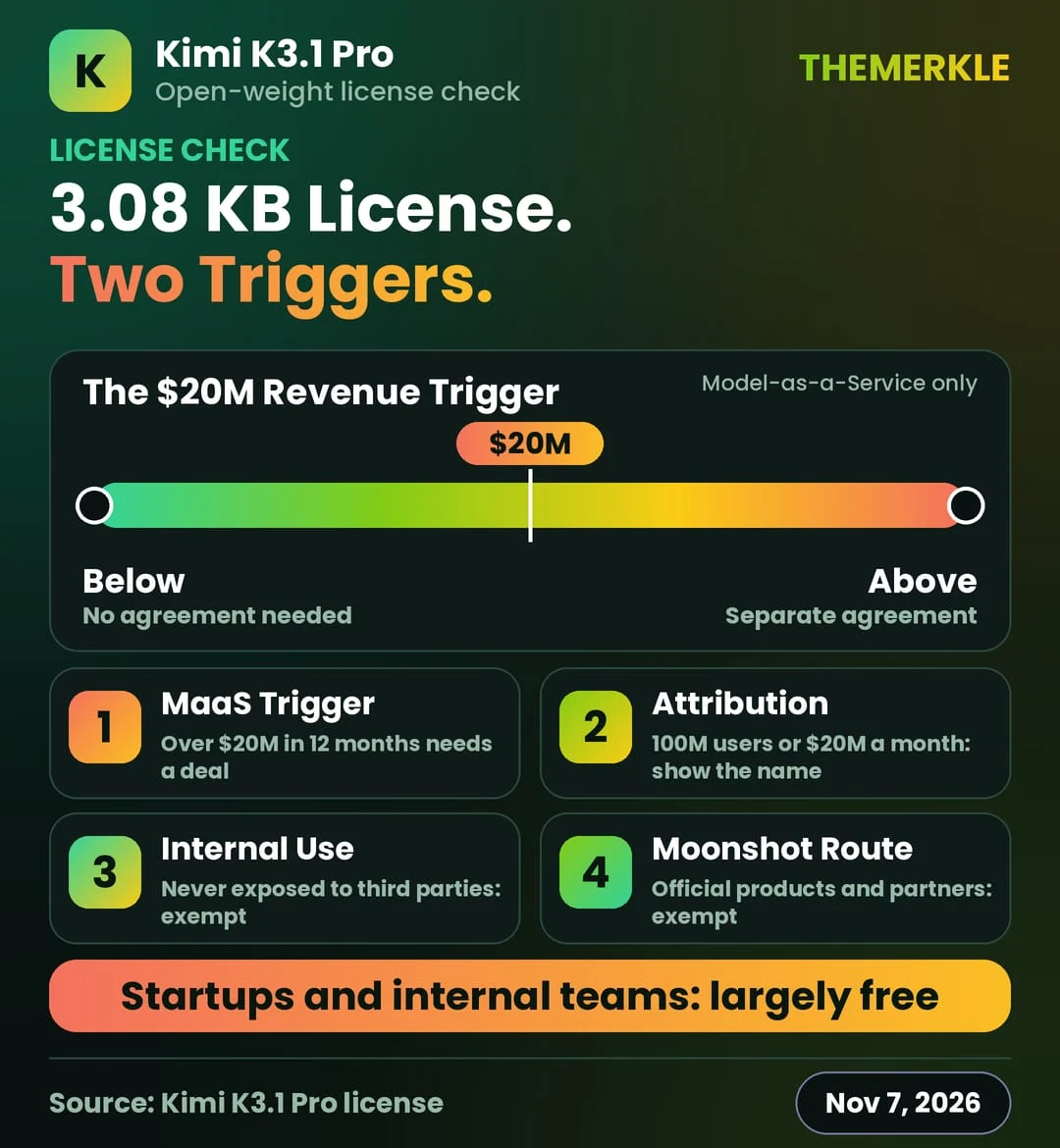
However, Moonshot AI has incorporated two crucial "revenue triggers" into the license, acting as strategic guardrails designed to protect its commercial interests, particularly its hosted API services. The first trigger targets "Model as a Service" (MaaS) businesses. If a licensee and its affiliates operate such a business—defined as providing third parties with access to inference or fine-tuning capabilities, typically via an API, where the third party can meaningfully control inputs, parameters, or training data—and their combined revenue surpasses $20 million in any 12-month period, a separate agreement with Moonshot AI is required before continued commercial use. This clause includes carve-outs for end-user products with embedded model capabilities and for simply relaying requests to models hosted elsewhere, clarifying its focus on direct inference providers.
The second trigger concerns attribution. Any commercial product leveraging Kimi K3.1 Pro that achieves more than 100 million monthly active users or generates over $20 million in monthly revenue must prominently display "Kimi K3.1-Pro" within its user interface. This ensures brand visibility for Moonshot AI in successful, large-scale applications, akin to how some open-source projects require attribution for their use in commercial products. Both triggers are waived for internal use where the model or its outputs are never exposed to third parties, and for use through Moonshot AI’s official products or certified inference partners. This nuanced approach clearly delineates obligations: startups and internal development teams enjoy significant freedom, while large-scale inference resellers and consumer-facing products with substantial reach face specific requirements. Companies approaching these thresholds are strongly advised to consult legal counsel to ensure compliance.
The Colossal Footprint: A Deep Dive into Kimi K3.1 Pro’s Architecture
While the license offers unparalleled freedom, the sheer scale of Kimi K3.1 Pro presents the primary practical barrier to its adoption. The model is a Mixture-of-Experts (MoE) architecture, boasting a staggering 2.8 trillion total parameters. In an MoE setup, only a subset of these parameters is "active" for any given token inference, making computation more efficient than a dense model of equivalent total parameter count. K3.1 Pro activates 104 billion parameters per token, spread across 896 experts, with 16 experts selected for each token. This design allows for a massive overall capacity without incurring the prohibitive computational cost of activating all parameters simultaneously.
However, the memory footprint remains immense. Even with sophisticated quantization techniques, such as MXFP4 for weights and MXFP8 for activations, trained with quantization-aware training, the model’s size is daunting. A conservative estimate, assuming four bits per weight for the 2.8 trillion parameters, places the weights alone near 1.4 terabytes (TB). This figure does not account for the vision encoder, other components, or the memory required for activations, context, and inference runtime. To put this into perspective, a high-end AI inference node typically features eight GPUs, each with 80 GB of memory, totaling 640 GB. This is less than half of what is estimated to be required for the K3.1 Pro weights alone. Running the full model therefore necessitates a multi-node setup with extensive inter-node bandwidth or access to specialized, very large memory pools, representing a significant capital expenditure and operational challenge.
The implication is clear: while the active parameters determine the computational load per token, every expert, even if not active for a specific token, must reside in memory to be accessible. This architectural demand dictates that only organizations with access to massive, enterprise-grade AI infrastructure can realistically self-host and run Kimi K3.1 Pro at its full potential. Smaller community quantizations, which aim to shrink the model’s footprint further, may emerge, but they inherently modify the model and thus cannot guarantee the performance or benchmark numbers published by Moonshot AI for the original K3.1 Pro. This creates a trade-off between accessibility and fidelity to the intended performance.

Operational Choices: Self-Hosting vs. API Access
The duality of Kimi K3.1 Pro’s release—open weights versus API access—presents developers and enterprises with a strategic decision based on their specific needs, resources, and priorities.
Advantages of Self-Hosting (Open Weights):
- Data Privacy and Security: For organizations handling sensitive or proprietary data, self-hosting allows prompts, inputs, and outputs to remain entirely within their own network, never touching third-party servers. This is crucial for industries with strict regulatory compliance requirements, such as finance, healthcare, or government.
- Customization and Fine-tuning: The open weights enable teams to fine-tune the model on their private datasets, tailoring its knowledge and behavior to specific domains or internal workflows. This leads to highly specialized and performant applications that are impossible with generic API access. The existing 6 quantizations and 11 fine-tunes already listed on the model page highlight the community’s immediate embrace of this capability.
- Control over Inference Settings: Self-hosting grants complete control over inference parameters such as temperature, top-p, and maximum reasoning effort. The model card indicates that Moonshot AI’s benchmark results use maximum reasoning effort, a temperature of 1.0, and top-p of 0.95, often through agent harnesses like Claude Code or Kimi Code. When running on internal hardware, these settings are entirely at the user’s discretion, allowing for precise optimization for specific use cases, which is often not possible or is limited via API.
- Cost Efficiency at Scale (Long Term): While initial hardware investment is substantial, for very high-volume usage, running the model in-house can become more cost-effective than continuous API calls, especially if existing infrastructure can be leveraged.
- Offline Capability: Self-hosted models can operate without an internet connection, which is vital for certain secure or remote deployments.
Advantages of API Access (Hosted Endpoint):
- Ease of Deployment and Maintenance: The Moonshot AI API offers immediate access to Kimi K3.1 Pro without any hardware burden, setup complexity, or ongoing maintenance. This is ideal for startups, individual developers, and organizations looking to quickly integrate advanced AI capabilities.
- Scalability and Reliability: Moonshot AI manages the underlying infrastructure, ensuring high availability, scalability, and performance. Users can scale their usage up or down without worrying about provisioning hardware.
- Advanced Features and Optimized Performance: The API provides access to features like vision input, structured output, tool choice, and context caching. Moonshot AI also optimizes its hosted models for performance, potentially leveraging proprietary optimizations or infrastructure not available to self-hosters. The API quickstart offers
kimi-k3.1-prothrough OpenAI- and Anthropic-compatible endpoints, simplifying integration for developers familiar with these ecosystems. - Bypassing License Triggers: For large companies that would otherwise trigger the "Model as a Service" revenue threshold or the attribution requirement when self-hosting, using Moonshot AI’s official products or certified partners via API provides a clear path to commercial use without needing a separate agreement.
- Managed Protocol Handling: The API enforces specific protocol details, such as expecting the full assistant message (including
reasoning_contentandtool_calls) to be passed back unchanged for multi-turn conversations and tool calls. Self-hosters must reproduce this handling themselves, adding a layer of implementation complexity.
Navigating the Nuances: Legal and Technical Considerations
For developers and organizations, navigating the Kimi K3.1 Pro release requires careful consideration of both its legal framework and technical demands. On the legal front, while the license is broadly permissive, the revenue and attribution triggers are critical. Companies that anticipate crossing the $20 million revenue threshold for MaaS businesses or the 100 million MAU / $20 million monthly revenue for attribution must engage legal counsel to understand their obligations and potentially negotiate a separate agreement with Moonshot AI. This proactive approach is essential to avoid potential legal disputes or interruptions to commercial operations.
Technically, the trust_remote_code=True flag in the Transformers examples provided on the model card warrants caution. This setting allows code from the repository to be executed, which, while convenient, introduces a security risk if the remote code is compromised or malicious. Best practices dictate reviewing such code thoroughly before execution or, preferably, utilizing one of the recommended inference engines like vLLM, SGLang, or TokenSpeed, which offer more secure and optimized deployment paths. These engines are specifically designed to handle large models efficiently, abstracting away some of the complexities of distributed inference.

Industry Landscape and Competitive Edge
The release of Kimi K3.1 Pro further intensifies the global AI arms race, particularly in the domain of large language models. Its 1-million-token context window is a significant differentiator. For comparison, leading models like OpenAI’s GPT-4 Turbo offers a 128K token context window, and Anthropic’s Claude 3 Opus offers 200K tokens, with custom versions potentially reaching 1M tokens. This massive context capability allows Kimi K3.1 Pro to process entire books, extensive legal documents, or complex codebases in a single prompt, opening up new possibilities for enterprise applications in legal tech, research, and data analysis.
Moonshot AI’s strategic positioning within the Chinese AI ecosystem is also noteworthy. Alongside companies like Baidu and SenseTime, Moonshot AI is at the forefront of developing foundational models that compete globally. The open-weight release of K3.1 Pro is a clear statement of intent, showcasing the technical maturity of Chinese AI research and development. It also contributes to the broader trend of democratizing access to powerful AI tools, which could foster a more diverse and innovative global AI landscape, even if the sheer scale of the model still creates practical barriers.
The Broader Implications for AI Democratization
The Kimi K3.1 Pro release epitomizes the ongoing tension in the AI world between open access and the practical realities of advanced model deployment. On one hand, Moonshot AI has made a monumental step toward AI democratization by offering its state-of-the-art model without prohibitive licensing fees. This allows researchers to dissect its architecture, developers to build novel applications, and enterprises to explore its capabilities without initial financial commitment to proprietary APIs. This openness fosters transparency and accelerates collective learning within the AI community.
On the other hand, the model’s immense size highlights that "open" does not necessarily mean "accessible" for everyone. The significant hardware requirements—measured in terabytes of memory and multiple high-end GPUs—mean that only well-funded organizations, academic institutions with access to supercomputing clusters, or cloud providers can truly leverage Kimi K3.1 Pro to its full extent. This creates a de facto barrier, where the freedom granted by the license is ultimately constrained by infrastructure. The release underscores that while model weights may be free, the cost of running cutting-edge AI remains substantial, influencing who can truly participate at the forefront of AI innovation.
In conclusion, Moonshot AI’s Kimi K3.1 Pro release is a landmark event, offering a glimpse into the future of large-scale AI. Its permissive open-weight license is a boon for the AI community, encouraging widespread adoption and innovation. However, the model’s extraordinary size serves as a potent reminder of the escalating hardware demands of frontier AI, ensuring that while the legal terms are easy to live with, the practical limits are firmly set by computational infrastructure. The unfolding story of Kimi K3.1 Pro will be a crucial indicator of how the AI industry balances open access with the economic realities of developing and deploying advanced artificial intelligence.