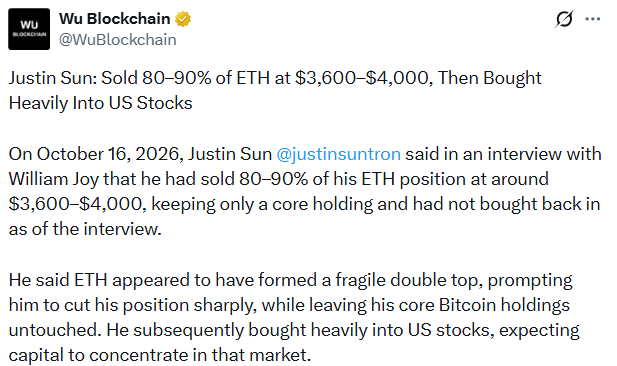
In a significant strategic shift that has captured the attention of the cryptocurrency and financial markets, TRON founder and CEO Justin Sun has announced his decision to liquidate 80% to 90% of his personal Ethereum (ETH) holdings. This substantial divestment is part of a calculated move to reallocate capital into a curated selection of U.S.-based cryptocurrency stocks, a decision driven by Sun’s assessment of burgeoning opportunities in the American market and a perceived slowdown in Ethereum’s performance. The announcement, made during an interview with Wu Blockchain, signals a potentially pivotal moment in how prominent figures within the digital asset space are navigating evolving market dynamics.
Strategic Rationale Behind the Ethereum Sell-Off
Justin Sun’s decision to significantly reduce his Ethereum exposure stems from a technical analysis of the cryptocurrency’s price action, which he characterized as exhibiting a "fragile double top pattern." This bearish technical indicator, according to Sun, suggests a potential for a sustained downtrend, thereby limiting profit-making opportunities in the ETH market. The "double top" is a chart pattern that indicates a potential reversal of an uptrend. It is formed when an asset reaches a peak, pulls back, and then attempts to reach the same peak again, failing to surpass it, and subsequently declining. This pattern is often interpreted by technical analysts as a sign of weakening buying pressure and increasing selling pressure, hinting at a possible downward price correction.
Sun’s analysis, as articulated in the interview, points to a persistent bearish pattern that has been hindering upward momentum for Ethereum. This observation, coupled with his outlook on other investment avenues, prompted the drastic reduction in his ETH portfolio. Notably, Sun clarified that his Bitcoin holdings remained unaffected by this strategic pivot, indicating a continued conviction in the long-term prospects of the flagship cryptocurrency, while expressing a more cautious stance on Ethereum at this juncture. This selective approach underscores a nuanced understanding of the cryptocurrency market, differentiating between assets based on their perceived technical health and future potential.
The timing of this announcement is particularly noteworthy, occurring as the cryptocurrency market continues to grapple with regulatory uncertainties and evolving investor sentiment. While Ethereum has historically been a cornerstone of the decentralized finance (DeFi) ecosystem and a significant player in the smart contract space, its recent price action has been subject to scrutiny. Data from CoinMarketCap or similar reputable sources could illustrate Ethereum’s performance over a defined period leading up to this announcement, comparing it to broader market indices or other altcoins, to provide context for Sun’s assessment of a "sluggish performance." For instance, if Ethereum has experienced a period of consolidation or underperformance relative to other growth sectors, it would lend credence to Sun’s rationale.
Focus on U.S. Crypto Stocks: Undervaluation and Diversification
Sun’s strategic reallocation is not merely an exit from Ethereum but a decisive entry into U.S.-listed cryptocurrency-related stocks. His rationale for this shift is twofold: the belief that these stocks are currently undervalued and the desire to diversify his investment portfolio. He perceives a significant opportunity in the American equity market, where he believes companies deeply integrated with the digital asset ecosystem are poised for substantial growth.
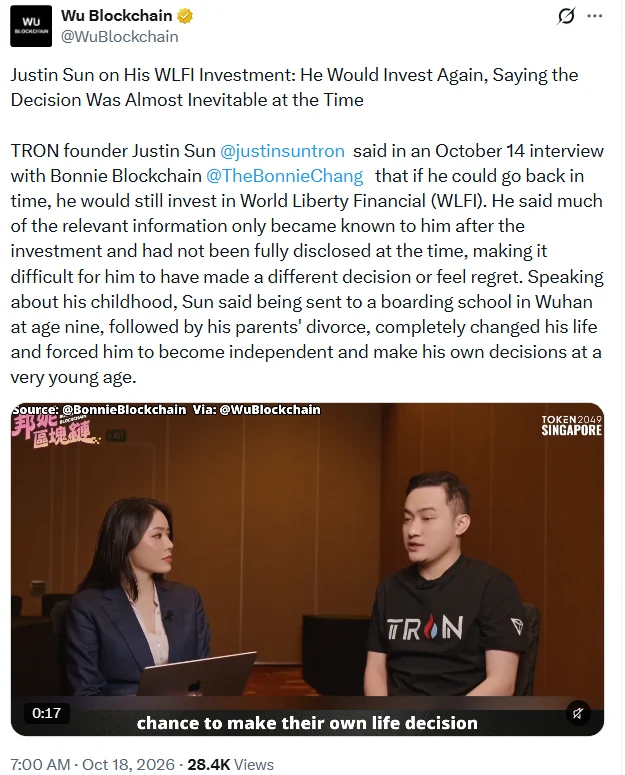
The TRON CEO’s conviction in U.S. crypto stocks is underscored by his specific mention of World Liberty Financial (WLFI). In a previous Wu Blockchain interview, Sun revealed his decision to invest in WLFI, a U.S.-based entity involved in the crypto space. He further expressed his strong endorsement of the company, stating that he would "inevitably reinvest" in WLFI if given another opportunity. This repeated emphasis on WLFI suggests a deep-seated belief in its market potential and the broader trend of traditional financial instruments embracing cryptocurrency.
Sun’s investment in WLFI was not a minor undertaking. Reports indicate that in November 2024, he acquired $30 million worth of WLFI tokens, a transaction that positioned him as the largest investor in this particular DeFi platform. The platform’s association with prominent figures, such as being "backed by U.S. President Trump," as mentioned in the original content, adds another layer of context to this investment, suggesting a potential intersection of traditional political and financial influence with the burgeoning digital asset economy. This move implies a broader strategy to capitalize on the integration of cryptocurrency with established financial and potentially political infrastructures in the United States.
The concept of "undervaluation" in the stock market implies that an asset’s current price is trading below its intrinsic value. For crypto-related stocks, this could mean that the market has not yet fully appreciated the long-term revenue potential and growth prospects of companies involved in cryptocurrency mining, exchange operations, blockchain technology development, or digital asset custody. By investing in these companies, Sun is aiming to benefit from their potential appreciation as the digital asset market matures and gains wider institutional acceptance.
Furthermore, diversifying his portfolio into U.S. crypto stocks serves as a risk mitigation strategy. While cryptocurrencies themselves can be volatile, investing in publicly traded companies provides a different risk profile. These companies are subject to corporate governance, regulatory oversight, and the broader economic factors that influence stock markets. By spreading his investments across different asset classes and geographical markets, Sun aims to reduce his overall exposure to any single point of failure or market downturn.
Broader Market Implications and Expert Commentary
Justin Sun’s strategic pivot raises several questions about the future trajectory of both Ethereum and the broader digital asset market. His decision, coming from a prominent figure with substantial holdings, could influence other investors and shape market sentiment.
One key implication is the potential impact on Ethereum’s price and its position within the altcoin hierarchy. While Sun’s personal holdings represent a fraction of the total ETH supply, his vocal stance and significant divestment could be interpreted by some as a bearish signal. However, it is crucial to distinguish between individual investment decisions and the fundamental health of a blockchain ecosystem. Ethereum’s continued development, its role in powering the DeFi and NFT markets, and the ongoing transition to Ethereum 2.0 (now known as the consensus layer) remain significant factors that could counterbalance any negative sentiment arising from Sun’s actions.
The increased focus on U.S. crypto stocks also reflects a growing trend of institutionalization within the digital asset space. As regulatory clarity improves in major economies like the United States, traditional financial players are increasingly looking for regulated avenues to gain exposure to cryptocurrencies. Investing in publicly traded companies that are deeply involved in the crypto industry offers a familiar and regulated framework for such participation. This trend could lead to increased capital flowing into these companies, potentially driving their valuations higher and, in turn, indirectly supporting the broader digital asset ecosystem.
The original article also referenced Kevin O’Leary’s perspective on Ethereum’s future, where he questioned whether it would remain the industry standard and named Solana and Avalanche as top alternatives. This highlights a broader debate within the crypto community regarding the competitive landscape of smart contract platforms. While Ethereum maintains a dominant position, the emergence and growth of competing blockchains present a dynamic environment where market share can shift. Sun’s decision, while not explicitly citing these competitors, aligns with a broader market narrative that acknowledges the increasing competition and the need for continuous innovation and performance from all major blockchain platforms.
It is important to consider that Justin Sun is known for his strategic and often contrarian investment decisions. His previous ventures, including the creation of the TRON blockchain and the acquisition of BitTorrent, demonstrate a capacity for identifying and capitalizing on emerging trends. Therefore, his current move should be viewed within the context of his broader investment philosophy and his ongoing efforts to navigate the rapidly evolving digital asset landscape.

Historical Context and Future Outlook
The cryptocurrency market has historically been characterized by periods of intense speculation, followed by significant corrections and reallocations of capital. Justin Sun’s decision to sell a large portion of his Ethereum holdings and reinvest in U.S. crypto stocks is a manifestation of this dynamic.
In the past, large holders, often referred to as "whales," have made similar moves that have influenced market prices. However, the current market is more mature and institutionalized than in previous cycles. The increasing involvement of venture capital firms, hedge funds, and traditional financial institutions suggests a more sophisticated and potentially less volatile market.
The U.S. regulatory environment remains a critical factor influencing the growth of crypto-related stocks. As the Securities and Exchange Commission (SEC) and other regulatory bodies continue to define the legal framework for digital assets and related companies, clarity can foster greater investment and innovation. Companies that successfully navigate this regulatory landscape are likely to be well-positioned for long-term growth.
Looking ahead, the success of Justin Sun’s strategy will depend on several factors: the continued performance of U.S. crypto stocks, the future trajectory of Ethereum, and the broader economic conditions influencing both equity and cryptocurrency markets. His move serves as a case study in strategic asset allocation within the digital asset space, emphasizing the importance of continuous market analysis, risk management, and the identification of emerging growth opportunities. The cryptocurrency world will undoubtedly be watching to see if Sun’s bold reallocation proves to be a prescient move or a missed opportunity.