The Dash Core Group has officially set the mainnet start date for its highly anticipated V24 network upgrade, marking a significant milestone in the evolution of the Dash blockchain. Signaling for the mandatory upgrade is slated to commence at 00:00 UTC on November 9, with the earliest possible activation projected for around November 28. This comprehensive update, which introduces critical advancements like shared masternode collateral and split payouts, underscores Dash’s ongoing commitment to enhancing network accessibility, decentralization, and overall robustness.
A New Era for Dash Masternodes and Network Infrastructure
The V24 upgrade, officially designated as a mandatory release for all nodes, is designed to bring a suite of enhancements that primarily impact the operational dynamics and economic incentives surrounding Dash’s unique masternode network. At its core, Dash differentiates itself through a two-tier network architecture, where masternodes play a pivotal role in governance, instant transactions (InstantSend), and enhanced privacy features (PrivateSend). This upgrade is poised to lower the barrier to entry for masternode participation and improve the flexibility for existing operators, thereby reinforcing the network’s decentralized nature.
Two distinct deployments, v24 and evo_shares, are scheduled as part of this release. However, a crucial detail in the commit message clarifies that only v24 is eligible for activation with this particular release. The v24 deployment focuses on the immediate enhancements to masternode collateral and payout mechanisms, while evo_shares, which encompasses similar features for EvoNodes (masternodes integrated with Dash Platform), is slated for activation in a subsequent release, likely v24.1, once the Dash Platform fully supports these functionalities. This phased approach ensures a stable and controlled rollout of complex network improvements.
The primary features delivered by the v24 activation include:
- Shared Masternode Collateral: This groundbreaking feature allows multiple parties to contribute to the 1,000 Dash collateral required to operate a masternode. By enabling fractional ownership, the upgrade democratizes access to masternode participation, potentially increasing the total number of active masternodes and further decentralizing the network.
- Split Payouts: Masternode operators will now have the flexibility to distribute their block rewards among several addresses, specified in basis points. This functionality is particularly beneficial for masternode pools, investment groups, or individuals who wish to automatically allocate rewards to different beneficiaries or wallets.
- Extended Network Addresses: Version 3 provider transactions will allow masternodes to explicitly list their core P2P, Platform P2P, and Platform HTTPS endpoints. This enhancement improves network discoverability and communication, applicable to both regular masternodes and EvoNodes.
- Platform Changes: The upgrade also incorporates several adjustments to how Dash Platform withdrawals work, including the introduction of a new
ProTxWithdrawtransaction type, the ability to store platform chain locks on-chain, and specific data structures for handling Platform P2P endpoints.
Chronology of a Critical Upgrade
The journey to the V24 activation has been meticulously planned by the Dash Core development team. The pivotal step occurred on October 29 when Dash Core developer ‘pasta’ merged the changes that solidified the mainnet schedule. This merge was executed across two key pull requests: #7973 for the main development branch and #7969, which backported the changes to the v24.0.x release line. These actions replaced placeholder dates in Dash’s chain parameters with the fixed activation schedule, initiating a critical window for masternode operators.
With the schedule now set, every masternode on the network has approximately one week from the merge date to upgrade their software to the mandatory v24.0.0 release. The newest tag in the repository, v24.0.0-rc.5, was cut on October 29, coinciding with the schedule merge, indicating the readiness of the client software.
Dash’s Enhanced Hard Fork Mechanism: DIP-0023
Unlike traditional Bitcoin-style hard forks, which rely on miner signaling, Dash employs its unique Enhanced Hard Fork mechanism, outlined in DIP-0023. This system places the signaling power primarily in the hands of masternode operators, reflecting their integral role in the network’s governance and security. The process for V24 activation involves several distinct phases:
- Masternode Signaling: Starting November 9, masternodes that have upgraded to v24.0.0 will begin signaling their readiness for the
v24deployment. This signaling is crucial as the fork cannot proceed until a sufficient number of masternodes indicate their support. - Lock-in Phase: Once a predefined threshold of masternode signals is reached within a specific signaling window (approximately 4,032 blocks or seven days), the
v24deployment enters a "locked-in" state. - Activation: Following the lock-in, a subsequent block window will trigger the full activation of the V24 features across the mainnet.
The release notes explicitly state that V24.0.0 is a mandatory upgrade for all nodes. Masternodes, in particular, face a strict deadline: they must upgrade before November 9 to participate in the signaling process and avoid potential penalties. Failure to upgrade before the activation block, expected around November 28, will result in other nodes following an invalid chain, effectively disconnecting them from the updated network.

Furthermore, masternodes have an additional, immediate incentive to upgrade. V24 raises the minimum masternode protocol version from 70240 to 70242. During distributed key generation, masternodes operating on the older protocol version will be flagged as having a "bad connection" and may incur Proof-of-Service (PoSe) penalties. This mechanism is designed to ensure network integrity and incentivize prompt upgrades, even before the hard fork itself takes effect.
The November 28 Arithmetic: A Best-Case Scenario
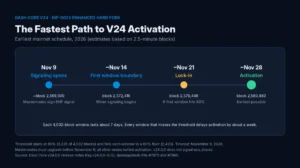
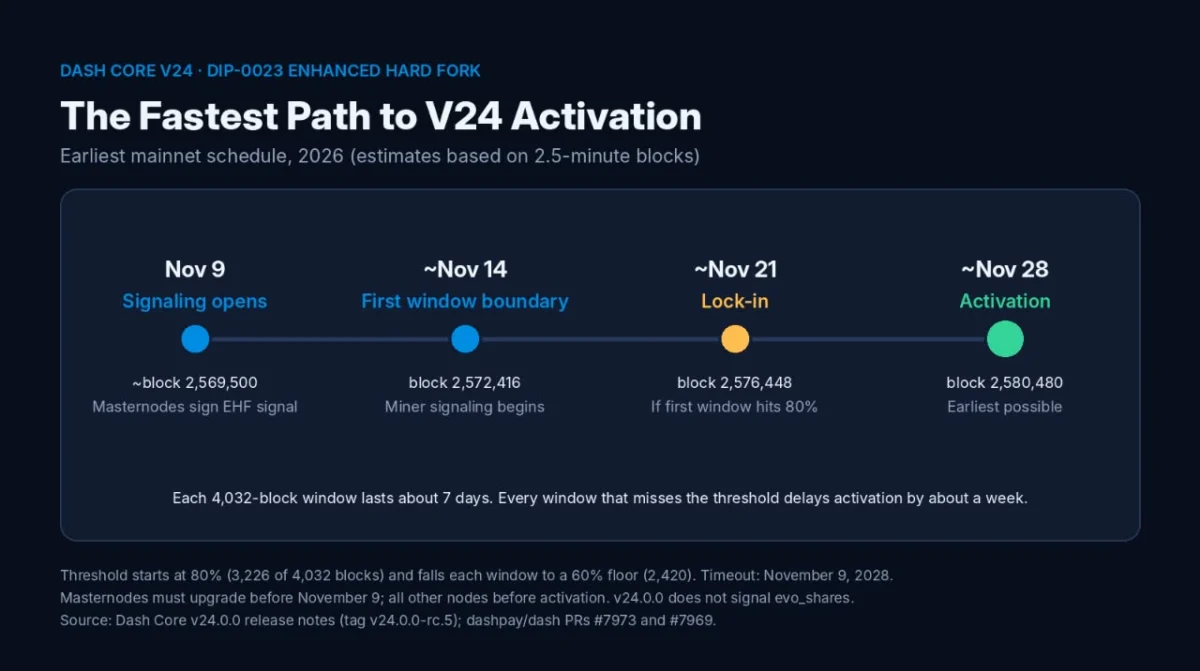
The Dash Core Group has provided a detailed timeline for the earliest possible activation, assuming an average block time of 2.5 minutes:
- Signaling Opens: November 9, coinciding with mainnet block 2,569,500 (approximately).
- First Window Boundary: The first signaling window concludes around November 14, near block 2,572,416.
- Threshold Achievement & Lock-in: If the necessary signaling threshold (initially 80% of masternodes, or 3,226 out of 4,032 blocks in a window) is met within this first window, V24 will lock in at block 2,576,448.
- Earliest Activation: The full activation of V24 features would then occur at block 2,580,480, projected for around November 28.
It’s crucial to understand that November 28 represents the earliest possible activation date. Each 4,032-block window lasts approximately seven days. If masternode adoption and signaling are slower than anticipated, and a window misses the required threshold, activation will be delayed by approximately one week for each missed window. The threshold for activation also gradually decreases over time, starting at 80% and stepping down to 60% (2,420 blocks) after 10 windows, ensuring that the upgrade can eventually activate even with slower adoption, albeit with a delay. This adaptive mechanism prevents outright failure of the upgrade process.
Strategic Implications and Broader Context
The V24 upgrade is one of Dash’s most substantial consensus upgrades in recent years, signaling a renewed focus on core infrastructure development and enhanced utility. In a cryptocurrency landscape increasingly defined by innovation and user experience, continuous protocol improvements are paramount for maintaining relevance and fostering adoption.
Dash, established in 2014, has consistently positioned itself as "digital cash," emphasizing fast, cheap, and private transactions. Its unique governance model, powered by masternodes, allows for self-funding development and democratic decision-making, distinguishing it from many other blockchain projects. The V24 upgrade directly supports this vision by making masternode ownership more accessible. By reducing the effective entry barrier through shared collateral, Dash aims to broaden its base of network participants, which can lead to:
- Increased Decentralization: More masternodes mean a more distributed network, making it more resilient to attacks and censorship.
- Enhanced Network Security: A larger and more diverse set of masternode operators contributes to the overall security of the network.
- Improved Governance Participation: As more individuals or smaller groups can participate in masternode operations, the pool of voters for Dash’s treasury proposals expands, strengthening its decentralized autonomous organization (DAO) model.
- Greater Liquidity and Utility: A robust and accessible masternode network underpins Dash’s InstantSend and PrivateSend functionalities, which are key differentiators for its "digital cash" use case.
The differentiation between v24 and evo_shares also highlights Dash’s long-term vision for its Dash Platform. The Platform is designed to provide a decentralized application (dApp) layer, allowing developers to build services on top of Dash. By scheduling evo_shares for a later release, the development team ensures that the foundational v24 features are robustly implemented before extending them to the more complex EvoNode ecosystem, demonstrating a methodical approach to product development.
What Stakeholders Need to Do Now
The mandatory nature of the V24 upgrade necessitates immediate action from various segments of the Dash community:
- For Masternode Operators: The most critical directive is to upgrade to
dashd v24.0.0before November 9, 2026 at 00:00 UTC. Failure to do so will prevent their masternodes from signaling for the upgrade, potentially leading to delays in activation, and more importantly, could result in PoSe penalties for operating on an outdated protocol version. Operators should refer to the official release notes and documentation for detailed upgrade instructions. - For Regular Node Operators, Exchanges, and Wallets: These entities must upgrade their Dash nodes before the anticipated activation date, around November 28. Running an older version after activation will cause them to follow an invalid chain, leading to service interruptions. Operators should also be prepared for a potentially longer initial start-up time (20-40 minutes or more) after the upgrade, especially if their nodes utilize address, spent, or timestamp indexes, as these indexes will be migrated to their own dedicated databases.
- For Developers: Any application, tool, or service that interacts with Dash provider transactions (ProTx), such as blockchain explorers, SPV libraries, and external wallets, must be updated to correctly parse and build the new version 3 format before activation. This ensures seamless compatibility with the upgraded network.
The V24 upgrade represents a pivotal moment for the Dash network, solidifying its infrastructure and enhancing its core value proposition. The successful implementation of this hard fork, driven by the collective action of its masternode operators, will underscore Dash’s resilience and its ongoing commitment to innovation in the decentralized finance space. The coming weeks will be crucial as the community rallies to ensure a smooth transition to this enriched network architecture.