
Renowned stockbroker and staunch Bitcoin critic, Peter Schiff, has issued a stark warning regarding the future trajectory of Bitcoin, predicting a significant downturn following the recent U.S. midterm elections. Schiff, a vocal proponent of traditional assets like gold and silver, believes that recent market movements, coupled with the election’s outcome, have eroded investor confidence in cryptocurrencies, setting the stage for further price depreciation. His pronouncements come as Bitcoin has experienced a notable pullback from its recent highs, prompting a closer examination of the factors influencing its volatility.
The economic analyst, who frequently leverages social media platforms to disseminate his financial perspectives, articulated his concerns to his extensive follower base. He posited that Bitcoin’s inherent resilience has been undermined by a confluence of events that have collectively pushed cryptocurrency prices lower. Schiff’s observations are rooted in his interpretation of market performance in the wake of the midterm elections, a period that has seen a divergent performance between traditional financial markets and the digital asset space.
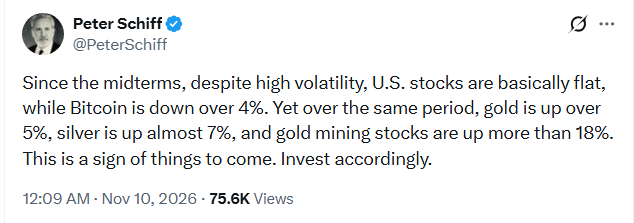
According to Schiff’s analysis, the period immediately following the 2026 midterm elections has been characterized by a significant surge in U.S. stock markets, which have reportedly climbed by approximately 12%. In stark contrast, Bitcoin has registered a decline of 4.6% during the same timeframe. This divergence is further amplified by the performance of precious metals, with gold and silver prices experiencing gains of 5% and 7%, respectively. Schiff interprets this differential performance as a clear signal of Wall Street and traditional investors favoring established assets over speculative digital currencies.
Election Outcome and Investor Reassurance
Schiff’s remarks suggest that the market’s positive reaction to the election results, which saw Democrats securing control of both the House and the Senate, has been a key catalyst. Initially, there was a palpable sense of apprehension among investors regarding the potential for protracted political wrangling following the Democratic sweep. However, these fears appear to have been assuaged by President Trump’s acceptance of the election outcome, thereby dispelling concerns about a prolonged electoral dispute. This resolution has fostered an environment where investors anticipate a more restrained approach to government spending and borrowing under a divided Congress, a scenario historically viewed as beneficial for traditional financial markets.
The impact of this electoral clarity on broader financial markets is also evident in the bond market. The yield on the benchmark 10-year Treasury note experienced a notable drop of 4.91% in the wake of the Democratic victory. Lower Treasury yields typically translate into reduced borrowing costs for businesses and governments, a factor that can bolster stock valuations. Furthermore, diminished returns on bonds make them less attractive relative to equities and precious metals, thereby redirecting investment capital towards these traditional safe-haven assets. This confluence of factors provides a compelling explanation for the robust gains observed in U.S. stocks and precious metals in the post-election period.
Bitcoin’s Vulnerability Amidst Shifting Market Dynamics
Schiff’s thesis posits that Bitcoin’s recent weakening is directly linked to the midterm elections and their subsequent impact on investor sentiment. He points to the fact that Bitcoin has fallen below a critical support level of $75,000, a significant decline from its recent peak of approximately $80,000. At the time of Schiff’s commentary, Bitcoin was trading around $73,135, underscoring a palpable downward pressure on the cryptocurrency.

The prominent critic is not alone in observing a historical correlation between midterm elections and Bitcoin’s performance. Schiff has previously noted a pattern of Bitcoin experiencing declines after midterm election cycles. He contends that the current scenario, marked by the loss of the $75,000 support level, suggests that further price drops are inevitable. Schiff has gone as far as to urge investors to divest their Bitcoin holdings, warning that the cryptocurrency is poised to slide towards its perceived cycle bottom, which he estimates to be around $59,517. He advocates for a swift exit from the market before this perceived "short window" of opportunity closes.
Broader Context of Market Volatility and Investor Sentiment
The current market environment is characterized by a heightened sense of caution among investors, influenced by a range of macroeconomic factors and geopolitical developments. The cryptocurrency market, known for its inherent volatility, is particularly susceptible to shifts in investor sentiment and broader economic trends. The confluence of the midterm election outcome, which has brought a degree of political certainty, and other significant events, such as the Binance hack, has contributed to a complex and often unpredictable market landscape.
The Binance hack, a significant security breach that impacted one of the world’s largest cryptocurrency exchanges, undoubtedly cast a shadow over the digital asset space. Such incidents erode trust and can lead to a reassessment of risk by investors. While the article mentions this event, a deeper dive into its specific timing and impact on Bitcoin’s price action, independent of the election, would provide a more comprehensive picture. For instance, understanding how the market reacted to the news of the hack in the days leading up to and following the election could reveal further nuances in investor behavior.
Analysis of Supporting Data and Potential Implications
The data presented by Schiff, highlighting the divergent performance of Bitcoin against stocks and precious metals, serves as a key piece of evidence for his bearish outlook. The 12% surge in the stock market, coupled with the 5-7% rise in gold and silver, indicates a flight to perceived safety and value by investors. Conversely, Bitcoin’s 4.6% decline suggests a lack of confidence in its ability to act as a hedge or a store of value in the current economic climate.
The assertion that lower Treasury yields support stock valuations by reducing borrowing costs is a well-established economic principle. This mechanism, when applied to the post-election scenario, explains why equities might be outperforming riskier assets like Bitcoin. The reduced attractiveness of bond returns further incentivizes investors to seek higher yields in other asset classes, and in the current environment, traditional assets appear to be the preferred destination.
Historical Precedents and Future Outlook
Schiff’s reference to a historical pattern of Bitcoin declines following midterm elections warrants further investigation. Examining historical data from previous U.S. midterm election cycles and correlating it with Bitcoin’s price performance could provide valuable context. Such an analysis would help determine whether this observed correlation is a consistent trend or a coincidental occurrence. Understanding the underlying reasons for this potential historical pattern—perhaps related to shifts in monetary policy expectations or investor risk appetite—would strengthen the argument.
The implication of Schiff’s warning is that investors who are heavily exposed to Bitcoin may face significant losses if his predictions materialize. His advice to sell before the perceived "short window" closes underscores the urgency he perceives in the market. However, it is crucial to acknowledge that Schiff is a vocal Bitcoin critic, and his pronouncements should be considered within the context of his long-standing bearish stance.
Expert Opinions and Market Reactions
While Schiff’s opinion is prominent, a comprehensive news report would benefit from incorporating a range of expert perspectives. Including insights from cryptocurrency analysts who hold a more optimistic view, or those who offer a more nuanced interpretation of the current market conditions, would provide a balanced overview. For instance, exploring the views of analysts who believe Bitcoin’s current price action is a temporary correction rather than a precursor to a prolonged bear market would offer a contrasting viewpoint.
Furthermore, examining the reactions of cryptocurrency exchanges, blockchain analytics firms, and prominent figures within the crypto community to Schiff’s statements would add depth. Do other market participants share his concerns, or are they dismissing his predictions as overly pessimistic? Understanding the broader consensus, or lack thereof, within the crypto ecosystem is vital for a complete picture.
Broader Economic and Regulatory Considerations
Beyond the immediate impact of the midterm elections, the cryptocurrency market is also subject to evolving regulatory landscapes and broader macroeconomic forces such as inflation, interest rate hikes, and global economic stability. These factors play a crucial role in shaping investor sentiment and influencing asset prices. For example, any potential regulatory actions or pronouncements from governmental bodies in the wake of the elections could have a significant impact on the cryptocurrency market.
The article briefly touches upon the Binance hack, but a more detailed exploration of its implications for the broader crypto market’s security and regulatory scrutiny would be beneficial. The extent to which such events contribute to a loss of investor confidence, as Schiff suggests, is a critical element in understanding the current market dynamics.
In conclusion, Peter Schiff’s warning of an imminent Bitcoin crash following the U.S. midterm elections is a significant development in the ongoing discourse surrounding the cryptocurrency’s future. His analysis, based on the divergent performance of Bitcoin relative to traditional assets and his interpretation of election outcomes, paints a bearish picture. However, a comprehensive understanding requires considering a wider array of expert opinions, historical data, and the interplay of broader economic and regulatory factors that continue to shape the volatile cryptocurrency market. The coming weeks and months will likely reveal whether Schiff’s dire predictions hold true or if Bitcoin can demonstrate resilience in the face of shifting market sentiments.