As the United States approaches its midterm elections, a historical pattern of significant Bitcoin (BTC) price corrections coinciding with these electoral events has emerged, prompting scrutiny from market analysts and investors alike. While correlation does not equate to causation, the recurring nature of these downturns has fueled discussions about potential future volatility for the flagship cryptocurrency. Analysts are examining past midterm election cycles to discern whether a similar trend might unfold in the current economic and geopolitical climate.
Historical Precedents: Midterm Elections and Bitcoin’s Price Trajectory
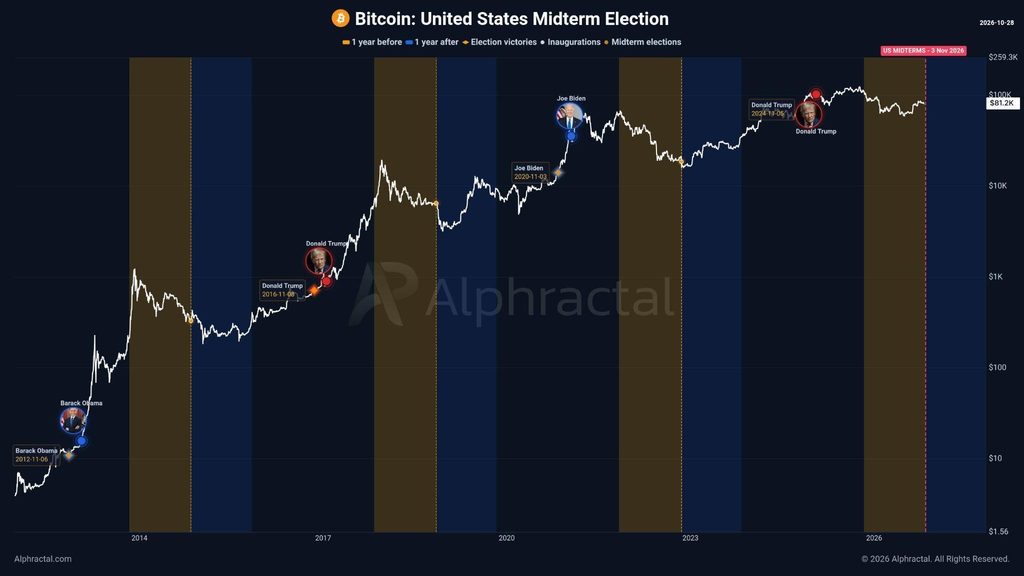
The analysis of Bitcoin’s performance around previous U.S. midterm elections, specifically those in 2014, 2018, and 2022, reveals a consistent, albeit complex, relationship. Crypto analytics platform Alphractal has observed that in each of these instances, Bitcoin was already navigating bearish market conditions prior to the elections. However, the selling pressure often intensified post-election day, leading to significant declines that ultimately marked cycle lows.
2014 Midterm Elections:
The U.S. midterm elections held on November 4, 2014, found Bitcoin already entrenched in a prolonged bear market. Following the election, the downward trend persisted, with the cryptocurrency continuing its decline for several weeks. This extended period of weakness culminated in Bitcoin reaching its cycle bottom in January 2015, underscoring a period of sustained bearish sentiment that extended beyond the immediate election timeframe.

2018 Midterm Elections:
Four years later, on November 6, 2018, as Americans went to the polls, Bitcoin was trading in the vicinity of $6,400. While the market initially exhibited a brief period of relative calm, this stability proved short-lived. In the subsequent month, BTC experienced a sharp downturn, shedding approximately 40% of its value. This significant price erosion ultimately led to the establishment of the market cycle’s bottom in December 2018.
2022 Midterm Elections:
The most recent midterm elections on November 8, 2022, occurred against a backdrop of already considerable losses for Bitcoin. The market was further shaken by the collapse of the cryptocurrency exchange FTX in close proximity to the election date. This event triggered a fresh wave of intense selling pressure, pushing BTC towards the $15,500 mark and signaling the bottom of that particular market cycle.
These three occurrences, while not definitively proving a causal link, raise pertinent questions about whether Bitcoin’s price action exhibits a meaningful correlation with the U.S. electoral calendar.
Expert Analysis: Patterns and Projections
Popular crypto analyst Ali Martinez has also meticulously studied Bitcoin’s historical performance across four U.S. midterm election cycles, offering a detailed quantitative perspective. Martinez’s findings indicate significant declines in BTC prices around the 2010, 2014, 2018, and 2022 midterm elections. The reported losses during these periods were substantial: 72% in 2010, 65% in 2014, 52% in 2018, and 27% in 2022. Martinez considers this consistent pattern of downside performance a critical factor for market participants to monitor as another election approaches.

Furthermore, Martinez has analyzed Bitcoin’s fourth-quarter returns during previous midterm election years. His data reveals a stark contrast: BTC experienced a remarkable surge of 391% in the fourth quarter of 2010. However, the subsequent election years presented a different picture, with the cryptocurrency recording losses of 16.70% in 2014, 42.16% in 2018, and 14.75% in 2022. This suggests that, with the exception of the early developmental stages of Bitcoin in 2010, three of the four election-year fourth quarters have concluded negatively.
For the upcoming election cycle, Martinez has identified $73,000 as a pivotal price level. He points to Bitcoin’s short-term holder cost basis – the average acquisition price for coins held by recent market participants – as a potential support area. Should selling pressure escalate post-election, a recovery from this region could bolster a bullish outlook, whereas continued weakness might signal further market deterioration.
Technical Perspectives: Smart Money Concepts and Downside Targets
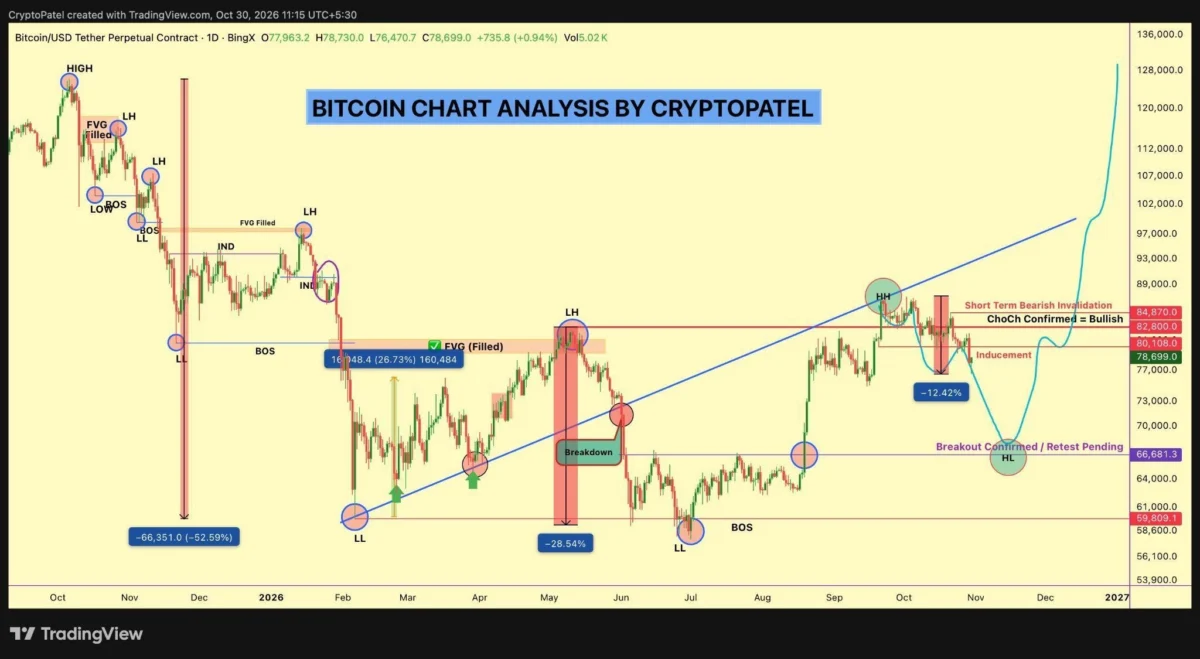
Beyond the historical election patterns, technical analyst Crypto Patel has also voiced concerns regarding Bitcoin’s immediate price direction, suggesting the possibility of another substantial decline. Patel’s bearish outlook stems from technical chart analysis, specifically the application of Smart Money Concepts (SMC), which focuses on market structure, liquidity dynamics, and price action to identify trading opportunities.
Patel recently noted that Bitcoin had already declined approximately 12% from his previously identified short-entry area. He explained that his bearish assessment was derived from observing a shift in market structure, where Bitcoin’s price action produced a higher high, leading him to anticipate a subsequent move toward a higher low. Additional bearish signals identified by Patel include the removal of inducement liquidity and a higher-timeframe candle closing below a relevant inducement level.
Based on his analysis, Patel has projected a potential downside target for Bitcoin ranging from $66,000 to $62,000, contingent on the cryptocurrency remaining below the $81,950 resistance level. However, Patel has also established a critical invalidation level for his short-term bearish outlook. According to his assessment, a higher-timeframe candle closing above $84,870 would prompt him to reassess his position, shift to a bullish stance, and anticipate a potential move beyond the $100,000 mark.
These projections underscore the potential for continued volatility in the Bitcoin market as traders navigate both the technical landscape and the geopolitical implications of the approaching U.S. elections.
Broader Market Context and Implications
The recurring correlation between U.S. midterm elections and Bitcoin’s price downturns, as highlighted by Alphractal and Ali Martinez, warrants careful consideration. It is crucial to acknowledge that these historical patterns do not definitively establish a direct causal relationship. Several macroeconomic factors and the inherent cyclical nature of the cryptocurrency market likely play a more significant role in shaping Bitcoin’s trajectory.
The period leading up to midterm elections often coincides with increased economic uncertainty and shifts in investor sentiment globally. Government policies, regulatory discussions, and broader economic indicators can influence risk appetite, potentially leading to reduced investment in speculative assets like cryptocurrencies. Furthermore, the cryptocurrency market itself has its own four-year cycles, often influenced by Bitcoin halving events, which can independently contribute to bull and bear phases.

The FTX collapse in 2022 serves as a stark reminder of how unforeseen events within the crypto ecosystem can exert immense pressure on asset prices, irrespective of external political cycles. This event significantly impacted market sentiment and liquidity, contributing to the observed downturn around that election period.
The identification of key support and resistance levels by analysts like Ali Martinez and Crypto Patel provides valuable insights for traders and investors seeking to navigate potential price movements. The $73,000 short-term holder cost basis identified by Martinez, and Patel’s projected downside targets of $66,000-$62,000, offer tangible reference points for market analysis. Conversely, the invalidation level of $84,870 mentioned by Patel highlights the potential for a bullish reversal under specific technical conditions.
As of the latest reporting, Bitcoin was trading at approximately $71,454, having experienced a 3.92% decrease over the preceding 24-hour period. This price action reflects the ongoing market dynamics, which are being influenced by a confluence of technical factors, investor sentiment, and the anticipation of macroeconomic events. The coming weeks, particularly in the aftermath of the U.S. midterm elections, will likely provide further clarity on whether historical patterns will repeat or if new market forces will dictate Bitcoin’s price trajectory. Investors are advised to exercise caution and conduct thorough research, considering the inherent volatility and evolving landscape of the cryptocurrency market.