


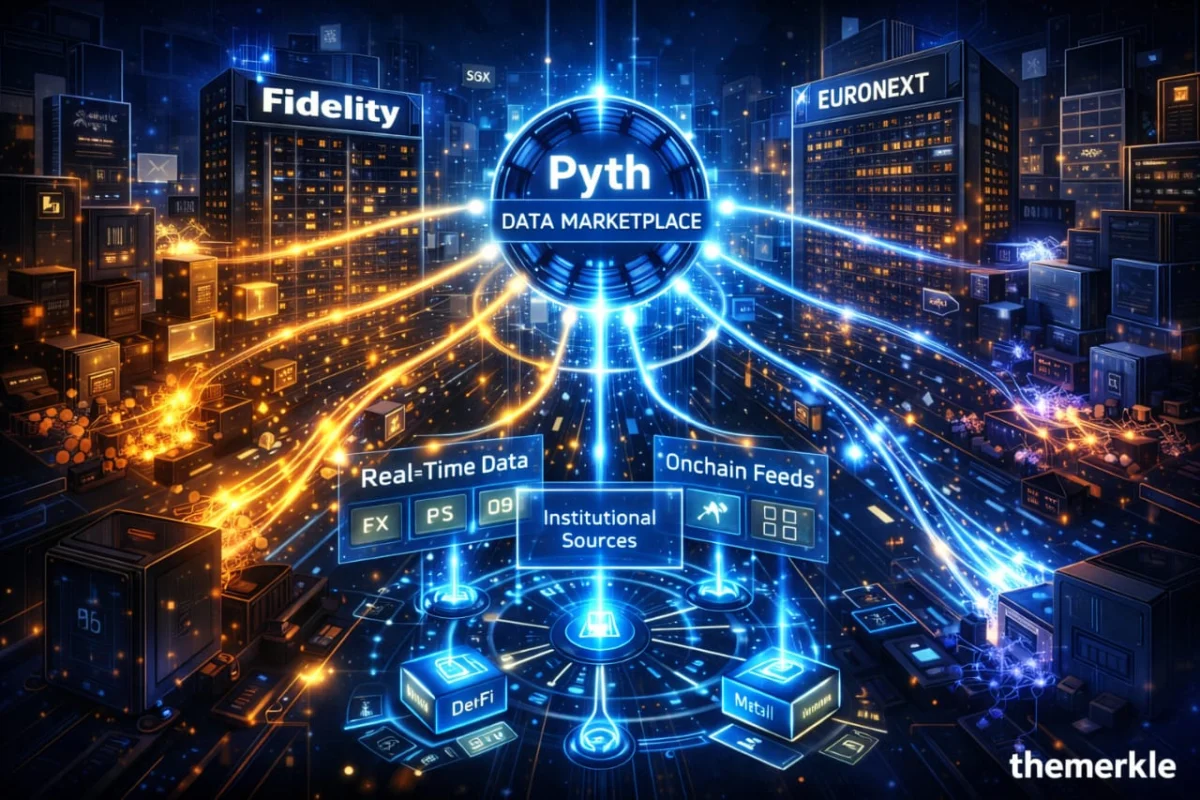
Pyth Network, a leading decentralized oracle solution, has officially launched its highly anticipated Data Marketplace, marking a pivotal moment in the convergence of traditional finance (TradFi) and decentralized finance (DeFi). This strategic initiative brings six prominent global financial institutions, including Fidelity Investments and Euronext, directly on-chain to stream proprietary, real-time market data, fundamentally altering how critical financial information is disseminated and consumed within the blockchain ecosystem. The move, announced on April 9, 2026, signals a significant validation of blockchain technology’s growing utility beyond crypto-native applications and positions Pyth Network at the forefront of this evolving financial landscape.
A New Paradigm for Financial Data Access
The launch of the Pyth Data Marketplace is not merely another partnership announcement; it represents a profound architectural shift in the provision of financial data. Unlike traditional data aggregators or superficial collaborations, this initiative involves financial powerhouses directly publishing their invaluable proprietary data onto a blockchain infrastructure. This direct integration bypasses multiple layers of intermediaries, promising unprecedented levels of speed, transparency, and integrity for a wide array of market data. For years, the financial industry has operated on a model where access to real-time, high-quality data often came at a steep price and was confined within proprietary terminals and subscription-based platforms. Pyth Network’s Data Marketplace challenges this status quo by creating an open yet controlled environment for data distribution, enabling decentralized applications (dApps) to tap into institutional-grade information directly.
Heavy Hitters from Traditional Finance Enter the Fray
The caliber of institutions participating in this endeavor underscores the significance of Pyth Network’s new offering. The initial cohort of data providers includes:
- Fidelity Investments: One of the world’s largest and most respected asset managers, overseeing trillions of dollars in assets. Fidelity’s participation lends immense credibility, as the firm is known for its rigorous due diligence and cautious approach to emerging technologies. Its involvement signals a strategic commitment to exploring blockchain’s potential for core financial operations.
- Euronext: A major pan-European stock exchange, operating markets in Amsterdam, Brussels, Dublin, Lisbon, Milan, Oslo, and Paris. Euronext’s decision to stream its data on-chain highlights the growing recognition among traditional exchanges of blockchain’s capacity to enhance market efficiency and reach a broader audience of developers and participants.
- Tradeweb Markets: A leading operator of electronic marketplaces for fixed income, derivatives, and ETFs, facilitating trillions of dollars in trading volume annually. Their contribution of data is crucial for providing depth in institutional trading segments.
- OTC Markets Group: The operator of financial markets for over-the-counter (OTC) securities, offering data on a vast array of equities. Their involvement brings transparency to traditionally less liquid and more opaque market segments.
- SGX FX: A subsidiary of Singapore Exchange (SGX), focusing on foreign exchange derivatives. Their data will be critical for global currency markets within DeFi.
- Exchange Data International (EDI): A leading provider of global financial data, offering a comprehensive suite of information across various asset classes. EDI’s participation ensures a broad spectrum of reference data and pricing across different markets.
These institutions collectively represent a significant portion of global financial infrastructure and trading volume. Their direct contribution of data to a crypto-native system like Pyth Network marks a crucial step in bridging the technological and philosophical divides between TradFi and DeFi.
The Mechanics of the Pyth Data Marketplace
At its core, the Pyth Data Marketplace is designed as a robust framework facilitating the secure and transparent publication of proprietary market data directly on-chain. This includes real-time pricing for highly sought-after financial instruments such as fixed income, crude swaps, spot foreign exchange (FX), and precious metals. Historically, such data was the exclusive domain of professional terminals like Bloomberg or Refinitiv, accessible only through expensive subscriptions and restrictive licenses.
Pyth’s approach leverages blockchain’s inherent properties to ensure data integrity and accessibility. When institutions publish data, it is cryptographically attested and recorded on-chain, making it immutable and verifiable. This process ensures that the data’s origin is transparent and its accuracy can be independently verified by any dApp or user on the network. The system also grants data providers full control over pricing models and attribution, addressing a critical concern for institutions wary of losing ownership or control over their intellectual property in an open environment. They are not merely "giving up" their data; they are actively managing its distribution and monetization within a new, more efficient paradigm.
Eliminating Intermediaries for Enhanced Efficiency
One of the foundational tenets of blockchain technology, and indeed Pyth’s Data Marketplace, is the disintermediation of traditional processes. In the context of financial data, this means removing the numerous "middle layers" that data typically traverses before reaching an end-user or an application. Traditionally, data might flow from an exchange to a data vendor, then to an aggregator, then to a client’s internal system, each step adding latency, cost, and potential points of failure.
By enabling direct publication from the source onto the blockchain, Pyth significantly reduces this complex chain. Developers and decentralized applications can access data with lower latency and higher fidelity, directly from the entities that generate it. This streamlined access not only enhances operational efficiency but also drives down costs associated with data acquisition, democratizing access to institutional-grade information that was previously out of reach for many smaller players and innovators in the DeFi space. This efficiency gain is a powerful incentive for both data providers seeking new distribution channels and data consumers demanding better performance.
Why This Matters Profoundly for DeFi
The availability of reliable, high-fidelity data has long been a bottleneck for the growth and stability of decentralized finance. DeFi applications, ranging from lending protocols and decentralized exchanges (DEXs) to complex derivatives platforms, are inherently reliant on accurate and timely price feeds (oracles) for their core functionality. Inaccurate or delayed data can lead to significant vulnerabilities, including liquidations at incorrect prices, arbitrage opportunities for malicious actors, and systemic risks across interconnected protocols. The infamous "flash loan attacks" and oracle manipulation incidents in DeFi’s history underscore this critical dependency.
Pyth Network’s integration with major TradFi data providers like Fidelity and Euronext directly addresses this fundamental challenge. By drawing data from the very sources that power global financial markets, Pyth significantly elevates the quality and trustworthiness of its data inputs. This move shifts Pyth’s focus from predominantly crypto-native feeds to incorporating the bedrock of traditional financial information, thereby enhancing the reliability and robustness of DeFi applications that consume this data. Improved data integrity fosters greater confidence among users and institutions, paving the way for more sophisticated and secure DeFi products.
From Closed Systems to Open Infrastructure: A Historical Shift
Historically, financial data has been treated as a highly guarded, proprietary asset. Access was a privilege, granted only to those willing to pay substantial fees, often through long-term contracts for specialized terminals and data feeds. This model fostered information asymmetry, concentrating power and opportunity among large institutions.
Pyth’s Data Marketplace represents a significant departure from this entrenched model, or at least a powerful expansion of it. By making institutional-grade data available on-chain, it transforms a traditionally walled garden into a more open, programmable environment. While not all data will immediately become free or universally accessible without restrictions, the fundamental shift in its distribution mechanism is revolutionary. It empowers developers to integrate this data into new applications without navigating the bureaucratic hurdles and prohibitive costs associated with traditional data gatekeepers. This paradigm shift could unlock unprecedented innovation in financial technology, leading to new products and services that leverage the unique capabilities of blockchain for transparency, automation, and global reach.
No Longer Just a Crypto Experiment: Institutional Validation
Moves like Pyth Network’s Data Marketplace fundamentally challenge the narrative that blockchain technology, particularly in finance, remains an unproven "experiment." When institutions of the stature of Fidelity Investments and Euronext actively participate by streaming their core data onto a blockchain, it signals a profound shift in perception and strategy. These are not speculative ventures for such firms; their involvement indicates a clear recognition of real, tangible value and strategic advantage.
As an industry analyst, John Stoller, remarked, "When firms like Fidelity are involved, that means business. These are companies that typically don’t leap without a compelling reason. So their involvement is evidence this has real value." This sentiment echoes across the financial world, where cautious optimism about blockchain is increasingly giving way to active exploration and integration. This development also vividly illustrates that the perceived chasm between traditional finance and the nascent crypto economy is rapidly narrowing. Instead of viewing blockchain as a peripheral or competing technology, leading financial players are increasingly seeing it as a powerful infrastructural layer capable of enhancing existing operations and unlocking new market opportunities.
Pyth Network’s Position Begins to Solidify
This strategic launch significantly elevates Pyth Network’s standing within the competitive landscape of decentralized oracle protocols. While numerous oracle solutions exist within the crypto space, few, if any, have managed to attract institutional participation at this scale and depth. Pyth is not merely aggregating existing crypto data; it is forging direct connections to the foundational sources of global financial information.
By directly onboarding major data providers, Pyth is creating a more authoritative "source of truth" for financial information within the blockchain ecosystem. This position is immensely valuable, especially as the adoption of DeFi and enterprise blockchain solutions continues to accelerate. A robust, reliable, and institutionally-backed oracle network is a critical piece of infrastructure for the next wave of financial innovation, providing the necessary bridge for real-world assets and data to interact seamlessly with on-chain protocols. This strategic advantage could enable Pyth to become a dominant player in the oracle space, particularly for institutional use cases.
A Quiet but Significant Turning Point
While the immediate impact of this announcement may not be a dramatic, overnight overhaul of global finance, it possesses the characteristics of a quietly profound moment that will likely accrue significant importance over time. It underscores a growing trend where traditional financial institutions are moving beyond mere observation or peripheral engagement with blockchain technology. Instead, they are actively "plugging in" and integrating their core operations and data flows directly into decentralized systems.
This represents an unprecedented level of engagement, moving from exploratory pilots to foundational infrastructure deployment. If this trend continues and other major institutions follow suit, the entire architecture of financial data distribution and utilization could undergo a radical transformation. The implications extend beyond just DeFi, potentially influencing how market participants access information, how financial products are constructed, and how risks are managed across the global economy. For now, it remains early days, but with titans like Fidelity Investments and Euronext already committed, it is unequivocally clear that Pyth Network’s Data Marketplace is no longer a small experiment but a significant step towards a more interconnected and transparent financial future.
Disclosure: This is not trading or investment advice. Always conduct thorough research before engaging with any cryptocurrency or investment service.














