
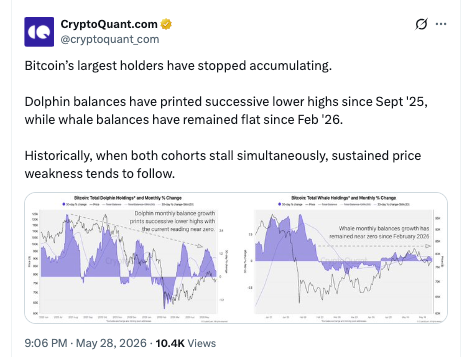
The cryptocurrency market is witnessing a significant shift as major Bitcoin holders, often referred to as "whales" and "dolphins," have largely ceased their accumulation activities, according to a recent report by on-chain analytics firm CryptoQuant. This pause in buying from key market participants, coupled with subdued overall market interest, has led to Bitcoin trading precariously close to the $74,000 mark, with bulls fighting to defend the crucial $70,000 support level. The current on-chain data paints a picture reminiscent of previous bear market cycles, particularly 2022, raising questions about the immediate future trajectory of the flagship cryptocurrency.
The report, disseminated via CryptoQuant’s official X (formerly Twitter) account, highlights a weakening structural demand for Bitcoin. Specifically, the analysis focuses on two critical investor cohorts: dolphin wallets, which hold between 100 and 1,000 BTC, and whale wallets, typically possessing 1,000 to 10,000 BTC, excluding those held by exchanges and miners. Data indicates that dolphin wallets have experienced lower highs in their holdings since September 2025, suggesting a lack of aggressive buying interest. More strikingly, whale balances have remained largely stagnant since February 2026, pointing to a significant absence of accumulation sentiment among these influential market players.
This trend among these large-scale holders is particularly noteworthy. Historically, the accumulation or distribution patterns of these groups have served as leading indicators for Bitcoin’s long-term price movements. Their current inactivity suggests a collective pause or uncertainty, which can significantly influence market sentiment and price action. The lack of robust buying pressure from these influential entities contrasts sharply with periods of strong accumulation that have historically preceded significant bull runs.
The current market position for Bitcoin bears a striking resemblance to the conditions observed in 2022, the year of the last major cryptocurrency bear market. During that period, similar on-chain metrics indicated a bearish bias among key investors before significant price downturns. Professional analysts closely monitor these on-chain buying statistics as they often provide valuable insights into prevailing market sentiment. The current data suggests that downward forces may currently hold sway over upward momentum.
While some institutional investors, such as Michael Saylor’s MicroStrategy, continue to make substantial Bitcoin purchases, this activity appears to be counterbalanced by a broader lack of retail engagement and occasional outflows from Bitcoin Exchange-Traded Funds (ETFs). A sustained rally in any major asset is typically preceded by consistent and broad-based demand from a diverse range of investors. The absence of such widespread buying activity currently raises concerns about the sustainability of any potential upward price movements.

A Deeper Dive into On-Chain Activity and Investor Behavior
The CryptoQuant report underscores the importance of understanding the behavior of different investor segments within the cryptocurrency ecosystem. Beyond the immediate buying and selling pressures, the long-term holder (LTH) metric presents an intriguing, albeit complex, picture. LTHs are defined as Bitcoin holders who have maintained their positions for at least 155 days. According to the report, LTHs have reached all-time highs, signifying a break in a multi-year downtrend for this segment.
Historically, a robust increase in LTHs has often been a precursor to a significant bull market. These investors, by their nature, are less likely to be swayed by short-term price fluctuations and are often seen as a stable base for long-term price appreciation. However, the current situation presents a nuanced scenario. While the sheer number of long-term holders is encouraging, their commitment to holding is contingent on sustained demand in the market. In a bear market environment, as the current one appears to be, low liquidity can allow such a market to persist for extended periods.
The implication of a prolonged holding period for LTHs in a stagnant or declining market is that the pressure for them to eventually capitulate, or sell their holdings, could increase over time. This capitulation, if it occurs, could lead to short-term price drops as a large volume of assets is dumped onto the market. Therefore, the current high levels of LTHs, while potentially a bullish signal in the long run, also carry the risk of future price volatility if accompanied by insufficient new buying interest.
Historical Context: Lessons from Previous Cycles
To fully grasp the significance of the current on-chain data, it’s essential to consider Bitcoin’s historical price cycles. The cryptocurrency market is known for its cyclical nature, characterized by periods of rapid growth (bull markets) followed by significant contractions (bear markets). The 2022 bear market, for instance, saw Bitcoin prices plummet from their all-time highs of nearly $69,000 in November 2021 to below $16,000 by the end of 2022. During this period, on-chain metrics, including those related to whale and dolphin activity, reflected a clear deleveraging and a lack of conviction among major investors.
The current scenario, with major holders showing reduced accumulation and the price struggling to break key resistance levels, echoes some of the sentiment observed during that bear market. The period between early 2022 and late 2022 was marked by significant macroeconomic headwinds, including rising inflation and aggressive interest rate hikes by central banks. These factors contributed to a broad risk-off sentiment across financial markets, impacting cryptocurrencies particularly hard. While the current macroeconomic landscape differs in specific details, concerns about global economic stability and inflation persist, potentially influencing investor behavior in the digital asset space.
The introduction of Bitcoin ETFs in early 2024 initially fueled a surge in demand, pushing Bitcoin to new all-time highs. These ETFs provided a regulated and accessible avenue for institutional and retail investors to gain exposure to Bitcoin. However, the report suggests that the initial euphoria has waned, and the continued outflows from some of these ETFs, coupled with the reduced activity from traditional large holders, indicate a cooling of that initial buying pressure.
The Evolving Landscape of Bitcoin Holders
The composition of Bitcoin holders has also evolved significantly over the years. Early adopters and miners once constituted the majority of significant holdings. However, the maturation of the market has seen the emergence of institutional investors, hedge funds, and a growing number of retail investors participating through various platforms. The report’s focus on "whales" and "dolphins" implicitly acknowledges this evolution, as these terms are used to categorize holders based on the quantity of Bitcoin they possess, irrespective of their background.
The participation of Generation X and Baby Boomers in the Bitcoin market has been a subject of increasing discussion. While younger generations, particularly Millennials and Gen Z, were early adopters of cryptocurrency, there is a growing sentiment that older generations, with their accumulated wealth and a potential search for alternative investment vehicles, are poised to become significant Bitcoin holders. This demographic shift could introduce new dynamics to market accumulation patterns, potentially bringing a more conservative and long-term investment approach. However, the current data from CryptoQuant does not explicitly segment holder behavior by generational cohorts, focusing instead on wallet sizes.
Recent Price Action and Future Outlook

Bitcoin’s price performance in recent months has been characterized by volatility. After attempting to breach the key $80,000 resistance level in May, the cryptocurrency faced a significant pullback. This failure to sustain the upward momentum has placed the bulls on the defensive, with the immediate focus shifting to maintaining the integrity of the $70,000 support.
The report’s assertion that investors are "simply not interested in the crypto sector right now" is a strong statement, likely reflecting the broader market sentiment beyond Bitcoin. The underperformance of cryptocurrencies relative to other asset classes, especially during periods of economic uncertainty, can lead to a rotation of capital into perceived safer havens. A resurgence of interest in the crypto sector is anticipated to take time, requiring a confluence of positive catalysts, including clear regulatory frameworks, continued technological innovation, and a more stable global economic environment.
The current data from CryptoQuant, highlighting the stalled accumulation by major holders and the prevailing bearish sentiment among key on-chain metrics, suggests that the path forward for Bitcoin may involve a period of consolidation or even further price discovery to the downside. The strength of the LTH cohort will be a critical factor to monitor, as their decision to hold or sell will significantly influence short-term market dynamics. The cryptocurrency market, known for its rapid shifts, will undoubtedly continue to be a focal point for investors and analysts seeking to navigate its complex and often unpredictable landscape. The coming months will be crucial in determining whether the current pause in accumulation by major holders is a temporary recalibration or the beginning of a more extended period of subdued market activity.