Ethereum developers have entered the final major stretch of preparations for Glamsterdam, the network’s most significant protocol overhaul since the 2022 Merge, marking a pivotal moment in the blockchain’s trajectory. This ambitious upgrade, slated for the latter half of 2026, promises to fundamentally reshape Ethereum’s architecture and pave the way for unprecedented scaling capabilities. The current phase involves rigorous testing on devnets, incorporating a comprehensive suite of Ethereum Improvement Proposals (EIPs) that will dictate the network’s future functionality.
The Road to Glamsterdam: A Deep Dive into Key Upgrades
The preparation for Glamsterdam is a testament to the intricate and iterative nature of blockchain development. Core developers and engineers at the Ethereum Foundation, such as Parithosh Jayanthi, are meticulously overseeing the process. Jayanthi, a DevOps engineer, emphasized that the current devnet stage represents the crucial final step before the code is hardened and deployed on public testnets, a precursor to its eventual mainnet launch. While a definitive launch date remains fluid, the targeted timeframe of the second half of 2026 underscores the complexity and thoroughness of the undertaking.
Glamsterdam’s impact is anticipated to be profound, challenging several long-held assumptions about the network and laying the essential groundwork for substantial future scaling. Among the most transformative changes is the formal enshrining of Proposer-Builder Separation (pB&S) through EIP-7732. This groundbreaking proposal aims to bring the currently off-chain block-building process directly onto the blockchain. Historically, block builders, who assemble transactions into blocks, have operated in a somewhat opaque environment. pB&S seeks to demystify this process by establishing clear on-chain rules and protocols.
Proposer-Builder Separation (pB&S): Enhancing Trust and Curbing Manipulation
The implementation of pB&S is designed to achieve several critical objectives. Firstly, it aims to significantly reduce trust assumptions within the network. By making the block-building process transparent and verifiable on-chain, users and validators can have greater confidence in the integrity of block production. Secondly, it directly addresses centralization risks. Currently, a few dominant block builders can exert considerable influence over transaction inclusion and ordering. pB&S, by standardizing and decentralizing this process, aims to mitigate the concentration of power.
Perhaps most significantly, pB&S is poised to curb manipulation associated with Maximal Extractable Value (MEV). MEV refers to the profit that block producers can make by strategically including, excluding, or reordering transactions within a block. While MEV is an inherent characteristic of blockchain economics, its current off-chain manifestation can lead to practices like front-running and sandwich attacks, which can negatively impact user experience and network fairness. By moving block building on-chain and separating the roles of proposers (who propose blocks) and builders (who construct them), pB&S aims to create a more equitable and efficient market for transaction inclusion, potentially reducing the ability of individual actors to extract excessive value at the expense of others. This could lead to more predictable transaction fees and a more stable user experience.
Block-Level Access Lists (EIP-7928): Optimizing Data Preloading and Execution
Another cornerstone of the Glamsterdam upgrade is Block-level Access Lists, introduced via EIP-7928. This proposal introduces a mechanism where blocks can proactively declare the specific accounts and smart contracts that are intended to be interacted with during their execution. The primary benefit of this feature lies in its potential to dramatically improve client efficiency. By allowing network clients to "preload" the necessary data associated with these declared interactions in advance, the execution speed of transactions can be significantly enhanced.
This preloading capability has several cascading positive effects. It contributes to greater predictability in transaction execution, as clients can anticipate and prepare for the required data fetching. Furthermore, it opens up new avenues for optimization. With a clearer understanding of the data landscape for each block, clients can allocate resources more effectively, potentially reducing computational overhead and improving overall network throughput. For developers building on Ethereum, this could translate into more responsive decentralized applications (dApps) and a smoother user experience.
Gas Repricing: Aligning Costs with Resource Consumption
The Glamsterdam upgrade also includes a significant adjustment to gas pricing, a fundamental economic mechanism on Ethereum. Gas is the unit used to measure the computational effort required to execute operations on the Ethereum network, and its price dictates transaction fees. The proposed repricing aims to create a more direct correlation between the cost of transactions and the actual resources they consume.
Under the new model, high-level computing operations are expected to become cheaper. This could incentivize more complex computations to be performed on-chain, potentially reducing reliance on off-chain solutions for certain tasks. Conversely, accessing and manipulating the Ethereum state – the distributed ledger that stores all account balances and smart contract data – will become more expensive. This shift is designed to reflect the true cost of state access, which is a more resource-intensive operation.
This recalibration of gas economics is also crucial for improving compatibility with zero-knowledge (ZK) proving systems. ZK proofs are a rapidly advancing cryptographic technology that allows for verifiable computation without revealing the underlying data. Ethereum’s future scaling strategies heavily rely on ZK-rollup technology. By aligning gas costs more closely with computational and state access requirements, the repricing will make it more economically feasible to generate and verify ZK proofs on the network, thereby facilitating the adoption of these advanced scaling solutions.
Historical Context and the Evolution of Ethereum Upgrades
Understanding Glamsterdam requires appreciating Ethereum’s historical commitment to continuous improvement and its evolutionary approach to scaling. The network has undergone several significant upgrades, each building upon the last. The most notable of these was "The Merge" in September 2022, which transitioned Ethereum from a Proof-of-Work (PoW) consensus mechanism to a more energy-efficient Proof-of-Stake (PoS) system. This was a monumental achievement, fundamentally altering Ethereum’s energy consumption profile and setting the stage for future advancements.
Prior to The Merge, upgrades like "London" introduced EIP-1559, which reformed the transaction fee mechanism by introducing a base fee that is burned, thereby creating a deflationary pressure on ETH. These historical upgrades demonstrate a pattern of addressing core network functionalities, improving efficiency, and preparing for scalability. Glamsterdam represents the next logical step in this evolutionary journey, building on the foundation laid by The Merge and London.
The current devnet phase is a critical juncture in this evolutionary timeline. It allows developers to simulate real-world network conditions and identify any potential issues with the proposed EIPs before they are exposed to a wider audience on public testnets. This iterative testing process is essential for ensuring the stability and security of such a significant protocol overhaul.
Data-Driven Insights and Expert Perspectives
While specific quantitative data on the precise impact of each EIP within Glamsterdam is still being refined through ongoing devnet testing, the underlying principles suggest significant improvements. For instance, the efficiency gains from EIP-7928, the block-level access lists, could potentially lead to a reduction in transaction confirmation times, especially for complex interactions. While precise metrics are not yet available, industry analysts often point to similar optimizations in other blockchain networks that have resulted in improvements of 10-30% in execution speed.
The repricing of gas, as outlined in the upgrade, is also a critical economic consideration. By making high-level computing cheaper, it could encourage developers to build more computationally intensive dApps directly on Ethereum, potentially fostering innovation in areas like decentralized AI and complex simulations. Conversely, the increased cost of state access might encourage developers to optimize their smart contracts to minimize state reads, leading to more efficient and cost-effective dApps overall.
Parithosh Jayanthi’s characterization of Glamsterdam as "likely the largest since The Merge" highlights the magnitude of this upcoming upgrade. His emphasis on ongoing testing, specification finalization, and community outreach underscores the collaborative and transparent nature of Ethereum’s development process. The community outreach, in particular, is crucial for ensuring that all stakeholders, especially those who will be impacted by the gas repricing, understand the implications and can adapt accordingly.
Broader Market Implications and Future Outlook
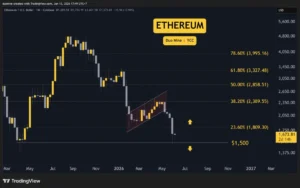
At the time of reporting, Ether (ETH), the native cryptocurrency of the Ethereum network, was trading around $1,748, experiencing a slight downturn of 1.08% in the past 24 hours. However, the longer-term sentiment surrounding ETH is heavily influenced by the anticipated success of Glamsterdam and its subsequent upgrade, "Hegotá." The promise of meaningful gains in speed and efficiency from these upgrades is a key factor driving investor confidence.
Beyond the core protocol upgrades, the broader ecosystem surrounding Ethereum also plays a crucial role in its future prospects. The potential approval of spot Ethereum Exchange-Traded Funds (ETFs) by regulatory bodies like the U.S. Securities and Exchange Commission (SEC) could significantly boost institutional demand for ETH. Such approvals would make it easier for traditional financial institutions to gain exposure to Ethereum, potentially leading to substantial capital inflows.
However, the path forward is not without its challenges. Regulatory scrutiny remains a significant factor, as demonstrated by the SEC’s ongoing deliberations on various cryptocurrency-related financial products. Furthermore, competition from other blockchain networks, particularly those known for their higher transaction speeds and lower fees, such as Solana, continues to be a notable risk. These "faster" networks often attract users and developers seeking immediate performance gains, posing a challenge for Ethereum to maintain its market share and attract new users if its scaling solutions are not implemented effectively and efficiently.
The successful deployment of Glamsterdam will be a critical test of Ethereum’s ability to evolve and adapt to the growing demands of the decentralized ecosystem. If the upgrade delivers on its promises of enhanced scalability, efficiency, and decentralization, it will solidify Ethereum’s position as the leading smart contract platform and pave the way for a new era of innovation in the blockchain space. The journey from devnets to mainnet is a long and complex one, but the groundwork being laid for Glamsterdam suggests a future where Ethereum is more robust, more performant, and more accessible than ever before.