
OpenRouter, a prominent player in the AI model routing landscape, has officially launched its groundbreaking API, Fusion, built upon a deceptively simple yet audacious premise: that a meticulously assembled panel of more affordable AI models, when combined effectively, can not only rival but potentially surpass the capabilities of a single, highly expensive frontier model. The target for this ambitious challenge is none other than Anthropic’s lauded Claude Fable 5, a model previously considered a benchmark for advanced artificial intelligence.
The Genesis of Fusion: A Paradigm Shift in AI Architecture
Fusion’s introduction marks a significant evolutionary step in the deployment and utilization of large language models (LLMs). For years, the AI industry has been captivated by the raw power of monolithic, "frontier" models—singular entities developed by leading research labs at immense cost and computational scale. These models, like Anthropic’s Claude series or OpenAI’s GPT family, typically represent the cutting edge of AI capabilities, but come with a hefty price tag and, as recent events have shown, potential accessibility restrictions.
OpenRouter, known for its platform that allows developers to seamlessly route API calls to a diverse array of AI models, recognized an opportunity to disrupt this paradigm. Instead of relying on a single "black box" solution, Fusion leverages the strengths of multiple specialized or general-purpose models, orchestrating them in a collaborative framework. This approach, often referred to as an "ensemble" or "compound AI system," posits that collective intelligence, when properly managed, can yield superior results to individual brilliance, particularly in complex problem-solving scenarios. The underlying hypothesis is that by mitigating individual model weaknesses and amplifying their collective strengths, a more robust, accurate, and ultimately cost-effective solution can be achieved.
Technical Deep Dive: How Fusion Orchestrates Intelligence
At its core, Fusion is an intelligent orchestration layer designed to extract the maximum value from a diverse set of AI models. When a user submits a prompt to the Fusion API, OpenRouter’s system initiates a sophisticated, multi-stage process:
-
Parallel Prompt Execution: The initial prompt is simultaneously dispatched to a curated panel of AI models. Each model in this panel is equipped with identical auxiliary tools, including web search capabilities for real-time information retrieval and Bash tools for executing commands or interacting with external systems. This parallel processing ensures that a wide array of perspectives and knowledge bases are brought to bear on the problem concurrently, increasing the chances of comprehensive coverage and divergent insights.
-
The Judge Model: As each panel member returns its individual response, a dedicated "judge model" takes center stage. This specialized AI is tasked with an intricate analytical role:
- Consensus Identification: It sifts through the various outputs to identify points of agreement or shared understanding among the models, establishing a baseline of common knowledge.
- Contradiction Detection: Crucially, the judge model actively seeks out discrepancies and outright contradictions between responses. This step is vital for uncovering potential biases, factual errors, or differing interpretations that might arise from individual models.
- Blind Spot Revelation: Beyond simple contradictions, the judge model also works to identify "blind spots"—areas where one or more models might have overlooked critical information or failed to address specific facets of the prompt. By comparing the collective output, it can highlight gaps in the overall understanding.
-
The Synthesizer Model: Following the comprehensive analysis by the judge model, a "synthesizer model" is employed to craft the final, definitive answer. By default, OpenRouter leverages Claude Opus 4.8 for this crucial role. The synthesizer’s task is to integrate the consensus points, reconcile contradictions (where possible, or highlight them if not), fill in blind spots identified by the judge, and present a coherent, grounded, and well-reasoned response that reflects the collective intelligence of the entire panel. This final synthesis is where the raw outputs are refined into a polished, actionable answer.
The entire Fusion process occurs server-side, abstracting away the complexity for developers. OpenRouter provides flexible integration options: users can simply swap their model string to "openrouter/fusion" for a default panel, integrate Fusion as a selective tool within their existing AI workflows, or even build and customize their own model panels directly within the Fusion chatroom, requiring no coding expertise. This flexibility underscores OpenRouter’s commitment to making advanced AI orchestration accessible to a broader audience.

The Fortuitous Timing: Fable 5’s Unprecedented Suspension
The launch of Fusion was impeccably timed, coinciding with an unexpected and significant upheaval in the frontier AI landscape that underscored the very problem Fusion aims to solve: reliance on single, potentially vulnerable, high-cost models.
Chronology of Events:
- Late May/Early June 2026: Anthropic, a leading AI research company, releases its highly anticipated next-generation models, Claude Fable 5 and Mythos 5. These models quickly garner attention for their advanced reasoning capabilities, expanded context windows, and improved performance across a wide range of tasks, cementing Anthropic’s position at the forefront of AI development.
- Days Later: A swift and unprecedented U.S. export control directive is issued. The directive mandates that Anthropic suspend access to Fable 5 and Mythos 5 for all foreign nationals worldwide. The stated reason for this drastic measure is a "disputed jailbreak finding," implying that the models might have exhibited vulnerabilities that could be exploited to bypass their safety guardrails, potentially leading to the generation of harmful or restricted content.
- Immediate Aftermath: The U.S. government’s action sends shockwaves through the global AI community. Access restrictions for foreign nationals create immediate operational challenges for businesses, researchers, and developers outside the U.S. who had come to rely on Anthropic’s frontier models. The term "disputed jailbreak" itself suggests an ongoing debate or lack of full consensus on the severity or even existence of the alleged vulnerability, further complicating the situation and raising questions about the future of international AI collaboration and access.
- June 13, 2026: Seizing the moment, OpenRouter takes to X (formerly Twitter) to announce the official launch of Fusion. Their message directly addresses the void left by Anthropic’s suspension, boldly promising "Fable-level intelligence at half the price," strategically positioning Fusion as an immediate and viable alternative for those suddenly cut off from their preferred frontier model. The tweet, featuring an infographic explaining Fusion’s workings, quickly gains traction, highlighting the industry’s need for resilient and accessible advanced AI solutions.
The background to this situation is crucial. Claude Fable 5, prior to its suspension, represented the zenith of Anthropic’s capabilities, renowned for its nuanced understanding, superior reasoning, and robust conversational abilities. Its "expensive" nature was justified by its perceived state-of-the-art performance, making it a go-to for complex applications in finance, law, research, and creative industries. The U.S. export control directive underscores a growing trend of national security concerns intertwining with technological advancements, particularly in critical areas like AI. Such controls can severely impact global innovation, create market fragmentation, and force companies and developers to seek alternative, potentially more resilient, solutions. OpenRouter’s Fusion emerged into this turbulent environment as a timely answer to a critical market need.
Benchmarking Fusion: Performance and Cost Efficiency
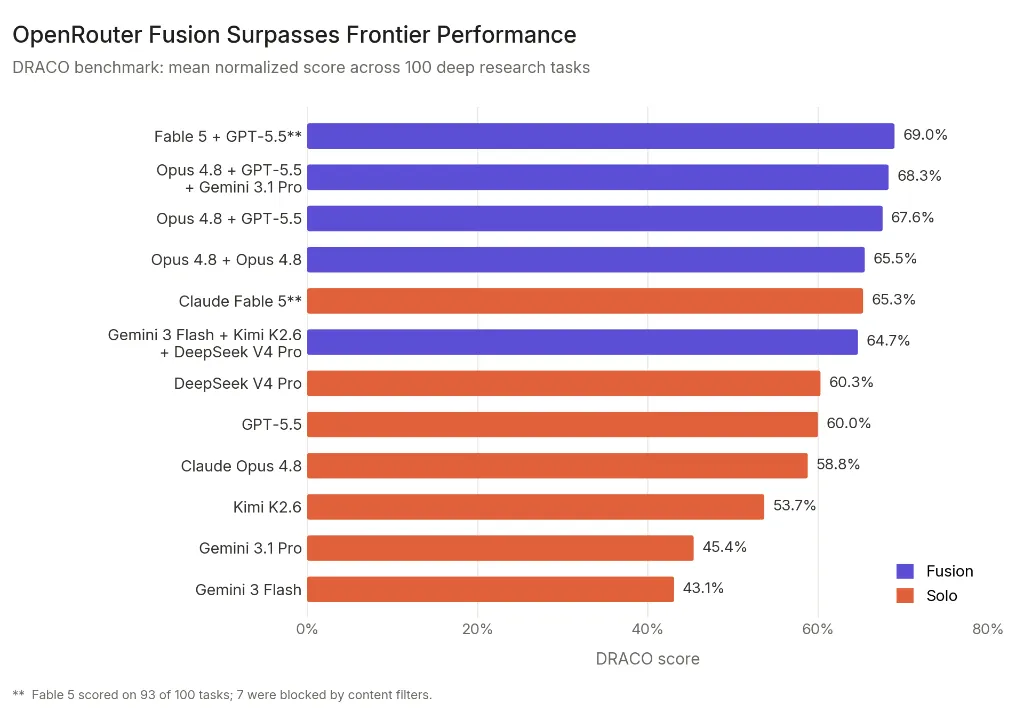
To validate its audacious claim, OpenRouter put Fusion through rigorous testing, utilizing Perplexity’s DRACO benchmark. DRACO (Deep Research Assistant Collaboration Optimization) is specifically designed to evaluate AI models on real-world, deep research requests from users, making it an ideal proving ground for Fusion’s ability to handle complex, information-intensive tasks.
The benchmark results were compelling:
- Frontier Ensemble Dominance: A Fusion configuration combining Claude Fable 5 and OpenAI’s GPT-5.5, with Claude Opus 4.8 acting as the synthesizer, topped the DRACO chart with an impressive score of 69%. This demonstrates that even when integrating other frontier models, Fusion’s orchestration layer enhances their collective output.
- Solo Fable 5’s Performance and Pitfalls: Solo Claude Fable 5 achieved a score of 65.3%. However, a significant caveat emerged: seven out of 100 tasks assigned to Fable 5 never ran because its internal content filters blocked them. This highlights a critical challenge for frontier models—while powerful, their inherent safety mechanisms, though necessary, can sometimes hinder their utility for certain queries, potentially impacting overall performance and accessibility. Fusion’s multi-model approach can mitigate such issues by offering alternative paths to problem-solving.
- The Cost-Effective Contender: The most striking revelation from the benchmark was the performance of a Fusion panel composed of significantly cheaper and more accessible models: Gemini 3 Flash, the open-source Chinese models Kimi K2.6 and DeepSeek V4 Pro, all synthesized by Claude Opus 4.8. This configuration achieved a remarkable score of 64.7%. This score not only landed within a single percentage point of solo Fable 5 but also comfortably outperformed solo GPT-5.5 (60%) and solo Opus 4.8 (58.8%) outright. Crucially, this high-performing, cheaper ensemble delivered its results at approximately half the cost of using a single frontier model. This finding directly validates OpenRouter’s core hypothesis and presents a powerful economic argument for Fusion.
- The Power of Synthesis and Diversity: Further analysis revealed the inherent value of Fusion’s architecture. Even pairing Claude Opus 4.8 with a separate instance of itself, synthesized by Opus, resulted in a score of 65.5%—a substantial 6.7-point increase over solo Opus. OpenRouter attributed roughly three-quarters of this performance lift to the synthesis step itself, emphasizing the critical role of the synthesizer in refining and consolidating information. The remaining quarter was attributed to genuine model diversity, even if it was just two instances of the same model processing in parallel.
One technical "wrinkle" during the benchmarking process was identified and swiftly addressed. Initially, the panel’s live web access allowed models to inadvertently surface DRACO’s own grading rubric in search results, posing a contamination risk. OpenRouter clarified that this was coincidental, not deliberate, and was rectified with a single configuration line to exclude the benchmark’s hosting domains from the search tools. All published numbers reflect this cleaned-up, unbiased run, ensuring the integrity of the results.
Navigating the Nuances: Fusion’s Strengths and Limitations
While Fusion presents a compelling alternative, OpenRouter is transparent about its current scope and limitations, acknowledging that it is not a universal replacement for all frontier model applications.
Strengths of Fusion:
- Enhanced Reliability for Complex Tasks: Fusion excels in scenarios demanding deep research, complex planning, or any task where contradictions, nuanced interpretations, or potential blind spots are critical. The multi-model, judge-synthesizer architecture is specifically designed to cross-check information, identify discrepancies, and provide a more robust and grounded answer than a single model might.
- Cost-Effectiveness: The benchmark results clearly illustrate Fusion’s ability to deliver near-frontier-level performance at a significantly reduced cost, democratizing access to advanced AI capabilities.
- Resilience and Accessibility: By abstracting away reliance on a single model, Fusion offers greater resilience against individual model downtimes, content filter limitations, or geopolitical export controls, ensuring more consistent access to high-level AI.
Current Limitations of Fusion:
- Long-Horizon Work: OpenRouter acknowledges that DRACO, by design, focuses on deep research requests and does not fully encompass "long-horizon work"—complex, multi-step tasks requiring sustained reasoning and planning over extended periods. For such applications, frontier models like Fable 5 reportedly still maintain a lead.
- Specialized Coding Tasks: For intricate coding tasks, Fusion is best utilized as a tool that a dedicated coding model calls selectively, rather than a wholesale replacement for a specialized coding AI. This echoes findings from Decrypt‘s testing of DeepClaude, a backend swap designed to make Claude Code cheaper, which still trailed Opus on the most challenging reasoning tasks within a coding context. The regular, specialized model is still expected to handle day-to-day coding requirements, with Fusion stepping in for questions where diverse perspectives might prevent critical oversights.
In essence, Fusion is positioned as a powerful augmentation for specific, high-value use cases—those "questions where one model might miss something important, and having a few perspectives cross-check each other actually moves the needle." For routine tasks, a single, efficient model may suffice, but for critical decision-making, in-depth analysis, or complex problem-solving where accuracy and comprehensiveness are paramount, Fusion’s multi-perspective approach offers a distinct advantage.
Industry Reactions and Future Implications
The launch of Fusion has sparked considerable debate and excitement within the AI community, reflecting a broader shift in how advanced AI capabilities are developed and deployed. Sentiment tracking of the launch thread indicated a roughly two-to-one positive reception.
Optimistic Outlook:
AI researcher Andrew Trask notably characterized Fusion as "a way bigger deal than it seems." His argument centers on the profound implication that "frontier labs will never again own the frontier alone." This perspective suggests that the era of proprietary, monolithic models dictating the cutting edge of AI might be drawing to a close. Fusion demonstrates that high-level intelligence can be democratized, assembled from a diverse ecosystem of models, including open-source and more affordable proprietary options. This could foster greater innovation, reduce barriers to entry for smaller companies and researchers, and accelerate the overall pace of AI development by focusing on clever orchestration rather than sheer computational scale alone. The ability to achieve similar or superior performance at a fraction of the cost fundamentally alters the economic landscape of AI.
Skeptical Counterpoints:
However, not all reactions were universally positive. Skeptics pushed back on OpenRouter’s framing, citing concerns about potentially poor coding results, inconsistent tool calling, and a perceived lack of transparency. A significant point of contention was the unavailability of Claude Fable 5 for direct, real-time comparison, making it challenging for some to independently verify OpenRouter’s claims post-suspension. These criticisms highlight the ongoing challenges in benchmarking and evaluating compound AI systems, particularly when one of the comparison models becomes inaccessible. Transparency in model selection, orchestration logic, and continuous performance validation will be key for Fusion to build sustained trust.
Broader Market Impact and Accessibility:
Fusion’s launch represents a significant milestone in the evolving landscape of AI. It signals a move towards:
- Democratization of Advanced AI: By offering "Fable-level intelligence" at a reduced cost, Fusion makes advanced AI more accessible to a wider range of developers and businesses, reducing the financial barrier to entry.
- Rise of Model Orchestration: This innovation solidifies the importance of "meta-AI" platforms that can intelligently manage and combine various models, moving beyond simple API routing to sophisticated workflow orchestration.
- Increased Competition: OpenRouter’s success could spur other platforms to develop similar ensemble approaches, fostering a more competitive and innovative market for AI services.
- Resilience Against Restrictions: In an increasingly complex geopolitical environment, where export controls and national security concerns can rapidly restrict access to frontier technologies, solutions like Fusion offer crucial resilience. By leveraging a diverse panel, it mitigates the risk associated with over-reliance on a single, potentially vulnerable, source.
It’s important to note that Fusion, while offering a powerful alternative, does not fundamentally resolve the geopolitical issues that led to Fable 5’s suspension. Fusion runs entirely on models routed through OpenRouter’s own infrastructure, meaning it provides an alternative pathway to high-level AI for those impacted by export controls, rather than fixing the "source" of the problem. For individuals and organizations locked out of Fable 5, Fusion joins a growing list of viable options, including backend swaps like DeepClaude, or increasingly capable open-weight alternatives such as GLM-5.2, which, while perhaps not universally superior, offer compelling performance for their price point.
Conclusion
OpenRouter’s Fusion API stands as a testament to the burgeoning field of compound AI systems, challenging the long-held notion that only the most expensive, monolithic frontier models can deliver top-tier intelligence. By intelligently orchestrating a panel of diverse and often more affordable models through a sophisticated judge and synthesizer mechanism, Fusion demonstrates that collective intelligence can indeed rival and even surpass the capabilities of individual titans, all while significantly reducing costs.
Launching into a market roiled by the unprecedented suspension of Anthropic’s Claude Fable 5 due to export controls, Fusion has strategically positioned itself as a timely and compelling solution. While acknowledging its current limitations for highly specialized or long-horizon tasks, Fusion clearly marks a significant step forward in the democratization and resilience of advanced AI. Its success suggests a future where innovative orchestration, rather than just raw computational power, will increasingly define the frontier of artificial intelligence, ushering in an era of more accessible, robust, and cost-efficient AI capabilities for all.