The cryptocurrency market is experiencing a period of significant turbulence, with Bitcoin, the flagship digital asset, facing a considerable downturn. Recent weeks have seen a sharp decline in Bitcoin’s value, erasing a substantial portion of its earlier gains and prompting widespread concern among investors. This bearish trend is further exacerbated by substantial outflows from "whales" – large holders of Bitcoin – and a prevailing skepticism among traders, as evidenced by negative weekly data indicators. Amidst this challenging market climate, Binance founder Changpeng Zhao, widely known as CZ, has stepped in to offer a counter-narrative, attempting to assuage fears and project a path toward recovery.
Bitcoin’s Recent Price Plunge and Market Sentiment
Bitcoin, which reached an all-time high exceeding $125,000 last year, has struggled to sustain its upward momentum. A critical juncture was the loss of the $112,000 support level, which was swiftly followed by a 32% depreciation over a three-month period. This significant drop triggered a notable capital rotation, with investors shifting their focus towards assets perceived as safer havens or offering different growth potentials, such as gold and stocks in the artificial intelligence (AI) sector.
The market’s downturn is not solely attributable to internal cryptocurrency dynamics. Macroeconomic factors have also played a crucial role in prolonging the bear market phase. By the end of the third quarter of 2025, a slowdown in institutional capital inflows became increasingly apparent. This year, the situation has been further complicated by escalating geopolitical tensions, which have instilled a sense of panic among both retail and institutional investors, leading to significant sell-offs.
The preceding bull market was characterized by substantial corporate treasury acquisitions, as companies sought to diversify their balance sheets by allocating billions to Bitcoin. Traditional financial institutions also entered the fray, becoming dominant players in asset accumulation. However, analysts had previously cautioned that such a concentration of holdings among a few large entities could pose a risk to price stability if market sentiment were to shift.
Following the initial significant price drop, institutional investors began to withdraw their capital, leading to a further decline in market sentiment and a nearly 35% plunge in Bitcoin’s value. As of the latest reports, BTC is trading just above $61,600, marking an 8% decrease over the past week and a further 2% dip in the last 24 hours, leaving many traders uncertain about the immediate future.
Whale Activity and Retail Demand Dynamics
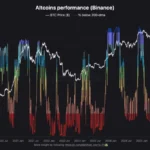
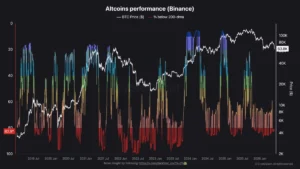
Recent data from Santiment, a prominent on-chain analytics firm, indicates a shift in market dynamics, with retail investors now exhibiting higher demand compared to institutional traders. This trend suggests a potentially extended period of market weakness. Institutional sell-offs have been ongoing for four consecutive weeks, and this trend is beginning to impact altcoins as well, leading to cascading effects throughout the broader cryptocurrency ecosystem.
The term "whale" in the context of cryptocurrency refers to individuals or entities that hold a substantial amount of a particular digital asset. These large holders can significantly influence market prices due to the sheer volume of their holdings. When whales begin to offload their assets, it can create selling pressure that drives prices down, often triggering panic selling among smaller investors. The current wave of whale liquidations is a key factor contributing to the prevailing bearish sentiment.
CZ’s Intervention and Historical Context
Changpeng Zhao’s recent intervention on social media platform X (formerly Twitter) aimed to provide a much-needed dose of optimism. He encouraged Bitcoin holders, stating that the asset would not remain in a downturn for long and is expected to recover once the sharp exits subside. This statement comes at a time when market sentiment has reached multi-month lows.

CZ’s perspective carries significant weight, given his position as the founder of Binance, one of the world’s largest cryptocurrency exchanges. His pronouncements often influence market perception and investor behavior. His call for patience and belief in Bitcoin’s resilience echoes the inherent volatility of crypto assets, which are known for their sharp swings that can result in substantial gains or losses.
Historically, the cryptocurrency market has demonstrated a remarkable ability to recover from significant downturns. However, the current economic and geopolitical climate presents a unique set of challenges. The period between 2020 and 2021, for instance, saw an unprecedented surge in Bitcoin’s value, fueled by a combination of factors including increased institutional adoption, growing retail interest, and a generally accommodative monetary policy. Corporate treasuries, such as those of MicroStrategy and Tesla, made substantial Bitcoin purchases, signaling a growing acceptance of the digital asset as a legitimate store of value and a hedge against inflation.
The narrative around Bitcoin’s scalability has also been a recurring theme throughout its history. Early critics often pointed to the network’s limited transaction processing capacity as a fundamental flaw that would prevent widespread adoption. The introduction of solutions like the Lightning Network, a second-layer payment protocol, was a direct response to these concerns, aiming to enable faster and cheaper transactions. The statement attributed to BitMEX Research, "Without Scalability Improvements, Bitcoin Would Be Dead By Now," highlights the critical importance of these ongoing technological advancements. The ability of the Bitcoin network to handle a growing number of transactions without compromising on security or decentralization is paramount to its long-term survival and success.
Broader Market Implications and Future Outlook
The current market conditions, marked by institutional sell-offs and a shift towards retail-driven demand, raise questions about the sustainability of any potential recovery. The precedent set by the last bull run, where traditional firms played a dominant role, suggests that a significant institutional turnaround would be a key catalyst for a renewed upward trend. However, the current macroeconomic headwinds and geopolitical uncertainties create a more complex environment for such a turnaround.
Zhao’s broader stance on the crypto industry emphasizes his support for market development, innovation, and regulatory clarity. In a recent post on X, he highlighted the historical significance of the current era, suggesting that future generations will evaluate how contemporary players navigate the evolving landscapes of artificial intelligence and cryptocurrency. This perspective underscores the intertwined nature of technological advancements and their impact on financial markets.
While concerns about market manipulation and illicit finance persist, as voiced by critics, other prominent figures in the crypto space, such as Michael Saylor, remain optimistic. Saylor, a staunch advocate for Bitcoin, has previously predicted that advancements in quantum computing will ultimately strengthen and further decentralize Bitcoin, making it more scarce and resilient. Such contrasting views underscore the polarized opinions within the industry regarding the future trajectory of Bitcoin and other cryptocurrencies.
The implications of the current market correction are far-reaching. For retail investors, it underscores the importance of risk management and a long-term investment horizon, given the inherent volatility of digital assets. For institutional investors, it presents an opportunity to re-evaluate their strategies and risk exposure in the crypto market. The ongoing developments in scalability solutions and regulatory frameworks will continue to shape the accessibility and adoption of cryptocurrencies.
The resilience of Bitcoin will ultimately be tested by its ability to adapt to evolving market demands and technological advancements. The ongoing debate surrounding its scalability, the influence of whale activity, and the broader macroeconomic environment will continue to be critical factors in determining its future price trajectory. While CZ’s optimistic outlook offers a glimmer of hope, the path to a sustained recovery remains contingent on a confluence of factors, including a stabilization of global economic conditions and a renewed inflow of institutional capital. The cryptocurrency market remains a dynamic and evolving landscape, where past performance is not indicative of future results, and adaptability remains the key to long-term survival.