
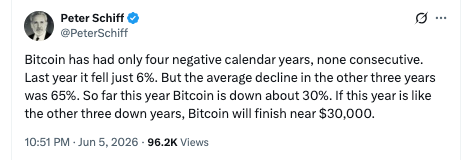
Prominent Bitcoin critic Peter Schiff has once again voiced his bearish outlook on the flagship cryptocurrency, forecasting a potential significant price decline to as low as $30,000 by 2026. Schiff’s latest pronouncements came in the wake of Bitcoin’s recent dip below the $60,000 mark, a move that has historically triggered intense scrutiny and dire predictions from the staunch gold advocate. His commentary, disseminated across social media platforms, particularly X (formerly Twitter), paints a grim picture for Bitcoin’s future valuation, drawing parallels with past market downturns.
Schiff’s projections are rooted in his analysis of historical Bitcoin price action, specifically referencing the substantial corrections observed in 2014, 2018, and 2022. He posits that if Bitcoin fails to avoid a second consecutive year of major losses in 2026, following what he perceives as a minor loss in 2025, its long-term viability could be severely jeopardized. This cyclical view of Bitcoin’s performance, according to Schiff, suggests a pattern of significant retracements that could repeat, leading to a substantial erosion of its market value.
The analyst’s concerns are amplified by the financial strategies of prominent Bitcoin holder Michael Saylor, the executive chairman of MicroStrategy. Schiff has been a vocal critic of Saylor’s aggressive Bitcoin acquisition strategy, which has seen MicroStrategy amass a significant portion of the cryptocurrency. Recently, MicroStrategy’s sale of a modest 32 Bitcoin (valued at approximately $1.9 million) sparked a wave of speculation regarding the future of the company’s Bitcoin holdings and the possibility of larger liquidations. Saylor has committed to delivering 11% annual yields on his STRC stock, with proceeds frequently reinvested into Bitcoin, making MicroStrategy one of the largest institutional buyers in the crypto market. Schiff contends that this leveraged approach to Bitcoin accumulation is unsustainable and will inevitably force Saylor to liquidate his reserves, triggering a sharp decline in Bitcoin’s price. Saylor, however, has consistently refuted such claims, asserting that such a scenario would never materialize.
Historical Context of Bitcoin’s Volatility and Schiff’s Skepticism
Peter Schiff, a well-known gold bug and CEO of Euro Pacific Capital, has maintained a consistently bearish stance on Bitcoin since its inception. His arguments often center on Bitcoin’s lack of intrinsic value, its speculative nature, and its perceived inability to function as a reliable store of value or a medium of exchange, unlike gold, which he champions. Schiff frequently draws attention to Bitcoin’s dramatic price swings, highlighting them as evidence of its inherent instability and unsuitability as a long-term investment.
The history of Bitcoin is indeed marked by periods of extreme volatility. Following its all-time highs, the cryptocurrency has experienced significant drawdowns. For instance, after reaching a peak of nearly $69,000 in November 2021, Bitcoin entered a prolonged bear market, eventually falling to lows around $15,500 in late 2022. This period saw a decline of over 77%, impacting numerous investors and fueling skepticism about the cryptocurrency’s future.

Schiff’s consistent commentary, particularly during market downturns, has led some observers to note a pattern where his criticism intensifies when Bitcoin’s price falters, while he remains largely silent during periods of significant price appreciation. This selective engagement, critics suggest, underscores a bias rather than an objective analysis of the asset’s underlying fundamentals.
Schiff’s Cyclical Bearish Thesis and the 2026 Projection
Schiff’s latest prediction hinges on a perceived cyclical pattern in Bitcoin’s performance. He argues that the cryptocurrency has historically experienced major price crashes in distinct years, such as 2014, 2018, and 2022. His thesis suggests that while Bitcoin has not historically endured two consecutive years of significant losses, a potential minor downturn in 2025 followed by a major crash in 2026 could break this pattern.
To substantiate his claim, Schiff pointed to the following historical data points and his interpretation of them:
- 2014: A significant crash occurred following the Mt. Gox exchange hack, leading to a substantial loss in value.
- 2018: The cryptocurrency market experienced a brutal bear market, with Bitcoin losing a significant portion of its value after a speculative bubble burst in late 2017.
- 2022: Following a period of strong gains in 2020 and 2021, Bitcoin entered another bear market, exacerbated by macroeconomic factors and the collapse of several major crypto firms.
Schiff’s concern is that if 2025 sees a downturn, even a minor one, and 2026 follows with another substantial decline, it would represent a critical juncture. Such a scenario, in his view, would invalidate the argument that Bitcoin always recovers and strengthens after a downturn, thus casting serious doubt on its long-term sustainability as a digital asset. The projected $30,000 target implies a potential drop of approximately 65% from current levels, a figure that, if realized, would represent a significant loss for many investors.
The Saylor Factor: A Potential Catalyst for Further Decline?
Michael Saylor and MicroStrategy’s aggressive Bitcoin accumulation strategy has been a focal point of Schiff’s criticism. Saylor has publicly stated his belief that Bitcoin is a superior asset to gold and that holding it on the balance sheet is a prudent strategy for preserving and growing shareholder value. MicroStrategy has consistently utilized debt financing and equity offerings to purchase more Bitcoin, steadily increasing its holdings.
As of the first quarter of 2024, MicroStrategy held approximately 214,278 Bitcoin, acquired at an average price of $35,158 per Bitcoin. This substantial holding makes the company one of the largest corporate holders of Bitcoin globally. The company’s financial strategy has been heavily scrutinized, with many analysts questioning the sustainability of its debt-funded Bitcoin purchases, especially during periods of market volatility.
Schiff’s argument is that Saylor’s leveraged approach creates a precarious situation. If Bitcoin prices were to fall significantly, MicroStrategy could face margin calls or be forced to sell its Bitcoin holdings to meet its debt obligations. Such a liquidation, especially if it were to involve a substantial portion of Saylor’s holdings, could trigger a cascade effect in the market, leading to further price declines.
The recent sale of 32 BTC, while minuscule in the context of MicroStrategy’s total holdings, has been interpreted by some as a potential indicator of future liquidity needs or a shift in strategy. However, Saylor has repeatedly downplayed these concerns, emphasizing the company’s long-term commitment to Bitcoin and its ability to withstand market fluctuations. He has often highlighted the uncorrelated nature of Bitcoin’s returns with traditional assets and its potential as an inflation hedge.
Market Reactions and Proponent Counterarguments
Schiff’s bearish pronouncements, while influential within certain circles, are often met with strong counterarguments from Bitcoin proponents and the wider crypto community. Many view Schiff’s predictions as a recurring theme that has historically failed to materialize over the long term.
One common counterargument posits that Bitcoin has demonstrated remarkable resilience, surviving multiple market crashes and emerging stronger. Proponents point to the increasing institutional adoption, the development of the Bitcoin ecosystem, and its growing network effect as indicators of its long-term viability. They argue that each previous downturn has ultimately led to new all-time highs, suggesting a pattern of growth and maturation rather than inherent weakness.

For instance, after the 2018 bear market, Bitcoin eventually rallied to new highs in 2021. Similarly, following the lows of 2022, the cryptocurrency has shown signs of recovery and renewed interest. Bitcoin proponents often attribute these recoveries to technological advancements, increasing regulatory clarity, and a growing understanding of Bitcoin’s potential as a digital store of value.
A user on X, replying to Schiff’s recent comments, highlighted this resilience: "BTC has survived worse crashes in previous cycles, and its proponents argue that it would be able to survive the latest crash too, rising stronger than ever." This sentiment reflects a common belief within the crypto community that Bitcoin’s decentralized nature and scarcity make it a robust asset capable of overcoming periodic market challenges.
Broader Implications and the Future Outlook
The ongoing debate between Bitcoin skeptics like Peter Schiff and its proponents underscores the fundamental uncertainties surrounding the future of cryptocurrencies. While Schiff’s predictions are based on historical analysis and a particular interpretation of market cycles, they also reflect broader concerns about speculative bubbles and the potential for significant financial losses in volatile markets.
The implications of Schiff’s forecast, if realized, would extend beyond individual investors. A sustained downturn in Bitcoin’s price could impact the broader cryptocurrency market, potentially dampening innovation and investment in the blockchain space. It could also lead to increased regulatory scrutiny, as policymakers grapple with the risks associated with highly volatile digital assets.
Conversely, if Bitcoin continues its upward trajectory, defying Schiff’s predictions, it would further solidify its position as a significant asset class and potentially validate the strategies of investors like Michael Saylor. The ongoing narrative surrounding Bitcoin’s potential as a store of value, an inflation hedge, or a digital gold alternative will continue to shape market sentiment and investment decisions.

The future of Bitcoin remains a subject of intense speculation and analysis. While Peter Schiff’s bearish outlook serves as a stark warning, the cryptocurrency’s history of resilience and innovation suggests that its path forward may be more complex than any single prediction can fully capture. The interplay between technological development, macroeconomic conditions, regulatory landscapes, and investor sentiment will ultimately determine Bitcoin’s trajectory in the years to come. The market will continue to watch closely as these forces converge, shaping the evolution of this nascent asset class.