
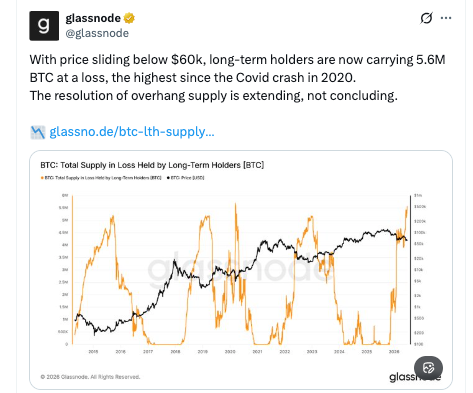
Bitcoin’s recent slide below the crucial $60,000 price support has triggered significant stress for seasoned cryptocurrency investors, often referred to as "diamond hands." On-chain analytics from the firm Glassnode reveal a stark reality: an estimated 5.6 million Bitcoin, representing a substantial portion of the total 20.04 million BTC in circulation, are currently held at a loss. This figure marks the highest number of Bitcoin held at a loss since 2019, surpassing even the significant market turmoil witnessed during the 2022 FTX collapse. As Bitcoin trades around $59,300, the absence of robust retail buyer interest is contributing to an increasingly bearish market sentiment.
The data, shared by Glassnode via their official X (formerly Twitter) account, highlights the precarious position of Long-Term Holders (LTHs) – investors who have held their Bitcoin for over 155 days. These LTHs are now experiencing deep losses, a trend that analysis suggests could persist. Historically, periods of significant LTH losses have often followed the conclusion of major bull markets, peaking in the subsequent year. This cyclical pattern provides a historical lens through which to understand the current market dynamics.
Despite the current "bloodbath," a significant portion of these LTHs, approximately 15 million BTC, remain in profit. This indicates that around 37% of these long-term investors are still seeing positive returns on their holdings, demonstrating the enduring value of their "diamond hands" strategy. Collectively, LTHs represent a dominant force in the Bitcoin market, accounting for an impressive 75% of the active supply. Their continued conviction, even amidst price depreciation, plays a crucial role in market stability and potential future recoveries.
Understanding Bitcoin’s Cycles Through Long-Term Holder Losses
The current market environment can be better understood by examining the historical behavior of LTHs during different phases of the Bitcoin market cycle. During the pronounced bull market of 2024-2025, the number of LTHs in loss remained remarkably low, below 800,000. This starkly contrasts with the present situation, where the re-emergence of bearish sentiment has driven this number to multi-year highs.
A similar pattern of LTH losses spiking after bull runs was observed following the 2020-2021 and 2016-2017 bull markets. The brief periods where the number of LTHs in loss declined significantly have historically coincided with bull market phases. Conversely, the extended periods of elevated LTH losses indicate that the cryptocurrency has often experienced longer bearish squeezes than bullish rallies. This suggests that periods of consolidation and correction are a natural, albeit often painful, part of Bitcoin’s maturation process.
The Role of Long-Term Holders in Market Dynamics

Long-Term Holders are often considered the bedrock of the Bitcoin market. Their conviction stems from a belief in Bitcoin’s long-term value proposition, often acquired during periods of lower prices. Unlike short-term traders who might panic sell during downturns, LTHs are generally more resilient to short-term price volatility. Their substantial holdings mean that their decisions – whether to hold, accumulate, or sell – can have a significant impact on market sentiment and price action.
The current data suggests that while many LTHs are experiencing unrealized losses, a substantial number are still holding strong. This resilience is crucial. If a significant portion of LTHs were to capitulate and sell their holdings, it could exacerbate the downward price pressure. However, the fact that 15 million BTC are still held by LTHs, with a considerable portion in profit, indicates a level of confidence that could help buffer the market against extreme sell-offs.
Factors Contributing to the Current Bearish Sentiment
Several factors are likely contributing to the current bearish sentiment and the pressure on Bitcoin’s price. The absence of strong retail investor participation is a key indicator. Retail investors often enter the market during periods of rapid price appreciation, driven by FOMO (fear of missing out). When prices stagnate or decline, retail interest tends to wane, reducing overall demand.
Furthermore, macroeconomic factors can also play a role. Global economic uncertainty, inflation concerns, and interest rate policies from major central banks can influence investor appetite for risk assets like Bitcoin. While Bitcoin has often been touted as an inflation hedge, its correlation with traditional risk assets means it can also be susceptible to broader market downturns driven by macroeconomic headwinds.
The increasing number of LTHs in loss also creates a psychological pressure point. As more investors see their holdings depreciate significantly, the temptation to cut losses can increase. This can lead to a cascade effect, where selling by some LTHs triggers further selling by others.
The Path Forward: Challenges and Potential Recovery
The immediate future for Bitcoin appears challenging, with LTHs likely to face continued testing of their resolve in the coming months. The cryptocurrency recently hit a 21-month low near $58,131 on June 25 before a partial recovery above $59,000. There is a growing sentiment among market observers that the $60,000 support level may prove difficult for bulls to defend, potentially leading to further price declines towards $55,000 or even lower.
However, historical patterns suggest that periods of extended correction are often followed by renewed periods of growth. The analysis of LTH losses indicates that the current phase, while painful, could be a precursor to a future recovery. The key for bulls will be to navigate through this bearish cycle and see the calendar year 2026 conclude on a more positive note.
Beyond 2026, market analysts and historical data suggest that the cryptocurrency market could experience improvements over the subsequent years. The next Bitcoin halving, an event that historically leads to increased scarcity and can drive price appreciation, is anticipated in 2028. This event, coupled with potential shifts in global economic conditions and increased institutional adoption, could pave the way for a renewed bull market.
Broader Implications and the Maturation of the Bitcoin Market
The current market conditions offer valuable insights into the ongoing maturation of the Bitcoin ecosystem. The resilience of LTHs, despite significant paper losses, underscores the growing conviction in Bitcoin’s long-term value proposition. This contrasts with earlier market cycles where capitulation often occurred more broadly and rapidly.
The increasing sophistication of on-chain analytics, as exemplified by Glassnode’s reports, provides investors and observers with greater transparency into market behavior. This data-driven approach allows for more informed analysis of market cycles and the impact of different investor cohorts.
The fact that China, a nation that has implemented a blanket ban on cryptocurrency trading, could theoretically surpass US Bitcoin holdings with a relatively small amount of additional BTC (only 4,012 BTC, as suggested by some speculative analyses based on potential hidden holdings) highlights the complex and often opaque nature of Bitcoin ownership. While official reports of state-level Bitcoin accumulation are rare and subject to considerable speculation, such scenarios underscore the global reach and diverse ownership structures of Bitcoin, even in the face of regulatory hurdles. This disparity between official policy and potential de facto holdings remains a point of intrigue and ongoing discussion within the crypto community.
Ultimately, the current downturn, while challenging, is a testament to Bitcoin’s cyclical nature. The market is demonstrating its capacity for significant corrections, which are often necessary for sustainable long-term growth. The actions and convictions of Long-Term Holders will be a critical factor in determining the speed and strength of any subsequent recovery, as the cryptocurrency continues to navigate its path towards broader adoption and market maturity. The resilience shown by a significant portion of these seasoned investors suggests that despite the current headwinds, the fundamental belief in Bitcoin’s future remains robust.