



The cryptocurrency market is currently navigating a pivotal transition as Bitcoin, the world’s largest digital asset by market capitalization, demonstrates signs of technical exhaustion following its recent struggle to maintain momentum above the $90,000 threshold. Market analysts, including the prominent observer Justcryptopays, have noted that Bitcoin’s recent breach below a critical multi-month trendline may serve as the primary catalyst for a significant shift in market dynamics. This technical breakdown suggests that the period of absolute Bitcoin dominance may be waning, clearing a path for a broader "altcoin season" as capital begins to rotate into high-utility tokens and emerging blockchain ecosystems.
For much of the preceding year, Bitcoin has acted as the undisputed benchmark for the digital asset class, capturing the vast majority of institutional inflows and retail attention. However, the inability to solidify the $90,000 level as a definitive support base has introduced a layer of caution among market participants. As of the latest trading sessions, Bitcoin is hovering near $90,525, a price point that reflects a precarious balance between bullish recovery attempts and bearish pressure. This stagnation in the flagship currency often precedes a "liquidity waterfall," where investors seek higher alpha in alternative assets such as Ethereum, Solana, and various decentralized finance (DeFi) protocols.
Technical Analysis of the Trendline Breach
The technical significance of Bitcoin’s trendline break cannot be overstated in the context of market cycles. For several months, a diagonal support line had guided Bitcoin’s ascent, providing a reliable floor for "buy-the-dip" strategies. When an asset of Bitcoin’s magnitude falls below such a line, it often signals a shift from a trending market to a ranging or distributive market. In professional trading circles, this is frequently interpreted as a signal to de-risk from the primary asset and reallocate capital toward "laggard" assets that have yet to experience their full breakout potential.
The struggle at $90,000 is particularly noteworthy. Psychological round numbers often function as invisible barriers where large clusters of sell orders—known as "sell walls"—are situated. When Bitcoin fails to clear these hurdles with conviction, the resulting sideways price action tends to diminish the asset’s short-term volatility, prompting traders to look toward the altcoin market for the volatility necessary to generate significant returns.
The Chronology of Market Transition: 2025 to 2026
To understand the current market sentiment, one must examine the trajectory of the digital asset space over the last twelve months. The year 2025 was characterized by a grueling bearish momentum for many altcoins, even as Bitcoin reached new heights. While Bitcoin benefited from the influx of institutional capital via spot Exchange-Traded Funds (ETFs), many secondary tokens suffered from a lack of liquidity and a "flight to safety."

As the calendar turned to 2026, the narrative began to shift. The early weeks of the year have seen a stabilization in the macro-economic environment, providing a more favorable backdrop for risk-on assets. The current phase is being described by analysts as a "cleansing of the palate," where the bearish residues of 2025 are being washed away by renewed interest in technological fundamentals rather than mere speculation. The transition from a Bitcoin-led market to a diversified market typically follows a predictable four-stage cycle:
- Bitcoin Phase: BTC price rises, and dominance increases.
- Ethereum Phase: ETH begins to outperform BTC, signaling the start of the rotation.
- Large-Cap Phase: Major assets like Solana (SOL), Cardano (ADA), and XRP see massive vertical moves.
- Altcoin Season: A "mania" phase where mid-cap, small-cap, and memecoins experience parabolic growth.
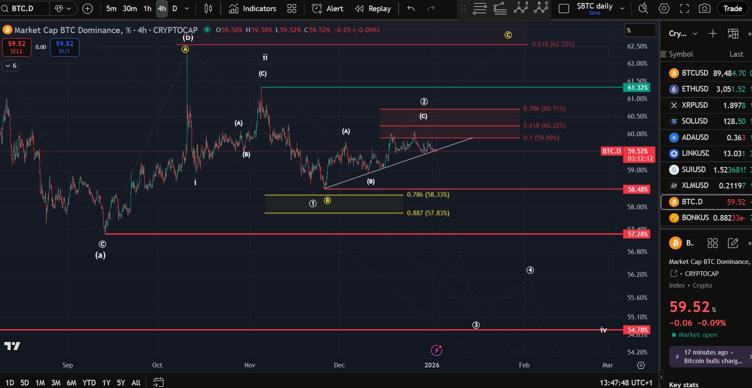
Currently, the market appears to be entering the transition between the second and third phases, as Bitcoin dominance begins to plateau.
Supporting Data and Asset Performance
Data from Binance Research and various on-chain analytics platforms suggest that the rotation is already underway. Several key indicators point toward an "altcoin awakening." For instance, the 21-day Moving Average (MA) has recently been reclaimed by several major altcoins, a technical feat that often precedes a multi-month rally. Chainlink (LINK), a critical infrastructure provider for the blockchain industry, recently broke above its 21-day MA, a move that is being closely watched as a bellwether for the rest of the DeFi sector.
Furthermore, the "Bitcoin Dominance Index"—a measure of Bitcoin’s share of the total crypto market cap—has shown signs of topping out. Historically, when this index falls while the total market cap remains stable or grows, altcoins experience their most aggressive price appreciation. Investors are currently monitoring the performance of "The Big Five" altcoins:
- Ethereum (ETH): As the leading smart-contract platform, ETH remains the primary destination for capital exiting Bitcoin.
- Solana (SOL): Known for its high throughput and growing ecosystem of retail-focused applications, Solana has become a favorite for those seeking high-beta exposure to the market.
- XRP: Following the resolution of various regulatory hurdles, XRP has regained its status as a top contender for cross-border liquidity solutions.
- Cardano (ADA): ADA continues to attract investors focused on long-term academic and peer-reviewed blockchain development.
- Chainlink (LINK): As the bridge between real-world data and smart contracts, LINK’s price action is often seen as a proxy for the health of the broader Web3 ecosystem.
Institutional Responses and Market Sentiment
While retail investors are often the first to jump into memecoins and emerging DeFi tokens, institutional players are also adjusting their portfolios. Reports from major digital asset management firms suggest a growing appetite for "diversified crypto baskets." The introduction of Ethereum ETFs in the previous year has paved the way for institutional-grade access to assets beyond Bitcoin, facilitating a smoother capital rotation.
Market sentiment, as measured by the Crypto Fear & Greed Index, has shifted from "Extreme Greed" (during Bitcoin’s run to $90,000) to a more sustainable "Neutral-to-Greed" zone. This cooling-off period is essential for a healthy market, as it allows for the "shaking out" of over-leveraged long positions. Analysts suggest that this reset is exactly what is needed to fuel a sustainable altcoin rally that is based on fundamental value rather than purely speculative leverage.
Broader Impact and Economic Implications
The shift toward an altcoin-centric market has broader implications for the blockchain industry at large. An "alt-season" typically coincides with increased activity in decentralized applications (dApps), higher transaction volumes on Layer-2 scaling solutions, and a surge in the development of Web3 technologies. This period of market expansion encourages venture capital firms to deploy "dry powder" into early-stage startups, fostering innovation in sectors like decentralized physical infrastructure networks (DePIN) and Artificial Intelligence (AI) integration on the blockchain.
However, the transition is not without its risks. The "bearish momentum of 2025" mentioned by analysts serves as a reminder that the altcoin market is subject to extreme volatility. While the potential for high returns is significant, the lack of a "safe haven" status—which Bitcoin enjoys to some degree—means that altcoins are more susceptible to macro-economic shocks, such as unexpected interest rate hikes by the Federal Reserve or sudden regulatory shifts in major economies.
Analyst Outlook: What to Expect Next
Looking ahead, the next two to three months will be critical in determining whether this shift is a permanent change in market structure or a temporary deviation. If Bitcoin can reclaim its trendline and hold above $92,000, the altcoin rally may be delayed as capital flows back into the "digital gold" narrative. Conversely, if Bitcoin continues to trade sideways or experiences a "healthy correction" toward the $85,000 level, the rotation into altcoins could accelerate.
Vigilant investors are advised to monitor the "ETH/BTC" trading pair, which serves as a definitive gauge for altcoin strength. A rising ETH/BTC ratio is often the "starting gun" for a full-blown alt-season. As 2026 unfolds, the market appears to be moving toward a more balanced and mature ecosystem, where value is distributed across a variety of protocols and use cases rather than being concentrated in a single asset.
In conclusion, the break below Bitcoin’s key trendline and its ongoing struggle at the $90,000 mark represent more than just a price fluctuation; they represent a potential regime change in the cryptocurrency markets. As capital rotates and market dynamics evolve, the stage is set for an altcoin resurgence that could redefine the hierarchy of digital assets in the coming year. Both institutional and retail participants are now positioned to capitalize on strategic opportunities across the spectrum of established and emerging digital assets.














