



The long-anticipated "Merge" of the Ethereum network, which transitioned the world’s second-largest cryptocurrency from a Proof-of-Work (PoW) consensus mechanism to Proof-of-Stake (PoS), has triggered a seismic shift in the global crypto-mining landscape. While the transition was celebrated as a victory for environmental sustainability—reducing the network’s energy consumption by more than 99.9%—it has simultaneously decimated the economic viability of GPU-based mining. For years, Ethereum served as the primary source of revenue for millions of miners worldwide. With that door now closed, a massive migration of computing power has flooded smaller PoW networks, leading to a "difficulty explosion" that has pushed mining profits into negative territory across the board.
The Mechanical Shift: From Hashing to Staking
To understand the current crisis facing miners, one must first look at the fundamental change in how the Ethereum network operates. Under the old PoW system, miners used high-end hardware—predominantly Graphics Processing Units (GPUs) and Application-Specific Integrated Circuits (ASICs)—to solve complex mathematical puzzles. The first miner to solve the puzzle earned the right to validate a block of transactions and receive a reward in ETH. This process required immense computational power, known as "hashrate."
On September 15, 2022, the Ethereum mainnet merged with the Beacon Chain, a PoS system that had been running in parallel. In the PoS model, the network is secured by "validators" who stake their own ETH holdings rather than running power-hungry hardware. This transition effectively "fired" the entire global fleet of Ethereum miners overnight, stripping them of a multi-billion dollar annual revenue stream.
The Great Migration and the Hashrate Overload
Following the Merge, miners were faced with three choices: sell their hardware, shut down their machines and wait, or point their hashrate toward other PoW-based cryptocurrencies. The majority initially chose the latter, seeking refuge in coins such as Ethereum Classic (ETC), Ravencoin (RVN), Ergo (ERG), and Flux (FLUX).

However, the scale of Ethereum’s hashrate was so massive that these smaller networks were physically unable to absorb the influx. Before the Merge, Ethereum’s hashrate fluctuated between 800 and 1,000 Terahashes per second (TH/s). In comparison, Ethereum Classic’s hashrate was approximately 25 to 30 TH/s. When even a fraction of the former Ethereum miners moved to Ethereum Classic, the network’s hashrate skyrocketed, increasing by nearly 500% in a matter of days.
This influx triggered the "Difficulty Adjustment" mechanism inherent in almost all PoW blockchains. These networks are designed to produce blocks at a constant interval (e.g., every 15 seconds for ETC). When hashrate increases, the network automatically increases the mathematical difficulty of mining to prevent blocks from being produced too quickly. Consequently, as more miners competed for the same fixed number of daily block rewards, the individual share of rewards for each miner plummeted.
Analyzing the Data: Negative Profitability
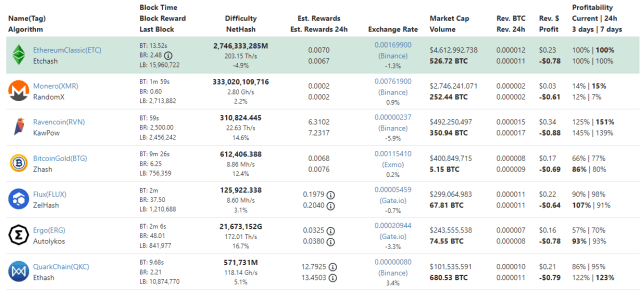
Current data from mining profitability aggregators like WhatToMine paints a bleak picture for those remaining in the industry. As of the latest market reports, virtually no popular GPU-minable coin offers a positive return on investment when factoring in average global electricity costs.
For a standard setup utilizing three AMD RX 480 graphics cards—a once-popular and efficient choice for mid-range miners—the daily profit for mining Ethereum Classic stands at approximately -$0.78 per hour. This calculation assumes an electricity cost of $0.10 per kilowatt-hour (kWh). Even miners equipped with top-tier hardware, such as the NVIDIA GeForce RTX 3090 Ti, are seeing hourly losses of roughly -$0.50.
In this environment, "profitability" has been replaced by "operational loss." Miners are essentially paying their utility companies for the privilege of securing these networks, with the cost of the electricity consumed far exceeding the market value of the coins earned. For many, the only way to justify continued operation is "speculative mining"—the hope that the coins they mine today at a loss will appreciate significantly in value during a future bull market.

Chronology of the Post-Merge Fallout
The timeline of the mining collapse was swift, occurring over the span of a single week:
- September 14, 2022 (Pre-Merge): Ethereum mining remains highly profitable. GPU prices on the secondary market begin to soften as savvy miners start offloading inventory.
- September 15, 2022 (The Merge): At 06:42 UTC, the Merge is completed. Ethereum mining ends. Within minutes, hashrates on Ethereum Classic, Ravencoin, and Ergo begin to climb vertically.
- September 16-17, 2022 (The Difficulty Spike): Networks adjust their difficulty levels. Ethereum Classic’s difficulty reaches an all-time high, rendering the vast majority of older GPUs obsolete.
- September 18, 2022 – Present (The Capitulation): Profitability across all major PoW altcoins turns negative. Mining pools report a steady decline in active workers as hobbyists and small-scale farms shut down their rigs to avoid mounting electricity bills.
Industry Reactions and the Hardware Market
The reaction from the hardware and mining sectors has been one of forced adaptation. Major mining pools, such as Ethermine (formerly the largest Ethereum pool), announced they would not support any PoW forks of Ethereum and instead transitioned to providing staking services. This move signaled a lack of institutional confidence in the long-term viability of "ETHPoW," a controversial fork created by miners seeking to maintain the old system.
The secondary market for PC components has also felt the impact. For the first time in years, the "GPU shortage" has been replaced by a surplus. Platforms like eBay and Facebook Marketplace have been flooded with used graphics cards from defunct mining farms. This has led to a dramatic price correction, with high-end cards like the RTX 3080 selling for less than half of their 2021 peak prices. While this is a boon for gamers and AI researchers, it represents a massive loss of capital for miners who purchased equipment at inflated prices during the mining boom.
Environmental and Regulatory Implications
From a broader perspective, the end of Ethereum mining is being viewed by regulators and environmental advocates as a landmark success. The massive reduction in energy consumption removes one of the primary criticisms leveled against the Ethereum ecosystem by ESG-focused (Environmental, Social, and Governance) investors.
However, the migration of hashrate to other coins has raised questions about the future of PoW. If these smaller networks do not see a corresponding increase in their market price, they will remain "un-minable" for the average person. This could lead to a centralization of hashrate, where only those with access to near-free electricity (such as those co-located with renewable energy sources or in regions with heavy government subsidies) can afford to keep the lights on.
The Path Forward: Is GPU Mining Dead?
The current state of the market suggests that the era of "easy money" in GPU mining has come to an end. For the industry to recover, one of two things must happen: either the market value of altcoins like ETC or RVN must increase by several hundred percent to offset the current difficulty levels, or a significant portion of the global hashrate must permanently go offline, allowing difficulty to drop back to profitable levels.
There is also the possibility of a new "hero coin" emerging—a project with strong fundamentals and high market demand that utilizes a GPU-friendly algorithm. However, given the current macroeconomic climate and the trend toward PoS and other more energy-efficient consensus models, the likelihood of a new PoW giant emerging to rival Ethereum’s former glory remains slim.
In the short term, the mining community is in a state of "winter." Large-scale industrial operations with low-cost power contracts may survive by operating at thin margins or temporary losses, but for the home miner, the math simply no longer adds up. The Ethereum Merge did more than just change a line of code; it effectively dismantled an entire global industry, leaving behind a graveyard of expensive hardware and a landscape of negative returns.
Conclusion and Market Sentiment
As of late September 2022, Ethereum (ETH) continues to trade in a volatile range, currently floating around the $1,400 mark—a 6% decline over the past week. The price action suggests that the "sell the news" event following the Merge, combined with broader bearish sentiment in the global financial markets, has tempered the immediate excitement surrounding the upgrade.
For the miners who once formed the backbone of the network, the future is uncertain. While some are pivoting to High-Performance Computing (HPC) or providing rendering power for AI and film studios, most find themselves at a crossroads. The transition to Proof-of-Stake was a necessary evolution for Ethereum’s scalability and mainstream adoption, but it has left the Proof-of-Work altcoin market in a state of total saturation. Until the "difficulty" of the mining landscape aligns with the "reality" of market prices, GPU mining remains a loss-making venture for the foreseeable future.














