The cryptocurrency landscape underwent its most significant structural transformation on September 15, 2022, when the Ethereum network completed "the Merge," a long-anticipated transition from a Proof-of-Work (PoW) to a Proof-of-Stake (PoS) consensus mechanism. While the event was hailed as a triumph for environmental sustainability—reducing the network’s energy consumption by more than 99.9%—it simultaneously triggered a seismic disruption in the global mining industry. Within hours of the transition, hundreds of thousands of miners, previously responsible for securing the Ethereum blockchain, were forced to find new homes for their hardware. This mass migration has led to a catastrophic collapse in mining profitability across all alternative Proof-of-Work cryptocurrencies, as an unprecedented flood of hashrate has overwhelmed smaller networks, driving mining difficulty to levels that render operations economically unviable for the average participant.
The Mechanics of the Mining Displacement
Before the Merge, Ethereum was the undisputed king of GPU (Graphics Processing Unit) mining. Unlike Bitcoin, which is secured by specialized ASIC (Application-Specific Integrated Circuit) hardware, Ethereum’s Ethash algorithm was designed to be mined effectively using consumer-grade graphics cards. This created a massive global ecosystem of small-scale "home miners" and large-scale industrial farms utilizing millions of GPUs. At its peak, Ethereum’s hashrate—the total computational power dedicated to the network—was significantly larger than all other GPU-minable coins combined.
When the "Paris" upgrade triggered the Merge, the Ethereum network ceased to issue rewards to miners. In an instant, a multi-billion dollar industry was decoupled from its primary source of revenue. Miners were faced with three choices: liquidate their hardware, repurpose their GPUs for high-performance computing (HPC) or AI rendering, or point their hashing power toward alternative PoW chains such as Ethereum Classic (ETC), Ravencoin (RVN), Ergo (ERG), or Flux (FLUX). The majority chose the latter, leading to an immediate and overwhelming influx of computational power into these secondary markets.

The Math of Negative Returns
The economic viability of mining is governed by a delicate balance between a coin’s market price, the network’s total hashrate, and the cost of electricity. Most PoW networks utilize a "difficulty adjustment" algorithm, which ensures that blocks are produced at a steady rate. When the hashrate increases, the network automatically increases the mathematical difficulty of mining a block. Consequently, each individual miner’s share of the total rewards decreases.
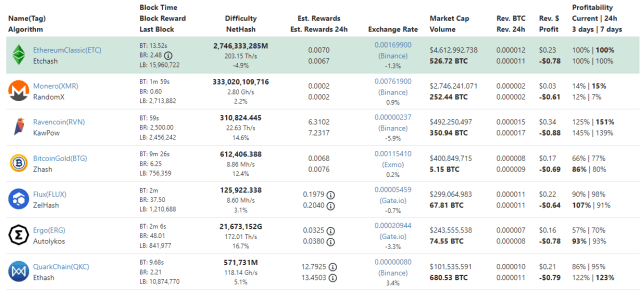
Data from the industry-standard mining calculator, WhatToMine, paints a grim picture for the post-Merge era. Before the transition, Ethereum Classic (ETC) maintained a relatively stable hashrate that allowed for modest profitability. However, following the Merge, ETC’s hashrate surged by more than 400% in a matter of days. This explosion in difficulty meant that even miners with high-efficiency hardware began spending more on electricity than they were earning in rewards.
For instance, using a standard setup of three AMD RX 480 graphics cards—a once-popular choice for mid-range miners—the current net profit for mining Ethereum Classic stands at approximately -$0.78 per hour. This calculation assumes a global average industrial electricity rate of $0.10 per kWh. Even those utilizing the most powerful consumer hardware available, such as the NVIDIA GeForce RTX 3090 Ti, are seeing hourly losses of roughly -$0.50. In this environment, mining has transitioned from a revenue-generating activity to a "speculative donation" to the network, where miners are essentially paying their utility companies for the privilege of securing a blockchain.
A Chronology of the Transition
The road to this profitability crisis was paved over several years of development and delays. To understand the current state of the market, one must look at the timeline of the Ethereum transition:

- December 2020: The Beacon Chain is launched, introducing the Proof-of-Stake "consensus layer" to the Ethereum ecosystem. This ran in parallel to the original PoW "execution layer."
- August 2021: The London Hard Fork (EIP-1559) is implemented, changing Ethereum’s fee structure and starting the process of burning a portion of transaction fees, which slightly reduced miner revenue but improved the asset’s scarcity.
- June 2022: The Gray Glacier upgrade delays the "Difficulty Bomb," a mechanism designed to make PoW mining impossible, giving developers more time to finalize the Merge.
- September 6, 2022: The Bellatrix upgrade is activated, marking the final countdown to the Merge.
- September 15, 2022: The Merge is completed as the Terminal Total Difficulty (TTD) is reached. Ethereum officially moves to PoS.
- September 16–20, 2022: Hashrates on Ethereum Classic, Ravencoin, and Ergo hit all-time highs, followed immediately by a collapse in profitability and a subsequent sell-off in the GPU secondary market.
Industry Reactions and Market Sentiment
The reaction from the mining community has been a mixture of resignation and frustration. Some prominent mining pools, such as Ethermine, chose to shut down their PoW operations entirely rather than pivot to smaller coins, citing a lack of long-term sustainability. Other groups attempted to keep the PoW dream alive by launching "hard forks" of the Ethereum chain, most notably EthereumPoW (ETHW). However, these forks have struggled to gain significant traction, as they lack the decentralized finance (DeFi) ecosystem, stablecoin support, and NFT volume that gave the original Ethereum its value.
Industry analysts had warned of this "hashrate hangover" for months. "The problem is one of scale," noted one blockchain researcher during a recent industry webinar. "Ethereum was a massive ocean. When you try to pour an ocean’s worth of water into a series of small ponds like Ravencoin or Ergo, those ponds will inevitably overflow. There simply isn’t enough liquidity or market cap in the remaining PoW coins to support the massive overhead of the global GPU mining fleet."
Hardware manufacturers are also feeling the pinch. NVIDIA and AMD, which saw record-breaking profits during the mining booms of 2017 and 2021, are now facing a glut of used GPUs hitting the market. Platforms like eBay and Craigslist have seen a surge in listings for "mining rigs," often sold at a fraction of their original retail price. This has been a boon for PC gamers, who had been priced out of the market for years, but it signals a period of stagnation for the mining hardware sector.
Broader Implications and the Future of PoW
The current state of mining raises fundamental questions about the future of Proof-of-Work outside of Bitcoin. Bitcoin remains insulated from this specific crisis because it uses SHA-256 ASIC miners, which are physically incapable of mining Ethereum or its derivatives. However, for the world of GPU mining, the outlook is bleak.
One potential implication is the increased centralization of the remaining PoW chains. As profitability turns negative, only those with access to nearly free electricity—often through government subsidies, stranded energy sources, or theft—can afford to keep their machines running. This concentrates the hashrate in fewer hands, potentially making these smaller networks more vulnerable to "51% attacks," where a single entity gains enough power to manipulate the blockchain.
Furthermore, the environmental narrative has shifted. While Ethereum’s move to PoS was a win for the "Green Crypto" movement, the migration of miners to other chains means that a significant portion of that energy consumption didn’t disappear—it simply moved. However, as the negative economics force more miners to unplug their rigs, the total global energy footprint of crypto mining (excluding Bitcoin) is expected to trend downward over the coming months.
Conclusion: A Market in Search of Equilibrium
As of late September 2022, the price of Ether (ETH) continues to experience volatility, trading around the $1,400 mark—a 6% decline over the week following the Merge. This "sell the news" price action has compounded the misery for miners, as the value of the coins they might switch to is also under pressure from broader macroeconomic headwinds.
For GPU mining to return to profitability, one of two things must happen: either the market price of alternative coins like Ethereum Classic must increase by several hundred percent to match the new difficulty levels, or a significant portion of the global mining fleet must permanently retire, allowing the hashrate to drop back to sustainable levels. Until that equilibrium is reached, the "golden age" of GPU mining appears to be over. The Merge did more than just change Ethereum; it effectively dismantled the economic foundation of the wider Proof-of-Work ecosystem, leaving a trail of idle hardware and red balance sheets in its wake.