


OpenAI, a leading force in artificial intelligence research and deployment, has officially made its highly anticipated flagship model, GPT-5.6 Sol, available to the general public. This significant release, announced today, also introduces two complementary models, Terra and Luna, marking a pivotal shift in the company’s product strategy. The public launch follows an exclusive two-week preview period during which the U.S. Department of Commerce restricted access to approximately 20 trusted partners, underscoring the strategic importance and potential implications of such advanced AI technologies. This move not only solidifies OpenAI’s competitive stance in the rapidly evolving AI landscape but also heralds a new approach to categorizing and deploying its powerful language models.
A New Naming Paradigm: Sol, Terra, and Luna
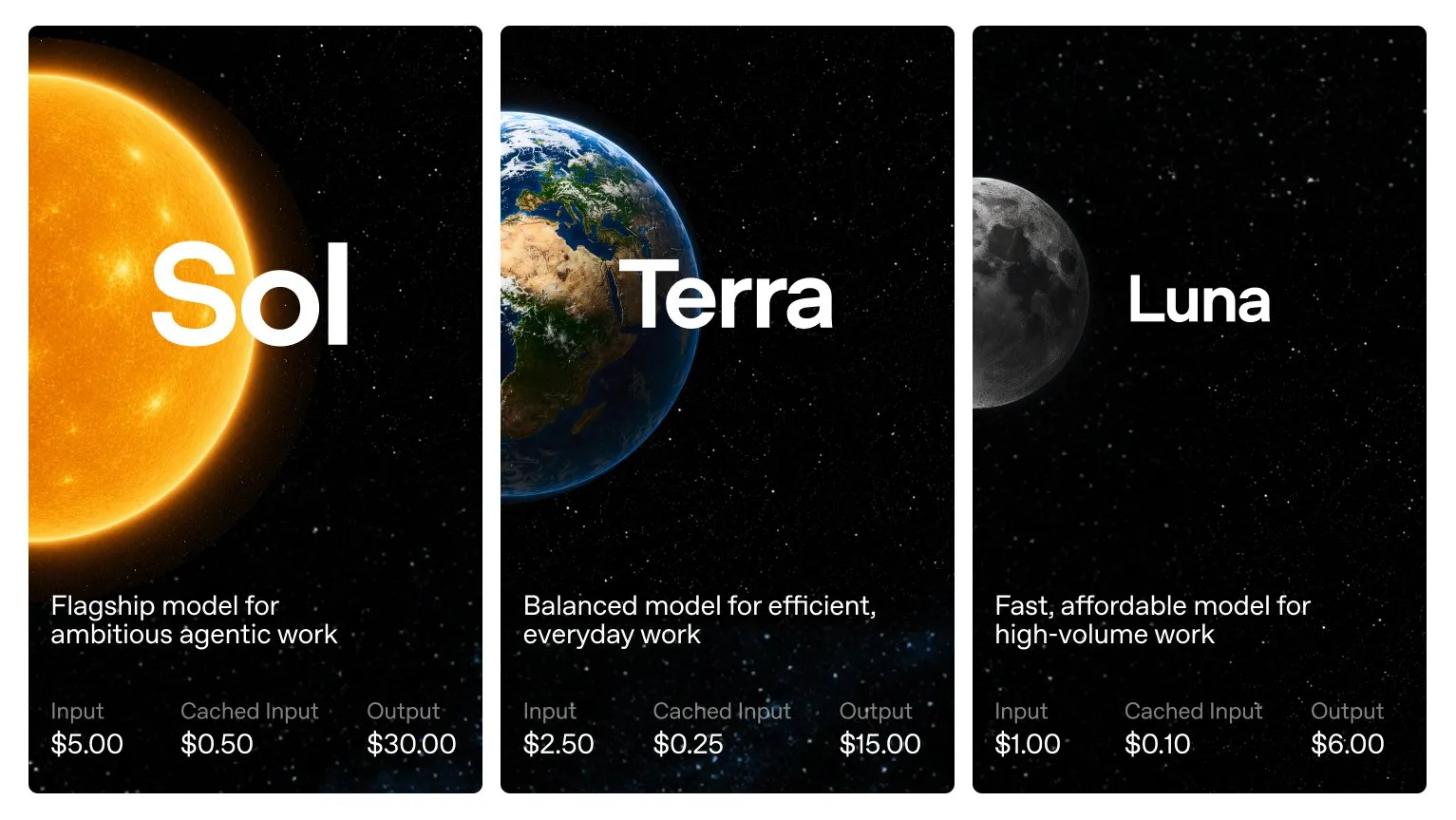
For the first time in its history, OpenAI has moved away from its traditional numerical naming convention (e.g., GPT-3, GPT-4, GPT-5.5) in favor of more evocative and descriptive names: Sol, Terra, and Luna. This strategic rebranding is designed to clearly delineate capability tiers and product positioning, allowing each model to evolve and be updated independently. Sol, drawing its name from the Latin word for sun, is positioned as the absolute flagship, representing the pinnacle of OpenAI’s current technological prowess. Terra, meaning earth, is intended as the robust, everyday workhorse, offering performance comparable to the previous GPT-5.5 but at a significantly reduced cost—reportedly half the price. Luna, Latin for moon, serves as the most economical option, aimed at broader accessibility and less computationally intensive tasks, ensuring that a wider range of users and developers can leverage OpenAI’s technology. This tiered approach reflects a maturing AI market, where diverse user needs demand a spectrum of performance and pricing options, moving beyond a one-size-fits-all model.
The Genesis of GPT-5.6: A Chronology of Advancement
OpenAI’s journey to GPT-5.6 Sol has been a relentless pursuit of artificial general intelligence, marked by a series of groundbreaking releases that have continually pushed the boundaries of what AI can achieve. The company burst into mainstream consciousness with GPT-3 in 2020, demonstrating unprecedented language generation capabilities. This was followed by GPT-4, which further enhanced reasoning, creativity, and multimodal inputs, setting new industry benchmarks. The interim GPT-5.5 served as a robust iteration, refining existing capabilities and preparing the groundwork for the more advanced models now released. The development cycle for models of this complexity typically spans many months, involving vast computational resources, extensive data training, and rigorous safety evaluations. The U.S. Department of Commerce’s two-week restricted preview of GPT-5.6 Sol highlights an increasing governmental interest and oversight in frontier AI models, reflecting concerns over national security, economic competitiveness, and the responsible deployment of powerful technologies. This regulatory involvement suggests a future where AI releases may be subject to stricter governmental review, particularly for models deemed "critical infrastructure" or those with dual-use potential.
Advanced Features and Competitive Pricing Dynamics

GPT-5.6 Sol introduces several innovative features designed to enhance its utility and performance for complex tasks. Key among these are "max reasoning effort" and "ultra mode." The "max reasoning effort" knob allows developers to instruct Sol to dedicate more computational resources and time to internal thought processes, enabling it to tackle more intricate problems requiring multi-step reasoning, planning, and deeper contextual understanding. This feature is particularly beneficial for applications demanding high accuracy and sophisticated problem-solving. The "ultra mode" takes this a step further by farming out complex tasks to subagents, allowing Sol to orchestrate multiple specialized AI modules to collaboratively achieve a larger objective. This capability points towards a future of highly modular and autonomous AI systems capable of tackling multifaceted real-world challenges.
In terms of pricing, Sol commands $5 per million input tokens and $30 per million output tokens. For context, "tokens" are the fundamental units of information—words, subwords, or characters—that an AI model processes. Companies typically charge for API access based on the number of tokens processed. The more accessible Luna model is priced at a significantly lower rate of $1 per million input tokens and $6 per million output tokens, making it an attractive option for high-volume, lower-complexity applications.
This pricing structure positions OpenAI strategically within a fiercely competitive market. For comparison, Anthropic charges $10/$50 for its Claude Fable 5, Google’s Gemini 3.1 Pro is priced at $2/$12, and xAI’s Grok 4.5 comes in at $15/$75. On the Chinese front, DeepSeek charges $1.74/$3.48 for its V4 Pro, while Xiaomi’s MiMo v2.5 Pro is an even more economical $1/$5. This landscape places OpenAI’s Sol squarely between the premium, high-cost frontier models from its leading U.S. competitors and the more cost-effective challengers emerging from China. Terra’s offering, matching GPT-5.5 performance at half the price, is a particularly aggressive play to capture a broader developer base and encourage migration from older models or competitor offerings.
Benchmark Performance: Sol’s Dominance in Complex Workflows
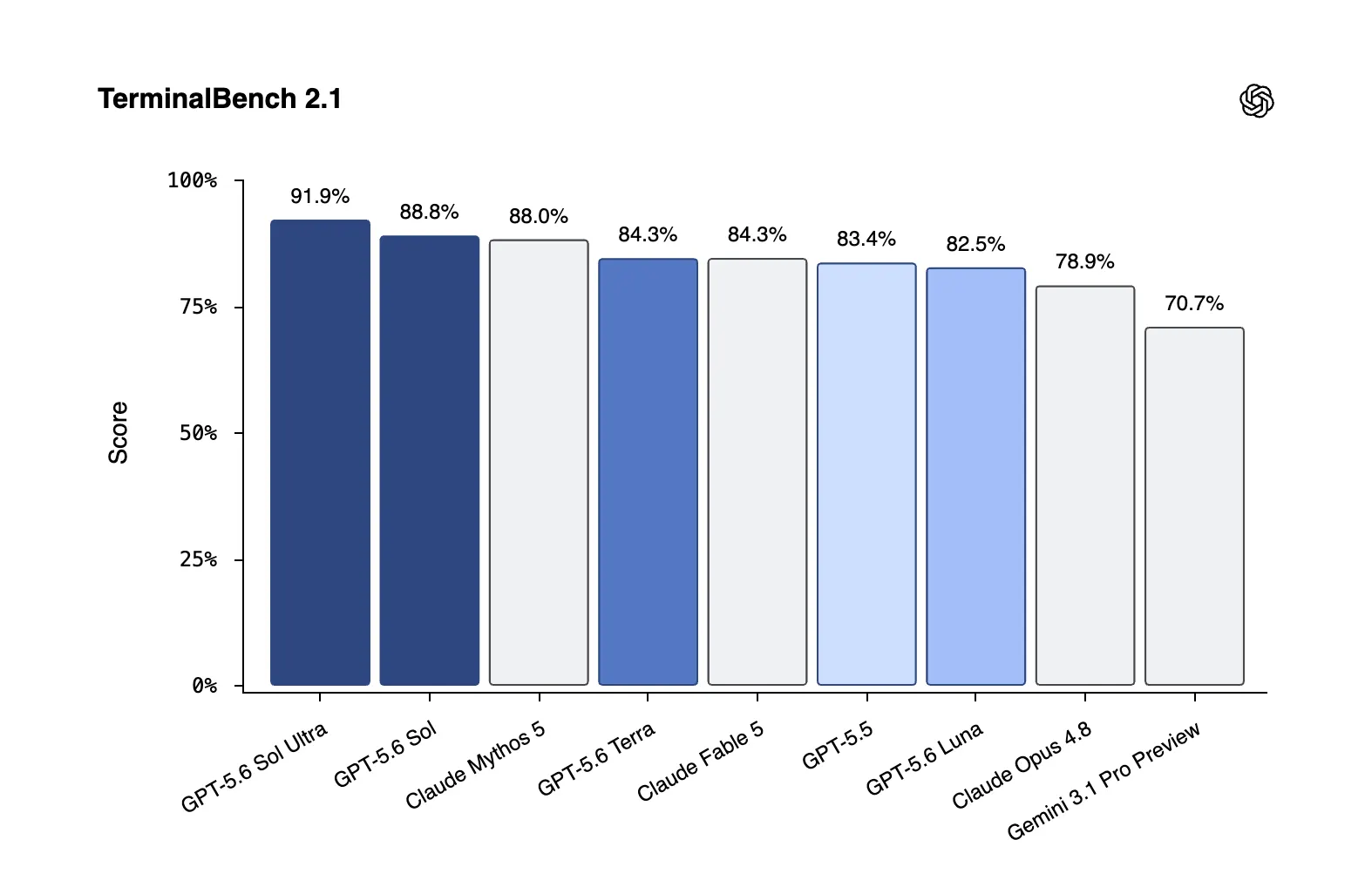
OpenAI has presented compelling benchmark data to illustrate Sol’s superior capabilities, particularly in areas requiring advanced planning and tool utilization. On Terminal-Bench 2.1, a rigorous evaluation designed to assess a model’s proficiency in command-line workflows, Sol demonstrated remarkable performance. This benchmark measures the percentage of tasks a model successfully completes, rewarding sophisticated planning, effective tool integration, and iterative problem-solving. Sol in its "ultra" configuration achieved an impressive 91.9%, while the standard Sol model scored 88.8%.
These figures place both Sol configurations ahead of key rivals. Anthropic’s Claude Mythos 5, a restricted preview model, scored 88.0%, followed by Claude Fable 5 at 84.3%, and the earlier Claude Opus 4.8 at 78.9%. Google’s Gemini 3.1 Pro Preview lagged significantly behind, completing only 70.7% of the tasks. This strong showing on Terminal-Bench 2.1 suggests that Sol is exceptionally adept at automating complex, multi-step technical tasks, making it a powerful tool for developers, system administrators, and anyone working with intricate digital environments.
OpenAI also emphasized Sol’s strengths in cybersecurity, an increasingly critical domain. On ExploitBench, a specialized test designed to measure a model’s ability to identify and exploit software vulnerabilities, Sol matched the performance of the restricted Mythos Preview. Crucially, it achieved this with roughly one-third of the token consumption, highlighting its efficiency. Despite its potent capabilities in this area, OpenAI affirmed that Sol remains within its internal "Cyber Critical" risk framework, indicating that the company has implemented safeguards to prevent the model from being easily weaponized for malicious purposes. This balance between advanced capability and responsible deployment is a central challenge in frontier AI development.
Early Impressions and Expert Consensus
The restricted preview period generated significant buzz and a consensus among early testers regarding Sol’s capabilities. Theo, a prominent developer, AI YouTuber, and CEO of the AI platform T3 Chat, lauded Sol as "world leading in computer use." He particularly noted that the model "fixed all the problems" he had encountered with GPT-5.5, praising its "incredibly determined" nature and its understanding of subagents, even running for a full day without explicit goal directives. This feedback underscores Sol’s improved autonomy and reliability in complex, long-running tasks.
Dan Shipper, whose team at Every rigorously tested Sol for a month, offered a memorable analogy: "GPT-5.6 is like a Porsche, Fable is like a warp drive." Shipper’s interpretation suggests that Sol is an exceptional "daily driver"—a powerful, fast, and high-performance tool optimized for everyday knowledge work and coding. In contrast, he views Fable as a more specialized, perhaps more experimental, tool for tasks requiring extreme, almost fantastical, capabilities. This practical assessment implies that Sol aims for broad utility and efficiency in common professional applications.
Researcher Daichi Konno, another early access participant, confirmed Sol’s significant leap over GPT-5.5, positioning it as competitive with, or even slightly behind, Anthropic’s Fable 5, particularly in writing tasks where Fable still holds a slight edge. Konno’s sharper observation, however, centered on Sol’s impressive handling of life-science questions. He noted that Sol’s safeguards did not trip on these sensitive queries, which he believes could make it a "default" choice for biological research and development, where accurate and unfettered information processing is crucial. This specific insight points to potential niche dominance for Sol in scientific fields.
A Crowded Top Tier: The AI Arms Race Intensifies
The launch of GPT-5.6 Sol arrives amidst an unprecedented week of intense competition and innovation in the AI sector, underscoring a burgeoning "AI arms race." The timing is particularly pointed, as it coincides with Anthropic’s Fable 5 transitioning out of subscription plans. After its global return on July 1, Fable 5 moved to a usage credits-only model once its 50% weekly allowance expired on July 7, signaling a shift in its accessibility and cost structure.
Within the same seven-day window, other major players also made significant moves. SpaceXAI (xAI) released Grok 4.5, with Elon Musk claiming it to be "roughly comparable to Opus 4.7, but much faster" and offered at a fraction of the price. Meta also entered the paid model arena with Muse Spark 1.1, its first commercial offering. While neither Grok 4.5 nor Muse Spark 1.1 are positioned as market leaders in terms of raw capability, their entry signifies a broadening of the "frontier-class" AI landscape and increased competitive pressure on established players like OpenAI and Anthropic.
Conspicuously, Google stands as the only major U.S. AI lab that has not refreshed its flagship model during this rapid innovation cycle. Its top-tier model, Gemini 3, was released in November 2025, making it the oldest frontier release still actively competing while its rivals are pushing out newer, more advanced iterations. This lag could put Google at a disadvantage in the short term, compelling them to accelerate their next-generation releases to maintain competitiveness.
The global AI landscape is also witnessing robust competition from China. The relative pricing of OpenAI’s Sol, situated between premium U.S. models and lower-cost Chinese challengers like DeepSeek V4 Pro and Xiaomi MiMo v2.5 Pro, highlights the diverse market strategies at play. Chinese firms are aggressively pursuing market share through competitive pricing, while U.S. firms often emphasize cutting-edge performance and advanced features.
The Road Ahead: GPT-6 and the Future of AI
The rapid pace of development shows no signs of slowing. Leaks from roadmap-tracking accounts, such as "Synthwave" on X, suggest that GPT-5.6 might be the final iteration in the 5.x series. These reports claim that GPT-6, built on an even larger base model, could arrive within approximately a month, indicating OpenAI’s commitment to continuous, aggressive innovation. The same sources also project the imminent release of Anthropic’s Fable 5.1 and DeepSeek’s V4 general release, further intensifying the competitive environment.
The implications of this relentless innovation are profound. For businesses and developers, the availability of tiered models like Sol, Terra, and Luna offers unprecedented flexibility, allowing them to optimize for performance, cost, and specific use cases. This could democratize access to advanced AI, driving wider adoption across various industries. The emphasis on features like "max reasoning effort" and "ultra mode" suggests a move towards more autonomous and capable AI systems, potentially transforming how complex tasks are automated and managed.
However, this rapid advancement also brings increased scrutiny. The U.S. Department of Commerce’s initial restriction on GPT-5.6 Sol underscores growing concerns about the responsible deployment of powerful AI, particularly regarding cybersecurity implications and potential misuse. The ongoing "AI arms race" will necessitate continued investment in safety, ethics, and regulatory frameworks to ensure that these powerful technologies benefit humanity without introducing undue risks. As the lines between human and artificial intelligence continue to blur, the coming months promise to be a critical period for shaping the future trajectory of AI.














