Addressing the Invoicing Conundrum in Service Businesses
For countless service businesses, the act of invoicing remains a necessary evil rather than a seamless component of their workflow. From crafting detailed quotes and estimates to generating final invoices and receipts, the process typically involves meticulous data entry, formatting adjustments, and brand alignment. This often consumes valuable hours that business owners, freelancers, and agency principals would prefer to dedicate to client work, skill development, or strategic growth initiatives. Industry reports frequently highlight the disproportionate amount of time small and medium-sized enterprises (SMEs) spend on administrative tasks. A 2023 survey by Xero, for instance, indicated that small businesses globally spend an average of 10-15 hours per week on administrative work, with invoicing and financial reconciliation being major contributors. This administrative burden not only siphons time but can also lead to delays in payment, errors, and a less professional client experience. Velocity Ticket steps into this void, proposing a radical simplification that redefines efficiency in financial document creation.

The Genesis of Velocity Ticket: Expertise Meets Innovation
Velocity Ticket is an early-stage Software as a Service (SaaS) product developed by The Merkle, LLC, a prominent web development and marketing firm known for its deep expertise in technology, cryptocurrency, and artificial intelligence. This background is critical to understanding the product’s innovative core. The Merkle’s proficiency in cutting-edge technological domains, particularly AI, provides the foundation for Velocity Ticket’s unique approach, differentiating it from conventional invoicing platforms that primarily offer templates and manual data fields.
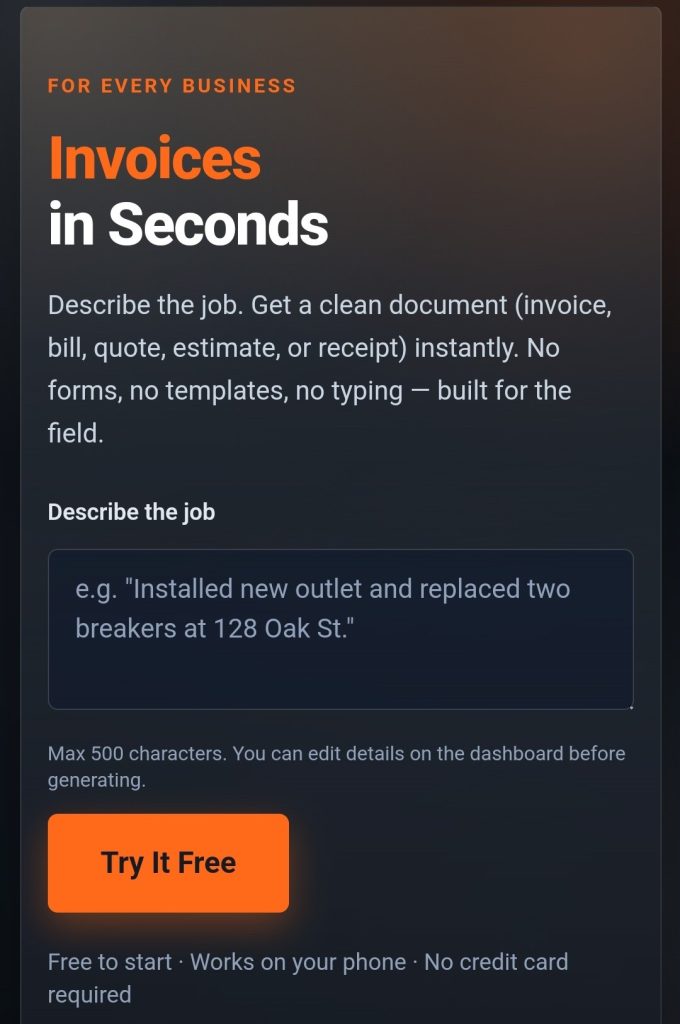
The platform is meticulously designed for a specific segment of the market: service businesses, freelancers, contractors, agencies, tradespeople, and consultants. These professionals share a common need for swift, accurate, and professional financial documentation without the overhead of complex software interfaces or extensive manual input. Velocity Ticket’s central promise is compelling: users can describe a job or project in plain, natural language, and the system will autonomously generate a complete, professionally formatted document – be it an invoice, bill, quote, estimate, or receipt – in a matter of minutes. This is not merely a templating tool that requires further manual population; it is an intelligent system capable of drafting a finished document, complete with line items, calculated totals, and appropriate formatting, ready for immediate review and dispatch. This level of automation and intuitive interaction represents a significant leap forward, offering a workflow improvement that, on first glance, might seem almost too ambitious until experienced firsthand.
The Landscape of Invoicing Software: A Call for Disruption
The market for invoicing software is saturated with established players like QuickBooks, FreshBooks, Xero, Wave, and many others, each offering a suite of features ranging from basic invoicing to comprehensive accounting integration. While these platforms have served millions of businesses, they often share common characteristics that Velocity Ticket aims to circumvent. Many require users to navigate extensive forms, categorize line items manually, or spend considerable time customizing templates to fit their brand and specific job details. The learning curve can be steep for new users, and the process, while digital, still retains much of the manual effort associated with traditional paperwork.
For a busy freelancer or a small trade business owner, the time investment required to learn and consistently use these systems efficiently can be prohibitive. Furthermore, the reliance on predefined structures and fields can limit flexibility, forcing users to adapt their job descriptions to the software’s framework rather than the other way around. This is the "major gap" that Velocity Ticket targets: the chasm between the natural, descriptive way a service provider thinks about their work and the rigid, structured input required by most existing software. By prioritizing natural language processing (NLP) and artificial intelligence, Velocity Ticket seeks to bridge this gap, offering a more human-centric interface to a traditionally mechanical task.
Frictionless Onboarding: A Gateway to Instant Productivity
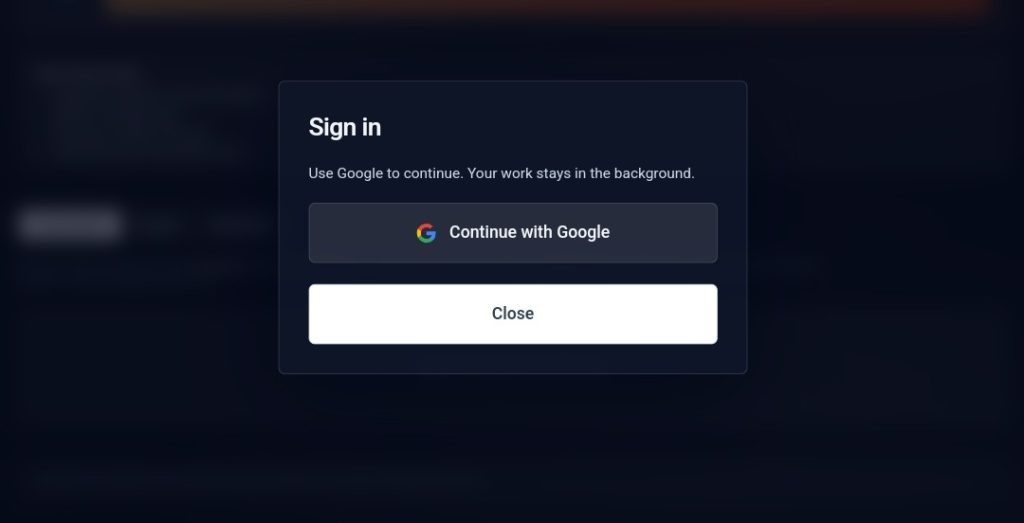
The initial user experience with Velocity Ticket is engineered for maximum ease and minimal friction, reflecting a deliberate design philosophy focused on immediate utility. Prospective users can visit the Velocity Ticket website, opt for the "Try it Free" option, and sign in effortlessly using their Google account. This streamlined setup process eliminates common barriers to entry, such as lengthy registration forms, mandatory credit card details for trial access, or time-consuming introductory tutorials. In an era where digital attention spans are short and immediate value is paramount, this frictionless onboarding is a strategic advantage. It allows users to dive directly into the core functionality, generating their first document within minutes of their initial interaction. This approach not only enhances user acquisition but also fosters a sense of empowerment, demonstrating the product’s value proposition without delay.
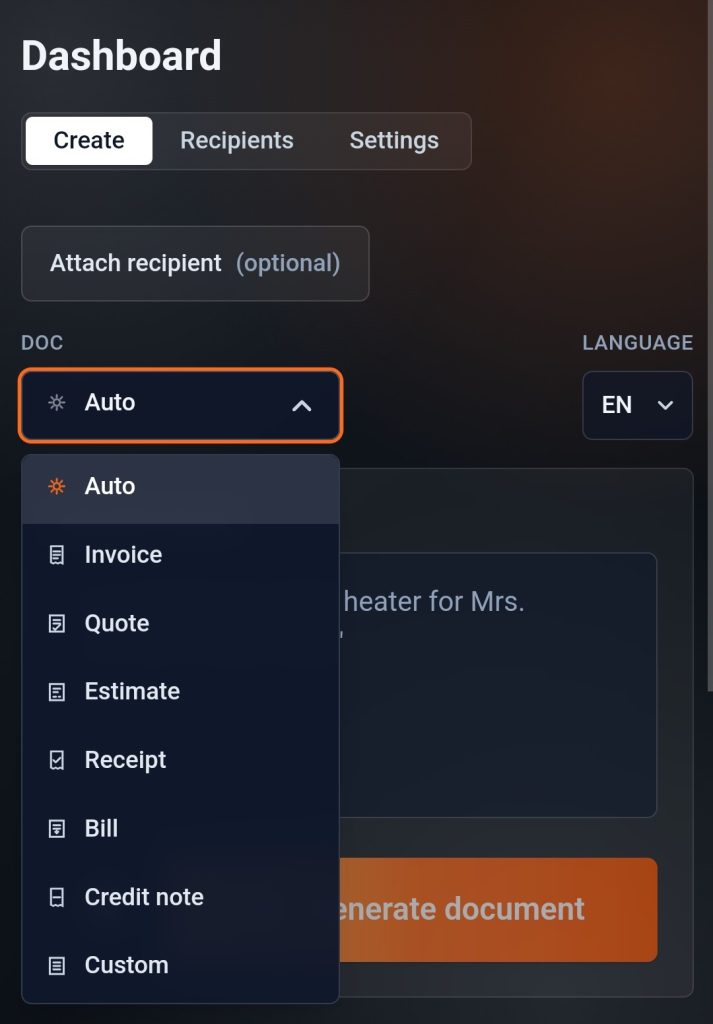
Upon successful login, users are directed to a clean, intuitive dashboard – the central command hub for all activities. From here, the "Auto" option unveils the full spectrum of document types that can be generated: invoices, quotes, estimates, bills, and receipts. The interface is meticulously designed for clarity and ease of use, reinforcing the core premise: describe the need in plain language, and the system handles the complexities. This design choice underscores the platform’s commitment to user-centricity, ensuring that even users with minimal technical proficiency can leverage its powerful capabilities effectively.
The Workflow Unveiled: From Concept to Polished PDF
The operational workflow within Velocity Ticket is where its innovative design truly shines, transforming the laborious process of document creation into a rapid, intelligent interaction.
Step 1: Describing the Job in Natural Language
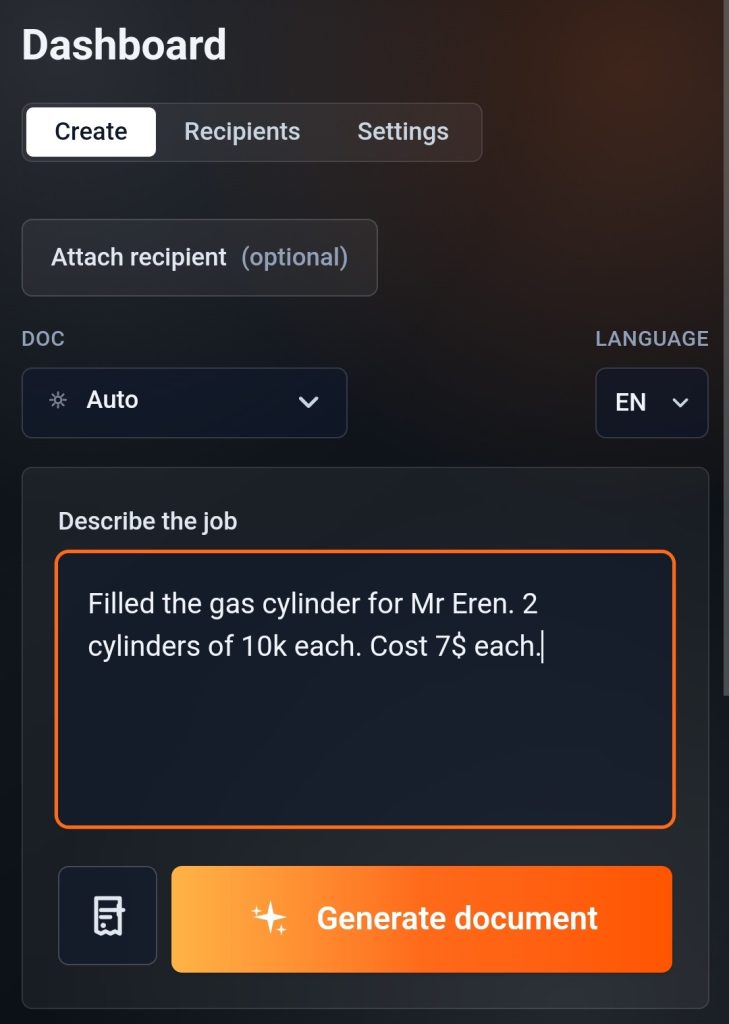
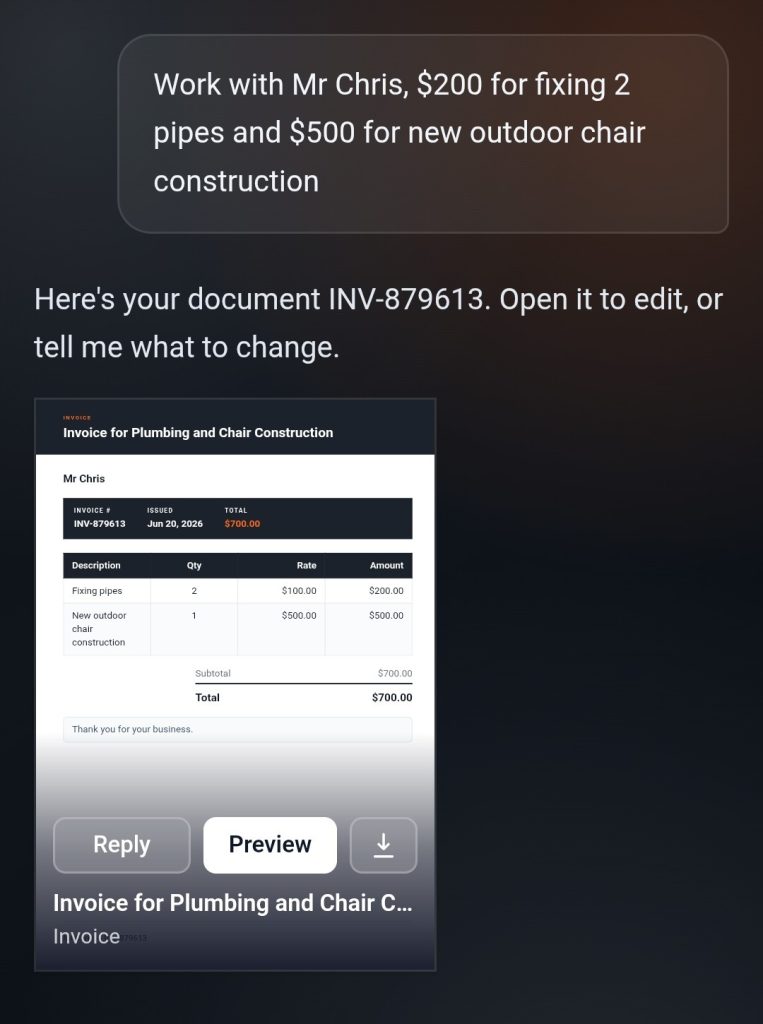
The process begins on the dashboard, where users input a description of the job or service rendered. This is where the natural language processing (NLP) capabilities of Velocity Ticket come into play. Users are encouraged to describe the work as they would explain it to a client – detailing tasks performed, materials used, specific services provided, and any pertinent information about the customer or project. For example, a plumber might type: "Replaced faulty water heater at 123 Main St for John Doe. Installed new 50-gallon Rheem heater, flushed lines, removed old unit. Total labor 3 hours at $90/hr. New heater cost $750."
Beyond textual descriptions, Velocity Ticket offers the practical option to attach photos, providing visual documentation that can be crucial for certain trades or service types. Users can also add customer context, such as contact details and specific project notes, before initiating the generation process. The critical aspect here is the absence of any requirement for special formatting, keywords, or predefined templates. The system is engineered to interpret natural human language, offering unparalleled flexibility and reducing the cognitive load on the user.
Step 2: Intelligent Document Generation
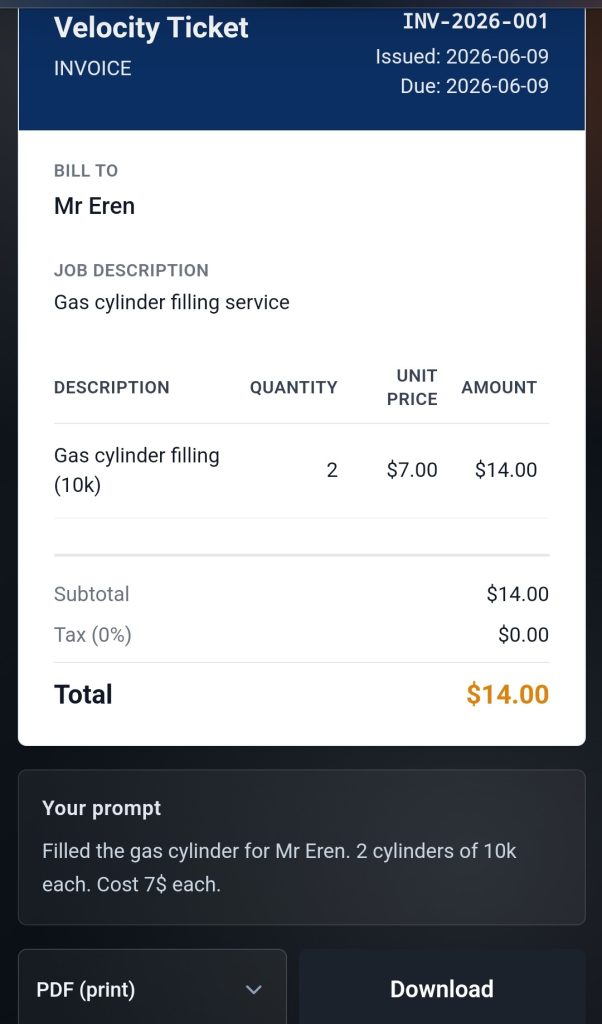
From this plain-language description, Velocity Ticket’s AI engine goes to work. It intelligently parses the text, identifies key entities (services, products, quantities, rates, client information), calculates line items, applies appropriate totals, and structures the information into a complete document draft. The output is not a raw, unformatted text block but a professionally formatted document, ready for review. This automated drafting process is a cornerstone of Velocity Ticket’s efficiency promise, drastically cutting down the time traditionally spent on manual data entry and formatting.
Step 3: Review and Refinement with AI Assistance
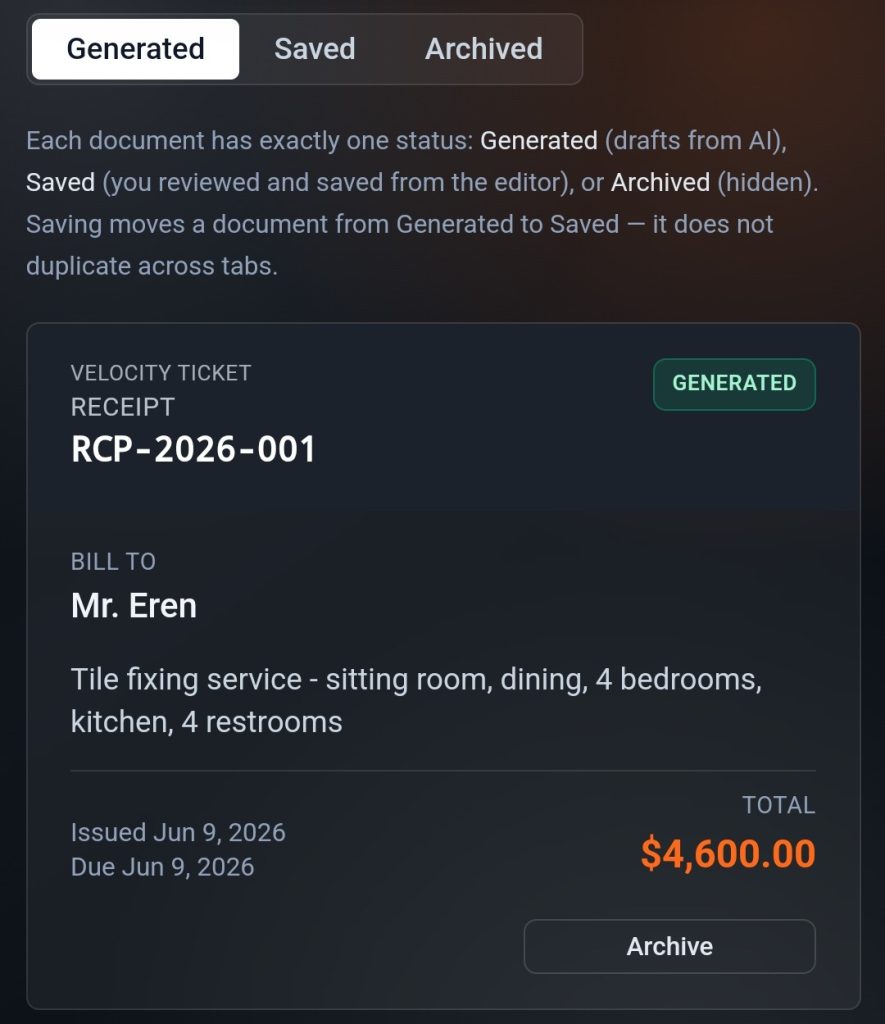
Every newly generated document initially resides in a "Generated" status, serving as a holding area for user review. This critical step ensures that while the AI performs the heavy lifting, human oversight and final approval are maintained. This design choice is intelligent, acknowledging that while AI is powerful, accuracy and client-specific nuances often require human intervention. It ensures the user retains full control over the final document sent to clients, mitigating any potential AI misinterpretations.
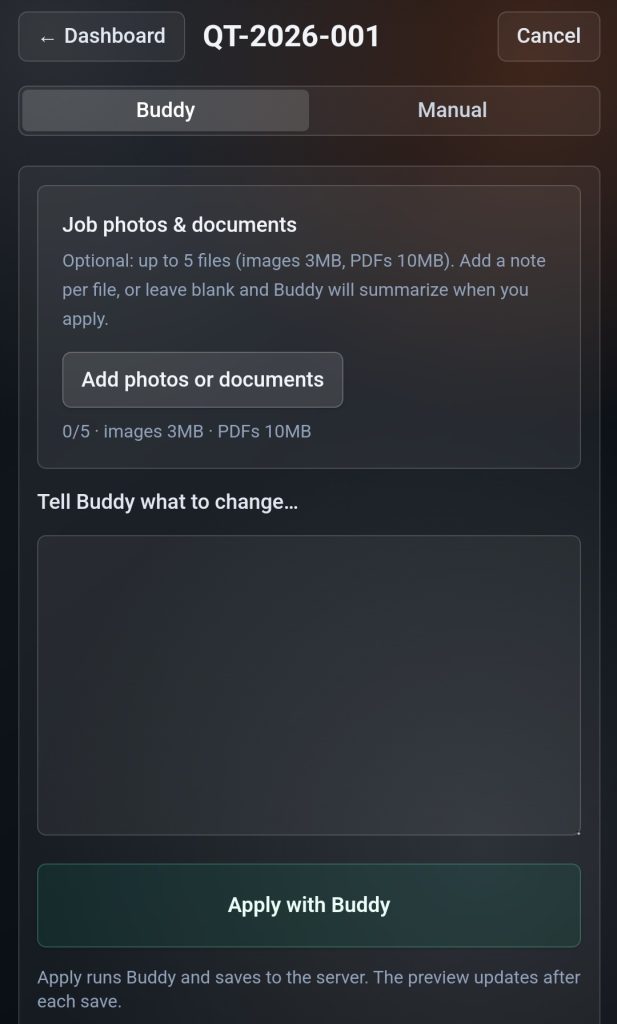
For adjustments, Velocity Ticket provides two intuitive paths:
- "Buddy" – The Conversational AI Editor: This feature is a significant differentiator. Users can interact with "Buddy," a natural-language editing assistant, to request changes conversationally. For instance, a user could instruct: "Buddy, increase the labor rate for line item 2 to $95 per hour," or "Change the tax rate to 8.5%," or "Update the client’s email address to [email protected]." This conversational editing capability mirrors the natural way humans communicate, making revisions incredibly fast and intuitive, further minimizing the need to navigate complex menus or fields.
- Manual Editing: For users who prefer direct control or for specific, granular adjustments, manual editing is readily available. All fields – recipient details, line items, tax rates, notes, and branding elements – are directly editable. Both "Buddy" and manual editing options are seamlessly integrated within the same editor interface, allowing users to switch between them effortlessly based on their preference and the nature of the required changes. This dual approach caters to diverse user needs and preferences, offering both AI-powered speed and traditional precision.
Once the document is refined and approved, users save it, and a polished PDF version is instantly available for download, ready to be sent to the client. All saved documents are stored securely within the user’s dashboard, remaining fully searchable and editable for future reference or modifications, ensuring a robust document management system.
Understanding Document Statuses for Streamlined Management
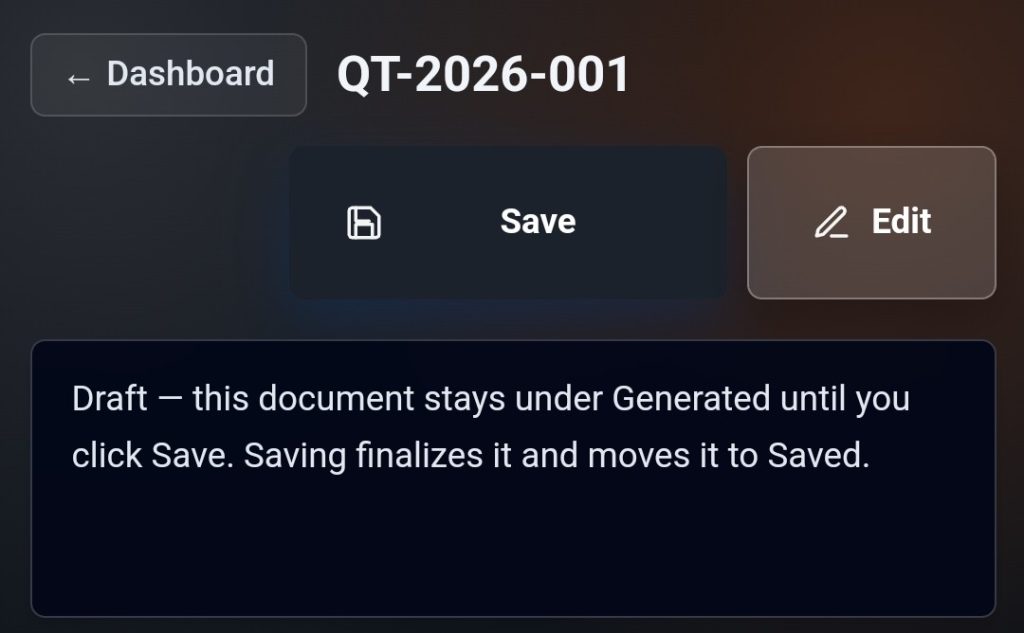
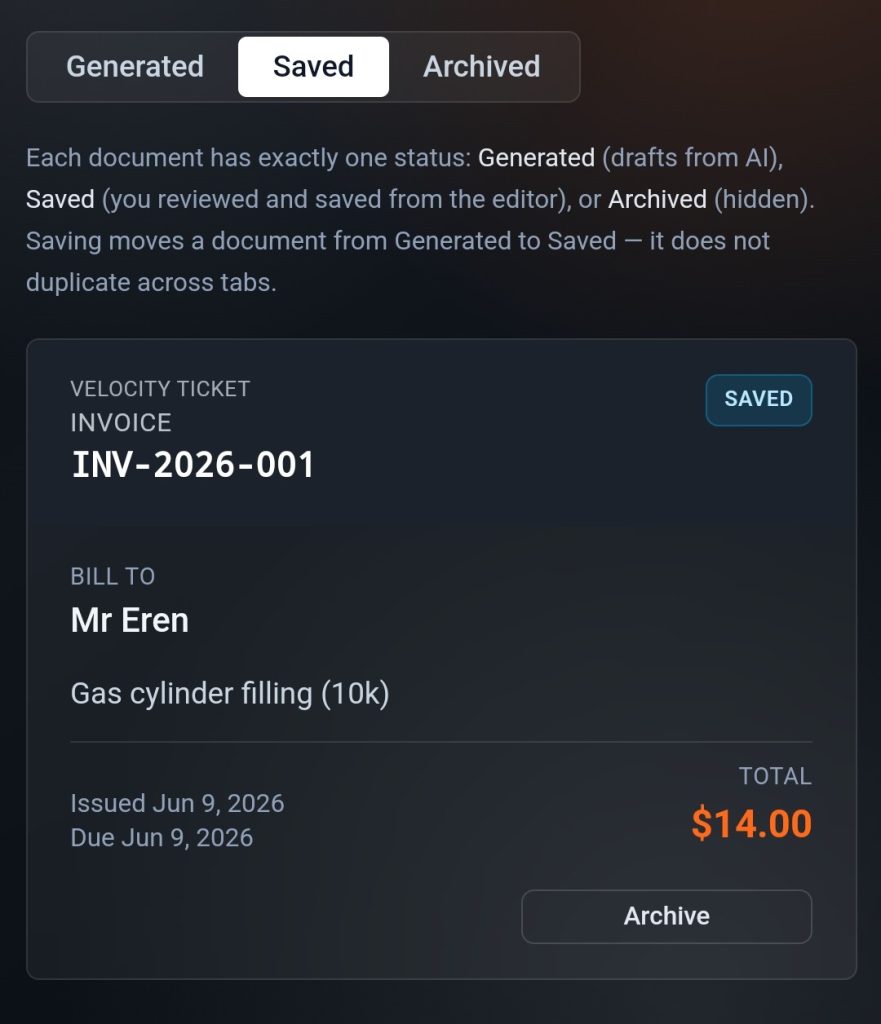
Velocity Ticket implements a clear and straightforward document status system to maintain an organized dashboard and streamline document management. Each document exists in one of three distinct statuses at any given time:
- Generated: This status signifies that the AI has successfully created a draft, and the document is currently awaiting review and potential edits by the user. It is the initial stage after the natural language input.
- Saved: Once a user has reviewed, made any necessary adjustments, and finalized the document, it transitions to the "Saved" status. This indicates that the document is complete, approved, and ready for use (e.g., sending to a client).
- Archived: For documents that are no longer actively needed but should not be permanently deleted, the "Archived" status provides a way to remove them from the active view without losing the data. This helps in maintaining a clean and uncluttered dashboard.
A key aspect of this system is that saving a document moves it from "Generated" to "Saved"; it does not create a duplicate. This ensures data integrity and prevents clutter. A document remains in "Generated" until the user explicitly clicks "Save." Once saved, it resides in the "Saved" section, always accessible for editing or downloading. This intuitive status system, once understood, significantly contributes to an organized workflow, even as the volume of generated documents grows.
Pricing Structure: A Generous Free Tier and Scalable Plans
Velocity Ticket’s pricing model is designed to be accessible and scalable, featuring a genuinely usable free tier that stands out in the SaaS landscape. Unlike many "freemium" models that offer severely limited functionality to push immediate upgrades, Velocity Ticket’s free account provides substantial value.
Free accounts are granted the ability to generate up to 20 documents every 30 days. This counter resets on an account-specific date, ensuring flexibility rather than being tied to a fixed calendar month. For individual freelancers, contractors, or small service businesses with moderate invoicing volumes, 20 documents per month can comfortably cover a significant portion of their operational needs. This generous free tier serves as an excellent opportunity for potential users to thoroughly evaluate the platform’s capabilities and integrate it into their workflow without any financial commitment. It also acts as a powerful acquisition tool, lowering the barrier to entry and fostering user loyalty by delivering immediate, tangible value.
For users whose needs exceed the 20-document monthly limit, paid plans are readily available through the platform’s Billing section. These plans unlock continued document creation without the need to wait for the monthly reset. The pricing structure adheres to a standard SaaS model: start free, and upgrade only when increased capacity or advanced features become necessary. This allows businesses to scale their usage seamlessly as their operations grow, ensuring that Velocity Ticket remains a cost-effective solution at every stage.
Broader Implications and Market Impact
Velocity Ticket’s innovative approach holds significant implications for the broader invoicing software market and the wider adoption of AI in business tools.
Disruption of the Status Quo: By leveraging natural language processing and AI for document generation and editing, Velocity Ticket challenges the conventional wisdom of invoicing software. It moves beyond template-driven solutions, offering a truly intelligent assistant that understands and interprets human input, significantly reducing the manual effort and cognitive load on users. This could compel established players to re-evaluate their own interfaces and consider deeper AI integrations.
Enhanced Productivity for Service Professionals: The core promise of generating professional documents in minutes from a plain-language description translates directly into substantial time savings for service businesses. If a freelancer typically spends 30 minutes on an invoice, and Velocity Ticket reduces that to 5 minutes, the cumulative time saved over a month or year can be enormous, allowing them to focus on revenue-generating activities. This increased efficiency contributes directly to higher productivity and potentially higher profitability for users.
Democratization of Advanced Technology: Velocity Ticket makes sophisticated AI capabilities accessible to everyday service professionals who may not have the resources or technical expertise to engage with complex enterprise solutions. By abstracting the complexity of AI behind a simple, conversational interface, it democratizes access to cutting-edge technology, empowering small businesses and individuals.
Future Integrations and Ecosystem Potential: While currently focused on document generation, the underlying AI framework of Velocity Ticket suggests a strong potential for future integrations. This could include seamless connections with popular accounting software (e.g., Xero, QuickBooks), payment gateways (e.g., Stripe, PayPal), and Customer Relationship Management (CRM) systems. Such integrations would position Velocity Ticket not just as an invoicing tool but as a central hub for financial and client management, further enhancing its value proposition and solidifying its place within the broader business software ecosystem.
The Future of Administrative Tasks: Velocity Ticket serves as an excellent example of how AI can fundamentally transform traditionally mundane and time-consuming administrative tasks. Its success could accelerate the trend of AI adoption in other business functions, from project management to customer service, by demonstrating tangible, immediate benefits in efficiency and user experience.
For service businesses currently spending hours each month on the intricate dance of invoicing, quoting, and billing paperwork, Velocity Ticket offers a compelling alternative. The unique combination of natural-language generation, a highly intuitive editing workflow powered by a conversational AI assistant, and a professional PDF output that exudes polish rather than basic template aesthetics, represents a genuine and significant advancement in the invoicing software space. Its emergence signifies not just a new tool, but a potential shift in how administrative efficiency is conceptualized and achieved for the modern service economy.