



The digital asset landscape has witnessed a significant reshuffling in recent months as BNB, the native utility token of the BNB Chain ecosystem, solidified its position as the fourth-largest cryptocurrency by market capitalization. By successfully reclaiming its standing above XRP in May, the token has reignited a fierce debate among analysts and investors regarding its long-term valuation potential. While recent market performance suggests a bullish continuation that could see the asset reclaiming its previous all-time highs and potentially breaching the $2,000 mark, more ambitious projections of $10,000 or $20,000 per token face rigorous mathematical and structural scrutiny. A comprehensive analysis of the current market cap, supply-side mechanics, and the broader macroeconomic environment reveals a complex path forward for one of the industry’s most prominent "blue-chip" altcoins.
The Mathematical Reality of a Five-Figure Valuation
To understand the feasibility of a $10,000 BNB price target, one must first look at the underlying market capitalization requirements. Currently, BNB maintains a market capitalization of approximately $80.6 billion. This valuation places it behind only Bitcoin (BTC), Ethereum (ETH), and the stablecoin USDT. During its historical peak in late 2021 and subsequent surges through 2024, BNB’s market cap reached toward the $185 billion mark. However, a move to $10,000 per token represents an entirely different order of magnitude in terms of capital inflow.
The BNB ecosystem operates on a deflationary model, with a long-term goal of reducing the total supply to 100 million tokens through a series of "Auto-Burn" mechanisms and real-time burning via the BEP-95 protocol. If the 100-million-token target is eventually met, a price of $10,000 would imply a total market capitalization of $1 trillion. For context, this valuation would rival the current market capitalization of Bitcoin, the world’s first and most dominant cryptocurrency. Such a scenario would require BNB to capture a significantly larger share of the global financial market, potentially evolving from an exchange-utility token into a foundational global reserve asset.
The analysis becomes even more speculative when discussing a $20,000 price target. At the current supply levels, such a price would demand a market capitalization of roughly $2.9 trillion, a figure that exceeds the current total valuation of the entire cryptocurrency market combined. Popular market analyst Crypto Patel recently highlighted this discrepancy, noting that while long-term growth is expected, targets in the $20,000 range are currently divorced from the reality of existing market liquidity. Such valuations would require a massive influx of institutional capital, likely facilitated by the approval of spot BNB exchange-traded funds (ETFs) and a fundamental shift in how decentralized finance (DeFi) is integrated into traditional banking.

The Competitive Dynamics: BNB vs. Ethereum
The ongoing rivalry between BNB and Ethereum remains a central theme in the "flippening" discourse. BNB’s recent victory over XRP in market rankings has shifted the focus to the next major hurdle: Ethereum. While BNB offers faster transaction speeds and significantly lower gas fees than the Ethereum mainnet, the market cap gap remains substantial. As of current data, Ethereum holds a valuation of approximately $203 billion, more than double that of BNB.
For BNB to overtake Ethereum in the current market environment, the token would need to reach a price of approximately $1,500, assuming Ethereum’s price remains stagnant. However, historical trends suggest that the two assets are highly correlated. In a broad market rally where BNB reaches new record highs, Ethereum is likely to experience a concurrent surge, effectively moving the goalposts for a market cap flip.
The primary advantage for BNB in this competition lies in its high-frequency utility. The BNB Chain remains a dominant force in stablecoin transactions and retail DeFi activity. However, Ethereum’s transition to Proof-of-Stake and the proliferation of Layer-2 scaling solutions like Arbitrum and Optimism have mitigated some of BNB’s competitive advantages. To truly challenge Ethereum’s second-place position, the BNB Chain must continue to diversify its ecosystem beyond its association with the Binance exchange.
The Binance Concentration Risk and Regulatory Context
A critical factor identified by market analysts is the "concentration risk" inherent in the BNB value proposition. Unlike Ethereum, which is widely perceived as a decentralized network with diverse stakeholders, BNB’s utility and value are inextricably linked to the Binance exchange. This includes its use for trading fee discounts, participation in Launchpool events, and its role as the gas token for the BNB Smart Chain.
This dependency means that any regulatory or legal headwinds facing Binance directly impact the price of BNB. The past year has been particularly transformative for the exchange, following a multi-billion dollar settlement with the U.S. Department of Justice (DOJ) and the stepping down of its founder, Changpeng "CZ" Zhao. While the exchange has transitioned to a more corporate structure under the leadership of Richard Teng, the shadows of regulatory scrutiny remain.

Furthermore, the "Binance ecosystem" encompasses institutional custody, on-chain activity, and the burning mechanism itself. Should the exchange face further restrictions in major markets or a decline in trading volume, the primary drivers for BNB demand could weaken. Conversely, the successful navigation of these regulatory challenges could serve as a massive catalyst for institutional adoption, potentially paving the way for the $2,000 to $3,000 bull case projected by analysts for the mid-term.
Evolution of the BNB Ecosystem: A Timeline of Growth
To understand where BNB is going, it is essential to review the milestones that have defined its trajectory:
- 2017: The Genesis: BNB was launched via an Initial Coin Offering (ICO) as an ERC-20 token on the Ethereum network. Its primary function was to offer discounts on the newly launched Binance exchange.
- 2019: Mainnet Launch: The Binance Chain was introduced, and BNB migrated to its own native blockchain. This marked the transition from a simple utility token to a network-powering asset.
- 2020: The DeFi Boom: The launch of the Binance Smart Chain (BSC) introduced smart contract functionality, allowing BNB to compete directly with Ethereum during the decentralized finance explosion.
- 2022-2023: Branding and Resilience: The ecosystem was rebranded to "BNB Chain" to emphasize its independence from the exchange. Despite the "crypto winter" and the collapse of several major competitors, BNB maintained its position in the top five market rankings.
- 2024: Institutional Interest: Amendments to filings by major asset managers like Grayscale and VanEck have hinted at the possibility of BNB-related investment products, potentially opening the door to Wall Street capital.
Technical Projections and the Path to $3,000
From a technical analysis perspective, the outlook for BNB remains cautiously optimistic. Analysts like Crypto Patel suggest that while five-figure targets may be a decade away, a move toward $3,000 is a "believable bull case" for the current or next market cycle. This projection is based on the continuation of the token burn schedule and the increasing Total Value Locked (TVL) in Real-World Asset (RWA) protocols on the BNB Chain, which recently hit a milestone of $3 billion.
The current price action shows a period of consolidation. If the market can sustain a breakout above previous resistance levels, the psychological barrier of $1,000 will be the first major test. Reaching $3,000 would require BNB to achieve a market cap of approximately $300 billion to $450 billion, depending on the remaining circulating supply. While ambitious, this valuation is within the realm of possibility if the broader crypto market cap grows toward $5 trillion or $10 trillion.
Broader Impact and Market Implications
The trajectory of BNB serves as a barometer for the broader "exchange coin" sector and the viability of centralized-decentralized hybrid models. If BNB can successfully decouple from the specific fortunes of the Binance exchange and become a truly independent decentralized infrastructure token, it could set a precedent for other platforms.
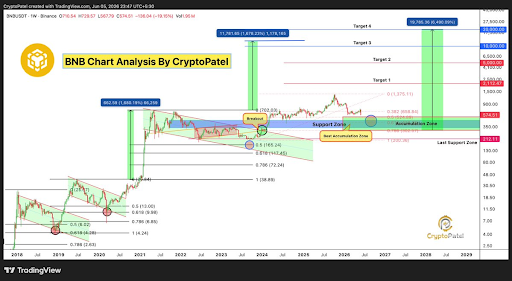
However, the cautionary notes regarding $10,000 and $20,000 targets serve as a reminder of the importance of "market cap math" in crypto investing. For these targets to be met, the global financial system would need to undergo a radical transformation where digital assets move from the periphery to the core of global value exchange. Until then, investors are encouraged to focus on the tangible growth of the BNB Chain’s TVL, its daily active users, and the successful navigation of the global regulatory landscape.
In conclusion, while the dream of a $20,000 BNB remains a distant and mathematically challenging prospect—likely not feasible until 2029 or beyond—the asset’s fundamentals suggest it remains a formidable player in the top tier of the crypto market. Its ability to outpace XRP and challenge Ethereum’s dominance underscores its resilience, but its future success will ultimately depend on its ability to balance its relationship with Binance with the demands of a decentralized, regulated global market.














