


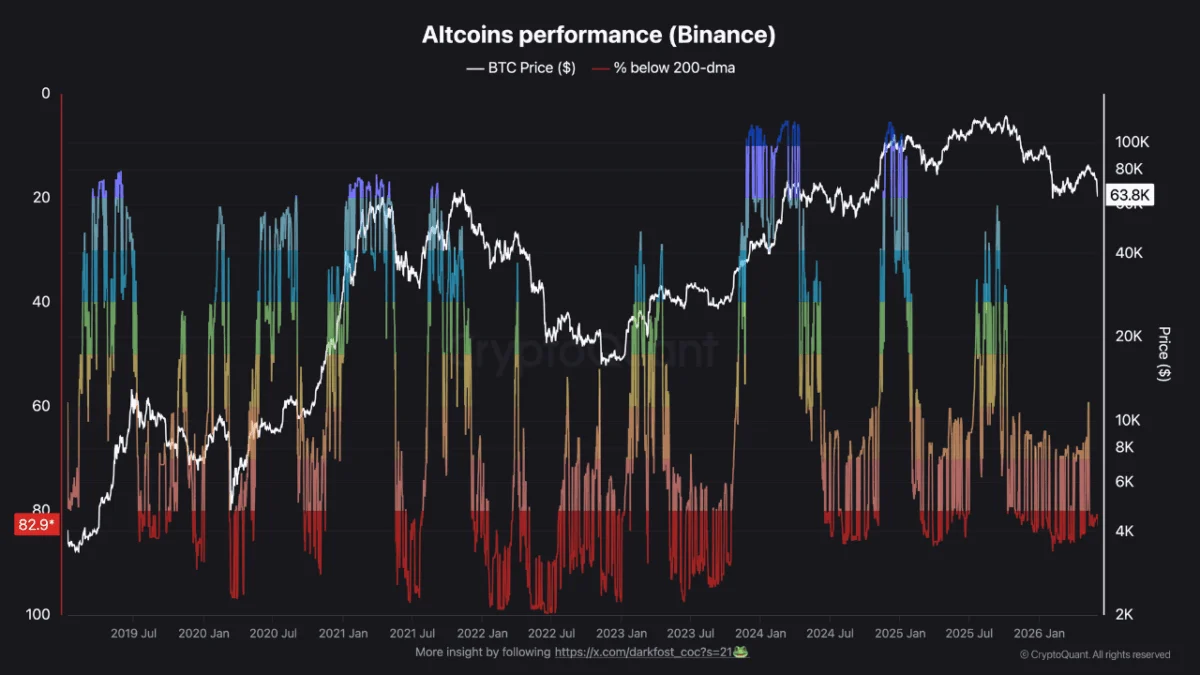
The global financial landscape underwent a period of intense turbulence recently, characterized by a massive deleveraging event that saw over $1 trillion in market capitalization evaporated from United States exchanges in a single trading session. This contagion, sparked primarily by a sharp reversal in sentiment surrounding artificial intelligence (AI) and semiconductor equities, has rippled through the digital asset sector with devastating precision. While Bitcoin has faced its own share of headwinds, the broader altcoin market—comprising thousands of alternative cryptocurrencies—has entered a state of profound structural weakness. According to a comprehensive market analysis by the seasoned crypto researcher known as Darkfost, approximately 83% of all altcoins are currently trading below their 200-day moving average (200DMA). This metric serves as a definitive barometer for long-term trend health, and its current reading suggests that the vast majority of the market is mired in a deep bearish cycle, even as the primary cryptocurrency attempts to maintain its dominance.
The Macroeconomic Catalyst: A Trillion-Dollar Retraction
The current malaise in the cryptocurrency sector cannot be viewed in isolation from the broader macroeconomic environment. On a Friday that many analysts are now describing as a "risk-off" flashpoint, the U.S. financial markets suffered a staggering blow. The tech-heavy Nasdaq Composite led the decline with a 4.7% drop, followed by a 2.6% slide in the S&P 500. The primary driver was a sudden cooling of the "AI trade," which had propelled markets to record highs throughout the previous year. As investors questioned the immediate profitability of massive infrastructure spending by semiconductor giants, capital began to flee speculative assets.
This "flight to safety" traditionally impacts the cryptocurrency market due to its high-beta nature. Bitcoin, often viewed as the "digital gold" of the sector, fell by 4%, a move that was relatively contained compared to the carnage witnessed in traditional tech stocks. However, the impact on altcoins was disproportionately severe. Unlike Bitcoin, which has benefited from the institutional legitimacy provided by Spot ETFs, altcoins remain highly sensitive to liquidity shifts. When the Nasdaq shudders, the altcoin market often collapses, as these assets are viewed as the furthest end of the risk spectrum.
Understanding the 200-Day Moving Average Crisis
The 200-day moving average is widely regarded by technical analysts and institutional fund managers as the "line in the sand" between a bull and bear market. When an asset trades above this line, it is generally considered to be in a healthy, long-term uptrend. Conversely, when it falls below, it indicates a lack of buying pressure and a prevailing sentiment of distribution rather than accumulation.

Darkfost’s data reveals a stark reality: 83% of the altcoin market is currently "underwater" relative to this 200-day benchmark. This is not merely a short-term dip but a signal of a "rust" that runs deep within the ecosystem. Historically, since the emergence of the modern crypto market structure around 2020, the percentage of altcoins trading below their 200DMA has fluctuated, but the current levels represent some of the weakest readings of the present market cycle.
This underperformance is particularly notable because it highlights a growing divergence within the crypto industry. In previous cycles, a surge in Bitcoin’s price would typically lead to an "altseason," where capital rotates from the leader into smaller-cap assets. However, in the current cycle, that correlation has largely vanished. Investors appear to be concentrating their capital into a narrow selection of assets—principally Bitcoin and, to a lesser extent, Ethereum—leaving the remainder of the market to struggle with dwindling liquidity and declining valuations.
The $520 Billion Capital Flight: Analyzing TOTAL3
To quantify the scale of this downturn, analysts point to the TOTAL3 chart provided by TradingView. This specific index tracks the total market capitalization of all cryptocurrencies, excluding Bitcoin and Ethereum. It is perhaps the most accurate representation of the "true" altcoin market.
According to Darkfost, the TOTAL3 index has experienced a precipitous decline, shedding approximately $520 billion from its local peak. From a high of roughly $1.19 trillion, the total valuation has tumbled to approximately $670 billion. This contraction has effectively erased months of speculative growth, returning the market to valuation levels last seen in late 2024.
The implications of a $520 billion loss are multifaceted:

- Liquidity Evaporation: As valuations drop, the "bid-ask spread" on many altcoins widens, making it harder for large holders to exit positions without further crashing the price.
- Project Sustainability: Many decentralized finance (DeFi) and Web3 projects rely on their native tokens to fund operations and developer grants. A sustained low valuation can lead to "brain drain" as developers migrate to more well-funded ecosystems.
- Retail Exhaustion: Retail investors, who are the primary drivers of altcoin volume, often suffer the heaviest losses during these drawdowns, leading to a prolonged period of disengagement from the market.
A Chronology of Declining Momentum
The current state of the altcoin market is the result of a gradual erosion of momentum that began nearly two years ago for some assets, though the most recent phase of the decline can be traced through several key milestones:
- March 2024: The market reached a peak of "breadth expansion," where nearly 90% of altcoins were trading above their 200-day moving average. This period was characterized by extreme optimism following the approval of Bitcoin ETFs.
- Late 2024: While Bitcoin continued to test new highs, altcoins began to decouple. The TOTAL3 index started to plateau as capital failed to rotate into mid-cap and small-cap assets.
- December 2024: A structural shift became evident. Despite positive headlines in the broader financial world, the majority of altcoins failed to reclaim their yearly highs, signaling a lack of fresh retail capital.
- February 2025: The recent "AI shock" in the U.S. stock market served as the final catalyst, pushing the percentage of altcoins below the 200DMA from a concerning 60% to a critical 83%.
Contrarian Perspectives: Is the Bottom in Sight?
While the data presented by Darkfost paints a grim picture, the analyst also suggests a contrarian silver lining. Historically, the cryptocurrency market is cyclical, and periods of "extreme pessimism" have often served as the foundation for future bull runs.
The analyst notes that periods when the vast majority of altcoins are trading above their 200DMA—such as in March and December 2024—often represent the "ceiling" of a market cycle. During those times, the market is overextended, and the potential for further upside is limited. Conversely, when 83% of the market is underperforming, the "weak hands" have largely been shaken out, and the assets that remain may be undervalued for long-term holders.
However, this "bottoming" process can be agonizingly slow. Unlike the V-shaped recoveries seen in 2020, the current market faces a "supply overhang." Thousands of new tokens are launched daily via meme-coin launchpads and new Layer-2 solutions, diluting the available capital across an ever-expanding sea of assets. For a true recovery to occur, the market likely requires a "culling" process where low-utility projects are abandoned in favor of those with genuine adoption and revenue models.
Institutional Influence and the "Bitcoin-Only" Narrative
One of the most significant factors contributing to the altcoin struggle is the institutionalization of the asset class. The introduction of Bitcoin ETFs has fundamentally changed how capital enters the space. Institutional investors, such as pension funds and sovereign wealth funds, are generally restricted to Bitcoin due to its status as a non-security and its high liquidity.

This has created a "walled garden" effect. While Bitcoin receives billions in inflows from Wall Street, these funds do not "trickle down" to altcoins as they might have in previous cycles when retail investors were the primary market participants. This structural shift has left altcoins dependent on a retail base that is currently struggling with high interest rates and a rising cost of living, further exacerbating the liquidity drought.
Broader Implications for the Crypto Ecosystem
The continued underperformance of altcoins carries significant risks for the broader blockchain industry. If the majority of tokens continue to lose value against Bitcoin, the incentive for decentralized governance and network participation may diminish. Furthermore, the regulatory environment in the United States remains a point of contention. As the SEC continues to scrutinize various altcoins as potential unregistered securities, institutional "market makers" are often hesitant to provide liquidity to these assets, leaving them vulnerable to the type of volatility witnessed in recent weeks.
In conclusion, the altcoin market is currently facing a "perfect storm" of macroeconomic pressure, institutional indifference, and structural oversupply. With 83% of assets trading below their 200-day moving average and $520 billion in market value erased, the path to recovery remains uncertain. While historical patterns suggest that such extreme bearishness can precede a turnaround, investors are currently favoring the perceived safety of Bitcoin and traditional cash equivalents. For the altcoin sector to regain its footing, it will likely need more than just a Bitcoin rally; it will require a fundamental shift in global liquidity and a renewed case for the utility of decentralized assets beyond simple speculation.














