


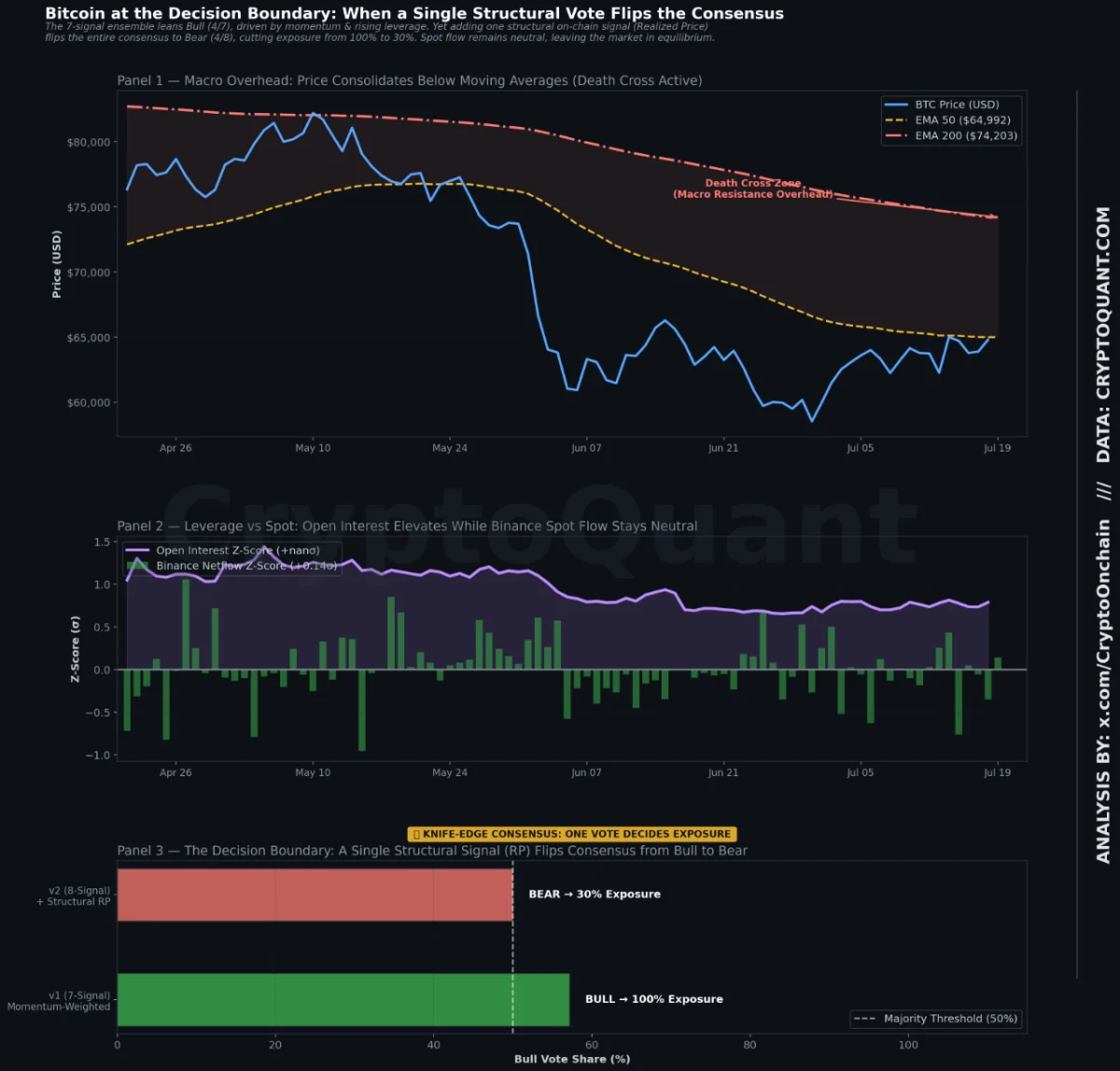
Bitcoin is currently navigating a precarious decision boundary, with its price action reflecting a robust recovery in short-term momentum that is now testing significant long-standing structural resistance. The premier cryptocurrency recently climbed to $64,792, marking a 1.59% increase over seven days, underpinned by an ensemble model of seven technical signals that collectively lean towards a moderate bullish stance. However, this immediate optimism is tempered by a deeper structural gauge, the Realized Price Age-Band Crossover, which presents a distinctly more bearish outlook. This fundamental divergence between immediate market strength and underlying long-term positioning has introduced a palpable sense of caution among traders and investors, who are now closely monitoring for the definitive signal of Bitcoin’s next major directional move. As of writing, Bitcoin trades at $64,587.74, experiencing a marginal 0.2% decline over 24 hours, with a weekly gain of approximately 2.88% and a 24-hour trading volume of $17.86 billion.
The Recent Price Recovery and Immediate Bullish Impulses
Following weeks of largely range-bound trading, Bitcoin has demonstrated renewed vigor, pushing back towards the critical $65,000 psychological threshold. This upward trajectory is primarily attributed to a confluence of short-term technical indicators that have recently swung in favor of buyers. The aforementioned 7-signal ensemble model, a proprietary analytical tool, currently registers four out of its seven components as bullish, signaling a collective short-term positive sentiment. Among these reinforcing signals are the Moving Average Convergence Divergence (MACD) readings, which often indicate shifts in momentum and trend strength, showing signs of upward crossover or sustained positive divergence. Furthermore, a notable increase in Bitcoin’s open interest, surging by 0.74 standard deviations, further supports this momentum reading. Open interest, representing the total number of outstanding derivative contracts that have not been settled, often serves as a proxy for market liquidity and potential future price movements. A significant rise typically suggests increased market participation and conviction, reinforcing the perception of growing bullish momentum.
Analysts tracking exchange volume have corroborated these observations, noting that the recent price appreciation aligns with broader market attempts to reclaim previously lost ground. This period of consolidation below $65,000, characterized by relatively muted price action, appears to be giving way to a more determined push from buyers, who are attempting to establish a higher support base and potentially challenge resistance levels that have held firm for an extended period. The sentiment among short-term traders has visibly shifted, with many interpreting the current price action as a potential precursor to a more sustained rally, provided these immediate gains can be consolidated.
The Contradictory Structural View: Realized Price and Its Implications

While short-term indicators paint a moderately bullish picture, a more profound, structural metric offers a starkly different perspective, injecting a layer of skepticism into the market’s current trajectory. The Realized Price framework, a sophisticated on-chain analysis tool, fundamentally re-evaluates the market’s consensus when integrated into the broader signal ensemble. Once this structural metric is included, the collective outlook shifts dramatically, with bearish votes now outnumbering bullish ones, resulting in four bearish signals out of an expanded eight-signal model. Consequently, the recommended exposure level for investors drops sharply from a full allocation to a mere 30% under this adjusted view, reflecting a significant increase in perceived risk.
The Realized Price model is designed to measure the aggregate cost basis of all Bitcoin held on the blockchain, effectively providing an average price at which all coins were last moved. By segmenting this metric across different holder age groups, such as short-term holders (less than 155 days) and long-term holders, analysts can gauge the conviction and profitability of various market participants. A key component of this framework is the Realized Price Age-Band Crossover, which analyzes the relationships between the cost bases of different age cohorts. Currently, four out of five of these age-band pairs remain inverted, a pattern historically associated with periods of distribution rather than accumulation. Distribution typically implies that existing holders are selling their assets, potentially signaling a lack of fresh demand at current price levels or profit-taking by longer-term investors. Conversely, accumulation phases are characterized by strong buying interest and new capital flowing into the asset.
The most pronounced gap within these inverted bands is observed between the one-to-three-month and six-to-twelve-month holder age groups. This significant spread has persistently held near negative 26.3% since January, indicating that despite recent price gains, there has been limited improvement in the underlying structural health of the market. This persistent inversion suggests that recent buyers have not yet managed to establish a dominant cost basis over longer-term holders. In simpler terms, the newer money entering the market has not been strong enough to absorb the potential selling pressure from those who acquired Bitcoin at lower prices several months ago. Market observers interpret this dynamic as a clear indicator that fresh demand remains tentative and perhaps insufficient to sustain a prolonged upward movement at current price levels. This structural weakness raises questions about the durability of the recent price rally and suggests that Bitcoin might still be vulnerable to further consolidation or even a retracement if stronger buying conviction fails to materialize.
Analyst Perspectives and the $60,000 Range
Prominent crypto analyst Daan Crypto Trades has highlighted Bitcoin’s ability to close another weekly candle above the Weekly 200-day moving average, a historically significant technical indicator often used to gauge long-term trend strength. While this is a positive sign, indicating that Bitcoin remains in a macro bullish trend, the analyst emphasized that a "strong push higher" is crucial to retrace the recent decline and definitively reclaim the Weekly 200 Exponential Moving Average (EMA). The EMA places more weight on recent data points, making it a more responsive indicator to current price action. Without such a decisive breakout, Daan Crypto Trades cautioned that Bitcoin’s price action risks remaining confined to a choppy, range-bound environment near the $60,000 mark. This perspective underscores the broader market sentiment that while short-term gains are encouraging, the real test lies in Bitcoin’s ability to overcome these significant technical hurdles and establish clear momentum above key resistance zones.
Other analysts echo this sentiment, pointing to the $60,000 to $65,000 range as a critical battleground. A sustained break above $65,000 with significant volume would likely confirm the bullish short-term outlook and potentially trigger a cascade of further buying interest. Conversely, a failure to hold this range, particularly a drop below $60,000, could invalidate the recent momentum and send Bitcoin back into a deeper consolidation phase, possibly testing lower support levels. The current market thus represents a standoff between buyers attempting to leverage recent momentum and sellers, particularly longer-term holders, who might view current levels as opportune for profit-taking, influenced by the underlying structural weaknesses identified by the Realized Price model.
Historical Performance and Model Discrepancies
The ongoing disagreement between momentum-driven and structural analysis models is not merely an academic exercise; it has tangible implications for investment strategy and risk management. Historical back-testing offers valuable insights into the efficacy of these different approaches. The Realized Price framework, despite its current bearish signal, has demonstrated robust performance over full market cycles. It achieved a full-cycle Sharpe ratio of 1.27, a measure of risk-adjusted return, indicating that it has historically generated superior returns for the amount of risk taken. Its maximum drawdown, a measure of the largest peak-to-trough decline, was approximately negative 40%. This compares favorably against a broader buy-and-hold strategy, which experienced a much more substantial decline of 76% during the same periods. This suggests that while the Realized Price model might err on the side of caution, it has historically provided a more resilient and less volatile investment path.
In contrast, the momentum-driven model has historically produced stronger raw returns, boasting a compound annual growth rate (CAGR) near 60.5%. This indicates that during periods of strong market trends, the momentum approach is highly effective at capturing significant gains. However, this often comes with higher volatility and potentially larger drawdowns during reversals. The year 2025 provides a compelling illustration of this divergence: the structural approach, guided by the Realized Price framework, posted gains between 23% and 29%, while passive buy-and-hold strategies suffered a significant decline of 34.6%. This stark performance gap underscores why both frameworks remain in active disagreement over current market conditions. Momentum models are optimized for capturing trend continuation, while structural models are designed to assess underlying market health and identify potential turning points or periods of vulnerability. The current conflict between them highlights a market where short-term trading opportunities exist, but long-term foundational strength is still under scrutiny.
Macroeconomic Context and Broader Market Sentiment
Bitcoin’s current delicate positioning is not occurring in a vacuum. Broader macroeconomic factors continue to exert significant influence on risk assets, including cryptocurrencies. Global inflation concerns, central bank monetary policies, particularly interest rate decisions by the U.S. Federal Reserve, and the overall health of traditional financial markets all play a role in shaping investor sentiment towards Bitcoin. Periods of economic uncertainty often lead investors to de-risk portfolios, which can result in capital flowing out of more volatile assets like cryptocurrencies. Conversely, signs of economic stability or renewed liquidity can fuel speculative interest.
The recent approval and adoption of spot Bitcoin Exchange-Traded Funds (ETFs) in major markets like the United States have introduced a new layer of institutional participation. While these ETFs have brought significant new capital into the Bitcoin ecosystem, their influence on price action is complex. Institutional flows can provide strong underlying support, but they can also react more acutely to macroeconomic shifts, potentially contributing to larger liquidations during periods of stress. The current market environment, characterized by ongoing debates about inflation trajectories and the timing of potential interest rate adjustments, creates a backdrop of cautious optimism, where strong bullish convictions are easily tempered by the specter of macroeconomic headwinds. This cautious sentiment can explain why, despite immediate momentum, deeper structural indicators signal caution.
Implications for Investors and the Path Forward
The current divergence between Bitcoin’s short-term momentum and its long-term structural indicators presents a complex scenario for all types of investors. For short-term traders, the prevailing momentum suggests opportunities for further upside, provided they employ stringent risk management strategies. However, the structural warnings imply that these gains might be fragile and susceptible to sudden reversals. For long-term investors, the mixed signals call for prudence. While Bitcoin’s ability to hold above key moving averages is encouraging, the inverted Realized Price bands suggest that the market is not yet in a strong accumulation phase, meaning that significant price appreciation might be harder to sustain without a fundamental shift in holder behavior.
The "decision boundary" Bitcoin currently occupies implies that a significant move is likely imminent, but its direction remains uncertain. A definitive breakout above the $65,000-$68,000 resistance zone, accompanied by increasing volume and a positive shift in the Realized Price Age-Band Crossover (i.e., less inversion), would signal a strong re-establishment of bullish momentum and potentially pave the way for a challenge towards previous all-time highs. Conversely, a failure to hold current levels and a drop below the $60,000 psychological support could indicate that the underlying structural weaknesses are prevailing, leading to further consolidation or a deeper correction.
Analysts will continue to closely monitor key on-chain metrics, exchange flows, and macroeconomic developments. The resolution of the Realized Price bands from their current inverted state will be a critical indicator of renewed market conviction and the re-establishment of a healthy accumulation phase. Until then, Bitcoin’s price action is expected to remain highly sensitive to incoming data, making the current period one of both opportunity and heightened risk. The market is effectively waiting for one of these powerful forces – immediate momentum or deep-seated structure – to definitively assert its dominance and chart the course for Bitcoin’s immediate future.














