


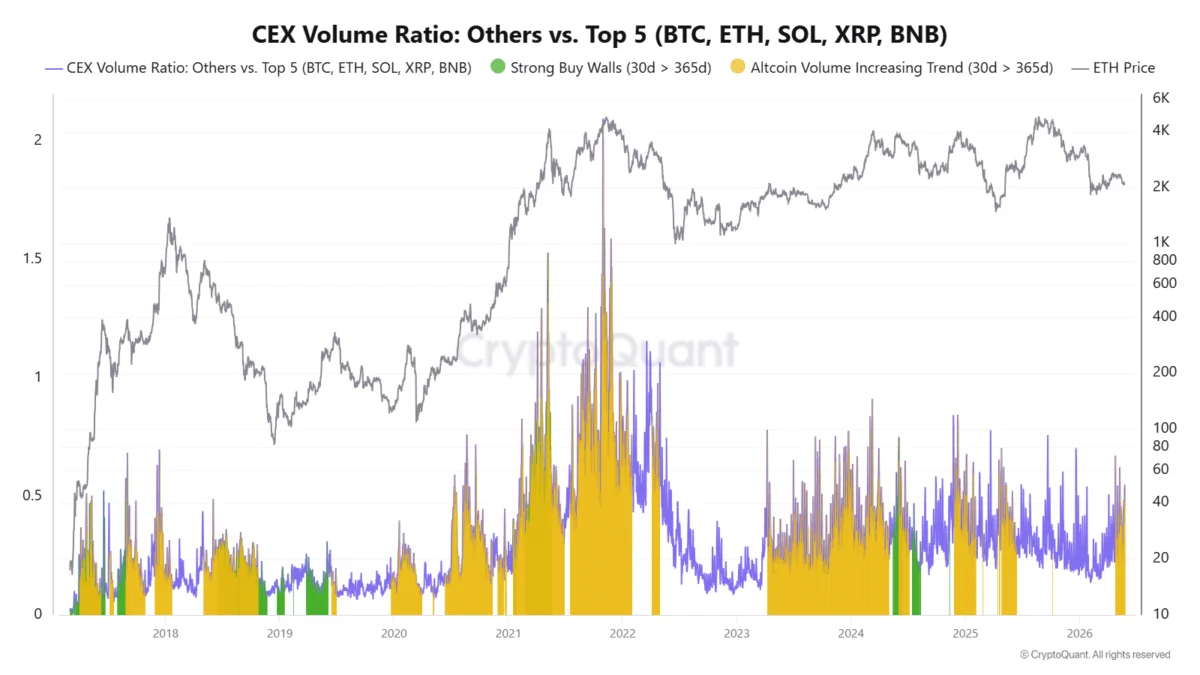
The global cryptocurrency market is currently navigating a period of profound structural transition, characterized by a notable divergence between aggregate investor sentiment and localized trading activity. While the broader market remains mired in a cycle of sideways price action and declining retail enthusiasm, sophisticated participants appear to be quietly repositioning themselves within the altcoin sector. Data recently released by on-chain analytics firm CryptoQuant highlights a significant behavioral anomaly: exchange volume for altcoins—specifically those excluding the "Big Five" of Bitcoin (BTC), Ethereum (ETH), Solana (SOL), XRP, and BNB—is on the rise. This uptick in activity occurs against a backdrop of diminishing overall market volume, suggesting that a specific cohort of investors is making deliberate, high-conviction moves while the majority of the market remains sidelined by exhaustion.
The Dynamics of the Volume Divergence
The current market environment is one defined by paradox. On the surface, the "crypto winter" hangover persists, with trading volumes across major centralized exchanges (CEXs) trending downward since the brief recovery attempts seen in early 2024. Macroeconomic headwinds, including fluctuating interest rate expectations and regulatory uncertainty, have dampened the speculative fervor that typically drives bull markets. However, the CryptoQuant data reveals that the "OTHERS" category—a basket of smaller-cap and mid-cap altcoins—is seeing a sustained increase in CEX volume ratio relative to the top-tier assets.
This divergence is statistically significant because it contradicts the standard "risk-off" behavior usually seen during periods of stagnation. Typically, when market sentiment turns negative, capital flows out of high-risk altcoins and into the perceived safety of Bitcoin or stablecoins. The fact that volume is concentrating in the more speculative end of the risk curve suggests that the participants currently active in the market are not the reactive retail traders who dominated previous cycles. Instead, this activity points toward "smart money" or institutional-adjacent players who utilize periods of low volatility to build positions in anticipation of a future rotation.
Historical Context and the Multi-Year Downtrend
To understand the weight of this signal, one must examine the multi-year trajectory of the altcoin market. Since the peak of the 2021 bull run, the OTHERS/BTC index—which tracks the total market capitalization of all cryptocurrencies excluding the top 10 assets against Bitcoin—has been in a persistent and punishing downtrend. For nearly three years, Bitcoin dominance has stifled the growth of smaller projects, as liquidity remained concentrated in the most established networks.

The "altcoin seasons" of 2024 were largely localized and short-lived, often confined to specific niches like meme coins or Artificial Intelligence (AI) tokens, rather than a broad-based market expansion. This has led to a prevailing sense of skepticism among market participants. Many who entered the market expecting a 2017 or 2021-style rally have been forced to liquidate or have simply stopped trading altogether. However, technical analysis of the OTHERS/BTC ratio suggests that the aggressive selling pressure that defined the previous 24 months is beginning to lose momentum. The ratio is currently testing a critical support floor near the 0.12 region, a level that has historically served as a base for consolidation before major trend reversals.
Technical Analysis: Stabilization Near the 0.12 Region
From a technical perspective, the altcoin market remains in a precarious position, yet signs of a structural floor are emerging. The OTHERS/BTC ratio is currently trading below its 50-week, 100-week, and 200-week moving averages (MAs). In traditional charting, this configuration is considered bearish, confirming that Bitcoin remains the dominant force in the market. Nevertheless, the rate of decline has slowed significantly.
The transition from a vertical drop to a horizontal consolidation phase is often the first prerequisite for a trend change. Analysts note that the repeated defense of the 0.12 support level indicates that sell-side liquidity is being absorbed by a steady wall of buy orders. While a confirmed breakout has yet to materialize, the increase in volume during minor recovery attempts suggests that the market is "coiling." If the OTHERS/BTC ratio can successfully reclaim the 50-week moving average, it would mark the first time in over two years that altcoins have demonstrated sustained relative strength against Bitcoin, potentially triggering a massive capital rotation.
The Role of Strategic Accumulation
The CryptoQuant report emphasizes that the current volume trend is not a flash-in-the-pan event. Unlike the "pump and dump" schemes prevalent in high-volatility environments, the current rise in altcoin volume is building incrementally across multiple sessions. This suggests a strategy of "quiet accumulation," where buyers seek to fill large orders without significantly moving the price—a tactic commonly employed by hedge funds and venture capital firms looking to enter positions at a discount.
This behavior is further supported by the lack of mainstream media coverage and the generally "depressed" state of social media sentiment. Historically, the most profitable periods for altcoin investment have occurred when the general public is disinterested or fearful. By the time sentiment turns "bullish" and retail investors return to the market, the initial phase of the rally is usually complete. The current data suggests that the market is currently in this "pre-hype" phase, where the foundation for the next cycle is being laid by those with a longer time horizon.

Macroeconomic Factors and Liquidity Injections
The broader financial landscape also plays a crucial role in the timing of this altcoin activity. Central banks globally are navigating a delicate balance between controlling inflation and preventing economic stagnation. Any shift toward a more "dovish" monetary policy—such as interest rate cuts or increased quantitative easing—typically results in an influx of global liquidity.
Cryptocurrencies, and specifically high-beta altcoins, are highly sensitive to liquidity cycles. As the US Dollar Index (DXY) shows signs of topping out and global M2 money supply begins to expand again, the "risk-on" appetite is expected to return. The rising volume in the OTHERS category may be a leading indicator that sophisticated traders are positioning themselves ahead of a global liquidity pivot. Furthermore, the maturation of the regulatory environment in jurisdictions like Europe (via MiCA) and the potential for a more crypto-friendly legislative stance in the United States could provide the necessary catalyst for institutional capital to move further down the risk curve.
Sector-Specific Drivers of Interest
While the "OTHERS" category is broad, certain sectors within the altcoin market are likely driving the lion’s share of this renewed volume. Analysts point to several key narratives that have maintained resilience despite the bear market:
- Artificial Intelligence (AI) and Decentralized Computing: As AI remains the dominant theme in global equity markets, decentralized infrastructure projects that offer GPU power or data labeling are seeing increased on-chain activity.
- Real-World Assets (RWA): The tokenization of traditional financial instruments, such as treasury bills and real estate, has attracted significant institutional interest, bridging the gap between DeFi and TradFio.
- DePIN (Decentralized Physical Infrastructure Networks): Projects focused on building physical networks for telecommunications, mapping, and energy are gaining traction as they offer tangible utility beyond pure speculation.
The concentration of volume in these "utility-driven" sectors suggests that the market is becoming more discerning, moving away from purely speculative meme-driven cycles toward assets with verifiable fundamental growth.
Potential Risks and the "Bitcoin First" Reality
Despite the optimistic signals found in the volume data, several risks remain. The "Bitcoin First" reality of the current cycle cannot be ignored. The success of Spot Bitcoin ETFs in the United States has created a structural demand for BTC that does not yet exist for the vast majority of altcoins. As long as Bitcoin remains the primary gateway for institutional entry, altcoins may continue to face a "liquidity lag," where they only begin to move significantly after Bitcoin has reached a new all-time high and stabilized.

Furthermore, if the macro environment worsens—perhaps due to a recession or a geopolitical shock—the fragile stabilization in the altcoin market could be easily shattered. In a "black swan" event, the OTHERS/BTC ratio could break below the 0.12 support level, leading to a final "capitulation" phase before a true bottom is found.
Conclusion: A Market in Transition
The divergence identified by CryptoQuant serves as a critical reminder that market prices do not always tell the whole story. While the charts for many altcoins look stagnant, the underlying volume data reveals a market that is far from dead. The quiet accumulation of smaller-cap assets during a period of peak skepticism is a classic hallmark of a market transition.
As the OTHERS/BTC ratio attempts to stabilize and move toward its 50-week moving average, the coming months will be pivotal. If the current volume trend continues to build, it will likely provide the fuel needed for a significant market expansion once the broader macro clouds begin to clear. For now, the signal is clear: while the masses are looking away, the "smart money" is moving back into the altcoin sector, betting on a future where the current silence is replaced by a renewed era of speculative growth and technological adoption.














