


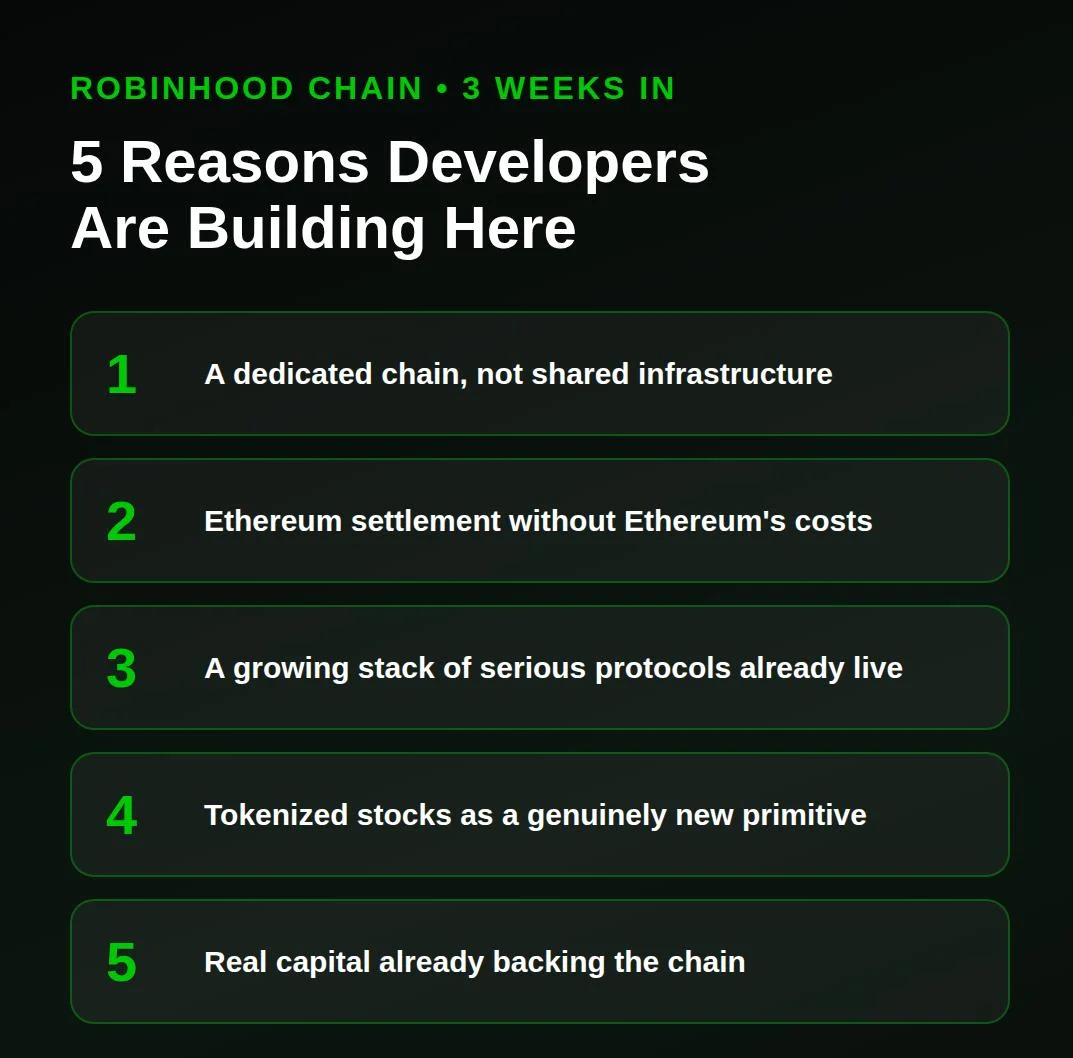
The landscape of blockchain technology is perpetually in flux, often characterized by the meteoric rise and equally swift decline of new protocols. However, Robinhood Chain, the latest entrant in the Ethereum Layer 2 ecosystem, appears to defy this trend, establishing a significant foothold with remarkable speed since its public mainnet launch on July 1st. Within mere weeks, the platform has witnessed an unprecedented surge in developer activity, outpacing many infrastructure projects tracked in the current year and signaling a potent combination of strategic design, robust backing, and novel utility.
This rapid traction is not accidental. Robinhood Chain, an Ethereum Layer 2 solution built on Arbitrum’s Orbit stack, represents a calculated evolution for Robinhood, the popular commission-free trading platform. The Orbit stack, a versatile framework, empowers developers to deploy custom Layer 2 or Layer 3 chains without the arduous task of constructing consensus infrastructure from scratch. This foundation allows Robinhood Chain to focus on its core proposition: a new generation of tokenized stocks and Exchange Traded Funds (ETFs) designed for 24/7 trading and seamless integration into on-chain applications. The compelling reasons behind the swift developer embrace are multifaceted, spanning technical architecture, ecosystem development, and significant capital potential.
The Strategic Imperative: Robinhood’s Evolution into Web3
Robinhood’s journey into the digital asset space began several years ago, initially offering crypto trading services alongside its traditional brokerage offerings. This move signaled the company’s recognition of the burgeoning interest in cryptocurrencies among its vast user base. However, the launch of a dedicated Layer 2 chain marks a substantial deepening of its Web3 commitment. It represents a strategic pivot to not just offer crypto assets, but to actively participate in and shape the underlying infrastructure of decentralized finance (DeFi), particularly where it intersects with traditional financial markets.
The decision to build on Arbitrum’s Orbit stack is significant. Arbitrum has established itself as a leading Layer 2 solution for Ethereum, known for its scalability, efficiency, and developer-friendly environment. By leveraging Orbit, Robinhood gains the benefits of Arbitrum’s proven technology while maintaining the sovereignty and customization necessary for its specific use case. This choice allows Robinhood Chain to inherit a battle-tested foundation, rather than attempting to reinvent the wheel, thereby accelerating its development and deployment timeline.
Reason One: Precision-Engineered Infrastructure for Financial Applications
One of the most compelling aspects drawing developers to Robinhood Chain is its departure from the general-purpose blockchain model. Historically, many applications, including Robinhood’s earlier explorations into tokenized assets, were deployed on shared infrastructure like Arbitrum One. While offering access to established liquidity and developer ecosystems, this approach inevitably leads to competition for block space and gas efficiency. General-purpose chains, by their very nature, are optimized for a broad range of applications, making them "fine for most things and ideal for very few." This can result in unpredictable fees, slower transaction times during peak demand, and a less tailored environment for specialized use cases.
Robinhood Chain fundamentally alters this dynamic. It is a dedicated Layer 2, meticulously optimized around Robinhood’s core priorities: tokenized real-world assets (RWAs), rapid transaction execution, predictable fee structures, and the capacity to handle significant transaction volumes characteristic of financial markets. For developers whose projects are inherently linked to these objectives—whether building new financial instruments, high-frequency trading protocols, or lending platforms collateralized by RWAs—launching on an infrastructure precisely tuned for their needs offers a distinct advantage. This specialized environment minimizes the inherent compromises of shared networks, providing a more stable, efficient, and cost-effective platform for complex financial applications. The predictability and performance are critical for attracting and retaining sophisticated DeFi protocols and potentially traditional financial institutions looking to experiment with blockchain.
Reason Two: The Security and Ecosystem Advantages of Ethereum Settlement
Despite operating as a distinct Layer 2, Robinhood Chain maintains a crucial connection to the Ethereum mainnet for final settlement and data availability. This architectural choice is fundamental to its value proposition. Transactions are processed off-chain, batched together, and then periodically posted back to Ethereum, allowing Robinhood Chain to offer significantly lower transaction fees and faster execution speeds compared to direct interaction with Ethereum’s main network. Crucially, this setup enables Robinhood Chain to inherit Ethereum’s robust security guarantees, a paramount concern for any financial application, rather than having to establish a trust model from scratch.
This hybrid approach carries profound implications for developers. Building on an Ethereum-settled chain provides immediate access to an enormous, mature ecosystem of tooling, security auditors, and infrastructure components that are already well-versed in securing and interacting with Ethereum-compatible systems. This "head start" is invaluable, as it drastically reduces the time and resources developers would otherwise need to invest in ensuring the security and compatibility of their applications. The familiarity with Ethereum’s Virtual Machine (EVM) and its associated standards lowers the barrier to entry, fosters innovation, and accelerates the development cycle, making Robinhood Chain a more attractive proposition than entirely novel base layers with unproven security assumptions.
Reason Three: A Robust DeFi Ecosystem from Day One
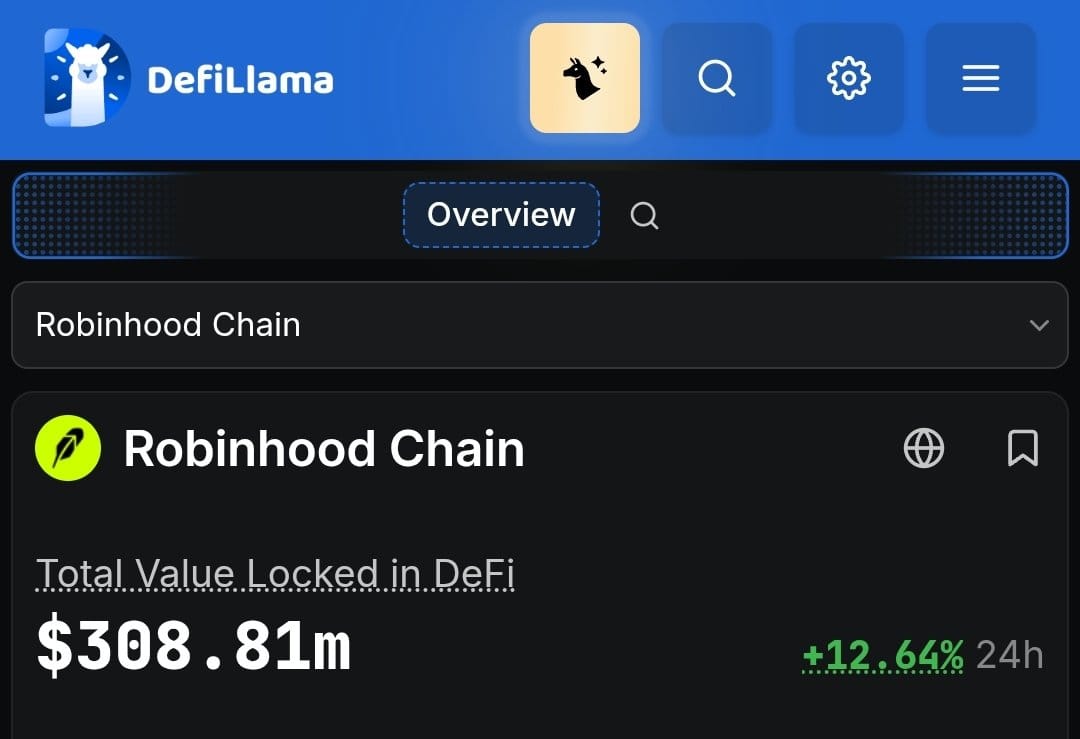
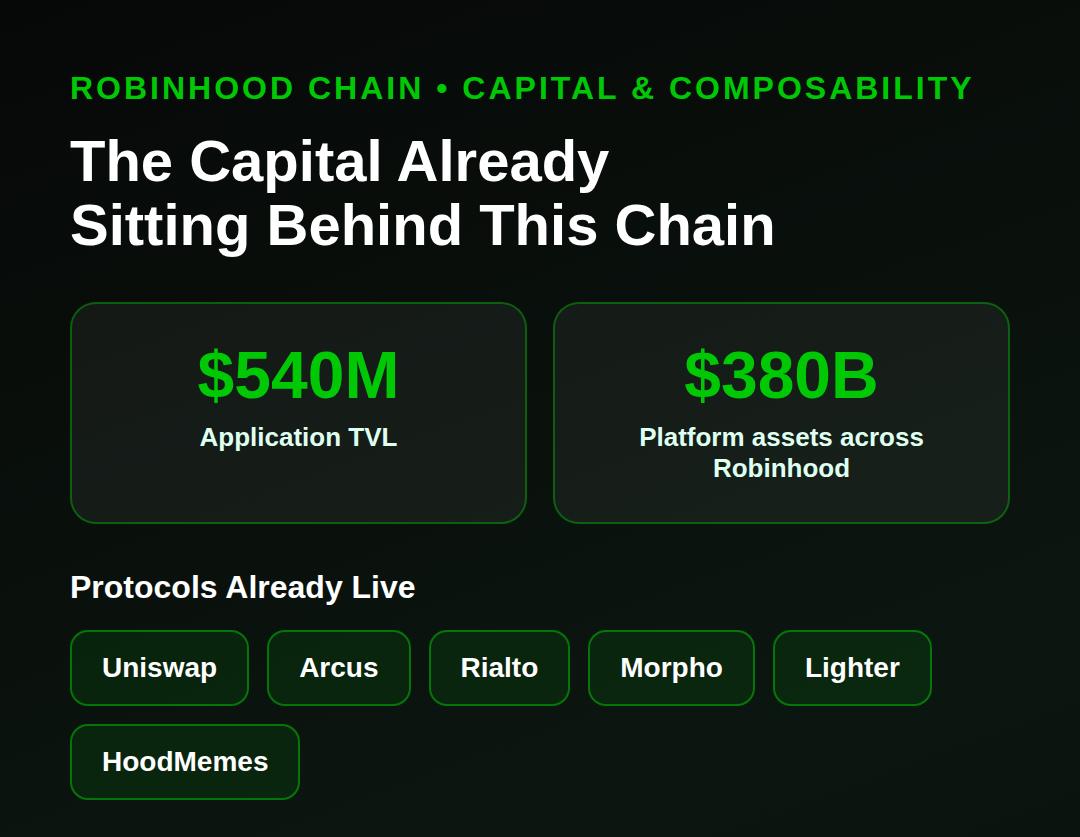
Developers rarely build in isolation; they thrive in environments where composability and existing liquidity are readily available. Robinhood Chain has strategically addressed this by assembling a formidable lineup of established DeFi protocols, going live with a substantial ecosystem already in place. This includes:
- Uniswap: As the chain’s core decentralized exchange (DEX), providing essential liquidity and token swapping capabilities.
- Arcus: Handling both spot DEX activity and perpetual trading, catering to more advanced trading strategies.
- Rialto: Operating as another DEX and liquidity aggregator, further enhancing trading options and depth.
- Morpho: Bringing critical lending and borrowing infrastructure, enabling users to leverage their assets.
- Lighter: Adding another venue for perpetual trading, diversifying derivative offerings.
- HoodMemes: A dedicated memecoin launchpad, catering to a distinct, often highly active, segment of the crypto community.
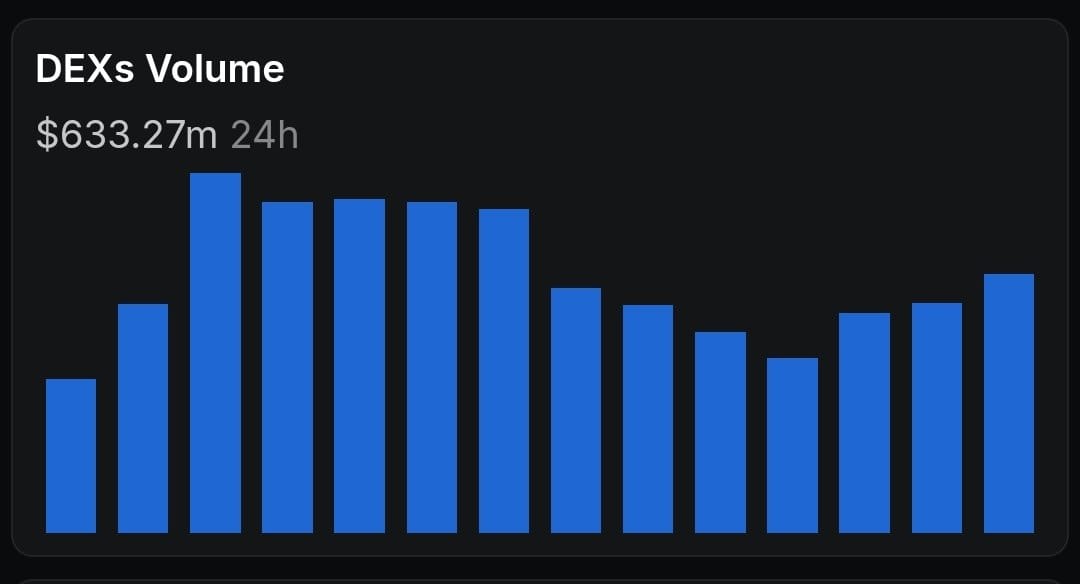
This immediate presence of diverse and serious DeFi infrastructure signifies that Robinhood Chain is not merely a platform awaiting its ecosystem to materialize. Instead, it launched with enough existing liquidity and composability to offer new protocols immediate utility and integration possibilities. This network effect is a powerful magnet for developers, allowing them to focus on their core product development rather than expending effort on bootstrapping fundamental market infrastructure. The mature ecosystem fosters confidence and provides a tangible environment for innovation.
Reason Four: Tokenized Stocks – A Genuinely New Financial Primitive
Perhaps the most distinctive and potent differentiator for Robinhood Chain is its native support for tokenized stocks and ETFs. These are real-world equities represented on-chain, enabling them to be utilized as collateral in DeFi protocols, lent out to earn yield, or traded around the clock without the traditional market hours constraints. This capability is not easily replicated by other Layer 2s, as it hinges entirely on Robinhood’s unique position as a regulated brokerage firm with existing infrastructure to manage and custody traditional securities.
For developers aiming to bridge the gap between traditional finance (TradFi) and decentralized finance (DeFi), tokenized stocks represent a genuinely novel building block. Applications that seek exposure to real-world assets—whether for structured products, synthetic assets, or collateralized lending—find an unparalleled opportunity on Robinhood Chain. While other chains might offer wrapped assets or synthetic derivatives, Robinhood Chain provides a direct, native on-chain representation of real equities, backed by a regulated entity. This unique offering allows for the creation of innovative financial products that are deeply integrated with both traditional markets and the decentralized economy, setting Robinhood Chain apart from the myriad of general-purpose Layer 2s vying for DeFi developer attention. The ability to integrate mainstream financial assets into DeFi protocols on a regulated platform unlocks a vast new realm of possibilities for financial innovation.
Reason Five: The Gravitational Pull of Capital: Robinhood’s Massive Asset Base
Ultimately, even the most innovative technology and well-designed ecosystem require significant capital to thrive. This is where Robinhood Chain presents an exceptionally compelling case. According to data shared by Token Terminal, Robinhood Chain currently boasts approximately $540 million in application Total Value Locked (TVL). While impressive for a nascent chain, this figure pales in comparison to the $380 billion in platform assets held across Robinhood’s broader business.
This colossal $380 billion figure is the ultimate magnet for developers. Unlike most new blockchain initiatives that must painstakingly convince capital to migrate organically, Robinhood Chain possesses an enormous existing user base and a colossal pool of assets sitting just one step away from on-chain integration. This implies a clear, plausible, and potentially massive migration path for capital onto the chain as Robinhood continues its strategic shift towards integrating more of its platform assets into the decentralized environment. Developers building on Robinhood Chain are not betting on hypothetical future liquidity; they are strategically positioning themselves early to capture a portion of this pre-existing, substantial capital base. This inherent advantage significantly de-risks development efforts and provides a level of certainty regarding future liquidity that is virtually unmatched by competitors. It suggests that Robinhood Chain is not just building a blockchain, but a bridge to its existing user and asset ecosystem.
Navigating Robinhood Chain: Entry Points and User Experience
For users and enthusiasts looking to interact with the chain directly, rather than building on it, the entry points are designed for straightforward navigation. Users can send and receive digital assets, engage in low-fee token trading, and interact with decentralized applications (dApps) through an intuitive ecosystem. Purchasing a token typically involves connecting a compatible wallet to a supported decentralized exchange (DEX) such such as Uniswap, Arcus, or PancakeSwap on Robinhood Chain. After selecting the desired token and amount, users can review the transaction details and confirm the swap. A crucial security practice, universally applicable across all blockchain networks, is to always verify a token’s official contract address before any transaction, which serves as a primary defense against scam losses.
It is noteworthy that Robinhood Chain operates without a proprietary native token. Transaction fees (gas) are paid in Ethereum (ETH), aligning with the operational model of many established Ethereum Layer 2 networks. This design choice implies a focus on utility and stability rather than speculative tokenomics, as there is no "NPRO-style token play" or embedded airdrop speculation driving the chain’s fundamental function. This contributes to a more predictable and user-friendly experience, mirroring the ethos of established L2s.
Broader Market Impact and Future Outlook
The rapid ascent of Robinhood Chain holds significant implications for both the DeFi sector and the broader financial industry. By successfully tokenizing real-world assets and integrating them into a scalable, Ethereum-secured Layer 2, Robinhood is poised to accelerate the mainstream adoption of blockchain technology. It provides a tangible use case for DeFi that extends beyond purely crypto-native assets, potentially attracting a new wave of users and institutions who have been hesitant to enter the decentralized space due to perceived risks or lack of familiar asset classes.
The convergence of Robinhood’s regulatory expertise and massive user base with the technical capabilities of a dedicated Layer 2 could set a new precedent for how traditional financial services evolve in a Web3 era. It challenges existing paradigms of market hours, settlement times, and asset ownership. While regulatory scrutiny remains a constant factor in the tokenization of securities, Robinhood’s established compliance framework positions it uniquely to navigate these complexities. The success of Robinhood Chain could inspire other financial institutions to explore similar dedicated blockchain solutions, further blurring the lines between centralized and decentralized finance.
Conclusion: A Synergistic Combination for Success
The unprecedented pace of developer activity on Robinhood Chain cannot be attributed to any single factor. A dedicated Layer 2, however optimized, would struggle without substantial capital. Similarly, tokenized stocks, while innovative, would remain a novelty without a robust and composable DeFi infrastructure. It is the powerful synergy of these five core elements—a purpose-built, optimized infrastructure, the inherent security and tooling of Ethereum settlement, a pre-existing and active protocol stack, the genuinely novel primitive of tokenized real-world assets, and a massive, accessible capital base with a clear on-chain migration path—that distinguishes Robinhood Chain. This potent combination has created an irresistible environment for builders, positioning Robinhood Chain not as just another contender, but as a significant force reshaping the future of finance at the intersection of traditional and decentralized economies.














