



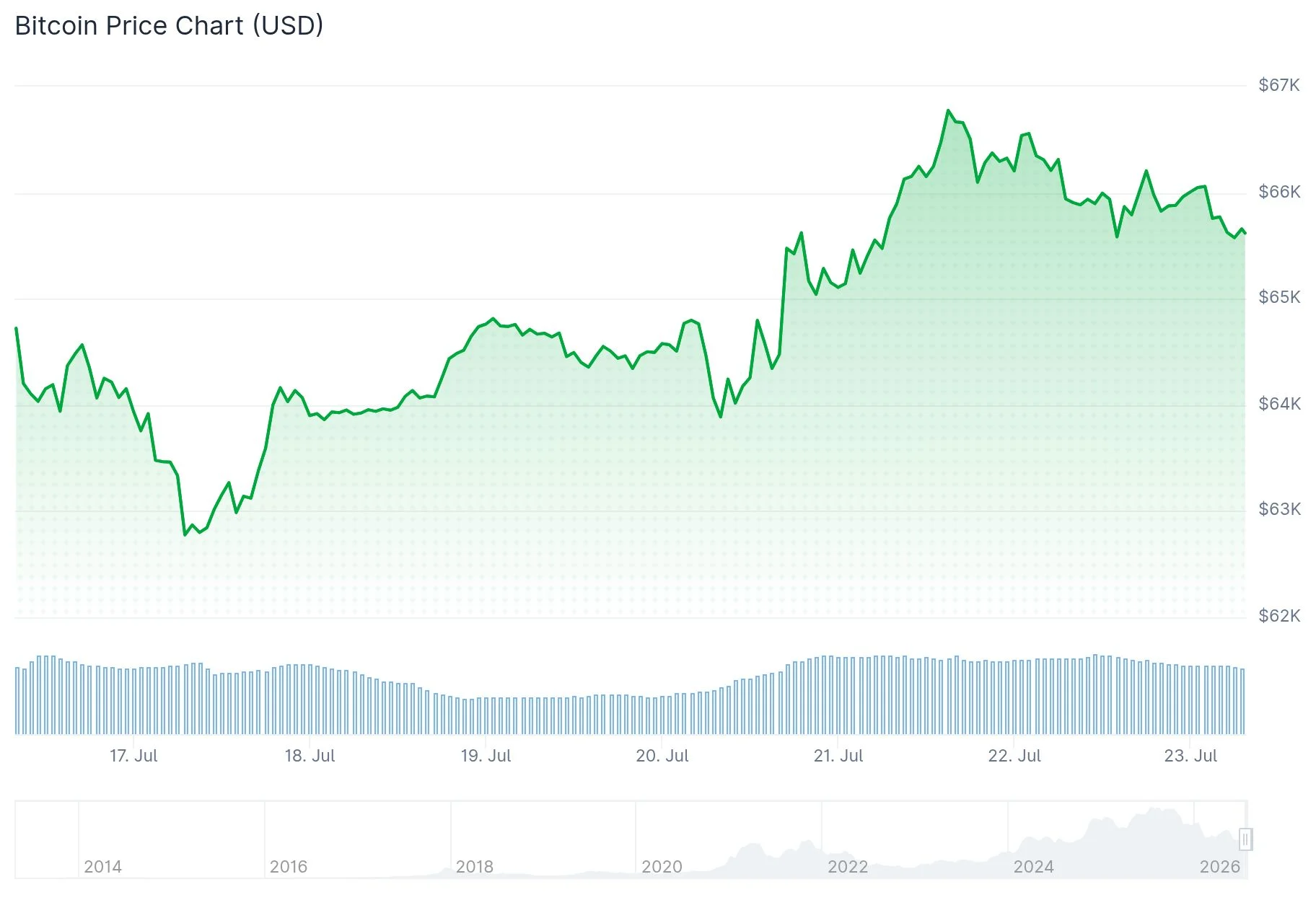
Bitcoin experienced a notable downturn during early Thursday trading hours, retracting to approximately $65,500. This represented an approximate 0.7% decrease from its midnight UTC levels, signaling a broader market sensitivity to prevailing macroeconomic and geopolitical factors. The flagship cryptocurrency had previously approached the $66,700 mark during Wednesday’s session before initiating its retreat, setting a cautious tone for digital asset markets. This movement did not occur in isolation, as the broader cryptocurrency market mirrored Bitcoin’s decline, with major altcoins such as Ether, Solana, and XRP each registering declines in tandem with the leading digital asset’s pullback. The convergence of several external pressures—primarily surging energy markets, rising U.S. Treasury bond yields, and persistent geopolitical tensions—appears to have created a challenging environment for risk assets, including cryptocurrencies, compelling investors to reassess their portfolio allocations.
Macroeconomic Pressures Mount: Energy Markets and Inflationary Concerns
A significant factor contributing to the recent market decline stems from the energy sector, specifically the escalating price of crude oil. West Texas Intermediate (WTI) crude futures surged to $88.60 per barrel, marking the commodity’s strongest level since June 11. This upward trajectory in oil prices is not merely an isolated market event; it carries profound implications for global economic stability and monetary policy.
Rising oil prices typically act as a powerful amplifier of inflationary pressures across economies. The cost of energy is a fundamental input for nearly all goods and services, from manufacturing and transportation to agriculture and consumer products. When crude oil becomes more expensive, these higher costs are often passed on to consumers, leading to an increase in the general price level. This dynamic creates significant challenges for central banks worldwide, particularly the U.S. Federal Reserve, which is tasked with maintaining price stability and maximizing employment.
The prospect of sustained high inflation, exacerbated by rising energy costs, complicates central banks’ considerations regarding monetary policy adjustments and potential interest rate reductions. Central banks have been navigating a delicate balance, attempting to curb inflation without stifling economic growth. However, a renewed surge in inflationary indicators, particularly from a critical sector like energy, could force them to maintain a more hawkish stance for longer than anticipated, or even consider further tightening measures. Such a scenario typically diminishes investor appetite for speculative and non-yielding assets like Bitcoin, as higher interest rates increase the attractiveness of safer, fixed-income investments while also raising the cost of capital for businesses and individuals.
Historically, periods of significant oil price spikes have often coincided with increased market volatility and economic uncertainty. The current surge, therefore, prompts concerns about its potential to fuel a broader inflationary cycle, making it harder for economies to achieve a "soft landing" and increasing the likelihood of a more prolonged period of elevated inflation. This environment encourages a "risk-off" sentiment, where investors shy away from assets perceived as more volatile in favor of those offering greater stability or guaranteed returns.
Bond Yields Reach Multi-Month Highs, Diverting Capital from Digital Assets
In a related development reflecting broader macroeconomic conditions, fixed-income markets also exhibited significant movements. The two-year U.S. Treasury yield surged to 4.31%, reaching its strongest reading since February 2025. Concurrently, the benchmark 10-year Treasury yield advanced to 4.66%, marking its most elevated level since May. These increases in government bond yields are a critical indicator for financial markets, directly influencing investment decisions across various asset classes.
The fundamental principle at play is the enhanced attractiveness of bonds relative to non-yielding assets, such as Bitcoin, when their yields rise. U.S. Treasury bonds are considered among the safest investments globally, offering guaranteed returns in exchange for lending money to the government. As the yield, or return, on these bonds increases, they become more competitive against assets that do not offer a fixed income stream and are subject to higher price volatility. This dynamic often prompts investors, particularly institutional ones, to reallocate capital from riskier cryptocurrency holdings into the perceived safety and now more lucrative returns of traditional fixed-income securities.
The surge in bond yields can be attributed to several factors, including expectations of persistent inflation, a more hawkish stance from central banks, and robust economic data that might suggest less need for immediate interest rate cuts. When investors anticipate that inflation will remain elevated, they demand higher yields on their bonds to compensate for the erosion of purchasing power over time. Similarly, if the Federal Reserve signals that interest rates will stay higher for longer, bond yields tend to adjust upwards to reflect this policy outlook. The 10-year Treasury yield, in particular, serves as a crucial benchmark for various lending rates across the economy, including mortgages and corporate debt, making its movement a key indicator of overall financial conditions.

This shift in capital preference away from speculative assets like Bitcoin into traditional fixed-income markets highlights the ongoing maturation of the cryptocurrency market, where it is increasingly influenced by macro-level financial dynamics rather than operating in isolation. The competition for capital intensifies when traditional financial instruments offer compelling returns, forcing investors to weigh the risk-reward profile of digital assets more carefully.
Geopolitical Tensions Add Layer of Uncertainty to Market Sentiment
Beyond purely economic indicators, international tensions have contributed an additional layer of uncertainty to global market sentiment, further dampening investor confidence in risk assets. According to reporting by Axios, U.S. military forces deployed a B-1 long-range bomber on Tuesday for strikes against facilities connected to Iran’s Islamic Revolutionary Guard Corps. This operation represented a significant escalation in scope compared to earlier military actions in the region, signaling a potential intensification of geopolitical friction.
Geopolitical instability inherently fuels market uncertainty and risk aversion. Such events can disrupt global supply chains, particularly in critical regions like the Middle East which are vital for global energy supplies. Any perceived threat to oil production or transit routes in the Persian Gulf, for instance, can immediately trigger spikes in crude oil prices, reinforcing the inflationary pressures discussed earlier. Moreover, increased geopolitical tensions can lead to heightened volatility across financial markets as investors seek "safe-haven" assets like gold, the U.S. dollar, or government bonds, at the expense of more volatile investments such as equities and cryptocurrencies.
The deployment of a strategic bomber against a significant military entity like the Islamic Revolutionary Guard Corps underscores the serious nature of the situation. Such actions can provoke retaliatory measures, further destabilizing an already fragile global political landscape. For financial markets, this translates into a heightened sense of caution, as the unpredictable nature of geopolitical events makes it difficult to assess future risks and returns accurately. Investors often respond by reducing their exposure to assets perceived as vulnerable to external shocks, opting instead for liquidity and safety until the geopolitical climate stabilizes. The broader impact extends beyond direct economic consequences, influencing investor psychology and overall market liquidity.
Legislative Prospects Fade for Digital Asset Market Clarity Act
Developments on the regulatory front within the United States also played a role in influencing market dynamics, specifically concerning the Digital Asset Market Clarity Act. A coalition of Senate Democrats voiced strong opposition to the latest version of the bill, citing inadequate ethics safeguards and critical missing provisions. This opposition immediately cast a shadow over the legislative prospects for comprehensive cryptocurrency regulation.
The market’s reaction was swift and quantifiable. Prediction markets, such as Polymarket, quickly incorporated this information, showing a decline in the probability of the bill’s passage from 46% to 38%. This dip reflects the immediate impact of political hurdles on investor expectations regarding the future regulatory landscape for digital assets in the U.S.
The Digital Asset Market Clarity Act is a pivotal piece of proposed legislation aimed at providing a clearer regulatory framework for digital assets, an area that has long been plagued by ambiguity and jurisdictional disputes between various U.S. regulatory bodies. The lack of a clear framework has been a significant barrier to institutional adoption and mainstream integration of cryptocurrencies, as companies and investors face uncertainty regarding compliance obligations and legal risks.
Despite the Democratic opposition, Senate Republicans unveiled their revised legislative draft on Wednesday. This updated text reportedly incorporated ethics language that received approval from both the White House and President Trump. Senator Bernie Moreno, a proponent of the bill, characterized these provisions as "the most powerful ethics language in U.S. history," emphasizing the efforts made to address concerns about market integrity and investor protection.
However, the bipartisan disagreement underscores the persistent challenges in achieving consensus on cryptocurrency regulation. While proponents argue that regulatory clarity is essential for fostering innovation and protecting consumers, opponents often raise concerns about potential loopholes, market manipulation, and the need for robust oversight. The ongoing legislative tug-of-war creates a state of perpetual uncertainty for the crypto industry, impacting investment decisions, business development, and overall market sentiment. A clear and stable regulatory environment is widely seen as crucial for the long-term growth and legitimization of digital assets, and the current impasse suggests that such clarity may remain elusive for some time.
Contrasting Data: Resilient Bitcoin ETF Inflows Suggest Underlying Confidence
Notwithstanding the recent price decline and the array of macroeconomic and regulatory headwinds, exchange-traded fund (ETF) activity painted a contrasting and more encouraging picture for Bitcoin. Analytics platform Santiment documented that Bitcoin ETFs have maintained positive inflows across seven consecutive trading sessions, a streak that began on July 14. This consistent demand through regulated investment vehicles offers a glimpse into sustained institutional and retail interest, even amidst market volatility.
Santiment’s comprehensive analysis revealed a substantial $981.2 million in cumulative net inflows throughout this seven-day period. This significant accumulation occurred even as Bitcoin approached the $66.3K level, indicating that a substantial segment of investors views current prices as an attractive entry or accumulation point, rather than a signal for divestment. The continuous inflow suggests a resilient demand base that is potentially looking beyond short-term price fluctuations.
To provide historical context, Santiment observed that the previous comparable streak of sustained ETF demand occurred in early October 2025. During that timeframe, Bitcoin was actively advancing toward its then-record high of $126K, a period characterized by widespread bullish sentiment and significant price appreciation. While the analytics firm emphasized that this pattern doesn’t guarantee identical outcomes, the company suggested that sustained inflows may indicate recovering investor confidence following the substantial outflows witnessed during May and June. Those earlier months had been marked by significant capital withdrawal from Bitcoin ETFs, reflecting a period of heightened uncertainty and risk aversion.
The re-establishment of consistent inflows is a crucial indicator, as spot Bitcoin ETFs have emerged as a primary conduit for traditional investors to gain exposure to the digital asset. Their continued popularity and positive net asset accumulation suggest that the underlying structural demand for Bitcoin remains robust, even when faced with adverse external conditions. This institutional channel provides liquidity and legitimacy to the market, acting as a bridge between the traditional financial system and the nascent world of cryptocurrencies.
However, Santiment also identified a potential warning signal worth monitoring. While current ETF activity generally supports favorable conditions for a potential rally toward the $70K mark, the firm cautioned that an exceptionally large single-session inflow could suggest overheated buying activity. This pattern has occasionally preceded local price peaks, where a surge of "fear of missing out" (FOMO) driven buying leads to a temporary top before a correction. This nuanced perspective highlights the need for vigilance, balancing optimism with a healthy dose of market prudence.
Outlook: Navigating a Complex Market Landscape
As Bitcoin held steady around the $65,500 mark during early Thursday sessions, the market found itself at a critical juncture, balancing powerful opposing forces. On one side, the dominant headwinds of surging energy commodity prices, rising Treasury yields, escalating geopolitical tensions, and persistent regulatory uncertainty created a challenging environment for risk assets. These factors collectively push investors towards safer havens and more conservative allocations, exerting downward pressure on Bitcoin’s price.
On the other side, the resilience of Bitcoin ETF inflows, with nearly a billion dollars accumulated over seven consecutive days, signals a robust underlying demand and potentially recovering investor confidence. This sustained accumulation through regulated financial products suggests that a segment of the market remains bullish on Bitcoin’s long-term prospects, viewing current price levels as attractive opportunities.
The interplay of these forces will likely dictate Bitcoin’s trajectory in the coming weeks and months. The cryptocurrency market, increasingly intertwined with global macroeconomic trends, will closely watch central bank pronouncements on interest rates and inflation, developments in key geopolitical hotspots, and progress on regulatory frameworks. While the path to $70K remains a possibility fueled by continued ETF demand, investors must also remain mindful of the potential for sudden shifts in sentiment driven by macro events or signs of overheated buying. The current landscape demands a cautious yet informed approach, recognizing that Bitcoin’s journey is now deeply influenced by a confluence of global economic, political, and financial factors.














