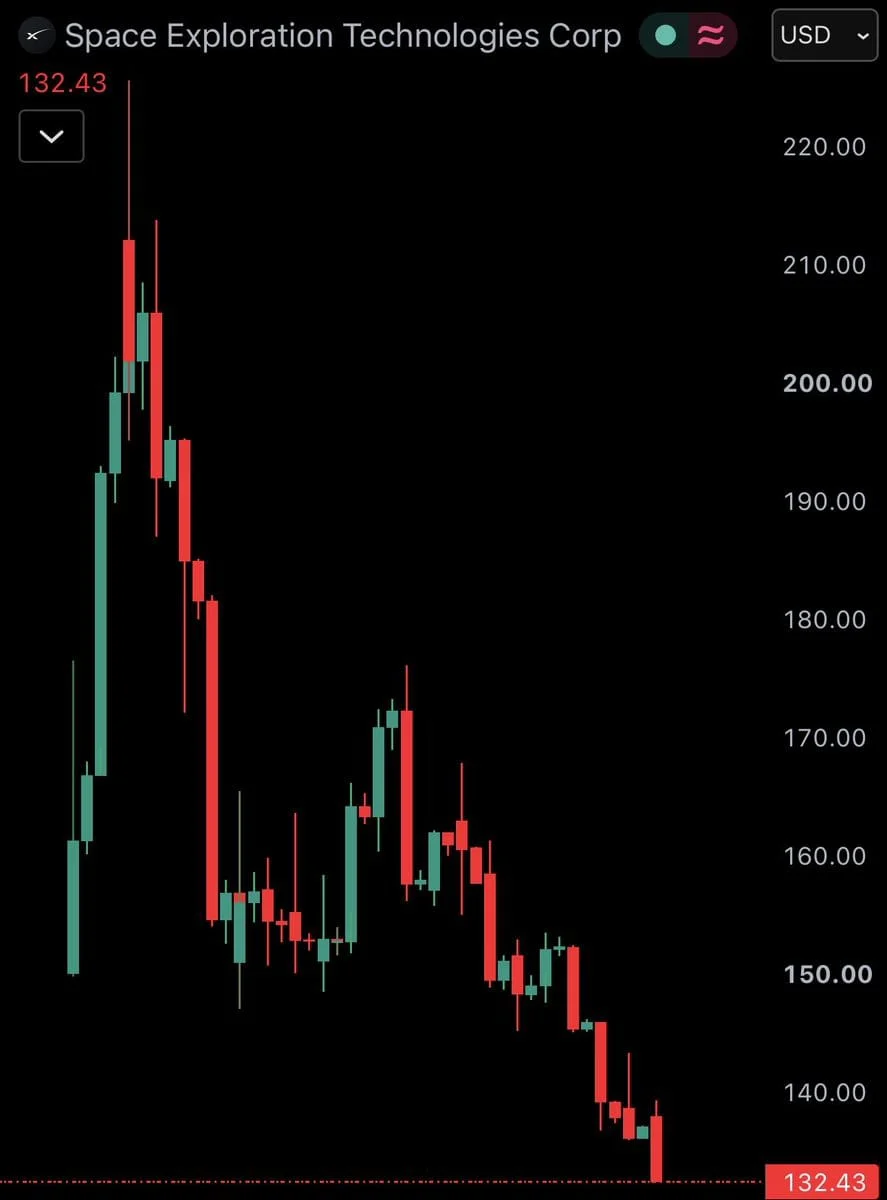
SpaceX, one of the world’s most innovative and valuable privately-held companies, has recently exhibited stock price movements more akin to a small-cap, highly speculative meme stock than a multi-billion dollar aerospace giant. This anomalous behavior, where its estimated valuation swings wildly, ceases to be a mystery once the unique mechanics of its stock float are thoroughly understood, revealing a situation rooted in simple, albeit profound, market dynamics.
Unpacking the Enigma of SpaceX’s Stock Performance
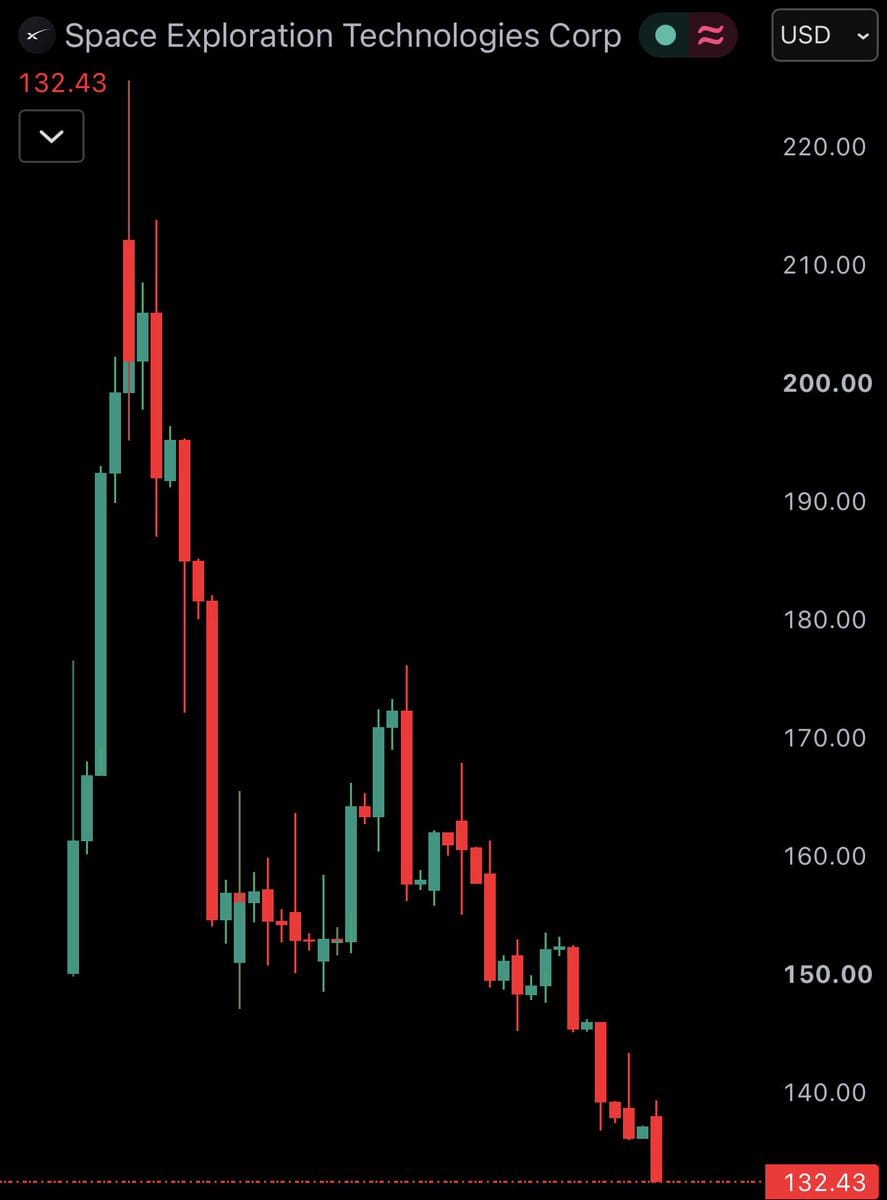
Despite its formidable achievements in space exploration, satellite internet, and rocket technology, the shares associated with SpaceX, often traded on secondary private markets under tickers like $SPCX, have experienced significant turbulence. Recent data indicates that the implied valuation of SpaceX has dipped below a reference point of $135 per share, often cited as its "IPO price" in private trading contexts. This decline represents a substantial 41.5% drop from its all-time high, a move that has reportedly erased an estimated $1.25 trillion in implied market capitalization from its peak. This dramatic correction means that individuals who acquired shares at or near the peak are currently facing significant paper losses. The central question that often gets overlooked amidst these striking headlines is precisely why a company of SpaceX’s colossal scale and strategic importance can experience such violent price fluctuations. The answer, surprisingly, has less to do with the performance of its rockets or satellite constellations and more to do with the extremely limited number of shares actively available for trading.
The Mechanics of the "Float Trap": A Detailed Explanation
The core issue underpinning SpaceX’s extreme volatility lies in what market analysts term the "float trap." In conventional public markets, the "float" refers to the number of shares of a company that are actively available for trading by the general public. A high float generally leads to greater liquidity and more stable price movements, as a large volume of shares can absorb buying and selling pressure without drastic price shifts. Conversely, a low float signifies that only a small fraction of a company’s total shares are circulating freely in the market.
Defining Public Float and Its Impact
For a typical publicly listed company, millions or even billions of shares are in the public float. Institutional investors, mutual funds, hedge funds, and individual retail investors can buy and sell these shares relatively easily. Even significant buy or sell orders might only cause modest price changes because there’s ample supply and demand to meet the volume. In contrast, when the float is exceptionally low, even a modest influx of buying interest or a relatively small amount of selling pressure can disproportionately impact the stock price. This is because the limited supply means that demand can quickly outstrip available shares, driving prices up sharply, or a wave of selling can rapidly overwhelm limited buyers, causing prices to plummet. This amplified sensitivity to supply and demand is the hallmark of a low-float stock.
Why SpaceX’s Float is Uniquely Small
SpaceX is, fundamentally, a privately held company. Unlike traditional public entities that conduct an Initial Public Offering (IPO) to list a substantial portion of their shares on a major stock exchange, SpaceX has largely kept its ownership concentrated. A significant percentage of its shares remain locked up with its founder, Elon Musk, early venture capital investors, and long-term employees. While there are mechanisms for secondary market trading of private company shares, such as through platforms like Nasdaq Private Market or other private equity exchanges, these markets are inherently less liquid and transparent than major public exchanges. The shares that do become available for trading are often a very small slice of the total outstanding shares. This creates a situation where a company with an estimated valuation in the hundreds of billions, or even trillions at its peak, has a trading behavior that belies its actual size and strategic significance, making it highly susceptible to the "float trap."
A Chronology of Price Swings: From Peak to Post-IPO Dip
The recent history of SpaceX’s implied share price illustrates this volatility vividly. While not a traditional IPO in the sense of a public listing on an exchange like the NYSE or Nasdaq, a reference price of $135 per share has been widely cited as a benchmark for early private market transactions or employee stock option conversions. From an implied peak, where its valuation reportedly reached figures that positioned it among the world’s most valuable enterprises, the stock has experienced a precipitous fall.
The $135 Reference Price and Subsequent Decline
The descent below the $135 reference point has been a critical psychological and financial marker for investors. This breach suggests a significant re-evaluation of the company’s prospects or a cooling of investor enthusiasm. The magnitude of the downturn, a 41.5% reduction from its all-time high, highlights the severe impact of market forces on a thinly traded asset. For context, such a percentage drop would be considered extreme even for a volatile small-cap stock, let alone a company with SpaceX’s established reputation and vast potential.

Quantifying the Market Cap Erosion
The reported erasure of $1.25 trillion in implied market capitalization from SpaceX’s peak valuation is a staggering figure. While the exact methodology for calculating this implied market cap in a private context can vary and often involves significant projections and assumptions about future growth, the sheer scale of the decline underscores the fragility inherent in a low-float structure. This significant loss of implied value reflects not a sudden deterioration in SpaceX’s operational capabilities—its rockets continue to launch, Starlink expands, and Starship development progresses—but rather the outsized impact of selling pressure on a market with limited liquidity. Investors who entered the market at higher valuations are now grappling with substantial losses, demonstrating the high risk associated with investing in such illiquid, high-valuation private entities.
Beyond the Rockets: Fundamental Questions Emerge
The recent market behavior suggests that investors are moving beyond purely aspirational valuations and beginning to scrutinize SpaceX through a more traditional financial lens. The company’s impressive technological feats and visionary goals are now being weighed against hard financial realities.
The Discrepancy Between Valuation and Revenue
A key driver of this re-evaluation is the noticeable discrepancy between SpaceX’s estimated valuation and its current revenue generation. The original article highlights a projected $18 billion in revenue for SpaceX in 2025. While substantial for a private aerospace company, this figure pales in comparison to established tech giants like Meta, which is projected to generate around $200 billion in the same period. Yet, at its peak, SpaceX’s implied valuation often rivaled or even surpassed that of companies with significantly higher, more stable revenue streams. This stark contrast between institutional-level valuation and retail-level trading behavior, amplified by the low float, creates a fundamental mismatch that the market is now attempting to correct. The market is increasingly demanding that the company’s valuation align more closely with its financial performance, rather than solely on its future potential.
Pre-IPO Hedging: An Amplifying Factor
Another contributing factor to the initial downward pressure on SpaceX’s implied valuation, as well as the broader space sector, was the dynamic of pre-IPO hedging. Many early investors and insiders, whose SpaceX shares were "locked up" and could not be directly sold, sought to de-risk their exposure. They achieved this by shorting a basket of publicly traded space equities. This strategy allowed them to effectively hedge against a potential decline in SpaceX’s value without selling their illiquid holdings. However, given the already thin float of SpaceX and the interconnectedness of the space sector, this hedging activity had an outsized, downward effect on prices, both for the implied value of SpaceX itself and for other companies in the space industry that were used as proxies.
As SpaceX’s implied share price has fallen below its $135 reference point, there’s an argument that a significant portion of this hedging pressure may have dissipated. Once the initial price levels that triggered these hedges are breached, the incentive to maintain or add to these short positions diminishes. This phenomenon could potentially clear the air for space equities moving forward, even if SpaceX’s own implied value continues to search for a definitive floor, suggesting a more stable, albeit perhaps lower, baseline for the sector.
The Fading Aura of the Elon Musk Narrative
For several years, a significant portion of SpaceX’s implied valuation has been underpinned by what can be termed the "Elon Musk trillionaire narrative." This narrative posits that Musk’s visionary leadership, unparalleled ambition, and track record of disruption (e.g., PayPal, Tesla) alone justify a premium valuation, often disconnected from conventional financial metrics like quarterly earnings, debt levels, or even immediate execution risks. His public pronouncements, audacious goals for Mars colonization, and advancements in AI often fueled investor optimism, creating an almost mythical quality around his ventures.
From Visionary Premium to Demands for Accountability
However, recent market shifts indicate that this "Musk premium" is rapidly evaporating. The market, in its perpetual cycle of enthusiasm and skepticism, is now beginning to ask more rigorous and traditional questions. The era of valuation based primarily on narrative and future promise appears to be giving way to a demand for concrete financial performance and transparency. Investors are no longer content to simply extrapolate Musk’s past successes onto SpaceX’s future.
Scrutiny on Debt, Starship Cadence, and AI Investments
Specific questions are now moving to the forefront. How much debt is SpaceX currently carrying on its balance sheet, and what are the implications for its financial health? How quickly can Starship achieve reliable, high-cadence launches, and how will this translate into substantial, predictable revenue streams from both government contracts and private customers? Furthermore, Musk’s increasing emphasis on AI, and the capital being allocated to these ventures within SpaceX, is drawing scrutiny. Investors want to understand the tangible return on investment for these AI bets and how they integrate into SpaceX’s core business model. These are no longer rhetorical questions debated by enthusiasts; they are critical financial inquiries that the market is actively pricing into the company’s implied valuation, marking a profound shift in investor sentiment.
Sentiment’s Outsized Influence: The Meme Stock Parallel
The low-float structure of SpaceX’s shares makes it particularly vulnerable to shifts in sentiment, a characteristic it shares with highly volatile "meme stocks." Retail investors, who often dominate discussions around such assets, frequently underestimate this aspect of the "float trap."
Low Float Magnifies Every Headline
In a stock characterized by a thin, illiquid float, sentiment can wield disproportionately powerful influence. A single negative headline—perhaps a delay in a Starship launch, a regulatory setback for Starlink, or a critical analyst note—can trigger a double-digit percentage price move in a single trading day. Conversely, positive news can send the price soaring. These dramatic swings are not necessarily a reflection of a sudden, overnight deterioration or improvement in SpaceX’s underlying business fundamentals. Instead, they are a direct consequence of how little room the limited float leaves for absorbing significant buying or selling pressure. The market simply cannot handle large order flows without substantial price adjustments, leading to amplified reactions to news events.
Structural Similarities with Highly Speculative Assets
This structural setup is precisely why comparisons between SpaceX’s stock behavior and that of meme stocks are not as unfair or hyperbolic as they might initially seem. It is not necessarily that SpaceX behaves irrationally as a company; rather, the underlying market mechanics—a massive implied valuation coupled with an extremely low trading float—create the same kind of exaggerated, sentiment-driven price swings typically associated with much smaller, more speculative, and often less fundamentally sound companies. The market’s reaction to news, rumors, or even social media chatter is intensified, leading to the erratic patterns observed.
Implications for Investors and the Future of SpaceX
For investors contemplating positions in $SPCX, the current situation, with its implied valuation dipping below the $135 reference, carries a clear message. It is not necessarily an indication that SpaceX’s rockets are failing or that its technological ambitions are collapsing. Instead, it signals that the broader market, even in its private secondary forms, is finally beginning to treat Elon Musk and SpaceX as a conventional enterprise. This means expecting accountability, demanding a balance of the books, ensuring debt obligations can be serviced, and requiring tangible proof that ambitious ventures, such as significant AI investments, are genuinely worth the capital being allocated. The era of the "Musk premium," where visionary rhetoric often outweighed financial scrutiny, appears to have officially evaporated. Now, the real work of demonstrating sustainable financial performance begins.
A Shift Towards Fundamental Valuation
This transition, while undoubtedly a rough ride for existing investors, is not inherently negative for the long-term health of the company or its investment prospects. A stock that trades on robust fundamentals—such as verifiable revenue growth, clear paths to profitability, efficient capital allocation, and manageable debt—rather than solely on an overarching narrative or the charisma of its leader, generally establishes a healthier and more sustainable long-term investment setup. This shift forces the company to mature in its financial reporting and strategic planning, potentially leading to a more resilient and predictable future.
What Lies Ahead for the Aerospace Innovator
Going forward, the trajectory of SpaceX’s implied valuation and its market behavior will hinge on several critical factors. Whether SpaceX can successfully prove out its significant AI bets, demonstrating clear applications and returns within its aerospace and Starlink divisions, will be crucial. The question of whether the company’s stock float will ever substantially loosen up through a future traditional IPO or other mechanisms, thereby increasing liquidity and dampening volatility, remains open. Ultimately, the market’s willingness to reward actual execution, consistent operational milestones, and demonstrable financial health over pure mythology will define SpaceX’s future valuation. These are the narratives that will now dominate the story of this pioneering aerospace company.