


The 2026 FIFA World Cup, hosted across the United States, Canada, and Mexico, has secured its place in history not only as the largest iteration of the tournament to date but as a transformative moment for the integration of blockchain technology into global sporting events. While traditional benchmarks such as a record-breaking 6.8 million in attendance and $10.5 billion in total advertising spend dominated the headlines, a secondary, decentralized economy was thriving in the background. New data from Chainalysis reveals that the tournament served as a massive catalyst for on-chain activity, generating an unprecedented $20 billion in prediction market volume and establishing a multi-million dollar ecosystem for digital collectibles that offered tangible real-world utility.
The sheer scale of the 2026 tournament, featuring an expanded format of 48 teams, provided a fertile ground for the growth of decentralized finance (DeFi) applications. For the first time, the "on-chain" version of the World Cup mirrored the massive financial flows of the traditional betting and memorabilia industries. This surge in activity represents a significant shift in how global audiences engage with live sports, moving from passive consumption to active, stake-based participation on decentralized rails.
A Chronology of Speculation: From Qualifications to the Final
The financial momentum of the 2026 World Cup began long before the opening whistle on June 11. Analysis of blockchain flows indicates that the tournament’s prediction market cycle actually commenced in January 2026. During this period, as national teams battled through the final stages of the qualification campaign, prediction market users were already generating nearly $50 million in daily on-chain volumes. These early participants focused primarily on match outcomes, group stage placements, and the eventual tournament winner.

As the qualification matches concluded in March 2026, the baseline of activity remained steady at $50 million per day. However, as the tournament approached, the intensity of the betting increased. During peak periods in the spring of 2026, daily activity frequently surpassed the $100 million mark. The true explosion of volume occurred in tandem with the tournament’s kickoff. Shortly after the opening ceremonies, daily volumes surged to $250 million, trending upward as the stakes grew higher with each knockout round.
The tournament reached its financial and competitive zenith during the final match between Spain and Argentina. On that day alone, bettors powered more than $300 million in volume. Despite the tapering of matches toward the end of the competition, the high-stakes nature of the final ensured that FIFA World Cup markets accounted for approximately 63% of the total global prediction market volume during the event’s duration.
The Mechanics of Modern Wagering: Prediction Markets and User Behavior
The 2026 World Cup saw nearly 400,000 unique digital wallets interact with blockchain-based prediction markets. These platforms, which allow users to trade on the outcome of future events, moved beyond simple "win/loss" bets. While the primary narrative—who would lift the trophy—drove the majority of the $5.7 billion generated during the tournament itself, niche "novelty" markets attracted significant capital.
One of the most notable examples of this trend involved the Portuguese star Cristiano Ronaldo. A specific market was created to predict whether the veteran forward would cry at the conclusion of his final World Cup campaign. This single market generated $49 million in volume, illustrating the appetite for highly specific, personality-driven speculation. When Ronaldo did indeed show emotion following Portugal’s exit, the market settled in favor of those who had bet on the outcome.

The data also provides a fascinating look at the demographics and success rates of these on-chain bettors. Across all World Cup-related markets, 55% of participants ended the tournament with a net profit. Perhaps more tellingly, 79% of those successful bettors were identified as experienced prediction market users. This suggests that while the World Cup attracted a wave of new users to the blockchain, the most significant gains were realized by those who had already developed a level of sophistication in navigating decentralized betting protocols.
FIFA Collect: Bridging the Gap Between Digital Assets and Physical Access
Parallel to the rise of prediction markets was the success of FIFA’s official digital collectibles program, "FIFA Collect." Operating on the Avalanche blockchain, this platform allowed fans to purchase and trade Non-Fungible Tokens (NFTs) that commemorated historic moments, star players, and team achievements. Unlike the speculative NFT booms of previous years, FIFA Collect focused heavily on utility, providing a bridge between the digital and physical worlds.
The platform offered fans an alternative route to securing tickets for the highly coveted matches. In an era where traditional ticket lotteries are notoriously competitive and often inaccessible, FIFA Collect allowed users to turn their "digital trinkets" into real-world entry passes. Over 100,000 fans successfully secured tickets through this blockchain-powered path. The "Right to Buy" mechanism allowed collectors to pay a premium for the guaranteed opportunity to purchase tickets later, effectively creating a secondary market for access.
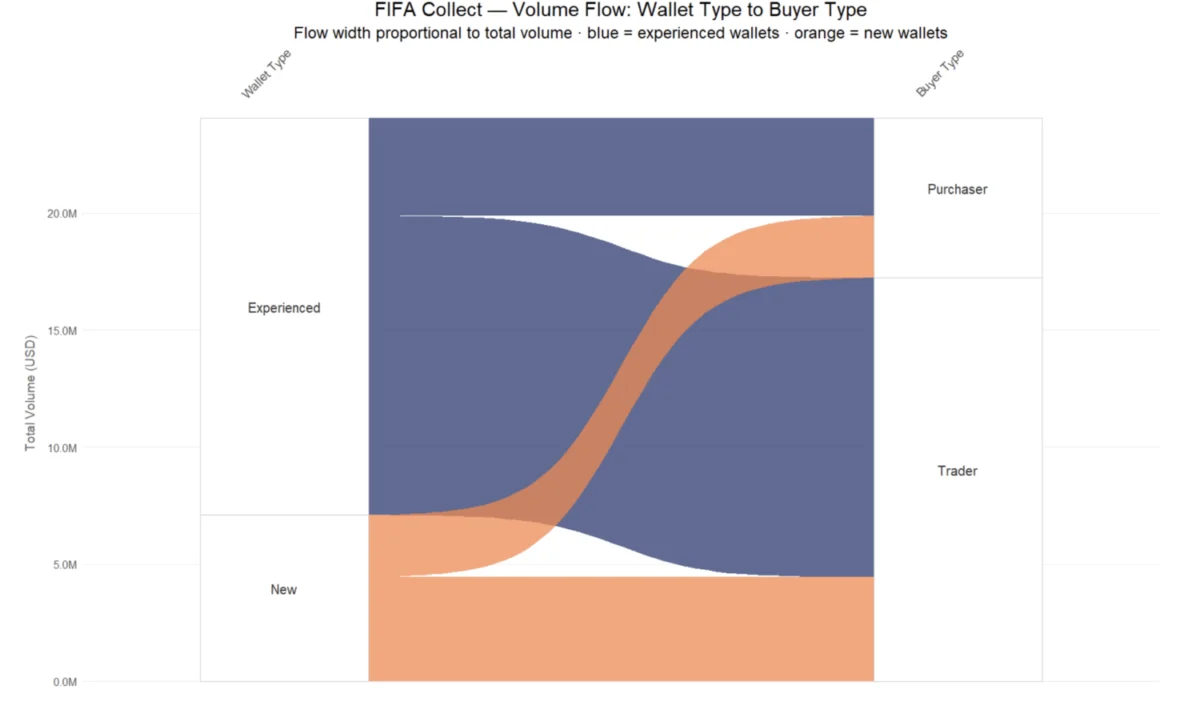
From a financial perspective, the FIFA Collect economy was robust. Between May 2025 and the end of the tournament, the primary wallet associated with the platform received $24 million in payments from collectors. This stablecoin-powered ecosystem was not only a win for fans but also a lucrative venture for the organization. FIFA implemented a 5% fee on all secondary market transactions. Chainalysis estimates that FIFA collected at least $6 million in revenue from these secondary trades alone, as fans shuffled assets to secure specific ticket rights or complete their collections.

Global Participation and Regional Leaders
The 2026 World Cup confirmed that on-chain finance is a truly global phenomenon. Using proprietary geolocation methodology, researchers tracked flows from every continent (excluding Antarctica). While the tournament was hosted in North America, the participation was led by a diverse array of nations.
The United States and China emerged as the primary drivers of prediction market volume. They were closely followed by Canada, Thailand, and the United Kingdom. This distribution highlights a growing trend: even in regions where traditional sports betting may face regulatory hurdles, decentralized prediction markets offer a borderless alternative for engagement. The high volume from China and Thailand, in particular, underscores the strong appetite for crypto-integrated sports entertainment in the Asia-Pacific region.
Compliance and the Challenge of Illicit Flows
As with any large-scale financial ecosystem, the World Cup’s on-chain activity was not entirely immune to bad actors. However, the data reveals a stark contrast between open prediction markets and the strictly regulated FIFA Collect platform.
In the broader prediction market space, approximately 3,700 wallets—representing less than 1% of the total participants—had histories linked to illicit activity. The single largest source of these "tainted" funds was Huobi (now known as HTX). This international exchange was sanctioned by UK authorities in late May 2026, and later by the EU, for allegedly facilitating Russian crypto flows. Approximately $5.4 million in volume flowed directly from Huobi-linked wallets into World Cup prediction markets. Other minor flows were traced to scam operators, stolen funds, and high-risk jurisdictions.

In contrast, FIFA Collect maintained a remarkably "clean" ecosystem. The exposure to illicit flows on the official NFT platform was described as negligible. This success is attributed to FIFA’s rigorous Know Your Customer (KYC) and Anti-Money Laundering (AML) procedures. To access the "Right to Buy" ticket features, users were required to undergo manual verification and declare the source of their funds. These "intense vetting" procedures served as a deterrent to criminals who prefer to operate in environments with less scrutiny.
Analysis: The Future of Global Events on the Blockchain
The 2026 FIFA World Cup serves as a microcosm of the expanding role of cryptocurrency in everyday life. The success of this tournament’s digital economy offers several key takeaways for future global events, including the 2028 Olympics and the 2030 World Cup.
First, the integration of utility is paramount. The success of FIFA Collect demonstrates that digital assets are most effective when they offer more than just speculative value. By linking NFTs to physical match tickets, FIFA successfully onboarded tens of thousands of fans into the blockchain ecosystem.
Second, the massive volume in prediction markets indicates that decentralized finance is becoming a preferred rail for global wagering. The transparency and instant settlement offered by blockchain technology provide a level of efficiency that traditional sportsbooks struggle to match, especially on a global scale involving multiple currencies.

Finally, the contrast in illicit flow exposure between open markets and regulated platforms highlights the ongoing tension in the crypto world. As more of the world’s financial infrastructure moves on-chain, the tools for following the money must become more sophisticated. The ability to trace, attribute, and assess digital flows in real time is no longer a niche requirement for investigators—it is a fundamental necessity for the platforms, regulators, and fans who participate in these new digital economies.
The 2026 World Cup has proven that the "digital pitch" is now just as important as the grass one. As the dust settles on Spain’s victory over Argentina, the legacy of the tournament will be defined not just by the goals scored, but by the $20 billion in digital trades that signaled a new era for the intersection of sports and finance.














